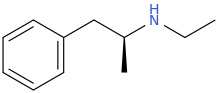
It IS an interesting pattern that the N-ethyl homologues of several classes of stimulant appear to be more selective.
It's a shame that fencamfamine is no longer used and that even when it was, the endo pair was 90% of the product simply due to it being energetically favoured. But the fact that the researchers went with the N-ethyl always seemed a bit odd to me. I've read (S) fencamfamine was responsible for most of the activity but designation of (R) and/or (S) is dependent on the structure in question (Cahn-Ingold-Prelog rules). I found one paper in which cyclodextrins were used to resolve the stereoisomers but it looks like it was a bit of a bust.
I've tasted camfentamine just once and at a low(ish) dose, it was surprisingly subtle. Obviously the original N-ethyl homologe (fencamfamine) would have a slightly more favourable LogP but the fact it's more rigid also likely plays a part in it's potency and activity. That extra steric bulk is possibly why it is selective, but I cannot radio-label a sample and undertake FMRI or FPET.
Obviously, I had noted that several papers suggested that fencamfamine had opioid activity but nothing that nailed down exactly what the relationship was. But I have previously mentioned that Fencamfamine's norbornane system can be viewed as two cyclopentane rings that share two carbons. The synthesis resulted in an intermediate with an olefinic bond. The fact that a reduction is undertaken MAY suggest that conformation was vitally important in the sought activity. Is it an indirect dopamine agonist? Do we really know given that research stopped two decades ago.
DOI 10.1016/0091-3057(94)00236-C
Yes, it IS an old reference, but the only one I could find that studied the hypothesized dual activities and then, based it on:
DOI: 10.1007/BF02244190
So I would consider it to be weak evidence. Yet we know that ampetamine uses that ambiguous term 'opiate sparing'.
But maybe just as the opioid activity of tianeptine wasn't recognized, equally does fencamfamine also act on the opiate receptors? Are we certain? Have noted that fencamfamine overlays both stimulants and opioids BUT it only has two key moieties identified by training-sets of opioids and as far as I know, to have significant opiate activity, three key moieties seem to be the minimum found in all of the MOR ligands I am aware of the aromatic and the lone-pair of the N are in the correct relative spacial positions and orientations for just one stereoisomer.
So of course I did try to work out if a benzylic nitrile or a benzylic hydroxyl derivative of fencamfamine/camfentamine was facile. I have to say now that I could not any a such synthesis - but feel free to suggest. Because experimentation using a derivative with an benzylic ethyl carboxylate or a benzylic propionoxy moiety would either show increased opate activity or, equally, less opioid activiy - but that WOULD require the four stereoisomers to be resolved - particularly since the stereoisomerism is so important and based on the training-set, the less energetically favoured pair would be the (potential) opioids. Or, rather, one of the pair would have the appropriate conformation.
This is to be expected. A lot of rational design relies on training-sets but if a ligand isn't potentially of value, it's rarely researched. I even wondered in a derivative with a phenoic meta hydroxyl derivative had been studied although the phenolic derivatives of the related opioids were in fact LESS active then their parents, but I still checked, just in case. I found nothing, but then, that doesn't mean I just missed a reference.
It also made me wonder if the reason the reason that a pair of the four stereoisomers of tramadol are more active analgesics than the single stereoisomer is also because the non-opioid stereoisomer is similarly monkeying around with monoamines. After all, nefopam is often cited as being as active as morphine in terms of analgesia and that seems to be a triple reuptake inhibitor.
Yes, I was trialled on Acupan (nefopam) because I asked if an alternative to an opioid might work. Yes, it did help control the pain but the anxiety was remorseless. Much like tramadol but amplified. I think it's been establised that one of the pair is a non-rigid analogue of codeine while the other monkeys around with the same monoamines.
I only searched for phenolic derivatives of fencamfamine because tapentaol has three key moieties and one of those is phenolic meta hydroxyl. In that case most sources state that a single stereoisomer has both opioid and NRI activity. I've never been prescribed tapentadol because it turned out to produce an unusual and difficult to manage physical dependence liability. The BNF even included a section on dexoxification of dependent patients - I suggest because methadone and buprenorphine cannot substitute for the activity of tapentadol. It's NRI activity likely meant that in patient subject to seizures, it's prescribing was contra-indicated. Whatever the detail, it was added to the list of Class A drugs so rightly or wrongly, the ACMD recommended it be listed as a class-A drug.