
• MDMA &
    Empathogenic
    Drugs

    Welcome Guest!
  • MDMA Moderators: Esperighanto

What is wrong with the MDMA available today? - v2

Fast heating inhibits endothermic solid-solid polymorphic transition giving a melting of low temperature polymorph with the next cold crystallization
 
I've done recrystallization in H20 it WAS MEH

NICE SHINY see thru LONG BLADES almost looked like meth

MEH

recrystallization using different solvent, a mix of meh mdma H20 and other meh mdmaproducts

Magic. But A VERY VERY small amount

So yes yes it DOES.
No analysis = no reliable results. Period.
 
No analysis = no reliable results. Period.
Hey man

10 people recrystallization in H20 meh that IS ANALYSIS virgins and old heads.

and yes this mdma had been sent to UVIC prior

All my meh has been tested as mdma

I have pulled off a successful crop of magic from meh.

And have given it to a select few. They only want my magic and I tell them it's very hard to pull off. I haven't figured out to get yeild

My honest guess, is you can break fast melt bonds with H20 recrystallization, it will make meh

It can then be rebonded via recrystallization in solvent to make magic

Say what you want. But maps uses only form 1 and THEY have done a lot of analysis

They are only ones so far to do XRFD

And UVIC has found 1% H20 in my xanax powder so that's saying something XD
 
Last edited:
No analysis = no reliable results. Period.
Crystallization from the melt can allow the achievement of high driving force for crystallization accompanied by relatively slow growth, nucleation, and transformation rates, features that favor its use as an efficient polymorph screening method. Surprisingly, even though melt crystallization has a long history, it has been employed less often in the search for new polymorphs than solution crystallization. Applications of melt crystallization to 21 highly polymorphic, well-characterized compounds with at least five ambient polymorphs revealed that melt crystallization afforded more than half of the known polymorphs and in many cases revealed new polymorphs not detected by other screening methods


You don't get giant rock mdma naturally
 

A common term used in the literature for materials that decompose prior to or during melting is “melts with decomposition”. If the term “melts” is an accurate description for loss of crystalline structure then the onset temperature of the endothermic peak would remain constant with heating rate because, as stated in the definition, thermodynamic melting occurs at a single, time independent temperature. Conversely, decomposition is a kinetic process that is time dependent (heating rate dependent). If loss of crystalline structure is due to the onset of thermal decomposition then the onset temperature will shift to higher temperatures at higher heating rates. The series of heating rates illustrated in Figure 3 shows that loss of crystalline structure for acetylsalicylic acid meets none of the requirements for thermodynamic (True) melting and is therefore an apparent melting material. A more accurate term than “melts with decomposition” would be “loss of crystalline structure due to a kinetic process” or Apparent Melting. For new users of DSC, the assumption may be that the shift in peak onset temperature with heating rate for Acetylsalicylic Acid is an instrumental effect caused by thermal lag. This is easy to disprove with a known melting point standard such as indium or phenacetin, a purity standard obtained from NIST (Figure 4). The effect of the change in heating rate from 1 to 20 °C/min is about 0.3 °C as compared to 10 °C with Acetylsalicylic Acid.

Before we consider other chemical processes that cause loss of crystalline structure, it is necessary to answer the question “If the endothermic peak is not True Melting then why does it look like a typical DSC melting peak?”. The answer to that question is not complicated and is based on the First Law of Thermodynamics, which states that energy cannot be created nor destroyed. As illustrated in the enthalpy plot of Figure 5, there is an absolute difference in enthalpy between crystalline and amorphous structure. If any process (thermodynamic, mechanical, or chemical) causes conversion of crystalline to amorphous structure then the material must absorb the absolute difference in enthalpy between the two phases at that temperature. The absorption of that energy difference would appear as an endothermic peak in the DSC curve, regardless of the cause.

Enthalpy plots are created by taking the absolute integral of heat flow rate (W/g) relative to time, or heat capacity (J/g°C) relative to temperature, over the temperature range of interest.

Dehydration, the most common form of desolvation, is the removal of a water molecule from a crystalline hydrate with the breaking of a covalent bond. The breaking of the bond disrupts the crystalline lattice and typically results in an amorphous anhydrous form and evolved water. Figure 8 compares the effect of pan type (hermetic vs. non-hermetic) on the dehydration of a crystalline hydrate with 5% bound water. The data from the non-hermetic pan (hermetic pan with pinhole) shows a broad endothermic peak due to evaporation of the water lost during the dehydration process. This is followed by a sharp exothermic crystallization peak near 120 °C which is crystallization of the amorphous material to form one of several possible polymorphic forms that then melts near 170 °C. Loss of water cannot occur in the hermetic pan and this prevents dehydration long enough to reach 100 °C, where crystalline structure is lost.
 
Last edited:
Flow chemistry offers clear advantages over traditional batch reactions, particularly with respect to controlling key reaction parameters like mixing, temperature, and pressure. These tighter controls not only boost efficiency but also make it possible to safely run highly exothermic or otherwise hazardous reactions that would pose risks in conventional batch setups.

Despite these proven benefits, flow chemistry in small molecule drug manufacturing has mostly been limited to reactions where all components stay dissolved in liquid phase and residence times are less than 30 minutes. However, many of the same advantages — enhanced heat and mass transfer in smaller, well-controlled reactors — also apply when solids are involved. Continuous slurry and solids-handling systems can leverage these same physical principles, though they require more sophisticated engineering to do so reliably. These fully soluble reactions, however, account for only about 17–19% of all pharmaceutical processes. The majority of reactions (>63%) involve solid starting materials, generate solid by-products, or produce solid products.1 When solids are part of the picture, the process becomes more complex, shifting from simple liquid flow to managing slurries (mixtures of solids suspended in liquids), which demands more sophisticated engineering and equipment.

Because continuous processing in pharma is still relatively young, few companies have tackled these extra layers of complexity. This hesitation is rooted less in impossibility than in the technical challenges of managing solids in flow and the shortage of personnel with the training and experience to operate such systems effectively. Other industries have long adopted assembly-line style continuous manufacturing, reaping consistent gains in cost, quality, and sustainability, benefits that pharma manufacturing stands to reap in equal or greater measure. Regulators like the U.S. Food and Drug Administration (FDA) actively encourage this shift, having endorsed continuous manufacturing for years as a proven path to faster, more reliable, and higher-quality drug production.

Despite regulatory support, many drug makers still confine flow chemistry to the easiest, fully soluble reactions while leaving more complex or solids-heavy steps in batch mode. This restricted approach undermines the potential of continuous manufacturing to transform entire supply chains. For companies building new greenfield facilities, however, the economics are clear: replicating outdated batch infrastructure makes little sense when continuous systems can deliver the same output faster, more economically and safely, and with less waste.

One of the biggest barriers now is talent, as the primary challenges in operating continuous systems that handle slurries and solids are as much about workforce training as equipment. Without investing in both, drug makers risk falling short of the business and patient needs of modern pharma and ultimately fail to deliver the speed, quality, cost, and sustainability that the market demands.
 
Crystallization from the melt
No, please. Simply said, you will fry it. Zone melting is good for purifying more stable substances. Anhydrous MDMA hydrochloride melts slightly above 150 °C, and keeping it at that temperature along with potentially reactive impurities (and without protection from air) is just not safe enough.
 
No, please. Simply said, you will fry it. Zone melting is good for purifying more stable substances. Anhydrous MDMA hydrochloride melts slightly above 150 °C, and keeping it at that temperature along with potentially reactive impurities (and without protection from air) is just not safe enough.
Then tell me how they make mdma bigger then the size of my fists

Without heat and pressure IE fast melt slow cooking

Pressure of course will lower the temperature needed

MDMA does not naturally form rocks bigger or about the same size as my fist.
 
Last edited:
No, please. Simply said, you will fry it. Zone melting is good for purifying more stable substances. Anhydrous MDMA hydrochloride melts slightly above 150 °C, and keeping it at that temperature along with potentially reactive impurities (and without protection from air) is just not safe enough.

Some manufacturers that see the benefits of flow chemistry but want to dodge the complexities of solids handling often resort to telescoping — pushing all solids-related steps to the very end of the process and then performing those steps in batch mode. In this shortcut, steps like crystallization, filtration, and drying are bundled together at the finish line under the assumption that a single, final crystallization will purify the product completely.

The problem is that this approach undermines one of the most important principles in modern drug manufacturing: building quality into every stage of production. A robust process should not wait until the last step to clean up impurities. Instead, it should monitor and manage them as they arise, actively purging them at multiple points. This stepwise approach is not only more scientifically sound, but it is also what regulators expect when evaluating process robustness. Relying on one final crystallization to remove all impurities introduces unnecessary technical risk and regulatory uncertainty, a point echoed in both industry best practices and recent FDA guidance.

Telescoping also compounds impurities rather than controlling them, leaving a heavier burden on the final step and increasing variability. In contrast, continuous processes that manage solids step by step minimize risk, ensure consistency, and deliver higher-quality outcomes.

One early test case illustrates the stakes. Metformin, one of the world’s most prescribed — and lowest-cost — diabetes drugs, is notoriously challenging to scale. The batch reaction runs at high concentration as a slurry, generates heat rapidly, and takes about 14 hours to complete. By-products build up during the reaction and must be controlled continuously, while incoming raw materials can carry solid impurities that must be removed upfront. CONTINUUS developed and patented a continuous polish filtration unit operation to purify the feedstock and then engineered a flow process to manage heat and limit unwanted by-products. Continuous crystallization, filtration, wet milling, drying, and other unit operations were integrated to complete the line.

In another project, the ICM platform was used to transform a four-step batch process, for another approved medication — in which each step involved solids — into a streamlined two-step continuous line. What once required a year to produce the active ingredient and several months more for tableting was compressed into just over two days from start to finished tablets. Such time savings illustrate the real value of handling solids in flow: faster delivery, lower cost, and better control.

Real-time monitoring of key process parameters is essential for making continuous manufacturing work as intended. Process analytical technologies (PAT) play a central role during development, providing the deep insight needed to lock in a robust process that runs reliably at steady state.

However, when solids enter the picture, monitoring becomes more complex. Many common PAT tools for flow chemistry, such as mid-infrared (mid-IR) spectroscopy, are designed to track molecules in solution but cannot see solid particles suspended in a slurry. This limits their usefulness for reactions where solids are part of the chemistry or form along the way

To close this gap, CONTINUUS has explored and applied a wider range of tools. Raman spectroscopy, for example, can detect many solid phases, provided they do not fluoresce under the laser. Focused beam reflectance measurement (FBRM) offers a practical solution for real-time particle sizing, capturing changes as crystals form and grow.
 
Last edited:
No, please. Simply said, you will fry it. Zone melting is good for purifying more stable substances. Anhydrous MDMA hydrochloride melts slightly above 150 °C, and keeping it at that temperature along with potentially reactive impurities (and without protection from air) is just not safe enough.
Fast melt recrystallization involves rapidly melting a solid—often by heating to just above its melting point or via fast scanning calorimetry (FSC)—followed by controlled, swift or slow cooling to induce purification or polymorphism changes. This technique is used for rapid, small-scale purification or in polymer analysis to study crystallization kinetics

Tell me how to made mdma rocks about 3-5" on a massive scale consistently without heat and pressure and I'll shut about this
 
Last edited:


Now my own take is that it's purely to obtain a patent on MDMA rather than the two polymorphs demonstrating signifcantly different pharmokinetics. As far as I can work out, raecemic MDMA does not demonstrate polymorphism.


Those interested in going into the grass can bay a copy of 'The ADME Encyclopedia" as if nothing else, it makes a good door-stop.

Now the ADDITION SALT, yes, that does make a difference. People may have tried Benzo Fury once and then later batches were disappointing. The reason in that case was that the product was so impure, it would not salt using dry HCl so they had to switch to the succinate salt. I haven't bothered to calculate the ratio of the two MWs but they look pretty close at a glance. Yet a lot of feedback was people asking what was wrong with the 6-APB. So we found out.
 
Last edited:


Now my own take is that it's purely to obtain a patent on MDMA rather than the two polymorphs demonstrating signifcantly different pharmokinetics. As far as I can work out, raecemic MDMA does not demonstrate polymorphism.


Those interested in going into the grass can bay a copy of 'The ADME Encyclopedia" as if nothing else, it makes a good door-stop.
Maps uses racemic and has encountered 3 kinds of polymorphs so it definitely does

It might not have passed phase 3

But their cGMP route isn't chiral

And this where they found polymorph 1,2,3

So it definitely can form polymorphs
 
Last edited:
Then tell me how they make mdma bigger then the size of my fists
It's impressive, and yes, they probably melt the crystals together. Aside from the beautiful appearance and perhaps lower hygroscopicity of the product, I can't see a reason for doing that, though.
 
It's impressive, and yes, they probably melt the crystals together. Aside from the beautiful appearance and perhaps lower hygroscopicity of the product, I can't see a reason for doing that, though.
Speed and space and avoid most impurity testing

Telescopic and or flow chemistry. Flow enables superior telescoping by allowing hazardous, unstable intermediates to be produced and immediately consumed in downstream reactors, increasing safety and reducing waste.

Push everything to the end. Use fast melt to push a majority of mdma impurities out maybe not all but a lot

Use fast melt but semi slow recrystallization to tell people my mdma is "pure" mdma doesn't make giant rocks unless "pure" resellers will say

Resellers say 99% (well minus the salt but whatever)

Most labs will say, "pure"

And in the end you fool everyone by in large.
 
Last edited:


Now my own take is that it's purely to obtain a patent on MDMA rather than the two polymorphs demonstrating signifcantly different pharmokinetics. As far as I can work out, raecemic MDMA does not demonstrate polymorphism.


Those interested in going into the grass can bay a copy of 'The ADME Encyclopedia" as if nothing else, it makes a good door-stop.

Now the ADDITION SALT, yes, that does make a difference. People may have tried Benzo Fury once and then later batches were disappointing. The reason in that case was that the product was so impure, it would not salt using dry HCl so they hat to switch to the succinate salt. I haven't bothered to calculate the ratio of the two MWs but they look pretty close at a glance. Yet a lot of feedback was people asking what was wrong with the 6-APB. So we found out.
 
It's impressive, and yes, they probably melt the crystals together. Aside from the beautiful appearance and perhaps lower hygroscopicity of the product, I can't see a reason for doing that, though.

Some manufacturers that see the benefits of flow chemistry but want to dodge the complexities of solids handling often resort to telescoping — pushing all solids-related steps to the very end of the process and then performing those steps in batch mode. In this shortcut, steps like crystallization, filtration, and drying are bundled together at the finish line under the assumption that a single, final crystallization will purify the product completely.

The problem is that this approach undermines one of the most important principles in modern drug manufacturing: building quality into every stage of production. A robust process should not wait until the last step to clean up impurities. Instead, it should monitor and manage them as they arise, actively purging them at multiple points. This stepwise approach is not only more scientifically sound, but it is also what regulators expect when evaluating process robustness. Relying on one final crystallization to remove all impurities introduces unnecessary technical risk and regulatory uncertainty, a point echoed in both industry best practices and recent FDA guidance.

Telescoping also compounds impurities rather than controlling them, leaving a heavier burden on the final step and increasing variability. In contrast, continuous processes that manage solids step by step minimize risk, ensure consistency, and deliver higher-quality outcomes.

Every element of this system was shaped by rigorous collaboration between chemists and engineers, who defined the performance needs for each unit operation and tackled the real-world challenges of integrating them. The result is an end-to-end continuous line for manufacturing small molecule drugs at scale that saves time and cost without compromising on quality: a practical solution that sets the ICM platform apart from other flow chemistry offerings still limited by equipment gaps or unrealistic custom designs.
 
It's impressive, and yes, they probably melt the crystals together. Aside from the beautiful appearance and perhaps lower hygroscopicity of the product, I can't see a reason for doing that, though.
The forensic detection of M-ALPHA-HMCA in some MDMA tells us that use of one pot or sloppy reaction telescoping is going on to an extent. https://doi.org/10.1016/j.forsciint.2020.110332

Whether it is done on a significant level is another question. On scale the most expensive thing it is the reduction catalyst and it is easy to break it with impure materials so generally one would expect people to be careful not to break the expensive catalyst so not run impure PMK into the reduction step.

I can see how it can be done in one pot with no distillation or purification but that's just soooooo sloppy and half assed that it's no wonder it's making shitty product that doesn't perform as it's supposed to.this is why meh needs to be tested for route specific impurities to determine how it's made.is meh all made the same way or is meh made by a variety of methods

Terminology is important, to understand what people are saying you need to be speaking the same language. this is the generally accepted use of one pot,
One pot does not have anything to do with whether stuff is distilled or not, one pot is where sequential reactions are carried out in one vessel (hence being called one pot) whether it is a glass lined reactor or a coke bottle.
With or without isolation of the intermediate products in that pot. so for example react step 1 crash solid intermediate product decant liquid, wash add new reagents react step 2 is a one pot with isolation, a one pot 2 step reaction.

Telescoped reactions are sequential reactions where the product is carried into the next step without purification to remove by products from the earlier step.

There is absolutely nothing wrong with one pot or telescoped reactions they are used all the time in Pharma API manufacturing because often they result in higher yields than more traditional approaches, they also prevent worker exposure to intermediates. In Pharma though the chemists actually know and understand the chemistry, the by-products and carefully manage the whole scheme
 

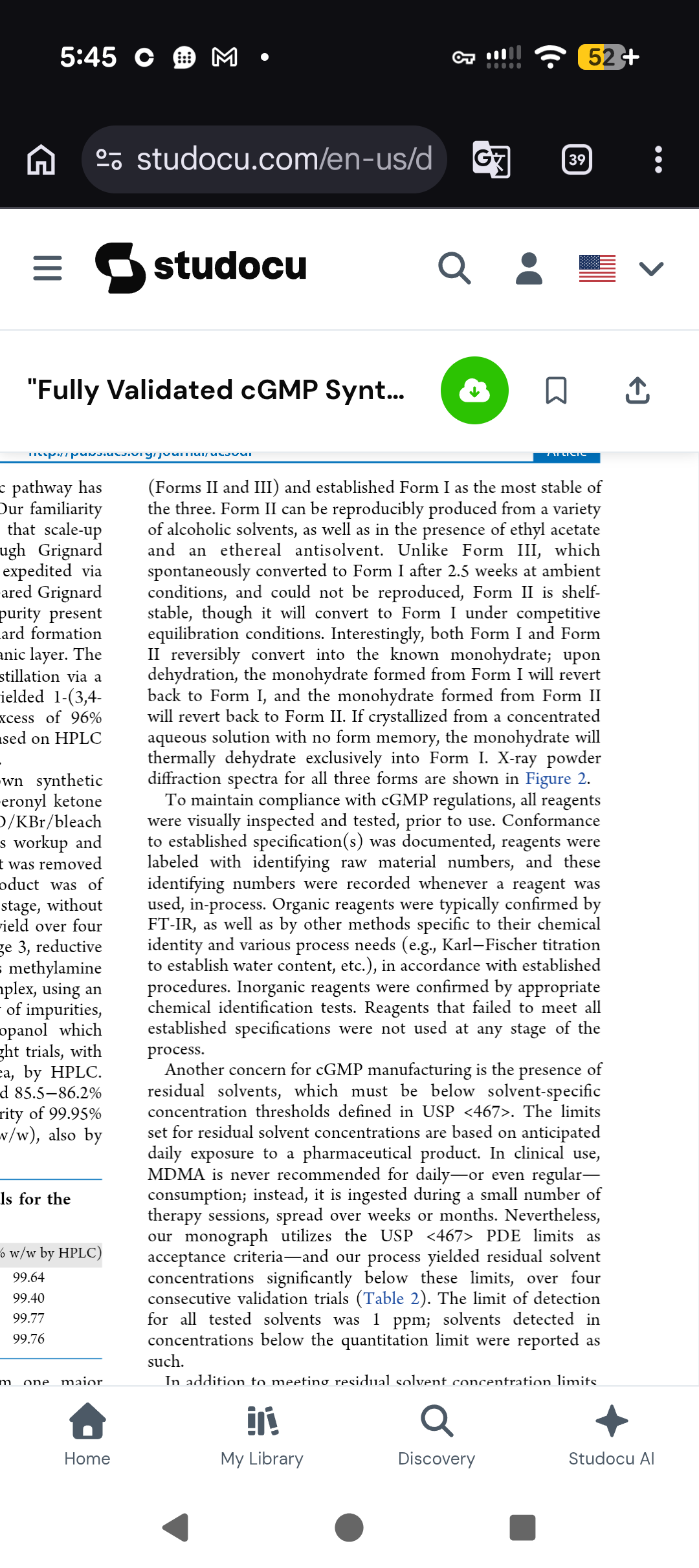
Yep, anhydrous raecemic MDMA hydrochloride does indeed form three identified polymorphs.

Also at least four hydrates.

Form III spontaneously converts to form I, Form II will convert to Form I under competitive equilibration conditions. In aqueous conditions, hydration occurs. As they point out, the well known Form I is the most stable.

It does seem to suggest all are readily soluble in water. Or, rather, all revert to Form I and then undergo hydration.

So I'm uncertain if this makes a blind bit of difference in the case of MDMA hydrochloride.

But it IS a viable way of obtaining a patent. I stand by that reading; that it's to get patent protection rather than having any real world advantage(s). Might be physically smaller, if that IS an advantage?

Different addition salts certainly DID alter the pharmokinetics of a related compound, but inherently changing the addition salt means the crystalline structure(s) will be different anyway. Maybe that's one reason why MDMA.HBr turned up on occassion? It's impossible to know why in most cases, but we just happened to get complaints so actually had to look into it.

If nothing else, the paper does demonstrate two less soluble impurities, 2-chloro and 2-bromo MDMA. Even a tiny amount of an impurity has the porential to wreck havok on crystalization.

I can only GUESS that 'moonrock' MDMA MAY be in an one of the less stable forms if seeding used a crystal of Form II or Form III, but in the presence of impurities? I don't know. Smaller WOULD be an advantage if it is to be smuggled.

I am aware of two cases where it mattered. The Ritonavir production-line suddenly began producing a much less soluble second form and manufacture was abandoned. The other was Rotigotine patches in which spontaneous polymorphic transition resulted in a less soluble form so a less active medicine. I don't say other examples simply don't exist, but those were the two that ended up in the news.

But I can follow the thinking...
 
Last edited:

Yep, anhydrous raecemic MDMA hydrochloride does indeed form three identified polymorphs.

Also three hydrates.

It does seem to suggest all are readily soluble in water.

Uncertain if this makes the blind bit of difference in the case of MDMA hydrochloride. Different addition salts certainly DID alter the pharmokinetics of a related compound, but inherently changing the addition salt means the crystalline structure(s) will be different. Maybe that's one reason why MDMA.HBr turned up on occassion? It's impossible to know why in most cases, but we just happened to get complaints so actually had to look into it.

Learning something new every day!
We all are man XD
 
Top





