• Psychedelic Drugs Welcome Guest
    View threads about
    Posting RulesBluelight Rules
    PD's Best Threads Index
    Social ThreadSupport Bluelight
    Psychedelic Beginner's FAQ
  • PD Moderators: Esperighanto | JackARoe |

Lysergamides LSI, Ancient LSD, Secret of the Eleusis Kykeon and Vedic SOMA

I have received a couple of pm's from people asking questions. One of these questions was from a person in Africa, he said he could not afford the book and asked if I could send him a pdf version of the book. I replied that my publisher "Sacred Forest Botanicals" does not allow me to give out the pdf version of the book as it is not copyright protected, only the kindle version is copyright protected. I told him just download the kindle app on his phone, then you can read the ebook that is available on his phone. Or if you don't have a phone, you can just order the ebook and read it directly off his computer in a pdf form that is copyright protected.

The 3 simple steps are in the book in chapter 5, most of the time is spent waiting 20 minutes between the 3 super easy steps.

The HBWR seeds contain 83% LSA, this is converted to LSI + LSV + LSCr for a TRIPLE PSYCHEDELIC EXPERIENCE that I way preferred to LSD,

In the book, LSA was stirred with 3g of the Aojiru young barley powder (comes in a nitrogen sealed packet for freshness), as the Aojiru barley contains not only extremely high levels of isovaleraldehyde, but also valeraldehyde and crotonaldehyde for a triple psychedelic combo that feels just like ALD-52 (anxiety free version of LSD also discovered by Dr. Hofmann) and mescaline combined. This brew experience is very potent yet zero anxiety and zero side effects, my all time favorite "ultimate psychedelic", and she tastes fine, no nastiness whatsoever, only a slight herbal taste. The last step produced a 60ml LSI + LSV + LSCr brew in water that is non-alcoholic.

Yes, this is a ground breaking discovery, a brand new ancient psychedelic that is my all time favorite.
 
Last edited by a moderator:
This is some extremely interesting stuff. Some proper Bluelight content, to be sure!

Thanks for your thorough research and willingness to try something new. I do hope you’re correct about it being Soma. That would be an answer to a centuries’ old question.
 
I know for almost certain that conversion from LSA's to LSH via abduction i think it was, is easily doable, just react extract of morning glories or, better yet, Hawaiian baby woodrose seeds with a source of acetaldehyde and there you go. My extract of HBWR went as follows,

Scrape outside of Seeds off (hair)
Grind in coffee grinder
Put powder of 50 seeds in 500mls of water for a week with sources of acetaldehyde (spiced rum, peppermint tea were my sources) and filter COLD, cyanoglycosides that result in extreme vasoconstriction and nausea, congeal at cold temperatures in water as they are lipids and this COULD be what makes the trip more enjoyable and not the acetaldehyde but Albert Hoffman pretty much confirmed you can create lsh from lsa's just by way of adding a source of acetaldehyde.

The resultant trip was euphoric as hell, soft colours every where (took 10 seeds worth) and sedating but not in an annoying manner. Way more recreational than an equal amount of HBWR chewed and swallowed.

I wrote this here to demonstrate that it's possible to make drastic chemical changes to a compound in very simple ways so this tek for lsd seems totally plausible.
 
The biosynthetic pathway is lysergic acid -> lysergic acid hydroxylethylamide -> lysergamide (the latter of which is a spontaneous and uncatalysed reaction simply proceeding by the inherent instability of such aldehyde adducts). The reaction of lysergamide back to LSH is to my knowledge entirely unknown in the scientific literature and there is no known way of this occurring anywhere - neither in plants, fungi, animals nor even glassware for that matter. The references shown so far by the proponents of the aldehyde adduct theory are entirely out of scope for the proposed conditions. If you can prove otherwise - and that means instrumental analytics, not bioassays, for which there is a multitude of reasons of altering behaviour, ranging from bias to entourage - come forward and fucking prove it. If not be happy with whatever effects you get but don't spout chemical nonsense on a thin basis and wishful thinking.
 
@tregar The bit I'm a bit stuck on when following the instructions in Chapter 5 of your book is that adding a set amount of tartaric or citric acid “brings the pH to 4”. In a mix that’s mostly ethanol, I’ve found pH meters and strips don’t really behave in a reliable way, since they’re designed for water and the readings tend to drift or not settle. Any advice would be appreciated.
 
flame_assay said:
The bit I'm a bit stuck on when following the instructions in Chapter 5 of your book is that adding a set amount of tartaric or citric acid “brings the pH to 4”. In a mix that’s mostly ethanol, I’ve found pH meters and strips don’t really behave in a reliable way, since they’re designed for water and the readings tend to drift or not settle. Any advice would be appreciated.
Yes flame_assay, thanks for question. Everclear (ethanol) has a natural ph of around 7.33, don't get hung up on measuring the ph, as it will drift like you mention. Simply drop in 30mg of DL tartaric acid powder in the beginning, and if you can't find DL tartaric acid powder (auction, high media store, etc.) just drop in 40mg of citric acid powder for this step, and use 10mg DL tartaric acid for very last step, or you can add 20mg citric acid powder instead.

As time goes on, and long after I am dead, others will make improvements to my procedure, and find that only 10 minutes stirring instead of 20 minutes stirring may work just fine for the 2 stirring steps, it will evolve.

Don't worry about the ph as the conversion from LSA to LSI + LSV + LSCr happens in the liver anyways via an in-vivo condensation reaction. We are dropping the ph "just in case" the reaction proceeds externally as well. I have even taken the brew 2 hours after a heavy mill of chili with 75 grams of protein (I'm a bodybuilder) and the brew still worked fantastic, that was the time I used 40 seeds converted to LSI, and it felt identical to 160ug of LSD, but even beyond LSD like a combination of ALD-52 (anxiety free version of LSD) + mescaline at same time, with extreme euphoria, hours of closed eye colored visions and heavenly music enhancement all night, and the most beautiful colors I've seen in my life, not to mention the constant diamond like shimmering of all visuals...and profound spiritual revelations, insights, and healing.
 
Don't worry about the ph as the conversion from LSA to LSI + LSV + LSCr happens in the liver anyways via an in-vivo condensation reaction. We are dropping the ph "just in case" the reaction proceeds externally as well.
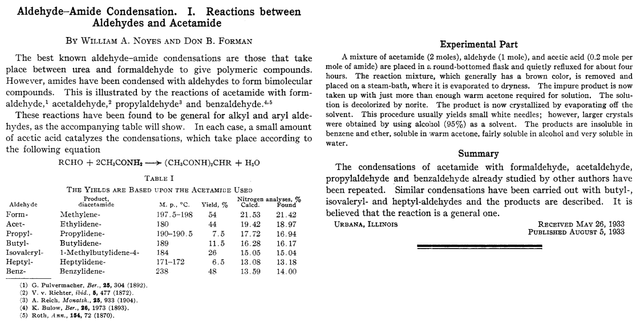
It's entirely plausible for the amide-aldehyde condensation to occur externally.

Aldehyde—Amide Condensation. I. Reactions between Aldehydes and Acetamide
image.png

https://pubs.acs.org/doi/10.1021/ja01335a085

The condensation of aldehydes with amides
Part VII. The condensation of piperonal

doi: 10.1007/BF03049118
Piperonal condenses best when heated without any other condensing reagent, with seven of the common amides, giving characteristic piperonyl bisamides. It does not condense with formamide

The condensation of aldehydes with amides
Part II. The condensation of cinnamaldehyde

doi: 10.1007/BF03045405
As far as we are aware, there has been only one such condensation reported, and that is by Gupta, of cinnamaldehyde with phenylacetamide, brought about without any condensing or catalytic agent, by merely heating the two together, and resulting in the production of cinnamylidene-bisphenylacetamide.

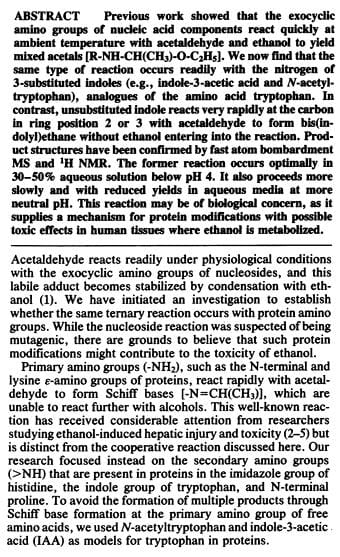
Even the indole nitrogen can condense with acetaldehyde. This paper was investigating acetaldehydes ability to react with indole-N.
doi: 10.1073/pnas.89.18.8439
IMG-20260114-WA0000.jpg


Here's an overview of aldehyde adducts based on reports from multiple forums.

The cinnamaldehyde and cuminaldehyde adducts are stimulating and sedating respectively. These aldehydes are easily found.
Written by flickedbic:
Cinnamaldehyde makes a speedy adduct that carries much more visual strength (and side effects- keep a handy bronchodilator like Cannabis). This one should be dosed lower.
Acetaldehyde to (re)form LSH adduct (fresh peppermint, cwe coffee, sherry that smells like apples) is a more traditional trip, not as visual with open eye but blissful and more giggly/trippy than the speedy but visual Cinnamaldehyde adduct.
• Perhaps my favorite; cuminaldehyde. I make a cumin tincture then shake it with the filtered acidified LSA CWE over ice, and then strain. A much more serene and zen, meditative trip: very peaceful but also very enjoyable.
...
I've probably done adduct formation from LSA a dozen times using various aldehydes.
...
Very cold, strong agitation of the aldehyde in the CWE is needed to form the adduct.

Here he describes it in more detail:
I have done experiments with adduct formation and talked with many others who have also. There are definite distinct timelines, effects, and side-effects for the various adducts.

My understanding of this reaction in a nutshell:
— "LSA" + the aldehyde + low PH (4) + cold agitation = an adduct with modified effect.

Alcohol may facilitate the reaction.

Quick adduct differentiation:

Acetaldehyde adduct: Great euphoria, classical psychedelic mentally. Offers light visual effects such as haloes, tracers, increased brightness and color saturation.
— The Acetaldehyde adduct gives me vasoconstriction, but no bronchial constriction.


Cinnamaldehyde adduct: Short duration, high energy, occasional OEV's: a rapidly expanding white "bubble-ring" (like the kind dolphins make and play with) shoots out from a Persian rug towards me.
— The Cinnamaldehyde adduct gave me bronchial constriction, so keep a bronchodilator like THC handy.

This is the only adduct that has given me actual OEV; and with half my usual dose at that! While it is the most stimulating adduct I've tried, it's the least uplifting.
More on the Cinnamaldehyde adduct: https://www.shroomery.org/forums/showflat.php/Number/22081081#22081081


Cuminaldehyde adduct: Good mood; centered. Fair energy. Long duration. Presents visual effects from soft "breathing" to "rubber objects" (or seeing things how a video camera does after the lens is splash and water goes into streams across the lens).
— Thinking is unclouded, not on overdrive, but zen. Feels almost holy. While the cuminaldehyde adduct may be slightly less euphoric than the acetaldehyde one, it is still very nice!

Here's my post on Cuminaldehyde written during and after trying it, "hbwr cumin mix kicks ass"*: https://www.shroomery.org/forums/showflat.php/Number/21168265#21168265

The vanillin and benzaldehyde adducts aren't recommended as lysurgeon reports on dmt-nexus. Lysurgeon also explored other aldehydes.

The piperonylacrolein (found in sassafras roots) adduct shows promise thanks to a report on shoomery (LSA + cwe sassafras root bark).

The syringaldehyde adduct has a promising report but reliable food sources are challenging. Ideally you just buy the pure aldehyde which is available.

The anisaldehyde adduct hasn't been tried afaik but it's promising since cuminaldehyde gives great results and shares a similar structure. Piperonal also hasn't been tried afaik. Both of these aldehydes are available otc if you know where to look.
  • anisaldehyde = 4-methoxy
  • cuminaldehyde = 4-isopropyl
  • syringaldehyde = 4-hydroxy-3,5-dimethoxy
  • piperonal = 3,4-methylenedioxy
 
Last edited:
The reaction of lysergamide back to LSH is to my knowledge entirely unknown in the scientific literature and there is no known way of this occurring anywhere - neither in plants, fungi, animals nor even glassware for that matter.
Besides the multiple papers on aldehyde-amide adduct formation, the specifics of LSA forming adducts hasn't been investigated in the literature. Usually there's a delay between a new finding and it's exploration in academia. The only paper so far is theoretical in nature but it's a start.

The references shown so far by the proponents of the aldehyde adduct theory are entirely out of scope for the proposed conditions. If you can prove otherwise - and that means instrumental analytics, not bioassays, for which there is a multitude of reasons of altering behaviour, ranging from bias to entourage - come forward and ... prove it.
I'm sure that eventually the appropriate people with the correct analytical equipment will do that. Why not be patient till then.

If not be happy with whatever effects you get but don't spout chemical nonsense on a thin basis and wishful thinking.
People's experimentation with LSA adduct formation has been going on for at least 30 years. I'm not exactly sure when the idea of acetaldehyde + amide came about but it looks like people were discovering the phenomenon by accident. Anyway, I don't see this avenue of exploration stopping anytime soon since it's pretty novel. Buying LSD is fun but DIY is more fun, especially if you can customise the vibe per se (see the "aldehyde menu").
 
Last edited:
I'd love to be proven wrong. But the literature so far cited has the following in common: terrible yields, anhydrous conditions, reflux. I have bought a couple HBWR seeds though - my intention is to plant them to eventually have fresh seeds, so experimentation on my end will have to wait. I don't question that it is possible to make such adducts, but I absolutely question that they are made by the conditions proposed so far (in vitro or in vivo). A couple years ago a Redditor attempted some work, but it fizzled out. Under anhydrous conditions with molecular sieves to sequester the inhibiting water, they only got so far as a 2.5 % yield of the bis-amide adduct of nicotinamide (SAR-wise the bis-amide would probably be uninteresting).

I think what is needed now is more rigorous work in the form of blind assays by the people who believe it works, and real analytical work. Armchair chemistry has been done by all the sides plenty by now. I propose the people who claim to be successful should do this work, as existence is easier to prove than non-existence, you know?

I'm aware of the adducts to indole-nitrogen and am a little bit less skeptical of them but find them to be moving the goalpost - they would yield what under the current understanding are pro-drugs to LSA.
 
I'm aware of the adducts to indole-nitrogen and am a little bit less skeptical of them but find them to be moving the goalpost - they would yield what under the current understanding are pro-drugs to LSA.
If someone were to only consider peer reviewed papers as truth then only acetaldehyde can form adducts with the indole-N (re paper mentioned in my earlier post) and LSA's amide-N can never form adducts.

I'd consider current academic understanding to be incomplete. Sekio had the same perspective as you:
There was also a recent study that showed that ALD-52 and 1P-LSD and other 1-acyl-LSD analogues are rapidly metabolized to LSD and simply function as prodrugs (I.e. they don't have "magical" effects or anything unusual and are equally likely to cause a bad or good trip as LSD). So even if you did form any sort of addition product to the aromatic nitrogen it would just turn back to LSD anyway.
Sandoz labs suggested that ALD-52 might actually have advantages over LSD, reducing any side effects but achieving a stronger trip.
Measurements of brain waves while people were taking the two drugs showed that while LSD produced brain waves associated with intense concentration and anxiety, ALD-52 produced brain waves showing a more relaxed mental state.

ALD-52 is listed as having a lower (approximately 1/5) intravenous toxicity (in rabbits), a lower approximately one eighth pyretogenic effect, and double the "antiserotonin" effect as compared with LSD.
Prodrugs can have intrinsic activity themselves, hence the distinction being made between pharmacolocially inactive and active prodrugs.

A couple years ago a Redditor attempted some work, but it fizzled out. Under anhydrous conditions with molecular sieves to sequester the inhibiting water, they only got so far as a 2.5 % yield of the bis-amide adduct of nicotinamide.
I recall his posts. From what I remember he didn't use acidic conditions. Successful reports use cold conditions at ph4, the presence of water doesn't appear to impede things - as flickedbic reports which I quoted in my earlier post. I knew flickedbic a decade+ ago and he was quite serious, not "playing around". Now this assumes external formation ... but internal formation is also plausible.
 
Last edited:
There are essentially three options, would you agree with that @tregar and @Allylbenzene :

1. LSA with aldehydes forms distinct compounds with altered pharmacology (amide adduct, indole-N adduct, perhaps something else)
2. LSA with aldehydes/plant extracts cause a pronounced entourage effect by the combination of multiple bioactive compounds
3. The addition of aldehydes/plant extracts to LSA extracts set a certain expectation in the tripper, influencing the experience (we all know psychedelics are one of the most susceptible drugs to this effect!)

The first one would need to be confirmed by instrumental analysis. It is known that the proposed adducts are relatively instable in various conditions. The options 2 and 3, and to a lesser extent 1, can be confirmed by at least self-blinding. I propose an experiment of 10 blinded trips: with each trip, the tripper has to declare whether or not they are tripping with additives or not. Unblinding has to follow after all the 10 trips are done. I'd be very curious about the success rate (caveat: people have troubles differentiating magic mushrooms and 2C-B in a blinded test, which is interesting considering most seasoned trippers would say they are quite distinct). It is only logical that the self-blinding has to be done by people who declare there is a noticeable difference.

I'm looking forward to experiencing LSA some day, but unless confirmed by instrumental analytics, I think there are more logical explanations for the altered effects you people are experiencing - I do have a background in chemistry and have spoken to a couple of other chemists about this matter.
 
I'm looking forward to experiencing LSA some day, but unless confirmed by instrumental analytics, I think there are more logical explanations for the altered effects you people are experiencing - I do have a background in chemistry and have spoken to a couple of other chemists about this matter.
Worth mentioning that when people write LSA it's rarely pure isolated LSA but a mixture of alkaloids (usually lysergic + clavine). Shulgin wrote that pure LSA was mostly uninteresting in TiHKAL #26 paragraph on LA-111.
Hofmann tried a 2 milligram dose of this amide [isoergine], and as with ergine, he experienced nothing but tiredness, apathy, and a feeling of emptiness. Both compounds are probably correctly dismissed as not being a contributor to the action of these seeds.

Lysurgeon from dmt-nexus ran several pioneering experiments back in the day. He outlined the possibilities of LSA chemical transformation quite well in this post:
I am not limited by the adduct paradigm. How many different places does (natural lysergic alk X) interact with the world during its existence?
1. grows in the plant
2. accumulates in seed
3. exposed to air in grinding
4. exposed to water unless absolutely anhydrous conditions and solvents (this could even be human saliva)
5. subject to salivary enzymes
6. exposed to hydrochloric acid in the stomach
7. exposed to enzymes in the stomach
8. absorbed into bloodstream, subject to possible accumulation in bodily organs and their enzymes, otherwise possible blood enzymes
9. finally makes it to CNS, possibly more metabolisis before binding to serotonin receptors.
10. activity in CNS
11. metabolised into inactive substances
12. back to blood to kidneys and excreted

I know I'm missing steps here due to poor understanding of human physiology, but my point is that there are many places this alkaloid goes where chemical changes are in fact likely to occur, and the presence of an additional reactive compound could alter these chemical changes, whether its during exposure to water (like forming an aldehyde-amide adduct in cold water extract), or exposure to hydrochloric acid (change takes place in stomach, change is altered by aldehyde) or stomach enzymes (maybe the lsa is protected or the enzymatic function is altered by the aldehyde).

Lysurgeon mentions the first 2 of your options in another post:
...I have read about it and I do not have the technological means to do any of the analysis methods mentioned here. On the contrary, no analysis being available keeps certain people from giving themselves the opportunity to try these mixtures, which is not what I want. sharing and learning, both i seek here. I want to know if the aldehydes bond to the amide, and if they don't then the differences must be from pharmic effect of the aldehydes. Moreover, if some way exists to elucidate the structure, i am curious about (if there is bonding) where bonding may take place.
...and i hope somebody with the technologies and the curiosity is reading this and can see what needs to be done here, and is willing to do the work.
 
Last edited:
Worth mentioning that when people write LSA it's rarely pure isolated LSA but a mixture of alkaloids (usually lysergic + clavine). Shulgin wrote that pure LSA was mostly uninteresting in TiHKAL #26 paragraph on LA-111.

Hofmann tried a 2 milligram dose of this amide [isoergine], and as with ergine, he experienced nothing but tiredness, apathy, and a feeling of emptiness. Both compounds are probably correctly dismissed as not being a contributor to the action of these seeds.

Long long ago I tried HBWR seeds, and this description fits very well the effects I got, along with some vasoconstriction probably. I just ate them straight, chewing them well and swallowing with lots of water. I think we may have tried to scrape them beforehand. The woman who tried them with me was unsure if she got any psychoactive effects at all. I didn't have significant nausea, but she had a sudden wave and projectile vomited.

People have reported tripping off of HWBR, so I can only assume that alkaloid content varies considerably between specimens. Or maybe it's just highly dependent on individual responses. Without a more systematic analysis of this discrepancy, we're all left guessing.

As interesting as this LSI stuff sounds, I am firmly with @xdrc here in so far as we need more evidence. If some compounds are being synthesized via a route that is not covered in literature, then we need instrumentation data to prove it. Most chemists would not eat something they synthesized without full confidence in what it is they actually made. We also need analysis of the original plant matter to see what other alkaloids could be playing a role. Ideally this could be compared with analyses of a few different alternative samples of HWBR to see if maybe some HWBR may produce more psychedelic alkaloids only under specific conditions.

I for one am not interested in trying HWBR seeds again until I have more confirmation that what I'm ingesting will actually work.
 
iom said:
I am firmly with @xdrc here in so far as we need more evidence.

Vecktor (advanced chemist like myself, from 1998) said to me (personal communication 20 years ago, when I had discovered LSH):
You have probably rediscovered something that has long been a curiosity, for example on the now defunct blacklight site there was a TLC posted of morning glory seed extract treated with (1) methanol, (2) acetaldehyde-methanol or with (3) acetaldehyde in ph=4 water. Both the extract treated with (2) acetaldehyde-methanol and with (3) acetaldehyde in ph=4 water showed a clear difference in the alkaloid profile, with a shift to several new non-polar spots which couldn't be identified. Very likely the LSA converted to LSH (LSA + acetaldehyde adduct = LSH). IIRC Erhlichs was used to develop the plates so these were indole compounds.
In Chapter 4 and 7 of my book, I also provide 4 scientific papers which back up my successful experimental results.

I promise everyone, in my successful experiments in the book in Chapter 5 (3 super simple steps from LSA in HBWR seeds to LSI), I experienced ZERO side effects even using 40 HBWR seeds, as I extracted the pure LSA residue and stirred it with 3g of Aojiru young barley grass (very high in the 3 aldehydes) to arrive at profound psychedelic effects just as powerful as 160ug of LSD but even beyond LSD, my absolute favorite psychedelic.

I took the 60ml non-alcoholic brew 2 hours after a heavy meal of chili with 75 grams of protein (I'm a bodybuilder) and the brew still worked fantastic, that was the time I used 40 seeds converted to LSI, and it felt identical to 160ug of LSD, but even beyond LSD like a combination of ALD-52 (anxiety free version of LSD) + mescaline at same time, with extreme euphoria, hours of closed eye colored visions and heavenly music enhancement all night, and the most beautiful colors I've seen in my life, not to mention the constant diamond like shimmering of all visuals...and profound spiritual revelations, insights, and healing.

I have been in contact with chemist at the Shulgin institute, I will be on Dr. Dennis Mckenna's you tube show "The Brainforest Cafe" on Jan 16, but it won't go up until 3 weeks afterwards. I have also been in contact with Graham Hancock, and writing an article for his website.

Dr. Nichols (chemical scientist at Purdue University who studies LSD) is so impressed with the effects that he is even synthesizing LSI, and writing a journal paper on this ground breaking discovery, citing my book of course he told me.
 
Last edited by a moderator:
Dr. Nichols (chemical scientist at Purdue University who studies LSD) is so impressed with the effects that he is even synthesizing LSI, and writing a journal paper on this ground breaking discovery, citing my book of course he told me.

Can you post your email exchanges with him or highlights/summaries of them?

And can you answer the question I asked you about him in a private message?

───────────────────────
Do you know the source of these statements from David Nichols and Peter Webster:

tregar posted these on other forums.

───────────────────────
Although the pharmacology of isoergine (and even ergine itself) is not well studied, in other lysergic acid amides the iso epimers are generally inactive, at least when compared to the normal amides. Therefore, I still believe that ergine must be the species active at the receptor, but if the ergine/isoergine equilibration can occur at body pH and temp, then ergine could be generated in the brain from isoergine. This may be a key point, and you should go back and look at the Tetrahedron paper[ ✱ ] where they apparently did some kinetics on the process.

Thus, I think that isoergine would lack pharmacological effects. But… there is another factor to consider. Absorption and partitioning through the body and into the brain only occurs with the unprotonated forms of alkaloids. That is, ergine is an alkaloid that will be protonated, or charged, at body pH. As such, before it can be absorbed from the gut or cross into the brain, it must lose its charge, or give up its proton. In the uncharged form it will readily cross into the brain, but this fraction is relatively small, perhaps only a few percent of the total.

Because of the ability of the amide of the D-ring of isoergine to form a stabilizing hydrogen bond to the amine nitrogen, it can deprotonate very easily at body pH, giving a neutral species that will have a very high lipid solubility. The intramolecular hydrogen compensates for the energy cost of deprotonation and desolvation. Using semiempirical methods, I calculated the length of this hydrogen bond to be about 2.65 Angstroms. Somewhat long, but reasonable. The work you cite in Tetrahedron could be used for parallel discussion, but I don't have the paper here. The consequence of the hydrogen bond is that isoergine will be absorbed much more readily than ergine, and will penetrate the brain to a greater extent than ergine. Once inside the brain, however, facile epimerization of isoergine will lead back to an equilibrium that contains ergine, which is most likely the form of the molecule that I believe is active at the receptor. Importantly, however, I think the concentration of ergine could be much higher than if ergine itself was taken, IF epimerization of isoergine back to ergine can occur at physiological conditions. Thus, at the brain receptor where ergine acts, a much higher concentration will be achieved than if ergine had been administered originally. If isoergine did have significant pharmacological activity, something which I doubt, but without evidence, it could be there in pretty high concentration, compared to what would be there after pure ergine administration. So, the question is: if isoergine is placed in pH 7.4 at 37 degrees C, will a significant amount of ergine arise by epimerization in a reasonable amount of time?

This process is completely analogous to the proposal by G.P. Migliaccio, T.-L.N. Shieh, S.R. Byrn, B.A. Hathaway and D.E. Nichols, "Comparison of Solution Conformational Preferences for the Hallucinogens Bufotenin and Psilocin using 360 MHz Proton NMR Spectroscopy", J. Med. Chem. 24, 206-209 (1981) to explain the high lipid solubility of psilocin, compared to bufotenin. In that paper, the authors proposed that an intramolecular hydrogen bond forms between the 4-hydroxy group of psilocin and the side chain amino group, providing enhanced penetration into the brain. Similarly, in isoergine, the hydrogen bond between the amide hydrogen and the unprotonated basic amine provides a very lipid-soluble, neutral substance that can easily be absorbed and penetrate into the brain. In pharmaceutical terms, we could consider that the bioavailability of isoergine would be much higher than that of ergine, following oral administration.
───────────────────────
https://mycotopia.net/topic/10352-lucid-and-visual-morning-glory-lsa-extracts/#entry190606

L. Bernardi, W. Barbieri, Ergoline derivatives—VIII: Configuration and conformation of lysergamides and dihydrolysergamides, Tetrahedron, Volume 21, Issue 9, 1965, Pages 2539-2551, ISSN 0040-4020, 10.1016/S0040-4020(01)93909-2.

───────────────────────
Also a comment about the graphs: The question here is what conditions is the extract subjected to (and for how long) before (and maybe even during) the HPLC? For instance, some researchers believe that perhaps all the content of MG seeds exists as the d-hydroxyethylamide, and it is the extraction/purification/testing procedures which then produce the APPARENT result that the alkaloids are ergine, isoergine, and maybe still some hydroxyethylamide. Thus your testing procedure might also be subject to this problem. A test that would fill us in on some important data would be to have the rate of epimerisation of ergine to isoergine in basic, neutral, and acidic media (and yes, the equilibrium is not far from 50/50). For this, you'd need to separate one epimer with chromatography, and then measure optical rotation over time. A little tricky to get it right unless ypu've done similar testing before. LSD takes a week to equilibrate even in basic conditions (to 88:12), whereas lysergic acid itself is almost instant in strong base (to 85:15). Prof Nichols believes the ergine-isoergine equilibration is rapid even in body fluids, I suspect it is not, and that this is one reason for the uncertainties we deal with in the book. But no one's got the hard data!
───────────────────────
Peter Webster, https://www.shroomery.org/forums/showflat.php/Number/6054828#6054828


 
On the show today where I am interviewed by Dr. Dennis Mckenna (Friday January 16th), the producers will be sharing a link to this bluelight thread so that others can learn more who watch the show. The show will not go up on you tube until 3 weeks from now: https://mckenna.academy/mka-podcast/ Update 1.17.27: The interview went very well!

Red 22 said:
Can you post your email exchanges with him or highlights/summaries of them?

Dr. Nichols said on Oct 3, and Jan 13 in email exchange with me:
(October 3, 2025) I will sit on pins and needles until the release of your book! (January 13, 2025) I am fascinated with the effects, this is all very intriguing. I am in contact with a super chemist who could probably synthesize it. Of course, we’d cite your work as the inspiration for making it.

iom said:
I am firmly with @xdrc here in so far as we need more evidence.

Vecktor (advanced chemist like myself, from 1998) said to me (personal communication 20 years ago, when I had discovered LSH):
You have probably rediscovered something that has long been a curiosity, for example on the now defunct blacklight site there was a TLC posted of morning glory seed extract treated with (1) methanol, (2) acetaldehyde-methanol or with (3) acetaldehyde in ph=4 water. Both the extract treated with (2) acetaldehyde-methanol and with (3) acetaldehyde in ph=4 water showed a clear difference in the alkaloid profile, with a shift to several new non-polar spots which couldn't be identified. Very likely the LSA converted to LSH (LSA + acetaldehyde adduct = LSH). IIRC Erhlichs was used to develop the plates so these were indole compounds.
In Chapter 4 and 7 of my book, I also provide 4 scientific papers which back up my successful experimental results.

I promise everyone, in my successful experiments in the book in Chapter 5 (3 super simple steps from LSA in HBWR seeds to LSI), I experienced ZERO side effects even using 40 HBWR seeds, as I extracted the pure LSA residue and stirred it with 3g of Aojiru young barley grass (very high in the 3 aldehydes) to arrive at profound psychedelic effects just as powerful as 160ug of LSD but even beyond LSD, my absolute favorite psychedelic.

I took the 60ml non-alcoholic brew 2 hours after a heavy meal of chili with 75 grams of protein (I'm a bodybuilder) and the brew still worked fantastic, that was the time I used 40 seeds converted to LSI, and it felt identical to 160ug of LSD, but even beyond LSD like a combination of ALD-52 (anxiety free version of LSD) + mescaline at same time, with extreme euphoria, hours of closed eye colored visions and heavenly music enhancement all night, and the most beautiful colors I've seen in my life, not to mention the constant diamond like shimmering of all visuals...and profound spiritual revelations, insights, and healing.

I have been in contact with chemist at the Shulgin institute, I will be on Dr. Dennis Mckenna's you tube show "The Brainforest Cafe" on Jan 16, but it won't go up until 3 weeks afterwards. I have also been in contact with Graham Hancock, and writing an article for his website.

Dr. Nichols (chemical scientist at Purdue University who studies LSD) is so impressed with the effects that he is even synthesizing LSI, and writing a journal paper on this ground breaking discovery, citing my book of course he told me.
 
Last edited by a moderator:
Top