• CD Moderators: nepalnt21
  • Cannabis Discussion Welcome Guest
    Posting Rules Bluelight Rules

The USA rescheduled Cannabis from Schedule I to Schedule III

Asante

Bluelighter
Joined
May 4, 2012
Messages
1,499
Location
Holland
610594750-Cannabis_Schedule_III_-_Dec_19_2025.png


Cannabis Rescheduled: What Schedule III Signals for the U.S. and the World​


The U.S. government’s decision to move cannabis from Schedule I to Schedule III under the Controlled Substances Act marks a quiet but consequential shift. It does not legalize cannabis, nor does it end federal control. What it does do is formally abandon a position the state has defended for over half a century: that cannabis has no accepted medical use.


That reversal matters—not just domestically, but globally—because U.S. drug policy has long functioned as an international reference point. This rescheduling is less a finish line than a signal flare, indicating where the next phase of normalization and decriminalization is likely headed.


A Turning Point for U.S. Drug Policy​


In the United States, the most immediate impact will be on research and institutional legitimacy. Schedule I status made cannabis uniquely difficult to study, even compared to far more dangerous substances. Schedule III lowers regulatory barriers, enabling broader clinical trials, standardized dosing studies, and FDA-adjacent research pathways.


Over the next few years, this is likely to result in:


  • Expanded medical indications backed by formal trials
  • Greater physician comfort discussing cannabis therapeutically
  • Increased integration into mainstream healthcare systems

Just as important is the symbolic effect. Once the federal government acknowledges medical value, the rationale for total prohibition weakens. Courts, regulators, and lawmakers tend to follow these signals—even when they do so slowly.


At the state level, this move reinforces existing trends. Legal and decriminalized states gain additional political cover, while prohibitionist states will increasingly appear out of step with federal science and public opinion. Expect fewer rollbacks, more cautious expansions, and growing pressure for harmonization between state and federal law.


Economic and Corporate Realignment​


Schedule III also reshapes the economic landscape. Pharmaceutical and biotech firms—previously hesitant due to legal uncertainty—are now more likely to enter cannabis research and development. That will bring capital, standardization, and regulatory rigor, but also raises concerns about corporate capture and the marginalization of legacy growers and small operators.


This tension will define the next phase: cannabis transitioning from counterculture commodity to regulated medical and wellness substance, with all the benefits and compromises that entails.


Global Ripple Effects​


Internationally, the impact may be even more significant.


Many countries still justify strict cannabis laws by pointing to U.S. federal scheduling and international drug conventions heavily influenced by American policy. A U.S. reclassification undermines that foundation.


In the coming years, expect:


  • More countries adopting medical cannabis frameworks
  • Expanded decriminalization in regions already experimenting with reform
  • Greater willingness by international bodies to revisit outdated classifications

For nations in the Global South—often pressured into prohibitionist models—this shift may open space for sovereign policy decisions grounded in public health rather than geopolitics.


Part of a Larger Normalization Wave​


Cannabis does not exist in isolation. This change fits into a broader global pattern: a slow retreat from punitive drug policies and a gradual embrace of harm reduction, medicalization, and evidence-based regulation. Psychedelic research, opioid policy reform, and shifting attitudes toward plant medicines all point in the same direction.


What we are witnessing is not sudden enlightenment, but institutional adaptation to reality. Public use, medical success, economic incentives, and scientific evidence have made total denial unsustainable.


What This Means Going Forward​


Over the next decade, cannabis will likely continue moving toward:


  • Normalization as a therapeutic and cultural substance
  • Reduced criminal penalties and enforcement priorities
  • Increasing global policy divergence, followed by gradual convergence

Schedule III does not end the drug war, but it does mark an inflection point. Once a substance is officially recognized as having medical value, the question shifts from “Should this exist?” to “How should this be regulated?”


That question—once asked—rarely gets un-asked.
 
Last edited:
I've got doubts anything will really happen - Trump just says shit cos it sounds good and whoever was talking to him that morning. If tomorrow an anti-cannabis senator talks to him Trump will be saying cannabis is deadly again. Never take him at his word - wait till the policy actually arrives. I imagine in 4 years time we will still be getting told cannabis will be rescheduled "within the next two weeks..."


It's a giant leap in the right direction - not legalization but a move to where research and medical access will be greater. Schedule I was utterly prohibitive, as if it were the worst of the worst.
Internationally this will likely augment all efforts towards decriminalization, as the US have always been the prime prohibitionist of this drug.
 
so will they leave it to the states?

or will it be super restrictive and rx only like (for example) ketamine?
 
Internationally this will likely augment all efforts towards decriminalization, as the US have always been the prime prohibitionist of this drug.

I think most countries will just defer to the UN rulings (that the USA has always enforced to the nth degree). Unless the US says the UN can alter their drug bans it makes no difference to the rest of the world. That's the excuse all countries say - "We can't legalise it cos the UN backed by the US are against it)
 
It will probably be soon, their war on cannabis is already lost - bigtime. Holding cannabis back is getting too expensive for the US gov't, plus they want to distract.

That said, let's take the ground we won.
Biden actually started the process. Trump's EO just expedites it. That might be a good thing since the process is geologically slow.
Kinda funny he did it the day before the (supposed) Epstein release.
 
They just legalized in my state. I'm a bit worried that this will affect recreational if/when it goes through.
 
Salutations,

Yesterday’s announcement in the Oval Office may appear as progress to some, though that ain't opening any door to many others, at best a transfer from one cage to another that's still lined with dehumanizing bars, behind which supervising custodians paradoxically stand in the light of puritan capitalism in a nanny‑state environment...

This in fact carries an uncanny sense of déjà‑vu, one with roots stretching back to Moscow's FCTC/COP6 (WHO) event of 2014, when the specter of Nora Volkow shaped the proceedings from a distance. Such legacy explains the glowing smile on her confident face, in presence of Donald Trump sitting only a few feet away.

The long‑awaited break with moral panic won't occur, adolescent brains remain a battlefield where recreational use of cannabis spontaneously translates into a pathological brain disease called « addiction » despite an absence of true co-morbidity as is associated with alcohol.

Trump's « never seen before » decree didn't mark the end of suffering, it's little more than a fresh coat of bigot varnish tainted with a different colour reaffirming that no person living in USA can fully exercise sovereignty over their own bodies, not even based on vaporization as a health-wise alternative. Worse, we can safely bet that chronic poisoning from combustion smoke won't stop being the royal gateway aligned with prohibitionist narratives all too well known to $pe¢iali$ts/expert$ and politicians from all sides, those very same who traditionally prefer to exploit cannabis as a self-serving political lever, much like Volkow who's been thriving on it since at least 2003 and now expects to enjoy plain job security.

💰

The path is set for a machinery that chews through the consumer’s humanity, stealing a bite to stir its appetite before inevitably coming back for more. This shift to Schedule III removes the 280E tax burden for licensed operators and paves the way to niche markets — the part that will feed headlines and dominate the landscape, while its socio‑toxic impact remains largely unspoken. Meanwhile, H.R. 5371 of November 2025 finally blocks access to psychoactive hemp by redefining the mid-seventies THC threshold established by Ernest Small at Agriculture Canada's experimental farm, extending its logic to include isomers in today’s regulatory framework.

Medication transforms into dependency, quietly eroding self‑esteem and turning already vulnerable patients into compliant subjects — the true product of a single‑molecule industry denying them the “entourage” synergy effect.

It takes work — once peeled this onion smells $i¢k ’n $ad, most unmistakably by design! But just like in my country even to this day, certain announcements also have a way of bouncing around when public attention is focussed elsewhere.
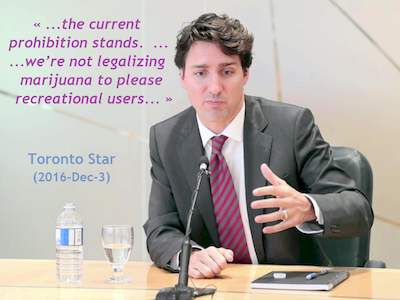
Justin_Mini_PET_Trudeau_-_Toronto_Star_2016-_Dec-3_400x300.png
The Toronto Star: Trudeau urges police to ‘enforce the law’ on marijuana (2016-Dec-3)​
« ...the current prohibition stands. ... ...we're not legalizing marijuana to please recreational users... »​

Good day, have fun!! ☮️
 
.......uh what? ^^^

Also, the executive order effectively does nothing. Read it. All it does is tell congress to look into recommending the dea look into rescheduling. Only the dea can do anything about it
 
obama issued a memorandum which directed federal prosecutors not to pursue cannabis prosecutions in states where marijuana was legal.

biden went a little further issuing pardons and moved to reclassify marijuana from Schedule i to schedule iii but it did not happen.

i've been told that us lefties never give trump credit for anything. i can only speak for myself and i think that is demonstrably untrue. but, while it remains to be seen what actually happens here, i give trump credit for trying to move things in the right direction.

alasdair
 
A full spectrum of reactions has erupted these last few days, ranging from portrayals of moral decay to normalization, like scattered sparkles swirling across the most colourful kaleidoscope of public imagination. Each reader must take personal responsibility for their own blind spots as the public imagery of cannabis keeps shifting, because once the historical anchors are laid out in objective, verifiable terms, the space for convenient misunderstandings vanishes like morning haze when clarity arises through the sheer glow of dawn...

One of the most revealing trajectories for gaining a broader view of this hyperbolic landscape is the influence exerted by Nora Volkow since the late nineties, beginning with her contribution to an addiction‑centric, prohibition‑aligned framing of "marihuana" through research conducted at the Brookhaven National Laboratory. Back then, positron‑emission tomography (PET) offered an early and visually compelling means of capturing synaptic signals in individuals exposed to psychoactive substances, a technology well suited to genuinely advance the field in savvy articles published by 'Science and Nature', yet equally capable of amplifying victorian‑age assumptions when filtered through the interpretative lens of neophyte editorials appearing in periodicals such as 'The New York Times'.

Studies she conducted (including those on the neuro‑metabolic effects of cocaïne) attracted significant attention from peers who viewed her findings through a similar dependency‑oriented conceptual posture, notably the attempts to map dopamine’s circuitry in compulsive reward and obesity, for example:
'How can drug addiction help us understand obesity?', Nora D. Volkow & Roy A. Wise, Nature Neuroscience, 2005​

This high-profile perspective granted her international visibility long before she was promoted to the directorship of NIDA in 2003. At the time, her theory of seductive reinforcement logic became one major building block in a framework defined by environmental dynamics linking addiction and obesity. Given the background one can now see how science, the media, and a populist cultural sphere mutually reinforce each other's moralizing foundations; a universe centered on deviance-as-spectacle, a kind of puritan voyeurism gradually transforming into some socio-toxic obsession over pathological delinquency, ultimately justifying urgent behavioral surveillance prompted by an inability to resist temptation, all because of a suddenly threatening appetite...

Please appreciate the full institutional weight behind this narrative, initiated by NIDA's establishment through an act of Congress in May 1974, less than a year after Nixon's demise... Initially housed within the Alcohol, Drug Abuse, and Mental Health Administration (ADAMHA), later absorbed into the National Institutes of Health under the Department of Health and Human Services in October 1992. Keep in mind the United States of America cycled through four party changes and five Presidents over the last fifty years while NIDA was growing into the world’s largest funder of research on drug abuse and addiction; politicians come and go but Nora Volkow never stops being a persistent axis of influence, regardless of the prevailing agenda.

This rhetoric is a sedimentation of metastasized metaphors - like long-lasting cognitive decline or plain IQ loss, unfinished brains allegedly taking 25 years to mature, post‑rehab subjects required to earn back their legitimacy by adhering to strict abstinence, impaired driving scenarios, and reefer‑madness narratives encoded during congressional hearings, etc. Behind every punitive impulse lies yet another layer of adult panic (recurring patterns among a few: Fix‑My‑Kid, Kids for Cash, Narconon Trois‑Rivières); those are hints of a moralistic architecture resurfacing as "scientific" opinions, false dilemmas or even pure Public‑Health wisdom. Notice the subjective framing of this title:
A scientist’s view of pot myths - Delaware Online, Ruth Marcus (2014-Jun-26)​
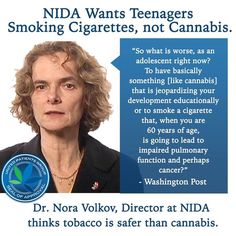
« Wait a second. ... Nicotine does not interfere with cognitive ability. So if you are an adolescent and you are smoking marijuana and going to school, it’s going to interfere with your capacity to learn. So what is worse, as an adolescent right now? To have basically something that is jeopardizing your development educationally or to smoke a cigarette that, when you are 60 years of age, is going to lead to impaired pulmonary function and perhaps cancer? ... I would argue that you do not want to mess with your cognitive capacity, that that is a very large price to pay. »​

Narurally she's proud to mention never having "inhaled" marihuana even once... At this point, her prohibitionist narrative has drifted so far beyond empirical science that it inspires me a succulent zoology exercise:
Nora-Volkov-The-myths-of-smoking-pot-(2014-Jun-24).jpg
Medulla‑Scavenger (Juvenis Mentis SiphoVorax)

Classification & morphology: In its mature state, the adult called Neuralis Masticus develops a hardened cranial carapace equipped with a fearsome parasitic appendage known as the Mediatic Rostrum Penetrans specialized in injection of tenacious larvae capable of metamorphosing the host’s cerebellum and eventually enabling deeper penetration into legislative tissue.

Habitat & Origin: unlike most parasitic organisms, the genesis of early Juvenis Mentis SiphoVorax specimens occurred in a clean sterile laboratory environment, quite possibly as an adaptation directly consecutive to the « War-on-Drugs ». This creature’s seed typically incubates in nutrient‑rich politician substrates best suited for accelerated cloning.

Reproductive Behaviour: the virulent strain has evolved to exploit human chemistry, using cannabinoïds as a catalytic vector which allows it to thrive in diverse situations, e.g. even hermetic christian-based communities where clandestine copulatory behaviour sustains hasty propagation most efficiently. It feeds preferentially on individuals under twenty‑five, exploiting their heightened hormonal flux.

Predation Pattern: the most lethal form of this pathogen grows best on a substrate of ambiguity, public uncertainty, and institutional inertia. It flourishes wherever rational nuance is scarce and moral panic has ripened into readily harvestable muscle.

Containment Protocol: official containment strategies failed miserably, starting with flavor neutralization. Statistical data actually reveal migrations of fresh gore sludge-slurping infectious agents of remarkable resilience (code-named eVALI)... These went unchecked and proliferated uncontrollably; well informed critics note that successive confrontational policies merely echoed the pressure of mis-placed concerns for public image. Independent analysts emphasize an urgent need for evidence‑driven guidelines to remedy broken decision‑making in the oval orifice. Meanwhile, the ban on gustatory stimuli triggered compensatory metabolic responses in Neuralis Masticus, exactly as predicted by Nobel recipients! In short, the void left by malignant federal procedurite created the ideal transmission environment where repeated Public Health guesswork mutated into administrative, epistemic and entirely preventable hazards - rather than classic phenomenons normally curable with a « T-Break » in severe cases, or a banal « couch-lock » otherwise...

A couple years later at the CSAM/SMCA 1st symposium on addiction the turn of québekers came, in my $a¢rifi¢ed province. Justin Trudeau had been in Ottawa for 1 year and the Colorado experience was supposed to "teach" us lessons - dare look where they are today then compare:
Nora-Volkov-at-ADDICTION-symposium-in-hotel-Marriott-Mtl-Radio-Canada-(2016-Oct)-440x260.png
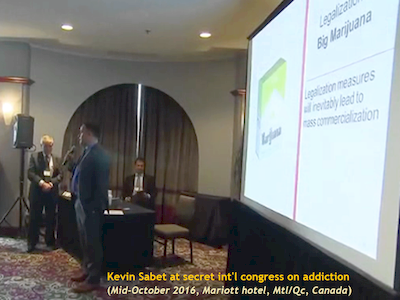
Kevin_Sabet_at_secret_Int_l_Montr_al_congress_on_addiction_2016.png
Légalisation de la marijuana: des experts américains mettent en garde le Canada (2016-Oct-26)​

By then, the prohibitionist pathogen had spread its spores northward. Notice her tense combative face, while another most confrontational ally named Kevin Sabet was also present nearby. Both U.S. emissaries had been invited as int'l guests and quite probably ushered by Jean-Pierre Chiasson sitting in the 1st chair of the front row. They had come to the Marriott hoping to mesmerize our political class through dozens of addictionnists, all conveniently gathered to enjoy Halloween tourism in downtown Montréal - their favourite kind of petri dish.

Contrary to their alarmist prophecies imported from Calgary/Alberta, the real cost of skimping on honesty and respect is now paid by our local youth. This became evident at the 26th "Journées Annuelles de Santé Publique" (JASP), held at the Québec City Convention Centre on November 28, 7 years later in room 307AB:

'L’évolution des modes d’usage du cannabis chez les adolescents'

Its data came from a longitudinal survey targeting 42 secondary schools across eastern Québec and benefited from infographics provided by La Presse, which exploited the image of a premium quality ~40 $Cdn Burn Lemon Haze vape without ever caring to mention its legal status:

Le vapotage de cannabis explose chez les ados (2023-Nov-28)​
« En quatre ans, la part de jeunes consommateurs ayant opté pour la vapoteuse a triplé »​

Several institutional partners were involved (INSPQ, ISAM), and we can safely bet such framing sounded quite familiar to american observers like Kamala Harris, who was heard invoking the very same themes in her interviews long ago (developing brain, impaired driving, redemption through abstinence re-hab)...

The persistence of topics ain't no coïncidence, it’s structural. Biden's administration could only initiate rescheduling through the HHS; the agency completed its review, issued recommendations then its cannabis reform stayed stalled much the same since this barrier's rise.

Trump’s executive order diverts attention like a roaring engine, but anyone watching the pedals can see the transmission is on neutral. So, all that symbolic choreography has performed was to generate exhaust and noise; too bad, but until the DEA decides to engage its gears every impression of forward motion remains an illusion of progress in a health‑wise direction:
Trump-signs-executive-order-to-reclassify-cannabis-(2025-Dec-18)-640x600.png

2026 will reveal whether it is Derek S. Maltz or Terrance Cole who must ultimately assume the agency’s direction.

Good day, have fun!! ☮️
 
Top