Deleted member 170540
Bluelight Crew
^ That looks like it could try to act as a substrate for aromatase and then destroy it by binding covalently due to that ketone-double bond arrangement.




N&PD Moderators: Skorpio
You are using an out of date browser. It may not display this or other websites correctly.
You should upgrade or use an alternative browser.
I Like to Draw Pictures of Random Molecules
Deleted member 170540
Bluelight Crew
^ That looks like it could try to act as a substrate for aromatase and then destroy it by binding covalently due to that ketone-double bond arrangement.

Deleted member 170540
Bluelight Crew
The N-demethylated metabolite of sertraline has only 5 times more affinity to SERT compared to DAT, but the affinities are so small that it's useless if it binds to plasma proteins in the same extent as sertraline.

The oxidized non-amine compound below is a dopamine reuptake inhibitor with IC50 = 20 nM. The missing amino group probably affects the amount of protein bound fraction, but not sure in which way. At least this would be easy to separate from amine impurities by extracting from low pH solution.


Non-amine-based dopamine transporter (reuptake) inhibitors retain properties of amine-based progenitors
Without exception, therapeutic and addictive drugs that produce their primary effects by blocking monoamine transporters in brain contain an amine nit…
www.sciencedirect.com

sekio
Bluelight Crew
That looks like it could try to act as a substrate for aromatase and then destroy it by binding covalently due to that ketone-double bond arrangement.


drugs like metandienone and chlordehydromethyltestosterone also have the dienone moiety and yet are not aromatase inhibitors, indeed metadienone is aromatized to 17-methylestradiol.
The fully hydrogenated analogue is also known. but not documented as to its pharmacology. I would call it 16-oxa-androsta-3,17-dione.
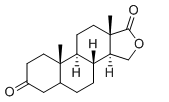
The oxidized non-amine compound below is a dopamine reuptake inhibitor with IC50 = 20 nM.
are there any other non-amine DAT substrates? Maybe one of these, based on fencamfamine/phenmetrazine/RTI-xx?
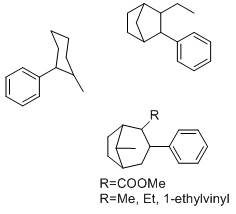
I seem to recall there is - there's also JWH171/176 which are fully hydrocarbon cannabinoid ligands.

RTI-371 is apparently a cannabinoid allosteric modulator, as well as DAT inhibitor like you'd expect from its tropane nature, and displays no locomotor stimulant activity in mice(!?).
 Last edited:

Nagelfar
Bluelight Crew
Yes there are phenyltropanes with the nitrogen replaced with an oxygen, a whole series of them in fact.
As for the lack of locomotor stimulation, maybe that *has to do* with the cannabinoid modulation.
It's funny how 4-FA had no dipeptyl peptidase IV activity whatsoever but adding a fluoro on the 5,4 - 3,5 - 2,4 gives it a sugar-blood lowering trough incretin inhibition effect that makes 3,4 fluoroamphetamine, despite its almost identical pharmacodynamics to 4-FA, maybe even better , a no-go IMO as a replacement for 4-FA, unless you like to see psycho sugar deprived tweaks at festivals.. It's a shame
Deleted member 170540
Bluelight Crew
are there any other non-amine DAT substrates? Maybe one of these, based on fencamfamine/phenmetrazine/RTI-xx?
I seem to recall there is - there's also JWH171/176 which are fully hydrocarbon cannabinoid ligands.
RTI-371 is apparently a cannabinoid allosteric modulator, as well as DAT inhibitor like you'd expect from its tropane nature, and displays no locomotor stimulant activity in mice(!?).
The article I linked also describes a non-amine methylphenidate and some kind of non-amine tropane compound. I had seen that article many times before but for some reason I hadn't noticed that it's actually sertraline that one of those non-amines was derived from. A tranylcypromine derivative 1-(3,4-dichlorophenyl)-2-hydroxycyclopropane is something I'd be curious to see.
Some DAT inhibitors don't have any obvious locomotor stimulant effects, presumably because they don't tend to cause any wrong-direction flow of dopamine through the transporter.
That full hydrocarbon cannabinoid is interesting, maybe some of the terpene type benzodiazepine binding site ligands are also hydrocarbons. A hydrocarbon opioid wouldn't be completely unbelievable either, but with 5-HT2A psychedelics the SAR is so restrictive that you probably can't even replace the nitrogen with oxygen and have it retain any activity. There aren't really many hydrocarbons found in active ingredients of present-day pharmaceuticals, unless you count paraffinum liquidum and cyclopropane (still used as general anesthetic somewhere, I think).
And by the way, Nagelfar, if you have difficulty using ChemDraw like apps on your phone, it's possible to get a mouse cursor on phone screen with a Bluetooth mouse or with some kind of USB-microUSB adapter cable:

How to Connect a Mouse, Keyboard, or Controller to Android
It's a breeze to connect accessories to your Android device.
 www.howtogeek.com
Last edited:
www.howtogeek.com
Last edited:
Nagelfar
Bluelight Crew
Thank you polymath, I'll look into that. In the meantime I've been looking into a cheap laptop.
Nagelfar
Bluelight Crew
Here's a sans-screensshot question. Can two overlapping arene rings be made between two sulfurs?
Deleted member 170540
Bluelight Crew
Here's a sans-screensshot question. Can two overlapping arene rings be made between two sulfurs?
I'm not sure what you mean by "overlapping", but it's even possible to make cyclic compounds that have a mechanical chemical bond with interlocked ring structures, as in the image.
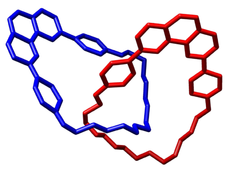
Those molecules are called catenanes. I'm not sure if it's possible with some kind of large aromatic ring (6 carbons is too small for this).
Nagelfar
Bluelight Crew
I have a screenshot on my phone but can't upload, it's just two sulfurs with three methylene units between, four bonds to each sulurs, and each sulfur at the 1 and 4 position of two arene rings overlapping in 3D and completely covering each other in 2D
i.e. both 1 and 4 position are for the same arene.
sekio
Bluelight Crew
https://imgur.com/upload maybe. Or use SMILES if you can figure that out. I have a feeling you're talking about some disgusting hypervalent knot of bonds that would make the atoms cry out in steric pain.
You probably don't mean this:
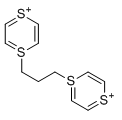
(joke: you fail @ describing strucures  )
)
also, AFAIK sulfur does not bond to more than 2 carbons, that is there are no quaternary S centers with 4 seperate C bonded to them. so "no" is my answer
tetrasulfur tetranitride is pretty cool though.
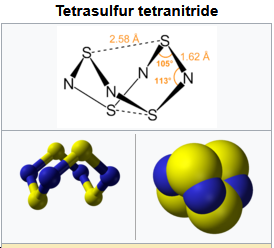 Last edited:
Nagelfar
Bluelight Crew
I'll have to make it to the library. But if it links to no more than two carbons, I'll have to try something else. Mostly oxygens then? What if it was two nitrogen heteroatoms next to each sulfur on one side. Again have an image soon (trying to make a ball rather than a circle arene but with only two dimensional additions)
Last edited:
sekio
Bluelight Crew
Try your best to draw it in ASCII text and I can replace it with a chemdraw image.
edit: a "ball arene?" so two benzene rings superimposed on each other, with one rotated 90 degrees so the apexes of the hexagons are shared? like barrelane?
proposed:
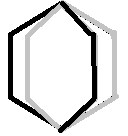
barrelane:

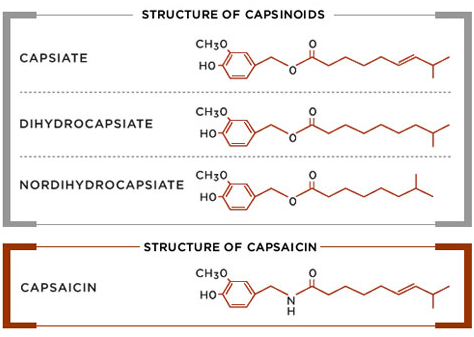
"Capsinoids", ester analogs of capsacin and its family. These are still TRPV1 agonists but do not manage to make it to the TRPV1 receptors in your oral mucosa (somehow) so they don't taste spicy but still produce systemic effects (vasodilation, probably pain relief)
Last edited:
Deleted member 170540
Bluelight Crew
If you're able to draw molecules in swisstargetprediction.ch with your phone, it will immediately tell the SMILES code for the chemical structure you drew and you can write it on paper and post here.
sekio
Bluelight Crew
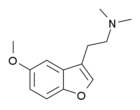
Oh, re: non-nitrogen drugs, dimembfe is a close one (benzofuran analog of 5-meo-dmt) but still has that tail N.
Nagelfar
Bluelight Crew
Very similar, where the gray and black meet at points, sulfur, then one of each out from sulfur, nitrogen twice. At least that was my original thinking, so there is as many double bonds as two arenes.
Though that tetrasulfur you gave is nice looking.
sekio
Bluelight Crew
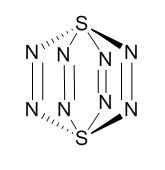
I don't think you can do that. Sulfur is only hypervalent with oxygen or itself (as double bonded ligands) and can only have 2 sigma bonded groups on it. Also, it's gotta be tetrahedral - VSEPR doesn't like having all 4 groups jammed onto one "face" of the atom. Now, swap sulfur and nitrogen, and reduce the symmetry to 3-way rather than 4-way, and maybe...
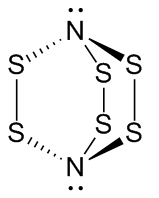
"dinitrogen(III) hexasulfide" or N2S6
This might actually work, though I have a feeling it may be unstable...
even worse, the disulfide (c.f. amine oxide)
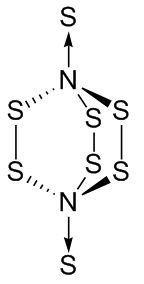
N2S8, I bet you money this will want to go to N2 and S8 if possible.
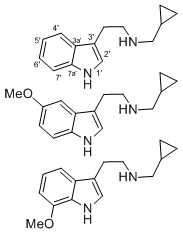
(Indole carbons numbered for posterity)
Shulgin mentions these are MAOIs - N-cyclopropylmethyl-tryptamine and its 5' and 7' methoxy relatives.
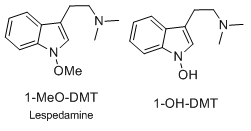
Lespedamine, or 1-MeO-DMT - named because it was isolated from Lespedeza bicolor or "shrubby bushclover" - and its demethylated homolog 1-OH-DMT. The former is an interesting N-methylhydroxylamine analog of DMT. Unknown activity in humans as of yet. Both compounds have similar SwissTargetPrediction results: most likely binding sites being 5-HT2a/b/c, 5-HT1a, SERT, and DAT. (For what it's worth, the predictions have low "probability", which I assume prediction accuracy of the model? STP results seem to be what the "cool kids" are using these days so I figured I'd try doing it too.)
STP results for 1-MeO-DMT
STP results for 1-OH-DMT
Last edited:
My latest discoveries, no images jusqu'à nouvel ordre, just smiles:
NC1CCCC1C1=CC=CC=C1
CC(N)CC1CCCCC1C1=CC=CC=C1
COC1=CC2=C(NC=C2C2CCCC2N)C=C1
CN(C)C1CCCC1C1=CNC2=C1C=CC=C2
O=C(C1CCCN1)C1=CC=CC=C1
CC1CCNC1C(=O)C1=CC=C(C)C=C1
Gaffy
Deleted member 170540
Bluelight Crew
even worse, the disulfide (c.f. amine oxide)
N2S8, I bet you money this will want to go to N2 and S8 if possible.
And possibly do that explosively, like these difficult-to-make unstable nitrogen allotropes.

Octaazacubane - Wikipedia
en.wikipedia.org
 This one seems like my favorite, most novel:
SwissTargetPrediction
 swisstargetprediction.ch
