
sekio
Bluelight Crew
Tetrabenazine and reserpine?




N&PD Moderators: Skorpio
You are using an out of date browser. It may not display this or other websites correctly.
You should upgrade or use an alternative browser.
The Big and Bangin' Pseudo-Advanced Drug Chemistry, Pharmacology and More Thread, V.2
sekio
Bluelight Crew
Tetrabenazine and reserpine?



ebola?
Bluelight Crew
whoops: was I thinking of VMAT2 substrates instead?
ebola
ebola?
Bluelight Crew
useful chart:

I'm wondering, though, if it's missing pertinent intracellular processes involving the NMDA receptor...
ebola

pharmakos
Bluelighter
hare-brained, likely underinformed thought:
would it be possible to create a drug test for hallucinogens as a broad class via testing for downstream biochemical reactions? (perhaps arachidonic acid levels or some such)
what would the moral and philosophical ramifications of such a test be?
pharmakos
Bluelighter
^ perhaps better left unexplored, i suppose.
new question:

this common food coloring^, Red #40 aka Allura Red AC, has been linked to hyperactivity and attention deficit disorder in children. any theories as to the mechanism of action that causes those effects?
endotropic
Bluelight Crew
hare-brained, likely underinformed thought:
would it be possible to create a drug test for hallucinogens as a broad class via testing for downstream biochemical reactions? (perhaps arachidonic acid levels or some such)
what would the moral and philosophical ramifications of such a test be?
You're thinking of a blood test or something? Probably not possible, hallucinogens have such pharmacologyically diverse mechanisms that the downstream signaling won't match up from class to class. If there is some downstream biochemical event that occurs with every hallucinogen, it's probably localized to one brain region, and the effect would be too small to detect in the blood.
I bet someone could devise an fMRI based test that would identify hallucinating people, but that wouldn't really be useful for anything.
You're thinking of a blood test or something? Probably not possible, hallucinogens have such pharmacologyically diverse mechanisms that the downstream signaling won't match up from class to class. If there is some downstream biochemical event that occurs with every hallucinogen, it's probably localized to one brain region, and the effect would be too small to detect in the blood.
I bet someone could devise an fMRI based test that would identify hallucinating people, but that wouldn't really be useful for anything.
for classical psychedelics you could theoretically measure the second messenger responses in a cell culture population expressing the 5-ht2a receptor, but it would obviously take too long and be too labour-intensive, equipement-intensive and expensive for practical use. besides the person you want to test would in all likelyhood be a lifeless and most of all blood-less husk if you want to gather enough material for this test to work (given current methods).
sekio
Bluelight Crew
this common food coloring^, Red #40 aka Allura Red AC, has been linked to hyperactivity and attention deficit disorder in children. any theories as to the mechanism of action that causes those effects?
Food dyes in general are bogeymen because downstream metabolites could include shit like anilines and benzidines that are, well, not good.
pharmakos
Bluelighter
^ yeah seems like it
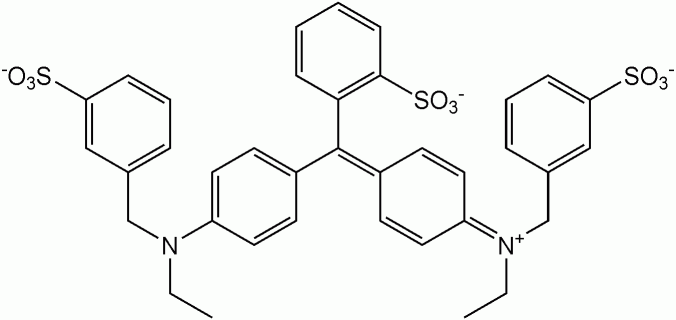
i was looking at some other food colorings.... Blue #1 here looked like it could potentially have some active metabolites to me:
sekio
Bluelight Crew
Those sulfonate groups decrease the likelihood of anything actually crossing the BBB much; they are charged at physiological pH and only become nonpolar in acidic media.
Realistically, there are lots of outright crazy wierd structures in artificial colors. Tartrazine and erythrosine are some of my faves.
Last edited:

vortech
Bluelighter
I'm confused why there is still so much confusion about the pharmacological actions of Methoxetamine. After this binding data was made public (http://www.bluelight.org/vb/threads/649843-Binding-data-for-popular-arylcyclohexamines/) people were scratching their heads because most had thought that it increased levels of dopamine in the brain, yet this binding data shows that there isn't any action that directly releases or inhibits dopamine reuptake. Is there some other way that it could increase dopamine levels? Maybe it only has an action at higher doses and this was tested with low doses? People were saying the same with the mu opioid affinity, that according to this it doesn't have an affinity, but maybe it does at higher doses (at least may be the case for ketamine).
Any clarification would be appreciated! Up until today I had thought MXE has DRI properties.
sekio
Bluelight Crew
I'm confused why there is still so much confusion about the pharmacological actions of Methoxetamine.
Conformation bias.
I for one trust the ECMD numbers pretty well.
endotropic
Bluelight Crew
I'm confused why there is still so much confusion about the pharmacological actions of Methoxetamine. After this binding data was made public (http://www.bluelight.org/vb/threads/649843-Binding-data-for-popular-arylcyclohexamines/) people were scratching their heads because most had thought that it increased levels of dopamine in the brain, yet this binding data shows that there isn't any action that directly releases or inhibits dopamine reuptake. Is there some other way that it could increase dopamine levels? Maybe it only has an action at higher doses and this was tested with low doses? People were saying the same with the mu opioid affinity, that according to this it doesn't have an affinity, but maybe it does at higher doses (at least may be the case for ketamine).
Any clarification would be appreciated! Up until today I had thought MXE has DRI properties.
Based on that evidence, we don't know whether MXE increases dopamine levels in the brain or not. All that we can say is that MXE doesn't increase dopamine levels by inhibiting the dopamine reuptake transporter. Or in other words we could say that MXE doesn't DIRECTLY increase dopamine levels.
There are plenty of INDIRECT ways that MXE could increase dopamine levels, none of which are ruled out by binding data. For example antagonism of NMDA receptors on GABAergic interneurons connected to the dopamine system could disinhibit dopamine release. In all likelihood the interaction is much more complicated than that. Here's a couple of reviews on the interaction between Glutamate and Dopamine signaling:
http://www.ncbi.nlm.nih.gov/pubmed/24735820
http://www.ncbi.nlm.nih.gov/pubmed/22763587
http://www.ncbi.nlm.nih.gov/pubmed/24409148
Also keep in mind, with the possible exception of 5-HT2A psychedelics, every single recreational drug increases striatal dopamine levels, and only a small proportion of those do so through a direct mechanism (see the 3rd review posted above). With that in mind it would be incredibly strange if MXE didn't increase dopamine levels in the brain, considering how readily people take it.
vortech
Bluelighter
Thank you endotropic, that's exactly the information I was looking for.
I was also just reading this article on PCP http://www.ncbi.nlm.nih.gov/pmc/articles/PMC2859735/ and read that PCP increases dopamine and norepinephrine production by stimulating tyrosine hydroxylase, so I am seeing the other ways in which drugs can increase neurotransmitter levels.
endotropic
Bluelight Crew
^ That's really interesting about PCP, tyrosine hydroxylase is one step I never would have even considered for an interaction!
edit: I decided to go back and read more about PCP and tyrosine hydroxylase so I did some reading and found this:
Phencyclidine: behavioral and biochemical evidence supporting a role for dopamine.
They claim that PCP's stimulatory effect on tyrosine hydroxylase is indirect, a consequence of its dopamine reuptake inhibition. Other dopamine reuptake inhibitors share this effect, while drugs like MXE without dopamine reuptake inhibition don't affect TH like this.
Last edited:
BallsStapledToLeg
Greenlighter
Is anyone aware of studies covering different pharmacokinetics or dynamics of drugs (more specifically MDMA) in Native American populations? I swear every time I hear of a case of massive acute MDMA toxicity in my region it seems to consistently be an aboriginal female. Any info or educated conjecture would be appreciated
Thanks,
Balls
endotropic
Bluelight Crew
Is anyone aware of studies covering different pharmacokinetics or dynamics of drugs (more specifically MDMA) in Native American populations? I swear every time I hear of a case of massive acute MDMA toxicity in my region it seems to consistently be an aboriginal female. Any info or educated conjecture would be appreciated
Thanks,
Balls
Off the top of my head I could probably point you towards a dozen studies showing increased incidence of drug use amongst Native Americans in the US, but I haven't seen anything like you're asking about specifically for MDMA. Take a look at these though (especially the last):
Prevalence of CYP2C19 variant alleles and pharmacodynamic variability of aspirin and clopidogrel in Native Americans.
Pharmacogenetics in American Indian populations: analysis of CYP2D6, CYP3A4, CYP3A5, and CYP2C9 in the Confederated Salish and Kootenai Tribes.
Evidence for a genetic component for substance dependence in Native Americans.
Moving you in the right direction I hope  hello chemistry people hopefully. could someone explain the difference and differing affects of [FONT=黑]C18H21NO4 [/FONT]Boc-3-(2-naphthyl)-D-alanine, CAS:[FONT=黑]76985-10-9[/FONT][FONT=arial, 宋体, sans-serif] and the oxycodone pills people receive for pain? if any. thanks. [/FONT]
ebola?
Bluelight Crew
What? Can you explain how they're similar?
ebola
endotropic
Bluelight Crew
hello chemistry people hopefully. could someone explain the difference and differing affects of [FONT=黑]C18H21NO4 [/FONT]Boc-3-(2-naphthyl)-D-alanine, CAS:[FONT=黑]76985-10-9[/FONT][FONT=arial, 宋体, sans-serif] and the oxycodone pills people receive for pain? if any. thanks. [/FONT]
The real question is, what makes you think they should have any similarity? The chemical you mentioned is totally unknown (best I can tell) and the chemical structure is nothing like oxycodone.
