• N&PD Moderators: Skorpio

Working Out The Stereochemistry Of (+)-N-(1-hydroxyethyl)-lysergamide

Morninggloryseed

Bluelight Crew
Joined
Aug 22, 2000
Messages
13,770
Location
Semi Retired
attachment.php


It is interesting because the enzyme that produces the ethyl group on this amide could (in theory) also produce two ethyl groups there (giving us LSD-25.)

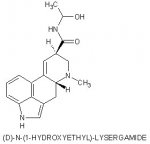
I am in the process of putting together a little page on naturally occuing (and active) lysergamides and I wish to make sure I am drawing them correctly. I can only find one representation of this molecule, in a report called "Ergot Alkaloids" by Hans Kobel and Jean-Jacques Sanglier.

This alkaloid has three chiral centers. Kobel and Sanglier show the usual stereocenters at C5 and C8, but do not give any indications as to the chirality of the 1-hydroxy group on the N-ethyl chain. So, can I assume the N-(1-hydroxyethyl) group is (+/-)?

Help!
 

Attachments

  • n-(1-hydroxyethyl)-lysergamide.jpg
    n-(1-hydroxyethyl)-lysergamide.jpg
    12.1 KB · Views: 664
Last edited:
Ok, found a reference for this.......................Glasser, A. 1961. Some pharmacological actions of D-lysergic acid methyl carbinolamide. Nature 189, 313

D-lysergic acid methyl carbinolamide is another name for D-lysergic acid 1-hydroxyethylamide. Who can be an angel and wants to send me copies of this journal. I'll pay ya.
 
This (the enzymatic metabolism to LSD) reminds me of a thesis paper I once had read about genetic modification of yeast to produce psilocybin (but I don't think the author ever actually was able to produce psilocybin yielding yeast). There was a big thread at the-h***.ws about this too. Maybe with a little tweaking it could be done to our advantage here?
 
1-hydroxyethylamides are not going to be stable compounds (a bit like having two hydroxy groups on the same carbon atoms a nitrogen and oxygen attached to a carbon in a non-cyclic structure is going to be subject to forming a ketone and an amide/amine) The 1-hydroxy - could it refer to the 1 position of the LSD molecule ie. the indolic nitrogen? if not, the only place on the ethyl group where it would be stable would be on the 2 position (which isn't chiral, so back to 2 chiral centres, which are correct on the diagram you gave).

If the OH group is on the indolic nitrogen, the name would be:

(D)-1-hydroxy-N-ethyllysergamide

on the amide substituent:

(D)-N-(2-hydroxyethyl)lysergamide.
 
Last edited:
I have since found two other representations of this molecule, each with the group on the amide substituent...Each showed it exactly as I have drawn it here...with a hydroxy on the alpha position of the N-ethyl group, not hanging off the end. A higher homologue is ergonovine (or ergometrine), which has a 1-hydroxymethyl-N-ethyl group.

I'm very confused as to why the N-(1-hydroxyethyl)amine group is not chiral. There are four different groups attached to the first carbon of the N-ethyl group...The 1-hydroxy, a hydrogen, the amine, and the beta carbon. I was under the impression that this would make it chiral.
 
Last edited:
Some Pharmacological Actions of D-lysergic acid methyl carbinaolamide
Glasser, A
Nature 1961 189:313-314

D-lysergic acid methyl carbinaolamide, C(18)H(21)N(3)O(2), is a new alkaloid produced by a strain of Claviceps Paspali Stewens and Hall. Arcamone, Bonino, Chain, Ferretti, Pennella, Tonolo and Vero (1) isolated the new alkaloid from submerged cultures and determined its structure. I have now investigated some of the pharmacological actions of the new alklaoids.
D-Lysergic acid methyl carbinolamide was kindly supplied to me by Prof. E. B. Chain. Freshly prepared aqueous solutions of the maleate salt (C(18)H(21)N(3)O(2).C(4)H(4)O(4)) were used in my experiments.
The intravenous LD50 of the new alkaloid was approximately 150mgm./kgm for mice and 0.75 mgm./kgm. for rabits/ Before death, the mice showed periodic convulsions of a clonic type, erection of the hairs and excitability. At doses of 50-100mgm./kgm. it produced only this peculiar symptomatology: the mice stood upright and pressed on each other's noses and chattered their teeth. In rabbits, and injection into the ear vein in doses of 0.1-1mgm./kgm. produced dilatation of the pupil, excitability or convulsions of a clinic type. The ears became pale and cold with intense vaso-constirction. The toxicity of the alkaloid to rabbits seemed to depend on its power of raising the body-temperature in this species. In rabbits the similarity between the effects of the new alkaloid and ergometrine were particularly striking, but ergometrine was less toxic to rabbits (the approximate intravenous LD50 of ergometrine was 3.5mgm./kgm.).
D-lysergic acid methyl carbinolamide induced, in low concentrations (minimum active concentration 0.1-1µgm./ml.), a contracture in the isolated uterus of the virgen guinea pig. There was a satisfactory dose/response relationship. Tgus contracture was very similar to that produced by ergmetrine maleate, which, however, was 1-2 times more potent.
On the rabbit uterus in situ both alkaloids produced a prompt contraction and increased rhythmic activity of the uterus. For ergometrine the minimum active dose by intravenous route was 0.1-0.3 mgm./kgm. and for the new alkaloid 0.2-0.5mgm./kgm. The actions of both alkaloids lasted some minutes, and owing to the favourable circumstance that the interference between the effects of the two alkaloids was negligible, it was possible to test them on the same preparation. Ergometrine was 1-2 times more potent than the new alkaloid.
On the isolated seminal vesicles of the guinea puig, the new alkaloid was approximately 200 times less potent than ergotamine tartrate as an adrenergic blocking drug.
Rabbits anaethetized with urethane supported doses of D-lysertgic acid methyl carbinolamide which would have killed unanaesthetized animals. Rapid intravenous injections of small doses (0.1-0.2mgm./kgm.) of the new alkaloid caused an evanescent decrease or a small increase of blood pressure; with higher doses (0.3/0.5mgm./kgm. and more) the blood pressure increased moderately without showing any dose/response relationship. Ergometrine maleate seemed to be less active on bloodpressure, and there was no significant change of blood pressure with 0.3-0.5 mgm./kgm.
The new alkaloid was without effect, when given in small doses, on the blood pressure of cats anaethetized with chloralose. Higher intravenous doses (0.1-0.3mgm./kgm.) caused a sustained hypotension of long duration and a moderate decrease of heart-rate. The respiration of rabbits and cats was depressed by small doses of the new alkaloid; cats seemed to be less resistant than rabbits. In cats, 0.01mgm./kgm. of the new alkaloid caused broncho-constriction and contractions of the nictitating membrane of long duration.
The new alkaloid have no action on isolated rabbit auricles at doses up to 100µgm./ml.
In summing up, the new naturally occuring alkaloid D-lysergic acid methyl carbinolamide has powerful ergometrine-like oxytocic action and weak ergotamine-like adrenergic blocking actions. It must be included, on the basis of pharmacological evidence, in the ergometrine group of ergot alkaloids. Ergometrine, however, is less toxic and more active than the new alkaloid. Some of my results suggest that it could have a lysergic acid diethylamide-like activity, but this hypothesis must be checked by experiments on humans.
Full details of this work will be published elsewhere.

 
Now the question is...can ergonovine-like activity in the uterus, vaso-constriction be in any way correlated to psychedelic activity? I personally think not...but fun to speculate.

Ergonovine (ergometrine) is a weak psychedelic at 2mg to 10mg...and produces some mildly to moderately uncomfortable body symptoms (which remind one of morning glory seeds.) This one is more potent than ergonovine with regards to bloodpressure, uterine contractions, and vaso-constriction properties. Does that mean (D)-N-(1-hydroxyethyl)-lysergamide is also a more potent psychedelic than ergonovine...perhaps active at 1mg to 5mg? Who knows! But fun to ponder on. Knowing these questions will further solve the riddle as to what in morning glory seeds causes the psychedelic action. Certainly D-lysergamide and D-isolysergamide are not responsible for most of the effects...at least if one judges by the few reports that exist on these pure amides.

Oh, anyone want to take a stab at this...which I accidently posted under WV's screen name...

I'm very confused as to why the N-(1-hydroxyethyl)amine group is not chiral. There are four different groups attached to the first carbon of the N-ethyl group...The 1-hydroxy, a hydrogen, the amide, and the beta carbon. I was under the impression that this would make it chiral.
 
^^ dont know which center you mean
can you pinpoint it out in the figure? would make it a bit clearer maybe.
 
I'm still having problems with the parent amine that forms the amide; you don't get 1-aminoethanol (aka 1-hydroxyethylamine), because it would decompose into ethanal (acetaldehyde) and ammonia v. quickly for the same reasons that 1,1-dihydroxyethane spontaneously decomposes into acetaldehyde and water. ans aminocarbinol would just be formaldehyde and ammonia. AFAIK, the only stable aldehyde hydrates (or similar with ammonia) are ones with a bif fuch off group like trichloromethyl attached directly ro the carboxyl carbon (as in chloral hydrate)
 
Take a look at ergonovine (ergometrine) as it is the same structure I have represented...but has a methyl in front of the hydroxy...so N-(1-hydroxymethyl)ethyl (or N-(2-hydroxy-1-methyl)ethyl if you wish) instead. I am sure that I have represented it correctly...and I have seen it drawn as I have it now in three seperate publishings.
 
Last edited:
ksi said:
^^ dont know which center you mean
can you pinpoint it out in the figure? would make it a bit clearer maybe.

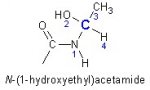
Well I am mainly picking up chemistry from here, and chem links off the web. Maybe my understanding of a chiral center is off. I thought it was a carbon surrounded by four different groups.

attachment.php


The carbon (in blue) has four different groups around it. If that is not a chiral center...what is? Help advance a brotha's knowledge further. :)
 

Attachments

  • 1-hydroxyethylacetamide.jpg
    1-hydroxyethylacetamide.jpg
    6.5 KB · Views: 391
With ergonovine, the nitrogen and oxygen are part of a ring structure, so the oxygen is present as an ether linkage, not a free hydroxyl group; it's the free hydroxy group that's giving me all the problems (if you want an understanding of the nature of these sort of compounds, have a look at the organic chemistry of sugars). If the oxygen atom had been part of say, a tetrahydrofuryl ring, then it wouldn't have been a problem.

See attached jpg of ergonovine (ergometrine)
 
Last edited:
The file you attached is for ergotamine, not ergonovine. Ergotamine is (obviously) not a lysergamide. A simple google image search on ergonovine or ergometrine will show the structure, and one can also find the structure that this thread is about. I am confident I am representing it correctly, but if I am wrong I would love to know what is right so I can learn even further. :)

And again, I ask is the carbon here a chiral center?
 
I don't see why N-(1-hydroxyalkyl)amide should necessarily be unstable. Sure 1-aminoethanol would be unstable, hell I'm sure it only exists as a transition state between acetaldehyde and ethylimine. But amide reactivity is quite different from amine reactivity. I really can't see any good mechanism that would lead to an appreciable breakdown into the unsubstituted lysergamide and acetaldehyde.
 
Now the question is...can ergonovine-like activity in the uterus, vaso-constriction be in any way correlated to psychedelic activity? I personally think not...but fun to speculate.
If I was more awsome at old school pharmacological preps then I'd be able to geuss...

I'm pretty sure the vasoconstriction is 5-HT2 receptor mediated, no idea about the uterus contractions...
 
Ergotamine is (obviously) not a lysergamide

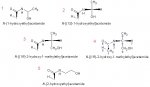
I'm afraid it is. The amide functional group is characterized by a C=O group bound to a nitrogen atom (see attached jpeg). I did post a pic of the wrong molecule, but after finding the correct one, it doesn't contain a carbon atom directly attached to a nitrogen and oxygen atom.

It's not helped by the fact that the original structure you posted is given, but the nomenclature doesn't match the molecule represented (again see att jpeg). The nomenclature is for a compound with the structure N-CH2-CH2-OH, as opposed to N-CHOH-CH3


PS Ergot alkaloids cause vasoconstriction due to alpha-adrenergic activity; nowt to do with the 5HT2a receptor
 
Last edited:
^ Yeah but if it was alpha then it wouldn't it have causes a big increase in blood pressure in anaethitized cats?
 
Ergotamine is (obviously) not a lysergamide.........I'm afraid it is.

There is an amide group in ergotamine...but I have always seen ergotamide considered an "ergopeptide" and never refered to as a simple lysergamide. But nomenclature is not my speciality.

it doesn't contain a carbon atom directly attached to a nitrogen and oxygen atom.

In ergonovine...no...there no carbon attached to an oxygen and a nitrogen. But in D)-N-(1-hydroxyethyl)-lysergamide there is.

I am really confused then because (D)-N-(1-hydroxyethyl)-lysergamide is what is in morning glory seeds, and I have always seen the molecule represented as I have shown it here. Also, my chem program labels molecules automatically and it labeled what I have shown in #1 as "N-(1-hydroxyethyl)acetamide" and labeled #5, "N-(2-hydroxyethyl)acetamide."

attachment.php
 

Attachments

  • amide groups.jpg
    amide groups.jpg
    33.1 KB · Views: 341
Top