• Psychedelic Drugs Welcome Guest
    View threads about
    Posting RulesBluelight Rules
    PD's Best Threads Index
    Social ThreadSupport Bluelight
    Psychedelic Beginner's FAQ
  • PD Moderators: Esperighanto | JackARoe |

Wondering if it exists; 2C-MD

Mracid

Bluelighter
Joined
Jan 26, 2015
Messages
532
Location
CA
When I saw 2C-O and 2C-G-3, I thought hey is there any 2C-x that has a Methylenedioxy group attached at the 3-4 th carbon ring, you know like MDMA; Methylenedioxy-Methamphetamine. But instead it would be;

2,5-Dimethoxy-3,4-Methylenedioxyphenethylamine.

I't basically be 2C-G-3 with oxygene on the side of the pentagon.

If that substance exists I wonder what it does and if it doesnt I wonder if it's theoretically stable enough to be tested and searched. Would call it 2C-MD

 
Thanks ! What is actually funny is that I read Pihkal, but didnt make the link then.. lol
 
I wonder why they never tried to make this. The synthesis is fairly straightforward using parsley oil. 75 to 100mgs produced lsd like and spiritual effects. It sounds like a decent chemical that never has been thoroughly researched.
 
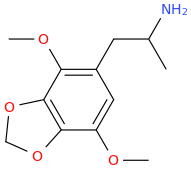
Parsley oil has too many substituted allyl benzene compounds of interest to be the first choice precursor for this I would think. I would suggest using Dill Apiole Essential Oil to get

1-(2,5-dimethoxy-3,4-methylenedioxyphenyl)-2-aminopropane.png


This has been done before, and 35mg did not produce any effect. Considering MMDA can take 300mg to get a decent trip, I would say these earlier experimenters most likely had their dosage level completely wrong. Also, this is the amphetamine version; the 2C version could be made from the essential oil too in a few more steps, but it would be a pain in the ass and likely less potent as well.
 
This family of Shulgin's creations can be a confusing sequence of M's and D's in the name. Sometimes the M stands for methoxy, sometimes for the methylene in methylenedioxy (MD) or methyl at the alpha.

The amphetamines end on A though, while the phenethylamines end on PEA like this:
https://www.erowid.org/library/books_online/pihkal/pihkal115.shtml

So I guess that would give the name DMMDPEA... but that is so long, maybe it is best to start describing it as an analogue of lophophine:

https://en.wikipedia.org/wiki/Lophophine

220px-Lophophine.png


None of this seems to be researched I guess, not even a clue whether 2,3,4,5-tetramethoxyphenethylamine has any activity...

although this does not sound too promising:
https://www.erowid.org/library/books_online/pihkal/pihkal145.shtml
 
Last edited:
how about 2,5-DIMETHOXY-3,4-METHYLENEDIOXYPHENETHYLAMINE. I cant seem to find it. its like 2,5-DIMETHOXY-3,4-METHYLENEDIOXYAMPHETAMINE minus the methyl group.
 
This family of Shulgin's creations can be a confusing sequence of M's and D's in the name. Sometimes the M stands for methoxy, sometimes for the methylene in methylenedioxy (MD) or methyl at the alpha.

The amphetamines end on A though, while the phenethylamines end on PEA like this:
https://www.erowid.org/library/books_online/pihkal/pihkal115.shtml

So I guess that would give the name DMMDPEA... but that is so long, maybe it is best to start describing it as an analogue of lophophine:

https://en.wikipedia.org/wiki/Lophophine

220px-Lophophine.png


None of this seems to be researched I guess, not even a clue whether 2,3,4,5-tetramethoxyphenethylamine has any activity...

although this does not sound too promising:
https://www.erowid.org/library/books_online/pihkal/pihkal145.shtml

This compound is in the Shulgin Index of Phenethyamines as 2C-DMMDA: https://isomerdesign.com/PiHKAL/explore.php?domain=pk&id=7860 . It has been tested in mice and frogs, and has similar effects as mescaline in frogs.
 
Top