




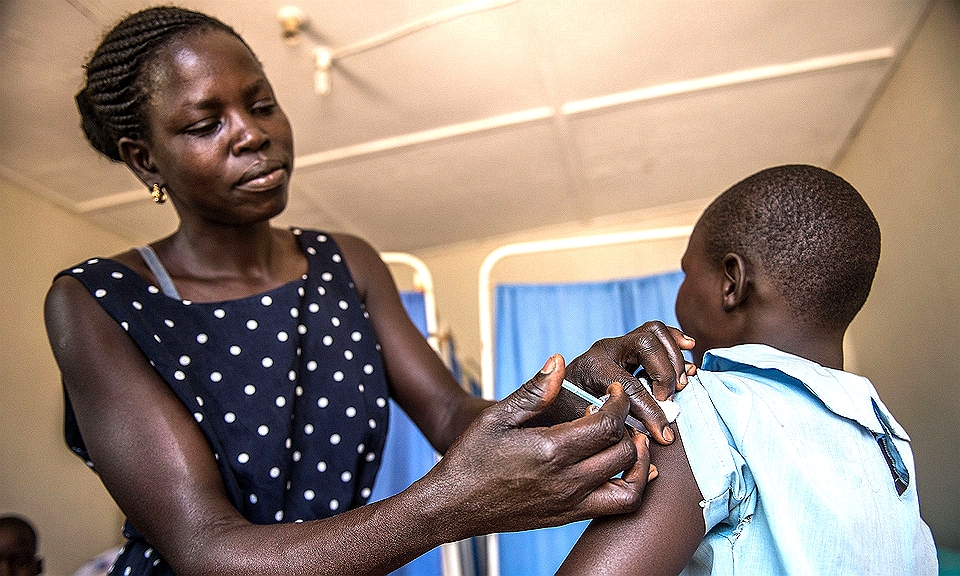
Evelyn Ayo, a vaccinator at the Reproductive Health Uganda clinic in Gulu, administers an HPV vaccine.
Women can be protected from cervical cancer – so why aren't we doing it?
by Nelly Mugo | The Guardian
Amid a global shortage of HPV vaccine, more must be done to steer supplies towards those most at risk: girls in poor countries.
For too many women, cervical cancer is a death sentence. But it doesn’t have to be. A life-saving preventative vaccine can dramatically cut cases and put the world on track to eliminate this deadly disease.
The UK first began offering a vaccine against HPV – the primary cause of cervical cancer – in 2008. According to a 2018 study by Public Health England, infections of certain cancer-causing types of HPV have since fallen by 86 percent among 16- to 21-year-old women. A study conducted in Scotland last year found that the vaccine reduced pre-cancerous cervical lesions by up to 90 percent.
But such impact has been largely confined to wealthy countries, where the vaccine is widely available. Today, 90 percent of all cervical cancer deaths around the world occur in developing countries, many of which have yet to introduce inoculation. Just 21 low-income countries have the vaccine.
While demand for the vaccine is high, efforts to roll it out in developing countries have been threatened by a global supply shortage. With limited doses available, millions of women and girls are left without protection against a largely preventable disease, simply because of where they live.
Last summer, the UK announced the expansion of their HPV vaccination programme to include boys. Other countries, including the US, Germany and Australia, have implemented similar policies. The US also recommends the vaccine for certain women up to 45.
Encouraging more people to get vaccinated is unquestionably a positive thing. But, in the context of a global shortage, expanding the population that receives inoculation could mean girls and women in poorer countries are left behind.
It should be noted that vaccinating girls against HPV protects boys too, through herd immunity: when enough girls in a community are protected, the virus can’t spread from person to person and everyone is safeguarded.
The effects of the vaccine shortage are compounded by lack of access to timely screening and treatment options in low- and middle-income countries. Reliable preventive care services to spot cancer early, like pap smears and visual inspection with acetic acid, are often unavailable. This can mean that cancer diagnoses are often made too late, if at all.
Even when cervical cancer is diagnosed, many areas do not have healthcare facilities with cancer specialists, or the equipment for treatments like radiation and chemotherapy. These services are also expensive, putting them out of reach for many. Without access to the HPV vaccine, girls and women in the regions of highest need are left without any tools to protect themselves.
In November, the World Health Organization’s strategic advisory group of immunisation experts recommended that all countries temporarily postpone the implementation of HPV vaccination strategies for boys and older age groups. The expert group also suggested that countries consider adopting a vaccination schedule where the second dose is administered three to five years after the first, as appropriate to the national context. Deferring the second dose for younger girls does not affect the vaccine’s effectiveness and will make more doses available now, when they are urgently needed.
Implementing these recommendations and steering vaccine supply toward countries at high risk could save hundreds of thousands of lives.
The HPV vaccine shortage has an end in sight – new manufacturers are entering the market and more doses will be available eventually, though probably not until 2024 at the earliest. But millions of girls should not have to wait years to receive the life-saving benefits of HPV vaccination.
To create a future where girls and women don’t have to bear the burden of cervical cancer, leaders need to take steps to ensure that the limited doses we have go to the regions where they can save the most lives. Countries must also invest in life-saving services like cervical cancer screening and treatment programmes that can protect women who haven’t received the vaccine.
If we take these actions, we’ll be sending a clear message that the lives of girls and women in poorer countries really are equal to those in rich ones.
From the article here: https://www.theguardian.com/global-...from-cervical-cancer-so-why-arent-we-doing-it
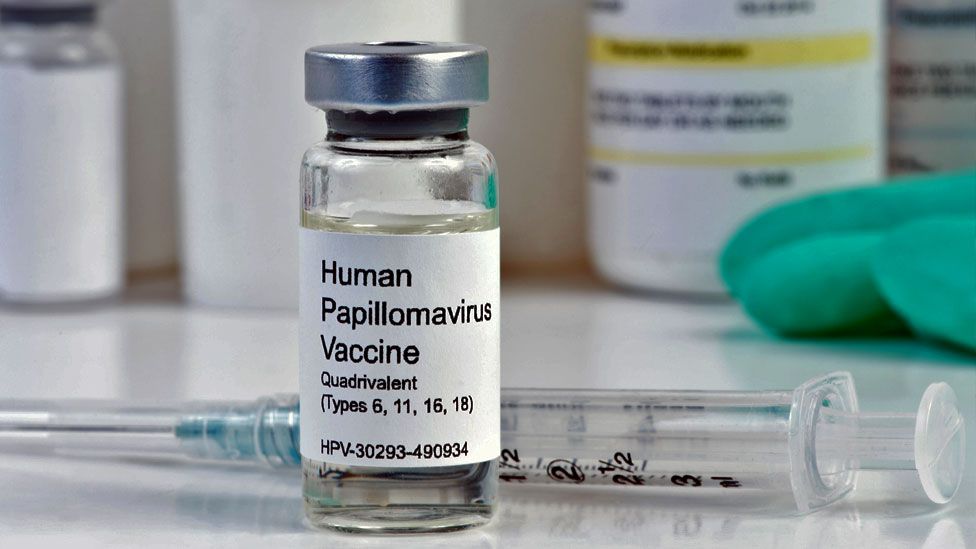
Drop in HPV seen after just one shot of HPV vaccine
by Will Boggs MD | Medscape | 30 Dec 2019
Even a single dose of human papillomavirus (HPV) vaccine is associated with a reduced prevalence of HPV infection among U.S. women, according to findings from the National Health and Nutritional Examination Survey.
"Getting adolescents to initiate their first dose should be a priority, with the goal that they will complete the recommended series," Dr. Ashish A. Deshmukh from UTHealth School of Public Health, in Houston, Texas, told Reuters Health by email. "Our findings are promising; however, they are not suggestive that only one dose is adequate until we get further definite answers from currently ongoing trials."
While about two-thirds of adolescents in the U.S. have received at least one dose of the HPV vaccine, only about half have completed the three-dose series.
Dr. Deshmukh's team used NHANES 2009 to 2016 data to investigate HPV-infection prevalence among U.S. women by the number of vaccine doses received.
Among the 1,620 women included in the study, 1,004 were unvaccinated, while 106 had received one dose, 126 had received two and 384 had received three.
The prevalence of infection with HPV 18 was significantly lower among women who received the vaccine than among unvaccinated women, the researchers reported.
The predicted probability of infection with these HPV types remained significantly higher in unvaccinated women (8 percent) than in women who received the vaccine.
The predicted probability of infection with these HPV types was significantly greater among black women (11 percent) than among white women (7 percent) and among women with more than five lifetime male sexual partners (12 percent) than among women with fewer lifetime male partners (3 percent).
"If a single dose of HPV vaccine could provide protection for a long-enough duration similar to currently recommended 2 or 3 doses, then receiving the vaccine will be a more achievable metric of population coverage," Dr. Deshmukh said. "The implication of our findings will be greater in low-resource countries where cervical cancer still remains one of the leading causes of cancer mortality."
"Yet, the HPV-vaccination coverage is extremely poor, as getting adolescents to receive their first dose itself is a big hurdle, and in many countries, as generally, there is not adequate infrastructure to provide the recommended vaccine series," he said.
Dr. Deshmukh added, "Continued and effective physician recommendation has a great potential to overcome the existing hurdles, mainly parental indecision about both vaccine initiation and completion."
Dr. Margaret Stanley of the University of Cambridge, in the UK, who has researched various aspects of HPV infection, told Reuters Health by email, "These observations should be placed in context with other studies, but my view is that the available evidence is that immunization with even 1 dose of HPV vaccine at high coverage over 80 percent of sexually naïve adolescents is protective against vaccine-type persistent HPV infection for at least 10 years. However, for policy changes and implementation of a 1-dose schedule, evidence from randomized controlled trials will be necessary."
"The name of the game is to get HPV vaccine into as many 9- to 15-year-old boys and girls as possible, even if it's only one dose," she said.
From the article here: https://www.medscape.com/viewarticl...CPEDIT_TEMP2&uac=341393BJ&impID=2278909&faf=1

