• N&PD Moderators: Skorpio

Why do different substituents on PEA "analogues" cause differing fx?

cyanide_sunshine

Greenlighter
Joined
Apr 26, 2008
Messages
9
PEA is a misnomer to an extent, but bear with me.

I've never tried adderall (or methamphetamine).

But I certainly have experienced ephedrine and pseudoephedrine, which don't cause alertness, but rather fatigue and high blood pressure. I note these are missing the amine.

Methylphenidate, which has a differing cyclic structure than most PEA, does not cause this in my experience, but has a similar MOA.

I understand this is a little below ADD. As well as anecdotal.
Won't be devastated if no one answers.

 
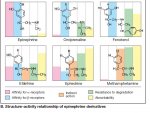
Both pseudoephedrine and ephredine have an amine (NH2) group, the difference is the beta-hydroxy group (which prevents blood-brain barrier penetration).

Methylphenidate is a norepinephrine and dopamine reuptake inhibitor while amphetamine is mostly a norepinephrine and dopamine releaser, and methamphetamine is a norepinephrine, dopamine and serotonin releaser. There differential effects on monoamines (and their preference ratios thereof) contribute to the unique human psychopharmacology of each drug.
 
Ephedrine etc directly interacts with noradrenergic receptors because of the beta hydroxy group. Replace the -OH witrh an -H and you've got methamphetamine, which is an indirectly acting drug. Changes in other areas alter the profile, such as replacing the N-methyl with an N-isopropyl, the latter being a lot more active as an anti-asthmatic.


If you haven't tried it yet, type "structure activity relationship" and the drug's name into Google etc. That should give detailed explanations of all you seek
 
I hope that helps
 

Attachments

  • SAR of epinephrine derivatives.JPG
    SAR of epinephrine derivatives.JPG
    55.3 KB · Views: 286
Well, the different structures prevent binding to the appropriate transmitters.

Most of these stimulating PEA derivatives (the ones that actually work for rec purposes) bind to one of two transporter proteins (well, much more than that, but these are the two that are really relevant for their recreational stimulant activity). There aren't many ligands that are VMAT2 selective (or even all that potent there), but many have some affinity. The most selective VMAT2 ligands (I think!) are Amphetamine and Methamphetamine. I think they're really the only drugs stimulants that aren't really DAT inhibitors (directly anyway).

The rest are a mix of releasers and reuptake inhibitors.

But when you start messing with the structure, you mess with the ability for it to fit into the transporter proteins. Beta substitutions are generally the worst.
 
Indeed, I was only thinking about simple substitutions, not ring-forming structures.
 
Top