• MDMA &
    Empathogenic
    Drugs

    Welcome Guest!
  • MDMA Moderators: Esperighanto

What is wrong with the MDMA available today? - v2

which is obviously false, since reductive amination always yields a racemic product.
If the "product" is a salt then this is not always true because a chiral acid can be used for the salting process, e.g. L-(+)-tartaric acid.
If the "product" is the base then this is true.
 
If the "product" is a salt then this is not always true because a chiral acid can be used for the salting process, e.g. L-(+)-tartaric acid.
If the "product" is the base then this is true.
The product of reductive amination in this context is always a Lewis base. Resolution is a separate reaction.
Actually it's not always, there are asymmetric catalysts, but afaik they aren't used.
 
The product of reductive amination in this context is always a Lewis base. Resolution is a separate reaction.Actually it's not always, there are asymmetric catalysts, but afaik they aren't used.
Step into the chrial pool

Thankfully enantioselective synthesis of MDA has a few papers on it so people won't have to resolve it with old microwaves anymore. "Surfing the chiral pool" for example.

Homochiral (R)- and (S)-3,4-methylenedioxymethamphetamine (MDMA) were prepared in six steps (each) from the chiral pool precursors D- and L-alanine, respectively.


A divergent two-step process has provided access to optically pure enantiomers of MDMA and MDA, clinically relevant phenylisopropylamine entactogens. Target compounds were synthesized from commercially available alanine-derived aziridines. Critical process parameters were identified, and the reactions were optimized to avoid chromatographic purifications toward gram-scale isolations, providing (R)-(−)-MDMA, (S)-(+)-MDMA, (R)-(−)-MDA, and (S)-(+)-MDA each in greater than 98% purity by UPLC, >99% enantiomeric excess, and net yields between 50 and 60% for the complete process.

Traditional resolution via selective crystallization of diastereomeric salt forms has not proven the most effective route for synthesizing MDMA in high enantiomeric excess.56 Instead, a more successful strategy has relied on the use of removable chiral auxiliaries. The first asymmetric synthesis of MDMA was reported by Nichols and co-workers Reductive amination of ketone 12 with (S)-α-methylbenzylamine (15) produced the (S,S) intermediate 16 following crystallization. The use of Raney nickel at 50 psi appears to be crucial for the selectivity of this reaction. In our hands, Raney nickel catalyzed hydrogenation did not proceed under atmospheric conditions, and the use of hydride reducing agents such as NaBH3CN yielded an inseparable 1:1 mixture of diastereomers (unpublished results). Palladium-catalyzed hydrogenolysis afforded MDA (14), which was converted to MDMA after reduction of the formamide. In 2014, Escubedo and co-workers reported a similar approach using Ellman’s sulfonamide as the chiral auxiliary


 
Last edited:
What solvents do you use for recrystallization ?
For MDMA.HCl, you can use boiling anhydrous isopropyl alcohol to the saturation point and then slowly add cold, anhydrous acetone until it gets slightly cloudy. Let that cool off slowly and the crystals will lock out impurities as they form each new layer of the forming crystal lattice gets scrubbed clean by the acetone.

For prettier—though more delicate—crystals, use methanol and acetone cooled slowly.
 
For MDMA.HCl, you can use boiling anhydrous isopropyl alcohol to the saturation point and then slowly add cold, anhydrous acetone until it gets slightly cloudy. Let that cool off slowly and the crystals will lock out impurities as they form each new layer of the forming crystal lattice gets scrubbed clean by the acetone.

For prettier—though more delicate—crystals, use methanol and acetone cooled slowly.
This is the correct way. However I used what I had on hand and he I think asked me what I used in this case... Methanol is harder to get where I am now then isopropyl though

It's easier for me to get 99% ethanol. However it's expensive and horrible for crashing out AMPH/MDMA/MDA etc
 
Last edited:
We should start working on recrystallization techniques and column chromotography for newbe people if that is allowable here
I gave recrystallisation a go but didn't really improve the experience. The product looked cleaner but wasn't noticeably different in experience. I'm happy to concede that it might be my technique as I have no background chemistry.

Regarding what you said about MAPS mdma: do you mean you've had some maps stuff and it's good? And that recrystallised bad product is as good as that?
 
The topic is very interesting, but the thread became filled with garbage responses with all the effort outsourced to LLMs.

Thank you for providing proper input about the purity of MDMA samples. I wonder what the remaining 5% is. Perhaps some aluminum complex. I saw the explanation saying that enantiomer ratio changed, which is obviously false, since reductive amination always yields a racemic product. Separating enantiomers isn't done, because consumers expect the racemate.

I disagree that MDMA is easy to make for a newb chemist, since access to MDP2P (or even safrole) is severely restricted these days.
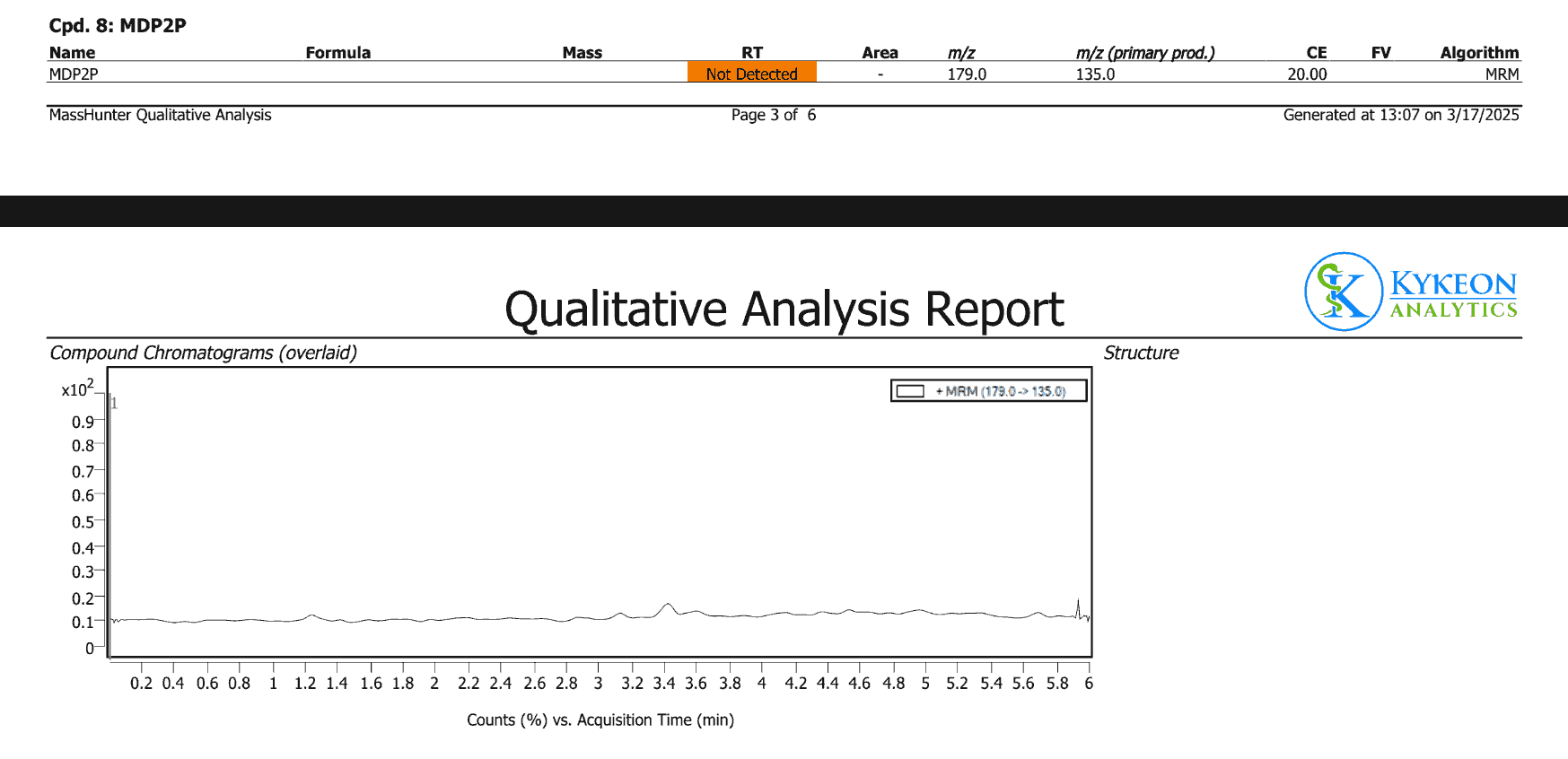
I sent a sample to Kykeon and asked them to look at some of the queried contaminants talked about in this thread. They said they could test for it but came back with a result of 92% mdma with no comment on what the 8% was. Even if we take the 92% as accurate, where is the info on trace content. Was hoping for something more like the forensic papers, e.g.: https://doi.org/10.1016/j.forsciint.2009.03.004
 
I sent a sample to Kykeon and asked them to look at some of the queried contaminants talked about in this thread. They said they could test for it but came back with a result of 92% mdma with no comment on what the 8% was. Even if we take the 92% as accurate, where is the info on trace content. Was hoping for something more like the forensic papers, e.g.: https://doi.org/10.1016/j.forsciint.2009.03.004
Did you ask for raw MS/GC data?
 
For prettier—though more delicate—crystals, use methanol and acetone cooled slowly.
Does "prettier" mean purer in this context ?

i.e.: for MDMA.HCl, you can use boiling anhydrous methanol up to the saturation point and then slowly add cold, anhydrous acetone until it gets slightly cloudy. Let that cool off slowly and the crystals will lock out impurities as they form each new layer of the forming crystal lattice gets scrubbed clean by the acetone.

Does that "cool off slowly" mean 1°C per minute, per hour, per day ... ?
 
Below is a 3rd-hand report from a local chemist that claims to have converted many sub-par "MDMA Dutch crystals" batches into magic MDMA.
Please do not kill me for relaying this anecdotal procedure to you.

The brown Dutch crystals were reacted with Tosyl Chloride in the presence of a Sodium Hydroxide in DCM to form the corresponding N-tosyl derivative. This formed crystalline compound was subsequently purified by recrystallization. The purified tosylated MDMA derivative was then subjected to detosylation (cleaving the sulfonamide bond) with Hydrobromic Acid in Acetic Acid (with Phenol added to scavenge any reactive intermediates and prevent side reactions like brominations) regenerating the original MDMA.

I do not know what solvents he used for the recrystallization but I guess the criteria would be something that does not dissolve the tosylated MDMA and a second solvent that dissolves the tosylated MDMA very well but does not dissolve its contaminants.
 
Last edited:
I gave recrystallisation a go but didn't really improve the experience. The product looked cleaner but wasn't noticeably different in experience. I'm happy to concede that it might be my technique as I have no background chemistry.

Regarding what you said about MAPS mdma: do you mean you've had some maps stuff and it's good? And that recrystallised bad product is as good as that?
Yes I had claimed resynthesized maps route many people tried that and loved it I still kept a small amount as person

I recrystallized my product and introduced it as new maps or expected maps equivalent and they say it was the equivalent or better then the maps I had prior.

If crystals crash out too fast it will clean it up and make it look prettier or white but not nessicarly maps equivalent ultra high purity I mine crash out pretty slow and made small see thru pebbles

Solvent choice could also play a factor. I used straight acetone which can be a bit hard to dissolve larger amounts of MDMA
 
Last edited:
Does "prettier" mean purer in this context ?

i.e.: for MDMA.HCl, you can use boiling anhydrous methanol up to the saturation point and then slowly add cold, anhydrous acetone until it gets slightly cloudy. Let that cool off slowly and the crystals will lock out impurities as they form each new layer of the forming crystal lattice gets scrubbed clean by the acetone.

Does that "cool off slowly" mean 1°C per minute, per hour, per day ... ?
Not always I've recrystallized from H20 and it was not better or actually made it worse

Conditions are based on ambient temp solvent etc

Most people transfer the hot flask from the hot plate, into a pot or tray or boiling hot water they periodically add hot water but not nessicarly boiling, then transfer to a fridge after 8- 12 hours

Recrystallization is an art as much of a science


I would try and run a TLC plate with UV light and see what comes up.
 
Last edited:
know what solvents he used for the recrystallization but I guess the criteria would be something that does not dissolve the tosylated MDMA and a second solvent that dissolves the tosylated MDMA very well but does not dissol
Below is a 3rd-hand report from a local chemist that claims to have converted many sub-par "MDMA Dutch crystals" batches into magic MDMA.
Please do not kill me for relaying this anecdotal procedure to you.


I do not know what solvents he used for the recrystallization but I guess the criteria would be something that does not dissolve the tosylated MDMA and a second solvent that dissolves the tosylated MDMA very well but does not dissolve its contaminants.
So does this tosylation procedure make sense? And should it be attempted by a non-chemist?
 
Yes I had claimed resynthesized maps route many people tried that and loved it I still kept a small amount as person

I recrystallized my product and introduced it as new maps or expected maps equivalent and they say it was the equivalent or better then the maps I had prior.

If crystals crash out too fast it will clean it up and make it look prettier or white but not nessicarly maps equivalent ultra high purity I mine crash out pretty slow and made small see thru pebbles

Solvent choice could also play a factor. I used straight acetone which can be a bit hard to dissolve larger amounts of MDMA
Right ok, yes I feel I substantially rushed it when I did it, and probably also some other shortfalls given what was discussed in that reddit link you posted.

Any good videos/text for procedures to follow?
 
Right ok, yes I feel I substantially rushed it when I did it, and probably also some other shortfalls given what was discussed in that reddit link you posted.

Any good videos/text for procedures to follow?
Reddit link for 1.

The tips I gave earlier. Transfer to a hot flask.

Have hot flask on hot water bath and consistently change or add hot water
Etc etc before fridge etc.
ALOT is just practicing
 
@ThreePointCircle:

0H5L7Bk.png


I asked my professor to take a look at it and he said that the above chromatogram might indicate a low concentration of 1-(1,3-benzodioxol-5-yl)propan-2-ol
 
@ThreePointCircle:


I asked my professor to take a look at it and he said that the above chromatogram might indicate a low concentration of 1-(1,3-benzodioxol-5-yl)propan-2-ol
Very interesting. The frustration that has existed since the first page of the first thread is that analysis could answer the question, but the services available to the public tend to just say 'pure as the driven snow' while forensic papers always talk about contaminants relating to the synthesis procedures. I remember one of the authors of the MDDMA inhibitor paper was asked how much it would take to have the 'meh' effect, and while they didn't know, they speculated that it could be a small amount. So anything else in the sample could be relevant but goes unreported by the testing services.
 
Could you ask them whether they are capable of doing some sensitive tests for the presence of low-concentration OH groups in the sample ?
 
Top