• N&PD Moderators: Skorpio

Way-267,464 (oxytocin agonist)

vinylmesh

Bluelighter
Joined
Feb 11, 2008
Messages
38
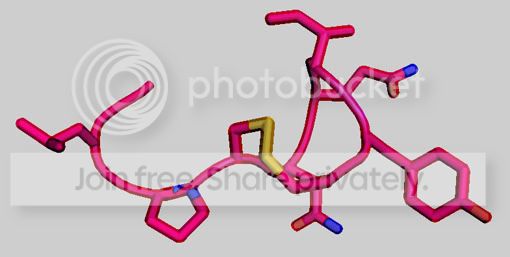
I thought I'd just leave this here;

WAY-267464_structure.png


WAY-267,464 is a psychoactive drug which acts as a high affinity, potent, and selective non-peptide agonist for the oxytocin receptor (OXTR), with negligible affinity for the vasopressin receptors. It has been shown to cross the blood-brain-barrier to a significantly greater extent than exogenously applied oxytocin, and in animal tests produces centrally-mediated oxytocinergic actions such as anxiolytic effects, but with no antidepressant effect evident.

Any thoughts?

:).
 
Interesting compound... its odd that such a large compound would cross the BBB. Doesn't really resemble any other novel recreational drug compounds I've seen lately, maybe some pharmaceuticals though...
 
If you compare it to oxytocin's sequence: CYIQNCPLG

and structure:

oxytocin-small.jpg

oxytocin-big.jpg


The dihydroxyphenyl group there likely mimics the tyrosine. The "stuff in the middle" from the piperazine to phenyl ring with the 2 amide bonds probably acts similar to oxy's hydrophobic core packing around the disulfide bond.

Then that leaves the tricyclic thing to do stuff we have no clue about... maybe it's a 3rd generation antidepressant as well? ;P
 
I'm very interested in these analogs as possible additions to entactogens to maybe bring back some of the "magic" that class of drugs once held or maybe just to increase its empathy it currently produces for me but i'm not holding my breath!!!
 
Big fat bump. This sounds like a potential MDMA booster. :D Any experiences yet? I wish this was synthesized somewhere somehow and made available.

Selective amnesic effects of oxytocinnext term on human memory

Abstract

The neuropeptide previous termoxytocinnext term is essential for mammalian parturition and lactation. Recent animal studies suggest that previous termoxytocinnext term is also implicated in the central nervous control of behavior including learning and memory. There has been little investigation, however, of the impact of previous termoxytocinnext term on human memory. The purpose of this study was to investigate the effect of a single dose of intranasal previous termoxytocinnext term on implicit and explicit memory in humans. In a placebo-controlled, double-blind study, 38 healthy men were randomly assigned to receive intranasal previous termoxytocinnext term (24 IU) or placebo 50 min before the study phase (incidental learning). Memory was measured using three different memory tests: an implicit perceptual test (word stem completion), an implicit conceptual test (category-cued semantic association), and an explicit test (cued recall). Due to the reproductive-biological role of previous termoxytocinnext term and the impact of adequate environmental conditions for the stimulation of behavioral effects of previous termoxytocinnext term known from animal research, we used semantic word stimuli with reproduction-related vs. neutral meaning. previous termOxytocinnext term significantly impaired recall performance as compared with placebo treatment irrespective of the meaning of words in the cued recall test. In the implicit conceptual test, characterized by a deepened information processing, compared with placebo, previous termoxytocinnext term significantly impaired only the overall generation of associated target words with reproduction relevant meaning, whereas no significant difference between previous termoxytocinnext term and placebo was obtained for neutral words. These findings concur with data from animal research suggesting that central previous termoxytocinnext term selectively influences memory performance depending on the kind of memory test used and, more importantly, the psychobiological relevance of stimuli.

The trial had to be aborted after 90 minutes due to two of the subjects starting to copulate in the research facilities' bathroom while the other thirty-six participants were laying on the floor stroking one another in what they referred to as a "cuddle puddle".^^

Physiol Behav. 2004 Oct 30;83(1):31-8.

Markus Heinrichsa, b, Corresponding Author Contact Information, E-mail The Corresponding Author, Gunther Meinlschmidtb, Werner Wippichc, Ulrike Ehlerta and Dirk H. Hellhammerb

aDepartment of Clinical Psychology and Psychotherapy, University of Zürich, Zürichbergstrasse 43, CH-8044 Zürich, Switzerland

bDepartment of Psychobiology, University of Trier, Trier, Germany

cDepartment of Psychology, University of Trier, Trier, Germany
Received 28 April 2004;
accepted 26 July 2004.
Available online 20 October 2004.



Receptor and behavioral pharmacology of WAY-267464, a non-peptide oxytocin receptor agonist.

The widely reported effects of oxytocin (OT) on CNS function has generated considerable interest in the therapeutic potential for targeting this system for a variety of human psychiatric diseases, including anxiety disorders, autism, schizophrenia, and depression. The utility of synthetic OT, as both a research tool and neurotherapeutic, is limited by the physiochemical properties inherent in most neuropeptides, notably its short half-life and poor blood brain barrier penetration. Subsequently, the discovery and development of non-peptide molecules that act as selective agonists of the oxytocin receptor (OTR) has been an important goal of the field. In this study, we report the receptor and behavioral pharmacology of WAY-267464, a first generation small-molecule OTR agonist. WAY-267464 is a high-affinity, potent, and selective (vs. V1a, V2, V1b) agonist of the OTR. In assays measuring both behavioral (four-plate test, elevated zero maze) and autonomic (stress-induced hyperthermia) parameters of the anxiety response, WAY-267464 exhibits an anxiolytic-like profile similar to OT. We have demonstrated that the anxiolytic-like profile of WAY-267464 is mediated through central sites of action. WAY-267464 also significantly reverses disruption in prepulse inhibition of the acoustic startle reflex induced by either MK-801 or amphetamine, similar to the antipsychotic-like effects previously reported for OT. Interestingly, in the mouse tail suspension test, WAY-267464 failed to produce changes in immobility that are seen with OT, raising the question of whether the antidepressant-like activity of OT may be working independently of the OTR. A selective OTR antagonist also failed to block the effects of OT on immobility in the TST. The significance of these findings for shaping the clinical development of OTR agonists is discussed.

Neuropharmacology. 2010 Jan;58(1):69-77. Epub 2009 Jul 15.

Ring RH, Schechter LE, Leonard SK, Dwyer JM, Platt BJ, Graf R, Grauer S, Pulicicchio C, Resnick L, Rahman Z, Sukoff Rizzo SJ, Luo B, Beyer CE, Logue SF, Marquis KL, Hughes ZA, Rosenzweig-Lipson S.
Source

Discovery Neuroscience, Wyeth Research, CN8000, Princeton, NJ 08543, USA. [email protected]
 
Last edited:
[legitamite discussion]...

The trial had to be aborted after 90 minutes due to two of the subjects starting to copulate in the research facilities' bathroom while the other thirty-six participants were laying on the floor stroking one another in what they referred to as a "cuddle puddle".^^

Please don't do this. If you want to add snarky comments keep them out of the quoted abstract. This isn't ED.


I think at best this is a novelty compound. It's not on the market because as far as anyone can tell, direct oxytocin stimulation isn't recreational.
 
Top