• 🇳🇿 🇲🇲 🇯🇵 🇨🇳 🇦🇺 🇦🇶 🇮🇳
    Australian & Asian
    Drug Discussion


    Welcome Guest!
    Posting Rules Bluelight Rules
  • AADD Moderators: Tronica

WA drug labs addict-based: commissioner

thestudent14

Bluelighter
Joined
Jan 23, 2010
Messages
1,618
Location
S.E Melb
Hundreds of clandestine drug labs uncovered in Western Australia have all been "addiction-based", not organised crime operations, Police Commissioner Karl O'Callaghan says.

The commissioner told a parliamentary estimates hearing on Monday there hadn't been "one single clan lab detection which can be classed at an organised level for the widespread distribution of drugs".

"Every clan lab found in WA has been an addiction-based clan lab, in other words it's not an organised crime lab," he said.
"It's a lab that can generate very small amounts of meth for a user or a couple of users."

Mr O'Callaghan said organised crime operations were not easily detected and were much more sophisticated than what was being found currently.

"One of the things contributing to the increase in clan labs is that many people are now finding our how it's done and they find out what pre-cursor chemicals that are required to create meth.

"They are generally available easily over the counter at a hardware store and the pre-cursor chemicals that are required, the actual extraction chemicals that are required, they can be bought at a chemist."

Mr O'Callaghan said people were beginning to realise they could make the substances quite simply with not much equipment.

"We're seeing an upward trend but at the same time the community are also becoming more aware of it.

"I do point out not all clan labs are set-ups that are found in houses.

"Some are just cobbled together in the back of cars or in the bush, we're just finding more and more of these."

Meanwhile, the WA Police Union conference on Monday heard that 696 clandestine drug laboratories had been uncovered in WA since 1998, out of around 4000 found nationally.

Chemist Paul Newell, from the contaminated sites branch of the WA Department of Environment, told the conference that those were only the labs detected by police.

"We might be generous in saying we are catching something like five to 10 per cent," he said.

WA was on track to break last year's record number of lab busts, Mr Newell said.

Drug labs ranged from very simple "box labs" that could be taken by motorcycle into remote bush areas to large, sophisticated operations that had been found in the eastern states run by trained chemists, he said.

The hazards involved in clandestine labs included the risks of explosion, toxic fumes, poisoning and chemical burns, and things could go wrong very quickly, Mr Newell said.

Houses used as drug labs could remain contaminated for many years, posing very real health risks to occupiers, he said.

Police lobbying since 2005 had resulted in national guidelines being released in April this year to promote safe dismantling of labs and the decontamination of premises used as labs, Mr Newell said.

Not a bad read. I don't know the direction of this thread, but I'd love to hear any input people have on experience to do with labs or know people involved in them. I'm not suprised that theres alot more popping up for personal use due to it not being overly difficult especially if you get shown by someone with a bit of experience in the area which is bound to make them more common exponentially.


I guess I was suprised by the amount busted, but compared to how many are actually around I don't think anyone really knows. 4000 busted in the last 13 years though was more then I expected. Supposing they're all two people operations (which is unlikely) thats 8000 cooks, if it was only 10 percent of what they think that would mean there would be around 80,000 cook/ex-cooks in aus. Which to me seems very high seeing it would be about 1 in 300 people.

Also reminds me of just how much resources must go into making these busts, 4000 busts most of which would've been operations planned by a team of L.E.
Another reminder of why the drug war desperately needs some changes.

 
very nice articl TS!


addiction based labs haha :D

i guess its much cheaper for them to cook it and use,

instead of paying for over priced stuff ^^
 
how are they defining "organized ?"

im sure there is cases of meth heads cobbling together the equipment to feed there habit, but there would also be cases where a criminal would supply the "cook/junkie" with the equipment and chemicals and get him to cook for drugs, which the criminal then takes a cut off and sells it on at ridiculous mark up! a criminal could have a few of these junkies doing this, and in no time he has a sizable amount of meth, which he could then cut down to make even more!

anyway its obviously a money making exercise..... criminal at that.
 
drug labs - QLD / NSW

Predominantly amphetamines and its derivatives, methylamphetamine and MDMA - more commonly called ecstacy, are being produced in Gold Coast suburban houses using improvised equipment says Det Supt Holahan.

Police suspect these smaller, just as volatile labs, are replacing more organised operations in response to strategies limiting the availability of chemicals and prescription drugs, like Sudafed, that are used particularly in the production of amphetamines.

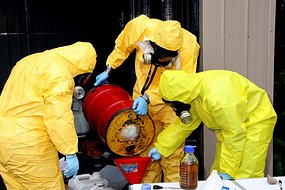
Many drug labs are ticking time bombs with the potential to harm, or even kill.
"They're extremely dangerous in terms of the flammable chemicals used and the vapours produced in the process, also dangerous in terms of other potential health risks and the toxic residue that's left," describes Det Supt Holahan.


Last year the number of illicit drug labs on the Gold Coast equated to five or six percent of Queensland, State Drug Investigation Unit Detective Superintendent Steve Holahan told the ABC Mornings program.
However, Det Supt Holahan says they've seen no spikes or increases in drug labs on the Gold Coast despite the growth and density of population.

While 'addiction-based' labs are increasingly being detected in Queensland, illicit drugs remain the most profitable form of organised crime, with cocaine, ecstasy, and ice, or crystal meth, among the most commonly traded chemicals (according to new figures released by the Australian Crime Commission).

An increasing number of drug labs are being detected around the country and earlier in the year the Federal Government issued guidelines for cleaning up almost 400 clandestine labs which are expected to be found around Australia in 2011, 60 per cent of which will be found in homes.

Closer to home, the NSW Drug Squad seized nearly double the drug labs detected in the previous year with the highest number of operations found in Coffs Harbour, Byron Bay and Tweed Heads.

Five men have so far been charged in relation to the Currumbin Valley property raid uncovering chemicals with a street value of $60 million.
Police state there are "loose associations with outlaw motorcycle gangs and other criminal organisations within the Gold Coast and Australia in relation to this drug trafficking network."

11th June 2011
here
 
Queensland leads nation in drug lab busts

New figures by the Australian Crime Commission show more clandestine drug labs are being found in Queensland than any in other state or territory.

The latest report shows the state's police uncovered 297 illegal laboratories in the 2009 financial year.

That is almost half of the 694 labs detected Australia-wide.

Queensland Police Commissioner Bob Atkinson says the high number is the result of good police work.

Crime Commission CEO John Lawler says the vast majority of the labs were discovered in ordinary neighbourhoods.

"[Police detected] 694 in 2009-2010, a percentage increase of 245 per cent over the decade since 2000/2001. The reality is we've got an increasing trend here," he said.

But the scale of activity at these laboratories is unclear.

And police and doctors are increasingly worried about burns injuries from exploding labs.

"The sort of chemicals that we are dealing with that make up clandestine laboratories are very dangerous materials in their own right," Mr Lawler said.

"The sort of methods involved involve the use of liquid petroleum gas, the use of heat, and indeed then are highly toxic and corrosive substances in their own right. It is a problem."

Mr Lawler says overall there were 85,000 drug-related arrests between 2009 and 2010.

"We had nearly eight tonnes of illicit drugs taken from the streets of Australia in 2009/10, as the report indicates, and indeed we prevent deaths in our community and other misery that affects families in all of their dimensions," he said.

"So I think [anyone] hearing that would say that is a positive outcome whether they want to class it as a war or not."

here
 
71 ‘clan labs’ detected in South Australia in 2009-10

The Australian Crime Commission's (ACC) Illicit Drug Data Report 2009–10 has revealed 71 clandestine laboratories were detected in South Australia in 2009–10.

South Australia reported an increase in clan lab detections in 2009–10 rising nine per cent from 65 in 2008–09, and a total increase of 195 per cent since2000–01.

"There were 694 clandestine laboratories detected in Australia in 2009–10, 10 per cent of these were located in South Australia," ACC Chief Executive Officer John Lawler said.

Mr Lawler launched the ACC's Illicit Drug Data Report 2009–10 at the Royal Perth Hospital with burns specialist Dr Fiona Wood and Western Australia Police Commissioner Karl O'Callaghan urging people to consider the physical harms caused by clandestine laboratories.

"The substances used to make illicit drugs such as MDMA and Methylamphetamine in illicit clan labs are toxic, corrosive, explosive, carcinogenic and pose a significant risk to the community, including respiratory problems, severe burns and even death," Mr Lawler said.

"The residue of drug manufacturing can pose risks for many years including damage to the environment through soil and water contamination as well as the disposal of toxic waste in public spaces."

South Australia Police provided key data to the report, including information on illicit drug seizures and arrests.

South Australia Police Assistant Commissioner (Crime) Grant Stevens welcomed the report, which is the 8th edition produced by the ACC.

"Illicit drug use harms individuals and families, while drug-related crimes impact the whole community," Mr Stevens said.

"It is a concern that despite all the warnings about the extreme dangers of clandestine drug laboratories, people still engage in this highly dangerous practice, often in residential areas.

"Often organised crime groups are involved in the manufacture of illegal drugs. SAPOL continue to target these criminals and their associates to disrupt their business and stop the flow of money and illegal goods that fuel this insidious business."

The Illicit Drug Data Report has become a key tool in the fight against illicit drug use, by providing government, law enforcement and relevant stakeholders with a national picture of the illicit drug market.

South Australia statistics are drawn from data provided by South Australia Police, Forensic Science South Australia, the Australian Federal Police and Customs and Border Protection.

A copy of the report is available at www.crimecommission.gov.au

Key findings from Illicit Drug Data Report 2009–10:

Over 85 000 illicit drug related arrests were made in 2009–10 — the
highest in the last decade.

Drug types that recorded the most substantial increase in arrests over
the last decade are cocaine and amphetamine-type stimulants (ATS), increasing by 91 per cent and 58 per cent respectively.

The 63 670 national illicit drug seizures in 2009–10 is the second
highest reported in the last decade.

Over 7.8 tonnes of illicit drugs were seized nationally in 2009–10
A record 694 clandestine laboratories were detected throughout Australia — an increase of 55 per cent from 2008–09 and 245 per cent since 2000–01.

here
 
Poledriver do you work in media?

I would say difference bw organised crime is like a larger more distributed operation, where the cook really doesnt have much to do with selling the product.

I think those figures dont include people who get busted then get out on bail, reset up, and people get thrown inside and othrrs get released, replacing them.
 
Neighbourhood drug lab busts up 245pc

Poledriver do you work in media?

Nah i don't.


The latest analysis of Australia's illegal drug trade has found a massive spike in the number of drug-making labs being busted across the country.

The Australian Crime Commission's annual report card on illegal drugs says police detected around 700 clandestine laboratories that were being used to make drugs like speed and ecstasy.

Crime Commission CEO John Lawler says the vast majority of the labs were discovered in ordinary neighbourhoods.

"[Police detected] 694 in 2009-2010, a percentage increase of 245 per cent over the decade since 2000/2001. The reality is we've got an increasing trend here," he said.

But the scale of activity at these laboratories is unclear.

Police and doctors are increasingly worried about burns injuries from exploding labs, which is why the illicit drug report is being released at the Royal Perth Hospital with burns specialist Dr Fiona Wood.

"The sort of chemicals that we are dealing with that make up clandestine laboratories are very dangerous materials in their own right," Mr Lawler said.

"The sort of methods involved involve the use of liquid petroleum gas, the use of heat, and indeed then are highly toxic and corrosive substances in their own right. It is a problem."

The report shows the number of cocaine arrests has doubled to 1,200 over the past 10 years, and the number of steroid seizures is at a record level.

Mr Lawler says overall there were 85,000 drug-related arrests between 2009 and 2010.

"People talk about losing battles. I like to [be] a glass half-full person," he said.

"We had nearly eight tonnes of illicit drugs taken from the streets of Australia in 2009/10, as the report indicates, and indeed we prevent deaths in our community and other misery that affects families in all of their dimensions.

"So I think [anyone] hearing that would say that is a positive outcome whether they want to class it as a war or not."


here


r516894_2836868.jpg
 
Last edited:
The commissioner told a parliamentary estimates hearing on Monday there hadn't been "one single clan lab detection which can be classed at an organised level for the widespread distribution of drugs".

Maybe not in WA, but certainly in NSW and QLD there have been..

Few weeks back in Currumbin Valley ;

POLICE seized more than 2 tonnes of chemicals capable of producing drugs worth $30 million in a raid on a Currumbin Valley property this week.

Five people have been charged in relation to the discovery of 2.5 tonnes of chemicals used to make methylamphetamines estimated to have a street value in excess of $30 million.

The laboratory was raided on Monday with more than 100 police staff acting on 18 months of intelligence, executing 8 search warrants to seize chemicals and more than $300,000 in equipment.


Australian Crime Commission National Manager of Target Development and Intervention Carey Stent said early examinations of the lab suggested it held enough chemicals to produce up to 70kg of methylamphetamine and had the ability to produce many types of drugs.

“The scale of this laboratory puts it in a unique category,” Mr Stent said.

“The majority of illicit drug laboratories detected in Australia are capable of producing one or two drug types.

“The laboratory shutdown on Monday had the potential to produce multiple drug types with multiple processing methods.”

here
 
This is extremely amusing since I just read today the WA Police Commissioners son was in a meth lab explosion while cooking meth. Link Wonder if he is partially saying this to cover his sons arse?
 
Yeah, and now he is saying pseudoephedrine should be prescription only. Way to make the non-meth making and using public pay for the sins of your son and others like him. :\
 
So Carl O'Callaghan's son isn't a serious criminal involved in crime???? What a load of shit, Carl is just trying to lessen the blow of his sons sentence. I bet if his son had not been involved in manufacturing methamphetamine he would never had made those comments.
 
So Carl O'Callaghan's son isn't a serious criminal involved in crime???? What a load of shit, Carl is just trying to lessen the blow of his sons sentence. I bet if his son had not been involved in manufacturing methamphetamine he would never had made those comments.

+ a gazillion.. been follwing this whole 'event' since day one.. Carl is really startin to make himself look like a complete fuckwit by the comments/statements he has been releasin to the media just to get his son off the hook.. fuck this country's authority is a joke.. 8)
 
Does it devalidate what he says? Someone whipping up a few grams in the boot of their car isn't the same thing as a setup pumping out kilos, any more than someone selling a few points at a time to pay for their own use is the same as someone making mint by selling those kilos.

Obviously his experience with his son has affected his viewpoint, but I don't see how that's a bad thing. If this country had more politicians and police commissioners with addicts for children (not that I would wish that on anybody), we might have a half way sane drug policy.
 
^^ hey don't get me wrong.. I'm 100% all for the commissioner sayin to the public what he has said as it might changes the public's perception/opinion on meth users/addicts.. but what pisses me off it that he his only sayin all this thanks to his son fuckn up... (hence tryin to get him a reduced sentence)
 
Top