To explore the molecular determinants for the activation of lysergamides for the dopamine receptor family, we determined the active-state cryoelectron microscopy (cryo-EM) structure of the D2R bound with the prototypical lysergamide, LSD.
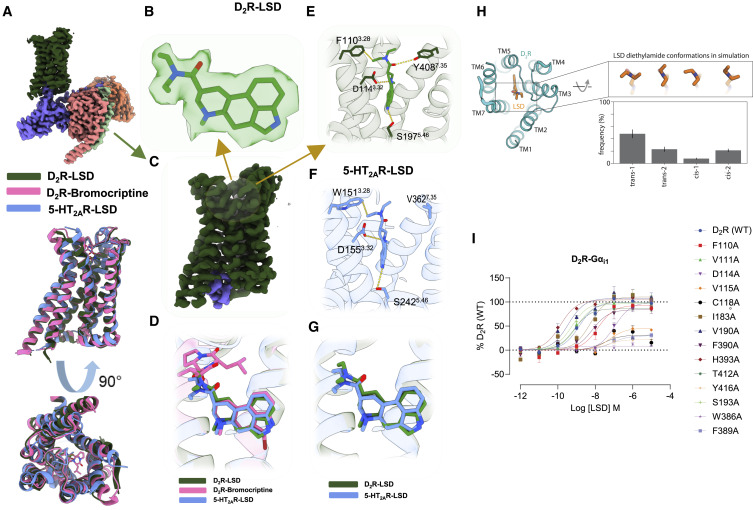
At a nominal resolution of 2.3 A˚, we unambiguously placed LSD within the orthosteric pocket and identified the interactions between the ligand and the receptor (Figure 5A).
To identify the orientation of the diethylamide moieties, we improved local map features by a focused refinement on thereceptor alone (Figure 5C), allowing us to model the diethylamide with further confidence.
We also turned to molecular dynamics (MD) simulations to validate the conformation of the diethylamide moiety of LSD bound to D2R.
In simulations of LSD bound to D2R, the most commonly adopted diethylamide conformation was a trans conformation (Figure 5H) matching that seen in crystal structures of LSD bound to 5-HT2A and 5-HT2B. Given the evidence based on the maps, previous studies, as well as simulations, we confidently modeled the diethylamide moiety of LSD in the trans conformation (Figure 5B).
To explore the various molecular determinants that allowed LSD to activate the D2R, we compared our new structure with the D2R-bromocriptine (PDB: 7JVR) and 5-HT2AR-LSD (PDB: 9AS3 and 9AS4) cryo-EM structures (Figure 5D).
Comparing our new D2R-LSD structure with the previously published bromocriptine, we noticed there was a significant overlap in the positioning of the lysergamide core (Figure 5D).
There was a slight shift in the ergoline rings in bromocriptine compared with LSD that was most likely due to the presence of the Br at the 2-position, slightly changing the orientation.
Additionally comparing D2R-LSD with the 5-HT2A-LSD structure, we found that there were conserved H-bonding interactions (Figure 5G).
Both the D2R and 5-HT2A H-bond to D3.32 (a conserved salt-bridge for all aminergic receptors) and S5.46 (Figure 5F) (all numbers are from the Ballesteros and Weinstein convention).
Moreover, at position 3.28, both receptors contained an aromatic residue—D2R was F1103.28, whereas 5-HT2A was W1513.28(Figures 5E and 5F).
Both residues made significant hydrophobic interactions with the diethylamide moiety of LSD; however, the interaction at W1513.28 in 5-HT2A was much closer compared with F1103.28 in D2R.
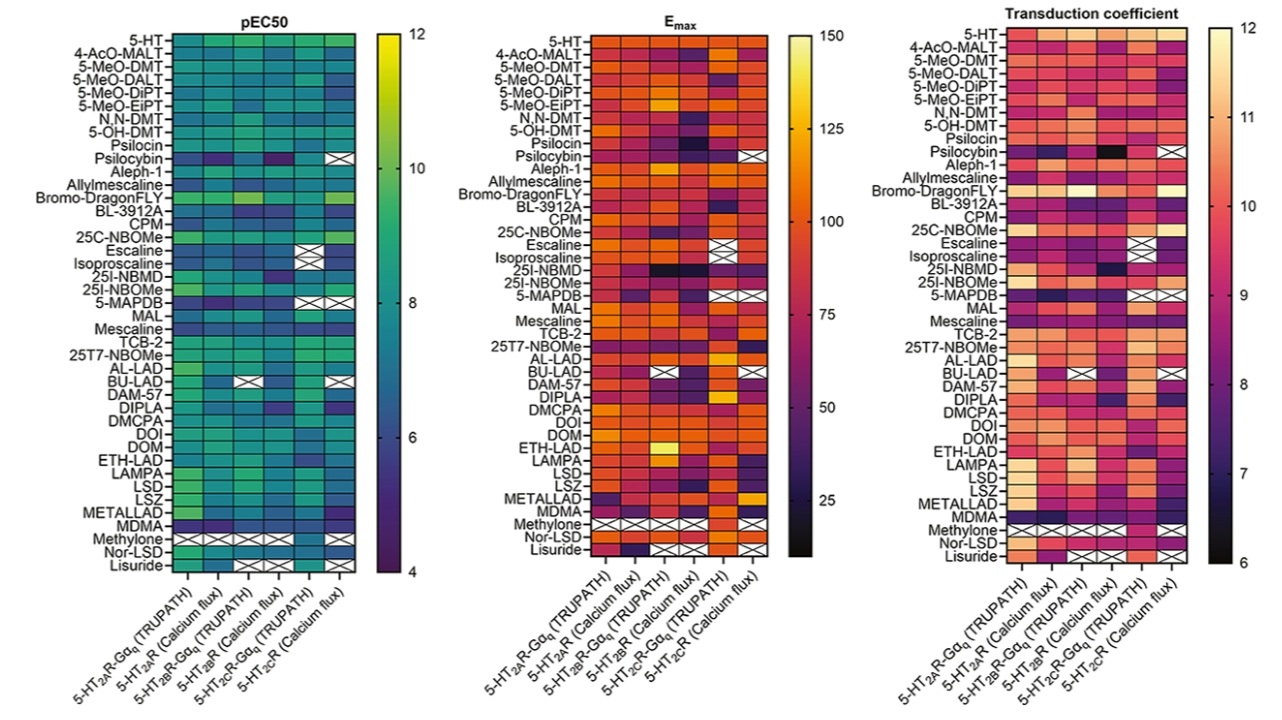
LSD was more potent (pEC50 = 9.43 ± 0.09) and efficacious (Emax= 96.51 ± 1.53) for the 5-HT2AR-Gαq pathway with a transduction coefficient (11.41 ± 0.04) compared with the D2R, which had apotency (pEC50 = 8.8 ± 0.15), efficacy (Emax= 76.78 ± 3.81), and transduction coefficient (10.68 ± 0.1) for the Gαi1pathway (Table S5).
The stronger hydrophobic interaction in 5-HT2AR due to W1513.28 compared with F1103.28 in D2R could explain why LSD was more potent and efficacious with a high transduction coefficient at 5-HT2AR.
We mutated some key residues around the orthosteric-binding pocket of the D2R and observed the functional activity of the receptor using a D2R-Gαi1 BRET assay (Figure 5I).
Cell surface ELISA assays were performed to determine their expression levels in the cell membrane (Figure S7).
Especially the D114A, F110A, V115A, W386A, and Y416A mutations in the D2R-binding pocket affected the activation of D2R by LSD (Figure 5I).