

-
Neuroscience & Pharmacology Discussion Welcome Guest
Posting Rules Bluelight Rules Recent Journal Articles Chemistry Mega-Thread FREE Chemistry Databases! Self-Education Guide -
N&PD Moderators: Skorpio
You are using an out of date browser. It may not display this or other websites correctly.
You should upgrade or use an alternative browser.The Large and Nifty Not-quite-advanced Drug Chemistry, Pharmacology and More Thread
- Thread starter nuke
- Start date
- Status
- Not open for further replies.


tryp2fun
Bluelighter
- Joined
- Dec 24, 2008
- Messages
- 253
Why exactly is sulfuric acid most often used for acid catalysis?
It is the strongest of the common laboratory acids, so it can form highly reactive intermediates like carbocations the best.
nuke
Bluelighter
- Joined
- Nov 7, 2004
- Messages
- 4,190
Why exactly is sulfuric acid most often used for acid catalysis?
Because it will protonate an alcohol group but it won't react with tertiary alcohols to form alkyl halides through an SN1 reaction.
dread
Bluelighter
Anyone have any information about 4-phenyl-2-pyrrolidone? By what I can tell it should be a prodrug to phenibut, possibly more potent?
I found a cas number and MSDS for it, but not much else...
http://www.chemcas.com/msds/cas/msds120/1198-97-6.asp
this says it produces analgesia and "changes in motor function" in mammals... I wonder if it would be worhtwhile in any way? Have any human bioassays been made ever?MurphyClox
Bluelighter
- Joined
- Mar 26, 2008
- Messages
- 1,416
Whats the name of this molecule: Hg(O2CCF3)2
Mercury(II) trifluoroacetate.
- MurphyI've been having some trouble understanding what causes conditions in a reaction to be acidic or basic.
For instance in the formation of a nitronium ion, nitric acid and sulfuric acid are reacted to form a nitronium ion by loss of water. So this happens because the nitric acid is protonated forming water which is an effective leaving group. What exactly gives the nitric acid the urge to become more acidic? Is it because sulfuric acid is more acidic and willing to protonate it?
Any help with an explanation on acidic and basic conditions in organic chemistry would be greatly appreciated because I've been having trouble incorporating it into mechanisms as needed.Is it because sulfuric acid is more acidic and willing to protonate it?
"Willing" invites metaphoric confusion. Better to consider the resonance forms of bisulfate ion:
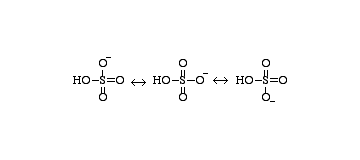
This anion is more stable than the nitrate anion.helium-4
Bluelight Crew
Any recommendations for advanced organic chemistry books? I've taken two semester of organic and my university doesn't offer higher level classes.^March's Advanced or Carey and Sundberg's Advanced. Either is roughly 2400 pages.
See this offsite thread for discussionhelium-4
Bluelight Crew
I know my library has an up to date (2007) March's, and Carey and Sundberg's Advanced from (1990)
thanks for the advice and the linkLast edited:Christo_Rey
Greenlighter
- Joined
- Nov 30, 2008
- Messages
- 7
I'm looking to know more into the mechanism of actions of different drugs, I've seen the Color Atlas of Pharmacology recommended earlier in the thread, is this a good starting point? Any other books to recommend to an amateur?
Reason to ask is : I've been dabbling in RCs for the past few years, and would like to know more about how they work so as to evaluate the dangers of those I'm interested in and better understand the journal articles to make more informed decisions as to what I choose to experiment with (eg to be more aware of the dangers of the drugs in themselves and also possible interactions with other medications I take... read to many horror stories about this).
nuke
Bluelighter
- Joined
- Nov 7, 2004
- Messages
- 4,190
Any recommendations for advanced organic chemistry books? I've taken two semester of organic and my university doesn't offer higher level classes.
Wileys Intermediate Organic Chemistry, 2nd Edition
It's weird that your university doesn't have more than 2 organic courses, most offer some kind of stereochemistry heavy upper level ochem course toohelium-4
Bluelight Crew
My university only has a few departments that even have a graduate program, and I believe only 2 departments with a doctorate program. Its a good university, but small (15000 including grad students) and up an coming. The chem program isn't very good. I should have thought about this before I went, but oh well...
JamtasticX
Bluelighter
- Joined
- May 3, 2010
- Messages
- 916
Just got chemoffice08, having fun playing around with it, seems like a great suite so far. Hopefully I'll will advance my mind on chemistry greatlynaura
Bluelighter
forgive me for the stupid question, but:
isn't cynanide toxic? what would the effects of 2c-cn be in terms of cynanide's ability to inhibit oxygen transport by blood cells (the way it poisons you, i believe)? would this be negated by its being bound in the phenethylamine?
enlighten me, someone who knows more.MurphyClox
Bluelighter
- Joined
- Mar 26, 2008
- Messages
- 1,416
Cyanide, per definition of the nomenclature, is an ion, i.e. CN-. That is the toxic species that inhibits the respiratory chain and, by the way, which is as toxic agents in the US' gas chambers nowadays (and in German gas chambers during 1933-45, too).
The CN in 2C-CN is bound covalently and for this reason should be called "nitrile", not "cyanide" (this naming is often confused).
The difference is that the former one is an independend molecule, able to reach its target (...CYPs of the respiratory chain), while the latter will stick to the ring until it gets metabolized. I have no idea at the moment what the metabolism for 2C-CN in particular is (if it was ever studied), but usual pathways go e.g.
-CN + water to -CONH2 (by nitrile hydratase)None of these liberates cyanide at any stage.
...followed by -CONH2 + water to -COOH + NH3(by amidase)
-CN + water to -COOH & NH3 (by nitrilase)
-CN + water to -CH=N-OH (by aldoxime dehydratases)
There may be exceptions, but in general are aromatic nitriles not extraordinarily toxic.
Peace! - MurphySlapdragonx
Bluelighter
Not extraordinarily, but possibly toxic?- Status
- Not open for further replies.