

-
Psychedelic Drugs Welcome Guest
PD's Best Threads Index Social ThreadSupport Bluelight Psychedelic Beginner's FAQ -
PD Moderators: Esperighanto | JackARoe |
You are using an out of date browser. It may not display this or other websites correctly.
You should upgrade or use an alternative browser.
You should upgrade or use an alternative browser.
Dissociatives The Big & Dandy DXM Thread - Part 2 - Robojesus, forgive us our sins
- Thread starter Jesusgreen
- Start date



TheAppleCore
Bluelighter
- Joined
- Jul 14, 2007
- Messages
- 5,510
^ Not really man, it can be a really stimulating, therapeutic, rewarding high. It's great for philosophizing, free-writing, and even dealing with my anxiety issues.
TheAppleCore
Bluelighter
- Joined
- Jul 14, 2007
- Messages
- 5,510
I think I'd take around 700-800 for 3rd then, and 1000-1100 for 4th, based on what calculators have told me regarding my weight. I might just jump straight to fourth, being a bit of a masochist - I assume if I do this though puking is almost guaranteed?
I definitely wouldn't advise this. The DXM dose-response curve is anything but linear, and even small increases can be shockingly powerful. For me, jumping from ~290 to ~390 milligrams took me from a comfortable, cozy, intellectually stimulating high, to something that shredded my mind so mercilessly that it was a monumental effort to even understand the most basic concepts and ideas.
DXM isn't like psychedelics, which IMO are still relatively kind on your mind and body if you overshoot your aim. DXM can become a veritable psycho-spiritual buzz-saw if you take too much, so please don't "be a bit of a masochist" and jump straight into a fourth plateau dose, if you've never been on at least a high third plateau (and a mid-third-plateau before high-third-plateau, etc.).

Biovail
Bluelighter
I definitely wouldn't advise this. The DXM dose-response curve is anything but linear, and even small increases can be shockingly powerful. For me, jumping from ~290 to ~390 milligrams took me from a comfortable, cozy, intellectually stimulating high, to something that shredded my mind so mercilessly that it was a monumental effort to even understand the most basic concepts and ideas.
DXM isn't like psychedelics, which IMO are still relatively kind on your mind and body if you overshoot your aim. DXM can become a veritable psycho-spiritual buzz-saw if you take too much, so please don't "be a bit of a masochist" and jump straight into a fourth plateau dose, if you've never been on at least a high third plateau (and a mid-third-plateau before high-third-plateau, etc.).
Not to mention much of the caucasian population (I've heard 10%) is extra-sensitive to to the drug. I weigh just under 65kg, and 300mg (5mg/kg) was enough for a low 3rd plateau while smoking weed. For most of the come up period, I felt like I was super drunk and my head was swimming, but without a lot of the loss in cognition that would come with alcohol intoxication. This lasted roughly an hour. And as others have said, it's impossible to predict what experience you'll have, even when you know your dosage. You might have a reality shattering trip one time with 500mg, and then not experience much at all the next with 800mg. And don't forget that being an NMDA antagonist, DXM may greatly reduce much of your sensitization to other drugs. I forgot this and took around 4 rips out of a bong.. not a good idea.
Biovail
Bluelighter
half a bottle (150mgs) is as high as i will go... DXM is a dirty droog
It's not dirty, but it can be dark.

Hopefully you had a nice experience.
For info on DXM for next time, check our DXM FAQ:
http://www.bluelight.ru/vb/threads/78090-DXM?s=&r=0
I can appreciate the fact that you don't return to this thread here in PD within a day, but there is no reason for
this to stay open anymore and have a side-tracked discussion next to our central thread.
So this is merged in.
Since you are a super fresh user I will keep the redirection link active for a long time.
For info on DXM for next time, check our DXM FAQ:
http://www.bluelight.ru/vb/threads/78090-DXM?s=&r=0
I can appreciate the fact that you don't return to this thread here in PD within a day, but there is no reason for
this to stay open anymore and have a side-tracked discussion next to our central thread.
So this is merged in.
Since you are a super fresh user I will keep the redirection link active for a long time.
half a bottle (150mgs) is as high as i will go... DXM is a dirty droogIt's not dirty, but it can be dark.
I've never personally understood what this 'dirtiness' is that people ascribe to DXM, although I've seen it mentioned often enough. Does anyone care to expand on what that they mean by dirty beyond 'I don't like it'? I personally haven't found DXM itself dirty in any sense, although chugging syrup can be unpleasant.
Is it the need to drink syrup coupled with the potential hot flushes/itchiness/other histamine reactions plus nausea or is it something more?

Jesusgreen
Bluelight Crew
I've never personally understood what this 'dirtiness' is that people ascribe to DXM, although I've seen it mentioned often enough. Does anyone care to expand on what that they mean by dirty beyond 'I don't like it'? I personally haven't found DXM itself dirty in any sense, although chugging syrup can be unpleasant.
Is it the need to drink syrup coupled with the potential hot flushes/itchiness/other histamine reactions plus nausea or is it something more?
^ I think a large part of it is likely to be attributed to what you mentioned, but part of it is also probably because of it's reputation as a drug that teenagers often abuse. It's similar to why to some people salvia is seen as a dirty or stupid drug purely because of it's main users.
Biovail
Bluelighter
I think people are talking about two different things when they say dirty. First there's what jesus is talking about, how a large portion of DXM users are teenagers and how this leads to a reputation for a cheap, crappy way to get fucked up. Second, there's the way the drug affects you; Loss of social inhibitions (for some). A feeling between being drunk and being stoned if you get the dosage wrong (2nd plateau). And your perception of the world just becomes "weird." Many people end up thinking about things in a way they shouldn't, or that doesn't make sense to a sober person. And this makes people feel "dirty."
And drinking cough syrup sucks.
And drinking cough syrup sucks.

lolusername
Bluelighter
- Joined
- Aug 30, 2011
- Messages
- 261
that really depends on the individual. i know plenty of people including myself that HATE cough syrup. in fact i've had such bad trips on this shit that i won't even take cough syrup when i actually need it to stop coughing!
Well, I'd say if you are one to enjoy dxm, it would be hard to have a bad trip on, atleast.
Well I think DXM is a dirty drug for me and some other people but not for everyone... and I believe this comes down to individual biochemistry, like how many enzymes you have of specific kinds. There are a few different metabolism pathways and it seems to me that if one pathway is the major one used by your body it might result in significantly more side-effects. Let's not forget that 10% of caucasian people are enzyme-deficient and don't get the proper effects. Apparently this does not happen with Asians (a genetic thing). At least almost not at all... Domo arigato mr roboto! 
Not really sure how many African people do the robo shuffle lol. Or eskimo's for that matter.
Anyway I blame differences in the way you metabolize DXM for the wide range in effects. Maybe if I could give DXO a try, I could see what other people find so wonderful about DXM. Maybe I'm wrong though and DXO is not at all what makes for pleasurable effects. Maybe it's 3MM.
There is another possibility and that is that some people might be more sensitive to other pharmacological effects other than NMDA antagonism responsible for the dissociation. For example some people might be exceptionally sensitive to histaminergic reponse and tend to have a scorching case of the robo itch, and similar to that you can imagine other cases where headache, feverishness and high bloodpressure and stuff like that may be much more apparent because of certain sensitivities. I'm not sure what makes me sensitive but on DXM, the feeling I get in my body absolutely sucks ass.
Anyway here are the metabolic pathways:
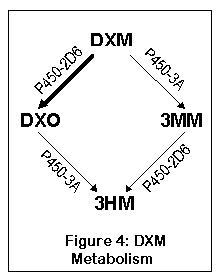
http://www.erowid.org/chemicals/dxm/faq/dxm_physiological.shtml
Not really sure how many African people do the robo shuffle lol. Or eskimo's for that matter.
Anyway I blame differences in the way you metabolize DXM for the wide range in effects. Maybe if I could give DXO a try, I could see what other people find so wonderful about DXM. Maybe I'm wrong though and DXO is not at all what makes for pleasurable effects. Maybe it's 3MM.
There is another possibility and that is that some people might be more sensitive to other pharmacological effects other than NMDA antagonism responsible for the dissociation. For example some people might be exceptionally sensitive to histaminergic reponse and tend to have a scorching case of the robo itch, and similar to that you can imagine other cases where headache, feverishness and high bloodpressure and stuff like that may be much more apparent because of certain sensitivities. I'm not sure what makes me sensitive but on DXM, the feeling I get in my body absolutely sucks ass.
Anyway here are the metabolic pathways:
http://www.erowid.org/chemicals/dxm/faq/dxm_physiological.shtml
DXM, as the hydrobromide salt, is absorbed quickly from the GI tract; within 30 minutes, all of it may have entered the bloodstream (2,3). The polistirex compound is intended for continuous absorption, and may take 6 to 8 hours to fully enter the bloodstream.
DXM is metabolized via two pathways, both of which lead to the same thing, 3-hydroxymorphinan (3HM). The first pathway goes from DXM to DXO (dextrorphan) and then to 3HM; the second goes from DXO to 3-methoxymorphinan (3MM) and then to 3HM. By far most of the DXM (up to 90% ) gets metabolized via DXO in normal individuals.
DXM is converted to DXO by a liver enzyme called cytochrome P450-2D6 (debrisoquine 4-hydroxylase). About 7% of Caucasians and 0.5% of Asians have a highly inefficient (70 times slower) version of this enzyme, and cannot metabolize DXM to DXO effectively (10). About 0.5 to 2% of the population have multiple copies of the P450 gene, leading to extremely fast metabolism of DXM into DXO (155). After being converted to DXO, the enzymes P450-3A4 and P450-3A5 convert DXO to 3-hydroxymorphinan (77).
The other pathway goes to 3-methoxymorphinan first (via P450-3A4 and P450-3A5), and then to 3-hydroxymorphinan. Most people do not metabolize much DXM this way, although people who lack the normal P450-2D6 will convert a substantial amount to 3MM. As 3MM is probably not psychoactive, this means that the 5-10% who lack the normal 2D6 enzyme will experience less effect from DXM (or more specifically, won't experience the effects of DXO).
P450-2D6 functions by removing the methoxy group and replacing it with a hydroxyl (OH) (or more accurately, pruning the methyl off the oxygen); this step is known as O-demethylation. P450-3A4 and 3A5 replace the methyl group with a hydrogen (H); this is the N-demethylation step. Refer to the diagram of the DXM molecule in Section 4.2 for the location of the methyl and methoxy groups.
Last edited:
lolusername
Bluelighter
- Joined
- Aug 30, 2011
- Messages
- 261
I agree that dxm does have a dirty feel to it, but nonetheless I enjoy the high.
Sublime947
Bluelighter
- Joined
- Oct 29, 2011
- Messages
- 165
DXM-First time experience-vomiting/nausea. How can I make my second time better?
Before I start, the only psychedelic drug I've done before this is shrooms. I weigh 135 pounds.
Last week I took ~290mg of DXM from CVS Adult Tussin Long-Acting Cough Liquid.
I vomited around 5-8 times after an hour of taking it due to nausea and fatigue. My puke consisted of the nasty syrup and pizza. and felt a bit drunk and strangely anxious for some reason. I was high, but it wasn't exactly pleasant until I got my hands on some marijuana around 8 hours later which made me feel calmer and it stopped the nausea. After smoking, I got some minor visual hallucinations, but my anxiety and nausea was gone.
The next few days i got a strange afterglow, not the same as MDMA but was still pleasant. I experienced some visuals and craziness again after smoking some weed.
I am thinking of trying dxm again, this time with weed right by my side.
How much should I take next time? Should I try a different syrup? because I remember before I smoked weed I was constantly spitting because of the nasty ass taste and syrup I felt in my mouth.
I also have the same CVS Adult Tussin Long-Acting Cough Liquid and some Delsym 12 hr. Should I try mixing it up?
Before I start, the only psychedelic drug I've done before this is shrooms. I weigh 135 pounds.
Last week I took ~290mg of DXM from CVS Adult Tussin Long-Acting Cough Liquid.
I vomited around 5-8 times after an hour of taking it due to nausea and fatigue. My puke consisted of the nasty syrup and pizza. and felt a bit drunk and strangely anxious for some reason. I was high, but it wasn't exactly pleasant until I got my hands on some marijuana around 8 hours later which made me feel calmer and it stopped the nausea. After smoking, I got some minor visual hallucinations, but my anxiety and nausea was gone.
The next few days i got a strange afterglow, not the same as MDMA but was still pleasant. I experienced some visuals and craziness again after smoking some weed.
I am thinking of trying dxm again, this time with weed right by my side.
How much should I take next time? Should I try a different syrup? because I remember before I smoked weed I was constantly spitting because of the nasty ass taste and syrup I felt in my mouth.
I also have the same CVS Adult Tussin Long-Acting Cough Liquid and some Delsym 12 hr. Should I try mixing it up?
Last edited:
jaurk
Bluelighter
DPH goes well, a motion-sickness tablet to suppress the puking.
Cannabis also goes well, and some people like to fast beforehand so they have a lower chance of puking.
edit: tehe, your post is at 11:11 and mine is at 11:22 :D
Cannabis also goes well, and some people like to fast beforehand so they have a lower chance of puking.
edit: tehe, your post is at 11:11 and mine is at 11:22 :D
Sublime947
Bluelighter
- Joined
- Oct 29, 2011
- Messages
- 165
haha nice, its only 7:23 here tho  . should i take a less or more dose tho? i feel like i threw up a lot of the stuff lol
. should i take a less or more dose tho? i feel like i threw up a lot of the stuff lol
Thorns Have Roses
Bluelight Crew
1. Make sure DXM is the ONLY active ingredient of your syrup.
2. Cannabis helps as you discovered.
3. DPH can help with nausea associate with vertigo
4. Take some ginger before hand.
5. Make sure to get the taste of the syrup out of your mouth ASAP by chasing it with something
6. Have something acidic with it to help balance out stomach pH.
7. Dose on an empty or mostly empty stomach, drink some fluids as well, if you have to throw up this might make it less unpleasant (solid matter or dry heaves suck, pure liquid is least lame, ime).
2. Cannabis helps as you discovered.
3. DPH can help with nausea associate with vertigo
4. Take some ginger before hand.
5. Make sure to get the taste of the syrup out of your mouth ASAP by chasing it with something
6. Have something acidic with it to help balance out stomach pH.
7. Dose on an empty or mostly empty stomach, drink some fluids as well, if you have to throw up this might make it less unpleasant (solid matter or dry heaves suck, pure liquid is least lame, ime).
Sublime947
Bluelighter
- Joined
- Oct 29, 2011
- Messages
- 165
Yes, DXM Hbr is the only ingredient in my syrup. I'll be sure to have weed and water by my side.should i go with a stronger or lower dose though?
Thorns Have Roses
Bluelight Crew
I think that dose was fine, but maybe drop it down lower, increasing the dosage is only going to make the nausea worse.

Transcendence
Bluelighter
- Joined
- Jul 19, 2006
- Messages
- 2,502
its a shame that zicam cough max was discontinued. That was the way to go for sure
one option is to clog your nose while drinking the syrop and keep it cloged while chasing the taste away with something to drink or some tooth paste
also a vegan diet the day before and not eating for atleast 4 hours prior is a very good idea when taking dxm in the form of syrop
also a vegan diet the day before and not eating for atleast 4 hours prior is a very good idea when taking dxm in the form of syrop