• N&PD Moderators: Skorpio

Testing MDPV with a spectrophotometer

diggmo111

Greenlighter
Joined
Oct 20, 2010
Messages
6
Location
Cleveland
Over the past month, my friends and I have obtained grams of MDPV from different vendors. We ordered the first batch in early March and were very happy with it. The powder was off-white (faintly beige/tan) and had a clumpy consistency. A new batch came in the mail today from a different source and it has a slightly different appearance. It has the same consistency as the first stuff but is entirely white. A few of us tried it and it seems to be as effective as the first batch.

I'm curious as to why the batches look different. I work in a biomedical research lab and I was thinking of using some of the analytical equipment to test the batches. I use a NanoDrop spectrophotometer basically every day and I think I'll test these different batches of MDPV. The DEA has a published UV-visual spectrum of MDPV in methanol, so I can dissolve the different samples in HPLC-grade MeOH and compare the spectra. I've only ever used the spec to measure DNA concentration so I don't know exactly how to interpret the data for MDPV.

I basically have two questions:
Will testing these samples on a spectrophotometer produce any useful information about purity or contaminants?

Once I measure the samples, can anyone help interpret the data if I post it here?
 
Last edited:

UV vis will provide some data, but not a lot, and it probably won't help a ton with identifying/quantifying contaminants I suspect (or even the suspected compound to some extent). You work in a research lab, don't you have access to NMR, GC/MS or LC/MS? Those would be loads more useful.
 
I've done TLC of 2 different batches of MDPV, I'd be very interested in seeing your results of UV/VIS spectrometry.

edit> GC or LC would be more revealing I suspect.
 
UV-VIS will only tell you if it's of reasonable purity or not, GC/MS (or even just GC/FID) are probably better for figuring a quantitative number and the relative masses of cuts/impurities.
 
UV vis will provide some data, but not a lot, and it probably won't help a ton with identifying/quantifying contaminants I suspect (or even the suspected compound to some extent). You work in a research lab, don't you have access to NMR, GC/MS or LC/MS? Those would be loads more useful.

I figured as much. There's an HPLC machine in the lab across the hall, but I would have to have a reason to use it. I should have time to test the samples tomorrow and post the results in the evening.
 
I suspect the tan stuff has oxidized/degraded, and that's likely the only difference. MDPV is very unstable in freebase form, and although stabler as an HCl salt it's far from perfect.
 
One of the samples of MDPV I tested with TLC had 2 impurities. It was an off-white colour.
 
If you're looking to find impurities (maybe side products from the synthesis), sure, why not take a UV-Vis spec?

I am mostly concerned with finding any potentially harmful impurities and determining which batch is cleanest.


What model Nanodrop instrument are you using? I haven't used the Nanodrop, but I know colleagues have, I think for protein assays.

You'll likely know this, but remember to blank the instrument and, very importantly (if you're used to measuring abs at 260nm) measure the absorbance of your compound using the UV-Vis function (I dunno the way to access this or the cutoffs for the Nanodrop, I think it's from 200nm to 700nm).

It's a NanoDrop ND-1000 and its range is 220-750nm. I'll measure in UV-Vis mode.

Here's the information on the instrument: http://www.nanodrop.com/Library/nd-1000-v3.7-users-manual-8.5x11.pdf

Also, I forgot to link the DEA characterization of MDPV. Here it is: http://www.justice.gov/dea/programs/forensicsci/microgram/journal2010/mj7-1_12-15.pdf
 
GC/MS would be the gold standard here, but if you're more comfortable with a UV spec then by all means do it. I'm assuming, of course, you have access to one.
 
Pictures

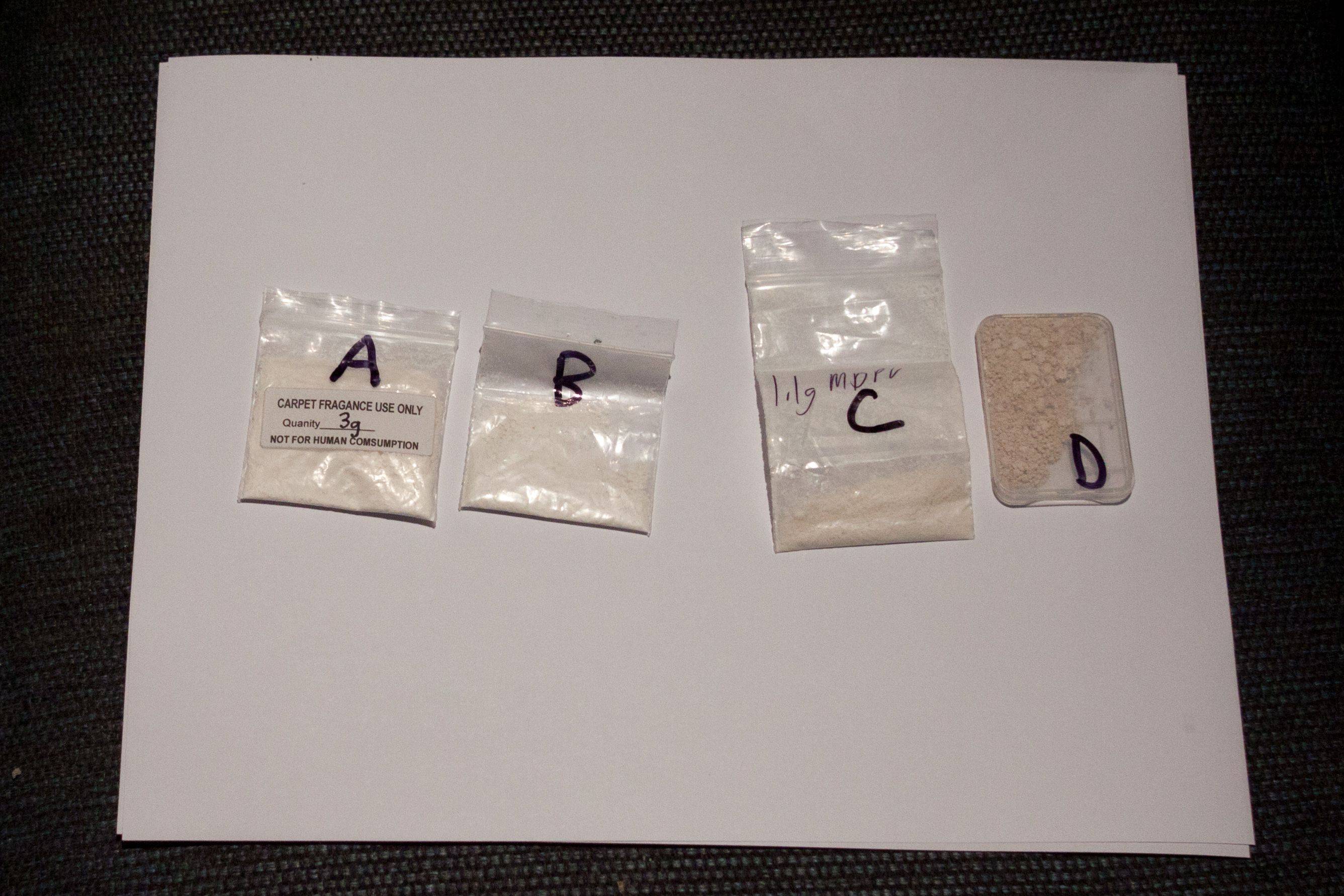
I took a picture of the 4 different kinds of MDPV that my friends and I have.

I wrote some notes about each sample. Samples A, B, and C were bought from different vendors on a social shopping website; sample D was bought on a $10/g blowout sale from a vendor on the east coast.

Sample A: "Carpet Fragrance"
Color: whitest of the bunch
Texture: clumpy and sticky. It tended to stick to the small flathead screwdriver I used to transfer it from bag to scale.
My friend claims that he feels less of a crash with A than with D. I've tried it a couple times and it didn't seem different from D.

Sample B:
Color: pretty white, about the same as A
Texture: exactly the same as A
This looks like it came from the same manufacturer as A did. I haven't tried it yet.

Sample C: "1.1g MDPV"
Color: faintly yellow
Texture: sticky but less clumpy than A or B
I don't think any of my friends have tried this batch yet. They're weary of the color.

Sample D: "Tan stuff"
Color: beige/tan
Texture: clumpy
I have the most personal experience with this one. I've used it on several occasions, usually at modest doses, with good results. This sample isn't in its original packaging.

I weighed out an amount of each to test at work tomorrow.

 
LOL @ NanoDrop

It's a NanoDrop ND-1000

Fucking LOL.

I <3 NanoDrop, and never considered it for RC analysis.

The beauty of NanoDrop is that it automatically adjusts the pathlength so that even if you are violating Beer's law, it'll still give you a reading and back calculate to 1 cm pathlength. Although we've had n00b's freak out over absorbance readings of like 30 OD, LoL... They just don't get it.

And the fact that you can measure a ul or two means you save on reagent.

OK... to address your question.

I would KEEP a tiny bit of each batch you recieve, and try to "blank" the NanoDrop with a previous batch, and then read the same dilution of a new batch. The subtractive spectra will show the differnces, and might hopefully indicate impurities.

lol... nanodrop. I can't get over that. If only Mr. Fisher Sci knew.
 
Spectra and observations

I ran the samples on the spec yesterday and today. Because of how the NanoDrop instrument works, it was hard to get a good reading with methanol solutions. I re-did the measurements with the samples dissolved in deionized (Milli-Q) water.

Here's a gallery with all the graphs. http://imgur.com/a/b2y6E

When I tried to dissolve sample B in methanol, a substantial portion of the powder did not go into solution, even after vortexing the tube for a while. I tried adding more MeOH to the tube but that made no discernible difference. None of the other samples had any trouble dissolving, so that leads me to believe that B is heavily cut with something. Today, when I tried to dissolve B in 400µL water, the same insoluble crap was there. After I added another 400µL H2O and vortexed for a while, all the powder dissolved.

I'm going to sleep now, but I'll post more about this tomorrow and explain my method better.
 
Top