• Philosophy and Spirituality
    Welcome Guest
    Posting Rules Bluelight Rules
    Threads of Note Socialize
  • P&S Moderators: JackARoe

Social Taking an online class in philosophy and critical thinking.

M1sterEd

Bluelighter
Joined
Apr 7, 2025
Messages
224
Location
Here
Philosophy (from the greek "love of wisdom) is a systematic and rational inquiry into fundamental questions about existence, knowledge, vales, reason, mind and language. It seeks to understand the world and human experience through critical thinking, logic and argumentation. metaphysics (what is real), epistemology (what is knowledge), ethics (what is right and wrong), logic (principles of reasoning) aesthetics (nature and beauty)

characteristics of philosophy
critical thinking, rigorous and logical analysis of concepts and arguments
questioning assumptions, challenging commonly held beliefs and examining their underlying foundations
conceptual clarity, precise definitions and clear articulation of ideas
argumentation, philosophical discussions rely on presenting reasons and evidence to support claims

Objective-develop critical thinking skills, improve problem solving, foster deeper understanding of oneself and the world, broaden perspective and intellectual horizons.

 
Philosophy (from the greek "love of wisdom) is a systematic and rational inquiry into fundamental questions about existence, knowledge, vales, reason, mind and language. It seeks to understand the world and human experience through critical thinking, logic and argumentation. metaphysics (what is real), epistemology (what is knowledge), ethics (what is right and wrong), logic (principles of reasoning) aesthetics (nature and beauty)

characteristics of philosophy
critical thinking, rigorous and logical analysis of concepts and arguments
questioning assumptions, challenging commonly held beliefs and examining their underlying foundations
conceptual clarity, precise definitions and clear articulation of ideas
argumentation, philosophical discussions rely on presenting reasons and evidence to support claims

Objective-develop critical thinking skills, improve problem solving, foster deeper understanding of oneself and the world, broaden perspective and intellectual horizons.
 
Stoicism rules!
Seneca wasn't a fan of this guy.
For the best in Stoic ideas read Epictetus.

“If anyone tells you that a certain person speaks ill of you, do not make excuses about what is said of you but answer, "He was ignorant of my other faults, else he would not have mentioned these alone.”
― Epictetus
 
Philosophy (from the greek "love of wisdom) is a systematic and rational inquiry into fundamental questions about existence, knowledge, vales, reason, mind and language. It seeks to understand the world and human experience through critical thinking, logic and argumentation. metaphysics (what is real), epistemology (what is knowledge), ethics (what is right and wrong), logic (principles of reasoning) aesthetics (nature and beauty)

characteristics of philosophy
critical thinking, rigorous and logical analysis of concepts and arguments
questioning assumptions, challenging commonly held beliefs and examining their underlying foundations
conceptual clarity, precise definitions and clear articulation of ideas
argumentation, philosophical discussions rely on presenting reasons and evidence to support claims

Objective-develop critical thinking skills, improve problem solving, foster deeper understanding of oneself and the world, broaden perspective and intellectual horizons.
Keeping in mind that there is no correct answer would you describe yourself leaning towards Plato or Diogenes ...
Why?
 
Keeping in mind that there is no correct answer would you describe yourself leaning towards Plato or Diogenes ...
Why?


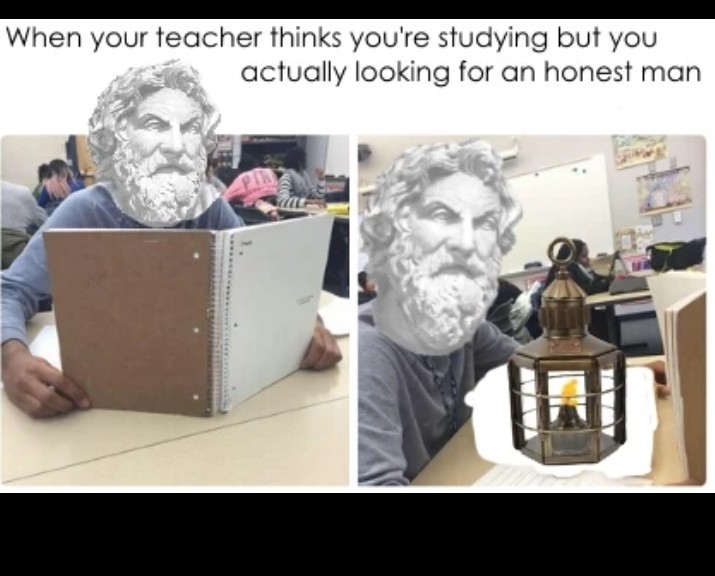
An interesting take on the dichotomy between the two exploring their contrasting views. I've always chuckled at Diogenes and his lantern - "I'm searching for an honest man, and I have not found him yet", lugging around his urn so he had somewhere to sleep.
 
Seneca wasn't a fan of this guy.
For the best in Stoic ideas read Epictetus.

“If anyone tells you that a certain person speaks ill of you, do not make excuses about what is said of you but answer, "He was ignorant of my other faults, else he would not have mentioned these alone.”
― Epictetus
 
I like Nietzsche and his sarcasm of the human condition. Stoicism is practical living skills, knowledge of self and one's role in life.
 
I like Nietzsche and his sarcasm of the human condition. Stoicism is practical living skills, knowledge of self and one's role in life.
Nietzsche is my favorite. I don't agree with him on everything (his views on women are ludicrous, for example), but he was on point on so many things. This Spake Zarathustra is probably his best work imo, but Genealogy of Morals is an interesting perspective on the the development of ethical positions too.

I also love Heraclitus, although I also get why he was known as "the obscure." Many of his statements seem to have layers of meaning that are not readily apparent at first glance (the line about how "you cannot step in the same river twice" comes to mind). If only we had more of what he said! Here is a link to his fragments with well done glosses on each: https://wiki.chadnet.org/files/heraclitus-the-complete-fragments-translation-and-commentary-and-the-greek-text-by-william-harris.pdf


An interesting take on the dichotomy between the two exploring their contrasting views. I've always chuckled at Diogenes and his lantern - "I'm searching for an honest man, and I have not found him yet", lugging around his urn so he had somewhere to sleep.

59fb969aaa9f2.jpeg
 
I like Nietzsche and his sarcasm of the human condition. Stoicism is practical living skills, knowledge of self and one's role in life.

Nietzsche is my favorite. I don't agree with him on everything (his views on women are ludicrous, for example), but he was on point on so many things. This Spake Zarathustra is probably his best work imo, but Genealogy of Morals is an interesting perspective on the the development of ethical positions too.

I also love Heraclitus, although I also get why he was known as "the obscure." Many of his statements seem to have layers of meaning that are not readily apparent at first glance (the line about how "you cannot step in the same river twice" comes to mind). If only we had more of what he said! Here is a link to his fragments with well done glosses on each: https://wiki.chadnet.org/files/heraclitus-the-complete-fragments-translation-and-commentary-and-the-greek-text-by-william-harris.pdf
I'd say my favorite philosophers overall are informed by my study of psychology, identity, and the self. Kant, while not my favorite to read, was a big part in understanding morality and purposefulness in the self. Hegel and Heidegger are two of the most influential as far as my development as an existential psychotherapist, and my understanding the dialectic processes that take place within our process of self awareness. Sartre also had an impact on my development of a sense of identity ownership and the creation of meaning outside of a religious faith. Robert Anton Wilson, while not explicitly a philosopher, had a profound influence on my identity as an intentional agnostic.
 
Top