
Nagelfar
Bluelight Crew
lol vanilla coke
I bet it tastes wonderful either as a drip or that 'creeping-up-the-back-of-the-tongue' from IV'ing taste effect.





N&PD Moderators: Skorpio
You are using an out of date browser. It may not display this or other websites correctly.
You should upgrade or use an alternative browser.
Substituted Benzoic acids as cocaine analogues (not phenyls making phenyltropanes)
Nagelfar
Bluelight Crew
lol vanilla coke
I bet it tastes wonderful either as a drip or that 'creeping-up-the-back-of-the-tongue' from IV'ing taste effect.

Nagelfar
Bluelight Crew
it seems unlikely that any metabolic process would lead to salicoyl methyl ecgonine being made from cocaine
Might aspirin being ingested in concurrence with cocaine, like the current segue of discussion in this thread, lead to that substance?
Nagelfar
Bluelight Crew
So would Salicylmethylecgonine be an in vivo metabolite of cocaine's use in conjunction with aspirin then, or is it just by natural process that it comes about or...(?)
Nagelfar
Bluelight Crew
*bump*
OK, I've started some threads on lipophilicity and hydrophilicity, but to put it into a drug context this old thread of mine seems a good starting point, which is one of the reasons I've brought up benzoyls in those other threads. Could cocaine be made even more hydrophilic with a substitution to the benzoyl group and even more lipophilic with a substitution/alteration of the tropane? I'd love to see more additions to ideas in the vein of this thread for cocaine particularly.

sekio
Bluelight Crew
You seem kind of confused on the issue - I suggest you read up on some organic chemistry tetbooks. "Hydrophilic" and "lipophilic" are two opposite ends of the spectrum.
What exactly are you aiming for? A more selective DAT binder than cocaine? A perceptually "better", more abusable drug?
Nagelfar
Bluelight Crew
You seem kind of confused on the issue - I suggest you read up on some organic chemistry tetbooks. "Hydrophilic" and "lipophilic" are two opposite ends of the spectrum.
What exactly are you aiming for? A more selective DAT binder than cocaine? A perceptually "better", more abusable drug?
Cocaine is apparently both "Hydrophilic and lipophilic" due to how it blocks sodium action potentials.
Any number of things, but here specifically: A faster onset, even if that precludes a shorter duration of action
Last edited:
sekio
Bluelight Crew
Cocaine's onset is already incredibly fast, esp. when IV'd or smoked. The only bit that's hydrophilic on cocaine are the ester linkages - they're needed for anesthetic action at the sodium channel - but overall the molecule is very lipophilic, especially in the free base form.
Exchanging the benzoyl ester for a dihalophenyl group is probably your best bet at increasing speed of onset, but I bet 2' acetoxy cocaine would be just as good.
Nagelfar
Bluelight Crew
The only bit that's hydrophilic on cocaine are the ester linkages - they're needed for anesthetic action at the sodium channel - but overall the molecule is very lipophilic, especially in the free base form.
The protonated form must be fairly hydrophilic from those linkages alone though, correct? Just from how instantly it disappears in water. I hear that pure cocaine even slowly evaporates into the open air from indoor levels of moisture.
Exchanging the benzoyl ester for a dihalophenyl group is probably your best bet at increasing speed of onset, but I bet 2' acetoxy cocaine would be just as good.
Interesting thank you. Anyone be willing to draw them?
sekio
Bluelight Crew
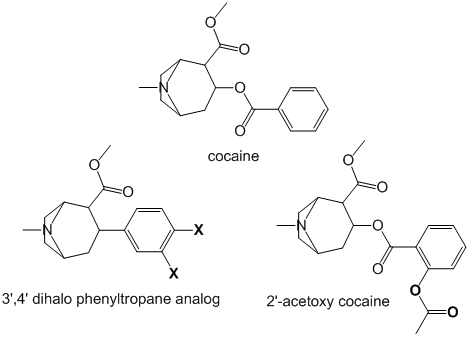
The protonated form of cocaine is soluble because of the free quaternary ammonium proton (that is added in the process of protonation). The ClogP for the protonated form is actually higher.
Nagelfar
Bluelight Crew
The protonated form of cocaine is soluble because of the free quaternary ammonium proton (that is added in the process of protonation). The ClogP for the protonated form is actually higher.
Thank you again sekio. So is that saying the protonated form is actually more hydrophobic? Would this mean hydrophilicity and water solubility are not necessarily related?
I think 2-position acetoxy cocaine is the basis I've been looking for. Though would such a conformation exclude or hamper the 3 & 4 positions from the halogens, if not reduced to a phenyl? What about adding the 2-acetoxy and the 34 dihalo on a benzoyl?
Edit: on second thought about 2'-acetoxy-, it appears that it would increase NE affinity too much in comparison to DAT affinity. Some other substitution to alter that in addition, may be interesting though.
sekio
Bluelight Crew
My version of the ClogP calculator works rather poorly with charged species. Rest assured that the labile proton on the amine allows good solubility.
Here's a paper you may be interested in.
http://www.scribd.com/doc/35574021/...ture-Activity-Relationship-of-Cocaine-Analogs
Deleted member 170540
Bluelight Crew
^ Are you sure? I know that pseudoephedrine hydrochloride dissolves in chloroform, but other than that, the only examples of ionic compounds dissolving in nonpolar solvents I know are salts of complexated metal ions, where the ligand masks the positive charge. (see 'purple benzene').
sekio
Bluelight Crew
When I was talking about the "solubility" of a protonated quat. ammon. I was referring to the water solubility.
Most quaternary ammonium compounds, save for the seriously sterically hindered ones, are very sol. in water and much less so in chloroform, etc. - their free bases are usually (but not always, in the case of very polar cmpds. - explaining cocaine freebase's small but nonzero solubility in water) not soluble. To use your example, pseudoephedrine.HCl is only "sparingly" soluble in CHCl3 whereas it is much more freely sol. in water and light alcohols. I think that there's enough proton exchange going on via chloroform to cause solvation, but not in e.g. benzene.
The rule I like to work with is, use protic solvents (water, alcohol) for dissolving salts and aprotic solvents (ether/dichloromethane/naptha/hexane) for free bases and organics. There are some exceptions but in general this holds true. Acid-base extractions rely on the differential polarity of salts versus freebases.
Deleted member 170540
Bluelight Crew
^ Ok there was some confusion here... Was that a typo when you wrote that the partition coefficient is higher for protonated cocaine than for the freebase? The partition coefficient is higher for more nonpolar substances, right?
sekio
Bluelight Crew
No, that wasn't a typo - though ClogP is the Calculated logP and not an actual measurement. It's suprising for me too but it might just be a consequence of how Chemdraw calculates it.
If it makes you feel any better, Chemdraw has a "normal logP" as well, and that goes down once you protonate a quaternary ammonium.
Nagelfar
Bluelight Crew
Here's a paper you may be interested in.
http://www.scribd.com/doc/35574021/...ture-Activity-Relationship-of-Cocaine-Analogs
Thank you.
Cloning mutated chimeric dopamine transporters just to see how cocaine binds is sure some extreme direction of study.
Does anyone hypothesize that the local anesthetic function on cocaine contributes to any form of active transport within the CNS at all whatsoever?
EDIT: and I suppose the million dollar question is: has any DRI ever been shown to be favored over cocaine (as a more discerning "positive reinforcer") ever in the history of animal testing?
Last edited: