• MDMA &
    Empathogenic
    Drugs

    Welcome Guest!
  • MDMA Moderators: Esperighanto

Study suggests little evidence Ecstasy causes brain damage

This automatically means the only people left to defend MDMA are the stupid ignorant retards; the ones that can't even read past an abstract and are too ignorant to come up with counter-arguments besides 'it's al governmental propaganda' or 'all studies indicating MDMA is dangerous used meth instead of MDMA'.

If the study had said Ecstasy causes brain damage would you have been happy?

Do you think they faked the study? Or do you think they studied hundreds of people and these were the conclusions they found?
 
Well I finished reading through the article and here's what I have to say about it.

When I first read it I was definitely very skeptical of what it said - of course, how could MDMA not be neurotoxic? However I think there are a few things to be deduced from this article.

#1 - MDMA is relatively safe. That means that it will not cause a significant amount of harm to you, probably even less so than alcohol and tobacco when used in proper moderation (whatever that may be, I don't think there is enough research done on this to really conclude the right answer on this; I believe at this point it is educated speculation). The study specifically mentions that in terms of cognitive functionality (notice, I did not use the word damage here) between users who raved with MDMA and without, they noticed zero difference.
Conclusion: MDMA will not affect your cognitive functionality any more than a normal raver.

#2 - This information is a step in the right direction. It's about time someone took an honest look at the substance. For many years it's been scrutinized so this is refreshing. A couple pieces of information I'd like to point out to those who may have skimmed over the article:

However, Halpern was sharply critical of the quality of the research that had linked ecstasy to brain damage. "Too many studies have been carried out on small populations, while overarching conclusions have been drawn from them," he said. For a start, some previous research has studied users who were taken from a culture dominated by all-night dancing, which thus exposed these individuals to sleep and fluid deprivation – factors that are themselves known to produce long-lasting cognitive effects. Non-users were not selected from those from a similar background, which therefore skewed results. In addition, past studies have not taken sufficient account of the fact that ecstasy users take other drugs or alcohol that could affect cognition or that they may have suffered intellectual impairment before they started taking ecstasy. In Halpern's study only ecstasy users who took no other drugs and who had suffered no previous impairment were selected.

This is a big step forward in getting more accurate information. Not only were the previous studies done on MDMA done in a lackluster manner, they were believed to have given proper results. Now we actually have a proper study done. They even took hair samples from each participant to ensure that they indeed did have the drug habits they spoke of.

Another point in the article I want to highlight:

"We even took hair samples of participants to test whether they were telling the truth about their drug and alcohol habits," said Halpern. "Essentially we compared one group of people who danced and raved and took ecstasy with a similar group of individuals who danced and raved but who did not take ecstasy. When we did that, we found that there was no difference in their cognitive abilities."

So, in essence, people who rave and take MDMA suffer no differently in terms of cognitive functionality than those who rave and don't take MDMA.

Make of it what you will, but the proof is in the pudding. Finally:

But the drug still posed risks, he said. "Ecstasy consumption is dangerous because illegally made pills often contain contaminants that can have harmful side-effects."

In conclusion, MDMA by itself is relatively save but when combined with other substances it becomes dangerous.

Again that is not to say there are side effects associated with MDMA itself, and that it is indeed neurotoxic so obviously this is not the green light to abuse MDMA.


If I have stated anything in ignorance or with misinformation please feel free to correct me.
 
So, in essence, people who rave and take MDMA suffer no differently in terms of cognitive functionality than those who rave and don't take MDMA.

And this begs the question how does it affect people who take Ecstasy in a sensible manner? Infrequently, at home, relaxed, not staying awake all night taking other drugs too. It seems like it would be even safer and have less harmful effect than even this study found.
 
Ismene, please read & respond. I have worked quite some wonders in remaining respecful throughout this whole post, please repay my kindness.
You havn't even read the study have you.
I wonder if you actually have read the study, and by this I do not mean the Guardian article, but the original study. You were talking about (and I quote)
do you think they studied hundreds of people
while they only studied about a hundred subjects, of which only 52 have actually used MDMA. That's not exactly hundreds of people, do you agree? Furthermore, you don't really present yourself as someone with access to scientific journals...but I could be wrong on that one, of course.

a
If I have stated anything in ignorance or with misinformation please feel free to correct me.
You have highlighted some interesting points of the study, although I do believe they were already highlighted somewhere in the beginnen of this thread (but who bothers reading all posts anyway, LOL). However, although I would definitely not call your response ignorant, here are a few comments:

In conclusion, MDMA by itself is relatively save but when combined with other substances it becomes dangerous.
The article did not look at the effects of MDMA in combination with other substances, they merely excluded poly-substance abuse. So this 'conclusion' (more specifically, the second part of is) is speculative at its best. Furthermore, calling something 'relatively' safe does not really say anything, because you make it relative. I understand what you mean by this, but it would only be a solid conclusion if they had established conditions under which MDMA is safe. This was not the point of the study, so I don't criticize them for skipping this. But concluding something is 'relatively safe' without proper conditions is not saying anything.

a
Not only were the previous studies done on MDMA done in a lackluster manner, they were believed to have given proper results. Now we actually have a proper study done.
A lot can be said about this statement. For instance, not all studies the authors regard as 'done in a lackluster way' are identified, so the reader has no means to conclude for him or herself if those studies are indeed faulty. Of course it would be impossible to name all studies, but they definitely could have mentioned a few large reviews of meta-analysis of which the majority of studies were 'lackluster'. Without doing so, it is an argument that cannot be measured by outsiders; everyone can find at least one or two studies that are carried out in a shitty way, it says nothing about the quality of their research that other fucked up.
Then, comments about their method can also be made. For instance, they use a cross-sectional approach with about 100 subjects incorporated. Cross-sectional approach means you can never look at trends in time or development of cognitive impairment; you test every subject at one point in time and base your conclusions on that. This is less solid than a longitudinal study design, where you follow subjects over time and test their abilities at multiple instances. Here, every subject functions as it's own control over time, which is always better than the use of 'healthy controls', since you can never correct for everything.
Secondly, the number of participants (106 if I recall correctly) is very limited for a cross-sectional design. Usually, cross-sectional studies incorporate whole city blocks. This does not literally mean that you can say nothing when you include only 106 people, but it does raise some questions... If they use a study design that is usually incorporating thousands of participants, how sound can there conclusions really be!? If you let someone with good critical writing skills do their magic, you could easily dismiss the approach with a cross-sectional design as just as 'faulty' as using the wrong control group.

a
I could easily raise some more questions:
- Lack of a proper negative control (never used MDMA, never went to a rave)
- Very strict exclusion criteria (50 times drunk max, that's not a lot for someone aged 25-30)
- No use of brain imaging techniques
- Only one measurement, about 4 months after last rave i.e. MDMA-use.
Just to show that this study might perhaps be better than some of the previous work, but questions about is can be raised just as easily as the preceding studies.

 
Last edited:
I have worked quite some wonders in remaining respecful throughout this whole post, please repay my kindness

I'll be kind to you in all my posts third eye. Remember, it was you who felt the urge to start cussing in your earlier posts.

while they only studied about a hundred subjects, of which only 52 have actually used MDMA

So exactly what are you suggesting? That they all had catastrophic brain damage and the study simply failed to pick this up?
 
So exactly what are you suggesting? That they all had catastrophic brain damage and the study simply failed to pick this up?
It isn't uncommon for serious adverse effects to display a prevalence of 10%-0.1%. Even an effect with a 10% prevalence can not really be picked up with only 52 subjects, at least not at a statistic relevant level. Interesting to note that prescription drugs that display catastrophic adverse effects at the 0.001% level are usually forced off the market; this study can't even detect those effects at the 1% level (and it is doubtful if it could detect them at the 10% level even...). Again: the study was not designed for this, so it is not a complete surprise they would fail to detect such adverse effects. But it does mean your interpretation of the results should be accordingly. For instance: People that use MDMA moderately and don't resort to poly-substance abuse, have at most a lower-than-20-per-cent chance to develop cognitive impairments.

Oh yeah, since you are so kind to respond: Could you please accept the difference between cognitive impairment and brain damage? You keep tying everything to brain damage, but this study only looks at cognitive abilities. Those two might overlap in some cases, but as I have said before: There are examples of people that had as much as 30% of their brain removed, without extensive impairment of their cognitive abilities. Look up Phineas Gage for a good example.
 
Just curious as to how you think this study compares to the others that claimed brain damage and cognitive impairment from much smaller study groups? Are you as hard on them? Or if they say "It causes brain damage" do you just go "Yep, that's what I thought, wonder when Kentucky Derby starts..."

Could you please accept the difference between cognitive impairment and brain damage?

Come on third eye - surely that's been the whole reason behind claiming E causes brain damage? Because that must mean it causes cognitive impairment?

I've certainly never heard of a study that said "E causes brain damage but don't worry about it". The whole point behind using the phrase "brain damage" is to conjoure up a terrifying image in the head of the bloke reading the story.
 
How many kids do you think might have had a few mental problems - like every teenager does - that would have vanished in a couple of weeks if there was no such thing as the big "E causes brain damage" story that's been reported for the last 20 years?

They put a few symptoms together and then combine it with some fucking peice of shit study claiming "IT'S BRAIN DAMAGE DUDE". Does that actually make their problems a thousand times worse?

Or do you genuinely think everyone who says he can "feel the brain damage" is actually brain damaged by E?
 
Just curious as to how you think this study compares to the others that claimed brain damage and cognitive impairment from much smaller study groups? Are you as hard on them? Or if they say "It causes brain damage" do you just go "Yep, that's what I thought, wonder when Kentucky Derby starts..."
As you might have guessed/noticed from some of my other replies on BL, I am generally not that much of a fan of epidemiological research in the first place. I believe the main point of research is to focus on the pathways and the physiological mechanisms. So I'd much rather look at animal studies, where the animals receive MDMA in a setting that is comparable to the human situation (i.e. with loud music and running in a treadmill).
Second to that, there are in vitro studies where human brain tissue is either cultured or obtained from donors, and exposed to concentrations of MDMA that are comparable to the concentrations found in the human brain after consumption of a typical amount of MDMA. These studies allow us a very close look on the changes at the molecular, subcellular and cellular level. Changes that cannot be measured in the intact brain until it is much too late, and cognitive deficits, severe anxiety/depression or other illnesses create the probability of confouding.

About your theory on the 'it's not brain damage it's just a phase all teenagers go through but they talk themselves into brain damage because of the horror stories'... First of all - as this is an example of a severly exagerrated placebo effect - the placebo effect does not work this intense, and especially not in this direction. Thinking a placebo painkiller works just because you believe in it is an entirely different league as talking yourself into a depression that lasts for months.
Secondly, parents tell this kind of story about everything they want to protect their children from. 'Don't touch girls between the legs or you'll catch the cooties', 'don't smoke marijuana or you'll end up psychotic', 'don't masturbate or you will become insane'. Funny how all of those myths do not actually cause people to catch the cooties, become psychotic or insane. While the one that is actually proven to be something more than a myth - MDMA can fuck your brain up - is leading people to talk themselves into a long-term depression. I don't really think your theory survives this comparison, do you?

Come on third eye - surely that's been the whole reason behind claiming E causes brain damage? Because that must mean it causes cognitive impairment?
Do you by any chance know what cognition means, and which territories of your brain are devoted to cognition? Do you think an emotional disorder like clinical depression has much to do with cognition? And how about anxiety disorders, are they related to cognition? Think I would ask you this questions if the answer was a full-blown 'YES THEY ARE!'?
And even if they were fully part of cognition, the possibility of a causal connection between brain damage and cognitive deficits does not mean 'No cognitive impairment so no brain damage'. Again I tell you: It is possible to have 30 per cent of your brain removed without severe cognitive impairments. So a cognitive test by itself is never an absolute measure of brain damage.

Oh, and btw...the reasoning that MDMA causes brain damage is based on a little bit more than what you appear to think. Hundreds of studies done on rats, mice, other animals, human and primate brain slices. You can't really perform a cognitive test on a piece of hippocampus that's only about 0.02 mm in thicknes, can you?
 
Funny how all of those myths do not actually cause people to catch the cooties, become psychotic or insane.

That's a really interesting point. "Masturbation causes insanity" is a joke to us nowadays but you can bet in victorian england it caused untold mental anguish for lots of people who believed it. You can bet the asylums were filled with people who had literally driven themselves mad believing the scare story.

I wonder if in 100 years people will view "E causes brain damage" in the same way we view "masturbation causes insanity"?

Oh, and btw...the reasoning that MDMA causes brain damage is based on a little bit more than what you appear to think. Hundreds of studies done on rats, mice, other animals, human and primate brain slices.

Yeah but when you read those stories it's always massively flawed stuff like "We injected enormous doses directly into the rats brain every 4 hours for 9 days straight then cut it's brain open and there was brain damage". You may well ask "So..fucking...what?". My guess is that rat, even after it had suffered as much "E brain damage" as you like - if you left it alive within a week or two it would be behaving exactly the same as every other rat without the "brain damage".
 
I used to have minor episodes of random memory loss and inability to articulate my thoughts. My first reaction was fear that my responsible (mostly) MDMA use had caught up with me and had still caused some sort of mild decrease in brain function.

I later found out that this was most likely due to my caffeine consumption. Excessive caffeine and/or alcohol use can cause a deficiency in vitamin B1 (after coming down). This can lead to short term memory loss, overall fatigue, and inability to articulate thoughts or any other mild change in thought process. I laid off the caffeine for a bit and I'll let you guess what happened...

I'm honestly not really sure why I went through the trouble of posting this. Maybe somebody wll get something out of it. I guess I've just always been very skeptical of the supposed harmful side effects of MDMA use. My other questionable habits and use of LEGAL substances has, as far as I can tell, caused far more problems than MDMA aka Satan Himself (according to the DEA and Nancy Reagan).

There's my two cents for the day. The more you know...
 
Yeah but when you read those stories it's always massively flawed stuff like "We injected enormous doses directly into the rats brain every 4 hours for 9 days straight then cut it's brain open and there was brain damage". You may well ask "So..fucking...what?". My guess is that rat, even after it had suffered as much "E brain damage" as you like - if you left it alive within a week or two it would be behaving exactly the same as every other rat without the "brain damage".

No. I don't want to start this discussion either because from your statement it seems like you do not have much experience in reading neuroscience papers.

Come on third eye - surely that's been the whole reason behind claiming E causes brain damage? Because that must mean it causes cognitive impairment?

I've certainly never heard of a study that said "E causes brain damage but don't worry about it". The whole point behind using the phrase "brain damage" is to conjoure up a terrifying image in the head of the bloke reading the story.

People say that MDMA causes "brain damage" but LSD doesn't because MDMA is neurotoxic (causes neuronal and axonal damage). While both LSD and MDMA can lead to behavioral changes MDMA can actually cause physical damage to the structure of the brain, not just receptor/transcription level changes. Several people have already pointed out that neurotoxicity is different from behavioral changes though. No one should be arguing that MDMA is not neurotoxic in this thread. Even the referenced paper doesn't make that argument. It is about whether these structural changes lead to permanent cognitive deficits.

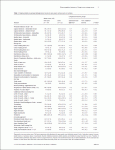
Regarding the paper itself 3rd_I_blind has done a great job at analyzing it and presenting various other interesting facts! In terms of the results presented in the paper (see attached), I'm not so sure that they represent no changes in performance. They try and justify their results with background information and by splitting the using group into heavy and moderate users but I'm not very convinced. I would trust a before and after use study a lot more.
 

Attachments

  • halpern_results.gif
    halpern_results.gif
    80.2 KB · Views: 45
No one should be arguing that MDMA is not neurotoxic in this thread. Even the referenced paper doesn't make that argument. It is about whether these structural changes lead to permanent cognitive deficits.

If we accept this at face value - that E is "neurotoxic" what does it actually mean in reality? Alcohol is neurotoxic but drinking a glass of red wine a day is good for your health. Go figure.

Every day we're alive our brains are suffering massive brain damage - brain cells die at an enormous rate. Is the idea that you always notice the damage to a few axons caused by E but not the million plus brain cells you lost last month from natural cell death?

Or maybe you don't have a schedule maybe 3 times a year?

All depends how I'm feeling. I go without for 10 months and then get through 10 grams in 3-4 months.

One powerful thing I noticed, when I first took E I used to get really bad depressions afterwards because I'd read that's what happened to you when you took E. Then after a while I started questioning the serotonin theory of depression. I found out it was all a load of fucking shit - low serotonin doesn't cause depression and never has. Once I stopped believing that theory I never got depressed from E ever again. Strange isn't it - just believeing that you're going to get depressed makes you depressed. Nothing to do with the drug - it's all to do with your perceptions of it.
 
As expected, all the scare stories about brain damage turned out to be a load of fucking horseshit:

http://www.guardian.co.uk/society/2011/feb/19/ecstasy-harm-brain-new-study

There is no evidence that ecstasy causes brain damage, according to one of the largest studies into the effects of the drug. Too many previous studies made over-arching conclusions from insufficient data, say the scientists responsible for the research, and the drug's dangers have been greatly exaggerated.

The finding will shock campaigners who have claimed ecstasy poses a real risk of triggering brain damage. They have argued that it can induce memory loss, decrease cognitive performance and has long-lasting effects on behaviour.

But experts who have argued that the drug is relatively safe welcomed the new paper. "I always assumed that, when properly designed studies were carried out, we would find ecstasy does not cause brain damage," said Professor David Nutt, who was fired as chair of the Advisory Council on the Misuse of Drugs by Alan Johnson, then home secretary, for publicly stating alcohol and tobacco were more harmful than ecstasy

May I point you to this article? http://www.guardian.co.uk/society/2006/apr/04/drugsandalcohol.drugs1
 
Didn't read much of the thread, but...

Come on guys, NO damage? So go ahead, take 5-htp every night and roll on clean pills every day for a month, then come back and tell us it doesn't do any damage. If that were true then why not roll daily? Or how about every 2 or 3 weeks you drop 5 pills at once, you'll notice problems after not too long from that too.
I thought we already knew abuse can cause brain cancer, and obviously the huge serotonin release will cause over stimulation of serotonin receptors. Are you guys this dedicated to staying in denial instead of moderating use? It seems like common sense to me, am I wrong here?
 
^^

I think the point of the article was that using Ecstasy doesn't cause problems. Obviously you can abuse anything in such an extreme manner that it can damage you - if you abuse water you will suffer massive brain damage.
 
Hey Ismene, some of my posts got deleted by a MOD. But i would like you to look at the E discussion and there are some threads saying like 'Russian roullete' and 'my choice to use MDMA has fucked me up' and others. I see countless threads like this all the time, and a lot of these people are moderate users. One of the people spaced out his usage by 3 years and has only dropped 7 clean pills total. Now he has a strong anxiety disorder which came out of his last usage, didn't i just bring up the point on how MDMA can switch psychological problems out of no where? What other drug does that, um i'd say methamphetamine and nothing. Just trying to add to my already valid arguments i had earlier in this thread, MDMA is a very harsh chemical. Proceed with caution
 
True, but the problem is when someone believes with all their heart that taking ecstasy is causing them damage that's enough to create symptoms even if they havn't actually got any damage.

I don't know if you heard about it but about 15 years ago in the UK there was a big scare story about living near electricity pylons. The moment the story became big there were hundreds of people going to their doctors saying they had terrible headaches, chronic depression - every symptom they'd read in the paper. One village was really suffering, almost everyone in the place had been getting excruiating headaches from the effects of these electricity wires. The electricity company investigated and found the wires hadn't even been fucking turned on for years.

Once a scare story becomes big, a certain percentage of the population will make themselves ill just by the placebo effect. Now I'm not saying that chronic use of Ecstasy can't cause you personality problems, but I'm saying we should be incredibly wary of accepting every kid that goes "I took ecstasy 6 months ago, and now I'm depressed, it must be the brain damage".
 
^
Obviously this is a major problem, but moderate use, even of clean pills, can still lead to obvious real problems. You may not be doing this, but many people try to look for reasons to say "MDMA couldn't cause any problems" because they love it and are in denial.... obviously massive unnatural serotonin release can lead to real problems.
What we also often don't take into account is what the average person taking ecstasy is taking, if they roll 5 times on 5 different kinds of pills, what do you think the chances are they don't get some methy pills and whatever else in there? Meth and MDMA both greatly potentiate the damage done by eachother. Pipes have their own problems I'm sure. The average user has pretty much no idea what they're buying.
 
Oh God I must be dead according to some of you people.

I'm in my 40's. Abused (in your terms) the living shit out of MDMA since 1989. Have many friends who've done likewise.

If ecstasy is a killer drug it's pretty shit at being so.
 
Top