• N&PD Moderators: Skorpio

Structure-minimzed THC derivatives

wungchow

Bluelighter
Joined
Dec 12, 2006
Messages
893
Location
nyc
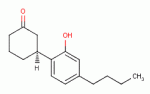
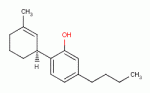
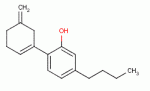
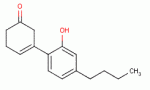
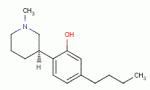
The other day I was thinking about how small I could make a CB1-agonist drug with effects similar to THC.

Some of these could be synthed fairly easily, then sprayed on oregano for a legal marijuana substitute.
 

Attachments

  • keto2.gif
    keto2.gif
    2.1 KB · Views: 98
  • methyl.gif
    methyl.gif
    2.2 KB · Views: 88
  • noiso2.gif
    noiso2.gif
    2.2 KB · Views: 89
  • nostereo.gif
    nostereo.gif
    2.1 KB · Views: 86
  • piperidine.GIF
    piperidine.GIF
    2.2 KB · Views: 71
^ olivetol is the resorcinol (two OH's) at the 3,5 positions to the amyl.
 
so, you can substitute the amyl for other substituants for longer acting/stronger analogs.
 
haribo1 said:
so, you can substitute the amyl for other substituants for longer acting/stronger analogs.

indeed
maximal potency is with the 1,2 and 1,1 dimethyl heptyl side chains. however the 1,1 dimethylheptyl analog of THC, nabilone is not too pleasant.

there is a huge amount of literature on analogs of THC and their SAR.
 
I thought nabilone was alright? Definitely not THC itself, cloudier, I think.

Actually, kind of the bad without the good of THC. Still, though, I didn't think it was particularly unpleasant, though. Probably something I'd try if I got it again, though.

Judging how enjoyable some of these obscure and hard to come by pharms is kind of difficult to tell how much I want to use it again and again if I can only get it once, you know? A once-off try is a little worthless.
 
nabilone and other DMH compounds are unpleasant because they are stronger partial agonists than THC, with a higher fat solubility and duration of action.

nabilone produces a greater intensity of the foggy, stupefying, sedative effects associated with CB1 receptor activation. if another OH group is added in the right position (like in CP55940) we get a *full* cb1 agonist which is capable of causing respiratory depression and hypnosis.

the three main required domains for partial agonism at cb1 are the phenolic -OH, side chain C(n)H(n+1) with 3<n<12, and a bulky alicyclic group ortho to the phenolic -OH
 
The only synthetic CB1 agonist I've tried was WIN55212-2, and that stuff is great, I liked it better than THC. Gets you stoned without clouding your thoughts and making you sleepy! There are a bunch of analogues of that which could be looked at, but they are all pretty structurally complex.

As for analogues of THC itself, well synhexyl and CP55940 are both meant to be pleasant although I've never tried them, and CP55940 is very unstable to temperature I'm told so can't be stored for long periods. I know someone who tried the HU210 as well and they said it was way too strong and long lasting, like a 9 hour K hole that made them unable to move from the couch.

So my feeling is that compounds which are equivalent or weaker partial agonists than THC are likely to be nice, but full agonists are not so good.

I wonder if you could feed cannabis plants alternative precursors (like with an n-hexyl or 1,1-dimethylheptyl chain attached) and get them to make the stronger analogues of THC themselves, the same way how mushrooms can be persuaded to make 4-HO-DET if you feed them DET. The biosynthetic route by which THC is made in the cannabis plant is known, so it should be easy enough figuring out which chemical to give them, might just be difficult getting them to take it up as I presume it would be very oily and non-water soluble.
 
The first structure, but with a dimethylheptyl side chain and a cyclohexanol rather than the ketone is called cp-44 something. It seems to be about the simplest structure necessary for activity. The equatorial alcohol is apparently several times more potent than the ketone or axial alcohol.

Saw a figure of history of development of cannabinoids and it went THC<DMH-THC<CP-44,xxx<CP55-940 so it sounds like it should be pretty strong, with reports here that 0.5mg CP55 is active.

Anyway, the analog of CP-44,xxx with a straight heptyl side chain was inactive at 5mg sublingual (DMSO). Erowid lists the dose for oral THC at 2.5-5mg (for chemotherapy? guess thats a strong dose?!). Surely the omission of the methyl groups wouldnt make that much difference? Anyone know if any straight chain thc analogs longer than hexyl have been made?
 
the two methyl groups on the side chain, when it is long, probably helps twist it into the correct conformation in the lipid membrane (which is its binding domain)
 
True, though i wouldnt expect it to be much less potent than with a hexyl side chain. The THC synthesis overview says n-hexyl is about 2x the potency of n-pentyl THC. Though it also says THC-V (1,2-dimethylheptyl THC) is 500x the potency, this would make it active at ~10ug! Anyway, im really confused! These numbers seem to be all over the place, anyone know if the 2.5-5mg listed on erowid is right?

Edit: Ok the thc synthesis overview says ~1mg/kg for THC, making THC-V roughly as potent as CP55940.
 
Last edited:
Seems though it is just a handful of 4-5 people i have seen comment on it that WIN 55,212-2 is genrally reviewed as a favorite and very pleasant ride even though it notable should have a ceiling of effect, though assumably that ceiling is high enough to get to a very nice zone that again from what i read appears to be a "cleaner" and "beautiful" cannabis/CB1 high

anyone else care to chime in

this is i believ not a schedule or analogue class drug in the US so something one can if they came into contact with it experiment with their mice collection as desired if i am correct in the above
 
also anyone got anything to say regarding Noladin ether or ACEA, more specifically i would think a "Meth"-ACEA is of possibel worth (using the methylation of methanadamide on this structure which sems obvious but i never saw it tested)
 
Well, THC is a partial agonist, but (and again stuff on this subject seems all over the place, almost like they were stoned) isn't it possible to kill yourself with a full agonist?
 
^ i do not believe so, i do not believe it can cause respiratory depression of that level or coma, but i may be wrong (and do not see any other potential mode to be fatal at CB1)
 
HU210 causes respiratory depression and you can certainly kill mice with it pretty easily, so I imagine a human could overdose also.

More to the point though, CB1 full agonists seem to have much more of a dissociative effect which goes way beyond the "stoned" effects that most people are looking for in these kind of drugs.

WIN55212-2 was very nice, but it cost $6/mg so was not cheap, the dose range was 1-3mg with a ceiling at around 3 (I took 5-10mg a few times and it doesn't get any stronger)

I don't think any of the anandamide derivatives are active, they don't seem to produce THC-appropriate responding in mice, I think maybe they don't cross the blood brain barrier or get metabolised super fast or something.

n-heptyl THC is available, CAS#54763-99-4

http://pubchem.ncbi.nlm.nih.gov/summary/summary.cgi?cid=6453074

Couldn't find anything about its effects, but more potent than THC itself I would imagine, this paper looks like it would have data but I don't have access to it.

New Analogs of Tetrahydrocannabinol. XIX
Roger Adams, Morton Harfenist, and S. Loewe
J. Am. Chem. Soc.; 1949; 71(5) pp 1624 - 1628

 
Top