• N&PD Moderators: Skorpio

Spectrophotometry as a cost effective method to quantify LSD samples

nuke

Bluelighter
Joined
Nov 7, 2004
Messages
4,190
I had a few thoughts the other day:
LSD samples are hard to quantify without laboratory access, which itself is likely to not be a private affair (and therefore pose a problem to the investigator).
Spectrophotometers are cheap ($50-$200).
Ehrlich's reagent forms a light absorbing compound when reacted with indolic rings.
While pure LSD to establish a relationship between absorption of light after reacting with Ehrlich's reagent is difficult to obtain, LSD only contains one indolic ring and therefore another compound with one indolic ring should be possibly to substitute, and the molar relationship extropolated from that data should also be applicable to samples of LSD reacted with Ehrlich's reagent.

Ergo:
One should be able to quantify samples of LSD for some value less than $200 if this were true.

Would this work? Phenols would complicate things since they also react sometimes, but something like 5-MeO-DMT might work to establish a relationship between solution molarity and absorbancy.

A related paper here:
A COLORIMETRIC METHOD FOR THE ESTIMATION OF CERTAIN INDOLES

The Ehrich reaction can, under standardized conditions, form the basis of a sensitive method of estimating certain indoles down to 1–2 μg/5 ml. An appropriate concentration of HCl in the Ehrich's reagent is essential. The concentration of trichloroacetic acid to give maximum sensitivity compatible with linearity between concentration of indole and absorbance must be experimentally determined. Absorbance should be measured between 530 and 580 mμ after a precisely measured time for colour development. Specificity can be increased by extraction of the colour complex into chloroform. The method has proved satisfactory for estimating the recovery of indoles from paper and thin-layer chromatograms and from silica gel columns.
http://www3.interscience.wiley.com/journal/119699672/abstract?CRETRY=1&SRETRY=0
 
Last edited:
1. The reaction of Ehrlich's reagent with indoles is not a common rule! It may work with LSD but not with indoles in general.

2. Why not measuring the LSD itself? It got a chromophoric system and should easily absorb UV. Also, one can 'use' the sample afterwards, which isn't possible when derivatized with Ehrlich's.

3. Ah yeah, btw: NICE IDEA!!!!

4.
LSD only contains one indolic ring and therefore another compound with one indolic ring should be possibly to substitute, and the molar relationship extropolated from that data should also be applicable to samples of LSD reacted with Ehrlich's reagent.
...
something like 5-MeO-DMT might work to establish a relationship between solution molarity and absorbancy.
...errrr, I think, that won't work. You can't extrapolate from one compound to another due to different absorptions coefficients. (these are compound-specific values!) Or did I understand something wrong?


But I like the concept in general. With some modifications, the idea could work.

PEACE! Murphy
 
Last edited:
"When treating ergot-alkaloids and related compounds (traces as impurities are enough) with 4-dimethylaminobenzaldehyde and Fe(III)-ion containing concentrated sulfuric acid, they will commonly yield blue colorations, being indole-derivatives with free alpha-position (Note: that is pos. 2 at the indole). The reaction mechanism is not elucidated unambiguously yet, so that the reaction conditions of the pharmacopeia must be followed exactly, in particular when applying this for quantitative measurements"
(from: Eger, Troschütz, Roth, "Drug Analysis: Reactivity, Stability, Analytics", Deutscher Apotheker Verlag Stuttgart 1999, 4th ed.)

Sounds like this method isn't very robust and tends to easily yield errors. The variation is known as "van Urk reaction".

Murphy

Edit: Btw, the color is thought to stem from this derivative:

 
Last edited:
you still couldn't determine active lsd compared to decomposed lsd (iso-lsd and lumi-lsd and the like) or leftover ergotamine with ehrlich's reagent, since those would also react.
 
Agreed! A purity control (i.e. quantification) in presence of closely related compounds (probably with closely related spectra, too) is quite complicated if not next to impossible.
 
So you think it'd work better via UV-visible spectroscopy?
 
i'd suggest using LC/MS (if possible with an enantioselective coloumn), but that defeats the whole purpose of using a low cost system.
 
Out of curiousity, what kind of Spectrometer were you referring to?

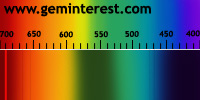
I have a portable diffraction-grating Spectroscope for gemological use. It can positively identify gemstones by displaying their absorption-spectra. For example:

sprs_rubisbirman.jpg

Ruby

There is simply no other stone that gives this very familiar pattern.

I've always wondered why these aren't used for identifying crystals of drugs. They're pretty cheap, too (under $50), but admittedly not all crystals (even of the same substance) produce an absorption spectrum.
 
Does it yield an absorbance value? The absorbance is used to determine a relationship between quantitive (when known) and concentration.
 
Hmm, well it is a purely optical device that yields exactly what you see above in the bottom bar. Can such value be calculated using the wavelength scales on the spectrum (assuming you have it on your lens, mine doesn't, but I have little use for it anyway)?

Oh, now that I think about it, I think I know why it isn't used for drugs: many of the absorption bands are caused by transition metals found in the stones such as vanadium, chromium, etc, most of which are absent from drugs.
 
I don't think so, absorbance from a spectrophotometer is usually given for a given wavelength. Colorimeters are similar but produce graphs of absorption values along the wavelengths of roughly the visible spectrum.
 
First, I was thinking that Nuke WAS already referring to UV/VIS-spectroscopy. What else could have been meant with "Spectrophotometers "?!

Jamshyd's device won't help here; it solely shows the wavelenght pattern of certain objects, without providing any means for quantification. The question why this wasn't used to identify drug crystals is easily answered: Normally drug crystals ain't big enough and (even more important), most drugs are colorless substances. The shown spectroscope does only analize the visible spectrum. (useful for coloured gems indeed) The scale is also not exact enough to be viable for identification of closely related compounds...

I'm still confused what Nuke thought about in the opening post if not UV/VIS-spectroscopy. :(

Murphy
 
I don't think so, absorbance from a spectrophotometer is usually given for a given wavelength. Colorimeters are similar but produce graphs of absorption values along the wavelengths of roughly the visible spectrum.

Ah, sorry, I had gone on a tangent actually.

I was not thinking of quantification at all, rather simple ID. There are cheap spectrometers on ebay for measuring "fruit sugars" - I assume these work on transparent and liquid/dissolved materials. Can we somehow adapt these for the benefit of drug identification?

Murphy: while chomophores are definitely the biggest producers of absorption spectra, clear objects will still produce absorption spectra simply through their refractive nature. Diamond is the best example - even the most colourless diamond still produces a familiar absorption spectrum. If pure carbon can, then certainly a carbon-containing compound will :)
 
I think you're right, but I'm just speaking from my experience with stones as well.
 
Top