• N&PD Moderators: Skorpio

So, why are there no phenethyltryptamine hybrids?

TacoSundae

Greenlighter
Joined
Jan 14, 2012
Messages
6
I was just thinking about how the difference between amphetamine and methamphetamine is a single methyl group, and it makes a huge difference.

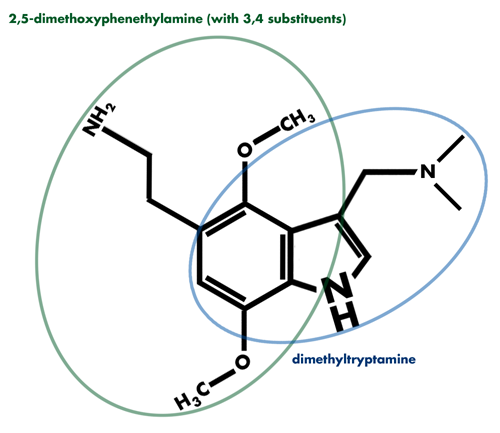
Sooo... why not swap out one of the methyl substituents on DMT's amine for some phenethylamine derivative? Or 2,5-dimethoxyphenethylamine? Or a 4-substituted version of 2,5-dimethoxyphenethylamine? If these compounds were possible, and showed any psychotropic activity, you would have potentially thousands of new compounds to experiment with.
Here's a quick sketch to show you what I mean. I used DMT and 2C-I since they're probably the structures everyone is most familiar with:

bViyo.png


It's not a stretch to imagine tacking on opiates to psychedelic compounds either (which would yield hundreds of thousands/millions of new molecules). Again, I'm 99% sure this has already been thought of and educated chemists considered it too stupid to be worthy of serious consideration. What I'd like it know is why?

Would it not pass the BBB? Would it be inactive for other reasons? Would the molecule itself not be stable? Have we simply not figured out a synthesis for it? I'm a reasonably competent synthetic organic chemist and the synthesis seems, if not simple, at least plausible. The molecule itself, or simplified versions of it, seem like they would be at least as stable as, say, LSD. Obviously I realize that chemical compounds are more than the sum of their parts, which is why I have every expectation that these compounds would be inactive at best about perhaps even toxic. It seems like if it were a viable route to psychoactive substances Shulgin would have written a book about it. Just curious if anyone has tried these types of syntheses or if there's any literature published about this.

 
You can theoretically attach anything to anything but that doesn't mean it will work like a sum of its parts. In fact, in pharmacology such combinations rarely work at all. In the case of psychedelic drugs, they have very specific chemical structures and properties that allow them to bind to certain areas of receptor proteins. Joining them to other random molecules will more than likely destroy their ability to bind to the sites you want.

An analogy:
You have two different cars and want to make them into a single, more useful car. You wouldn't just weld them together end-to-end. The resulting vehicle would be practically useless and wouldn't perform the functions of either individual car. Instead, you would analyze each part of both cars and assemble the components into one vehicle.
 
No. Even if they did separate you would be left with Tryptamine and 2C-I (without an amine) or vice versa.

In conclusion this is a horrible idea.
 
Thank you for responding. Again I know very little about the chemistry of the human brain, so I appreciate your patience. What about something like this:

47FFE.png


It seems to be much more in line with what you were saying about paying attention to functional groups rather than just "welding" things together. Do you think there is a possibility that such a compound might be psychotropically active? There's a relatively electronegative secondary amine on the 4 carbon (where an electronegative halogen would be in 2C-I/B/C). Is there any way to predict which compounds will bind to which areas of certain receptors, other than experimentation?

As a secondary question for people who know the human brain: Are there any compounds that you don't know to have been synthesized but which you predict would show some psychotropic activity?
 
Also I'm not actually suggesting that I am going to synthesize any of these and try them. I'm not insane, just curious.
 
This is kind of like grafting wings onto a car and saying "hey guys I made a car AND a plane in one vehicle!" Unfortunately your plane-car will function well as neither...

The reason you don't see any bastard hybrids of tryptamines and phenethylamines is they bind in very different orientations (at least at 5ht2aR). There are quite a few tip-offs that the two classes are not so closely interrelated as people make them out to be - for instance N-benzylation of phenethylamines produces the 25x series, high-activity psychedelics active at below 1mg, but N-benzylated tryptamines are actually antagonistic to psychedelics...

The 5-HT2a receptor like any other G-protien coupled receptor, haqs only a limited amount of space to accomodate ligand binding. So if you start lumping compounds together and building really big ones, unless they fit almost exactly (LSD, 25x) you will find they lack activity.

Really the only argument I can produce is empirical observations and computer models of psychedelic activity don't show activity for "middle ground" compounds, unless they are very specifically oriented (LSD, ibogaine).

Are there any compounds that you don't know to have been synthesized but which you predict would show some psychotropic activity?

Go ask Dr. Nichols, not random guys on the net lol
 
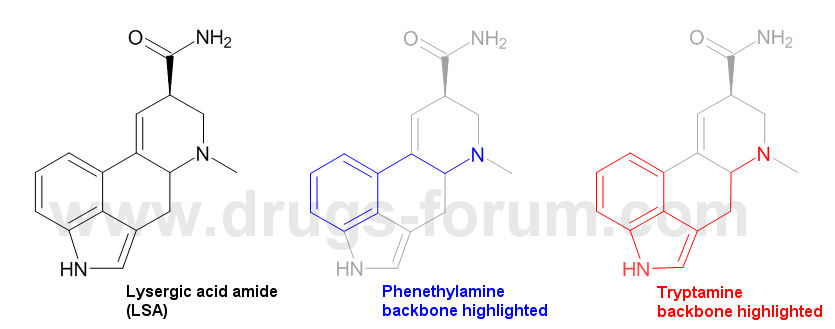
there is one class that is a combination of phenethylamine and tryptamine structures; the ergolines

LSAbackbones.png
 
^That's what I was going to say, although its really a special case (ergolines technically shouldn't even be active when considered from the phenethylamine perspective, because they are tertiary amines... but again, they are a special case, essentially being constrained tryptamines that are able to present such a planar surface to the receptor, and are thus incredibly good ligands).

And sekio gave a great answer as well (as always).

Aside from that, would you really think its that simple OP? "Let's just slap two of these things together and make a super-thing".... no, it doesn't work that way (and if it did, do you really think you'd be the first person to think of the idea?). The tryptamine SAR is totally distinct from the phenethylamine SAR, and they are both quite nuanced.
 
Last edited:
there is one class that is a combination of phenethylamine and tryptamine structures; the ergolines

LSAbackbones.png

Well... that's damned fucking interesting! Given that the above applies to LSA, could it be suggested to the less dense layman that the molecular structure of LSD shares similarities with both Tryptamine & Phenethylamine psychedelics? If so I very much look forward to discussing this with someone who asked me very recently what group of drugs LSD comes from (this one even I could answer) & what other psychoactive compounds might be structured similarly. This question I felt quite different from the usual, "how do the effects of LSD, psychedelic Tryptamines & Phenethylamines compare, which through a little experience & plenty of anecdotal evidence, I could also answer, at length.

Seeing the various molecules lain over each in pics such as those above illustrates this beautifully &, certainly to myself, explains the huge cross pollination of effects between LSD & other classes of classic psychedelic of the Tryptamine & Phenethylamine sort.

Very interesting thread for me, good job. It's not often ADD doesn't fly quickly straight over my head Lol
 
The fact that ergolines "contain" both phenethylamines and tryptamine backbones is nothing more than trivia and provides no explanation at all for LSD's unusually strong effects,
 
If only it were possible to make both a dopamine-NE-5-HT releaser that was also a mu opioid agonist. Basically just methamphetamine and oxycodone's properties in one chemical. It'd be the perfect drug.
 
There are pethedine analogs that fit that description (triple monoamine releaser + opioid) but as far as I know the controlled substances act kind of limits their usage.

And hospitals already have enough trouble with abuse of the even moderately euphoric analgesics like fentanyl... do you really want stocks of a morphine+MDMA analog in your hospital pharmacy? It's like having a big neon sign saying ROB ME PLEASE. I give it 3 weeks between the pharma stocking the new drug and someone driving an armored car through the plate glass windows of the hospital lobby...
 
There are pethedine analogs that fit that description (triple monoamine releaser + opioid) but as far as I know the controlled substances act kind of limits their usage.

And hospitals already have enough trouble with abuse of the even moderately euphoric analgesics like fentanyl... do you really want stocks of a morphine+MDMA analog in your hospital pharmacy? It's like having a big neon sign saying ROB ME PLEASE. I give it 3 weeks between the pharma stocking the new drug and someone driving an armored car through the plate glass windows of the hospital lobby...

I was joking, well kinda. I was joking in the sense I don't actually think it'd have any uses and I don't think time and effort should be put to making it, but if it were to be made it'd be nice :P I thought of it because when you combine the two they don't really feel much like either individual drug and more of a new type of high.
 
Top