• Psychedelic Medicine
  • Psychedelic Medicine Moderator: mr peabody

SAN PEDRO | +40 articles

Ruysen-Venancino.jpg


Mescaline as Therapy*

by Dave Hodes | Green Market Report | 10 Feb 2022

The exploration of other types of psychedelics is common now, with MDMA, 5-MeO-DMT (toad venom), LSD all getting attention for different mental health treatment studies and different therapeutic interventions.

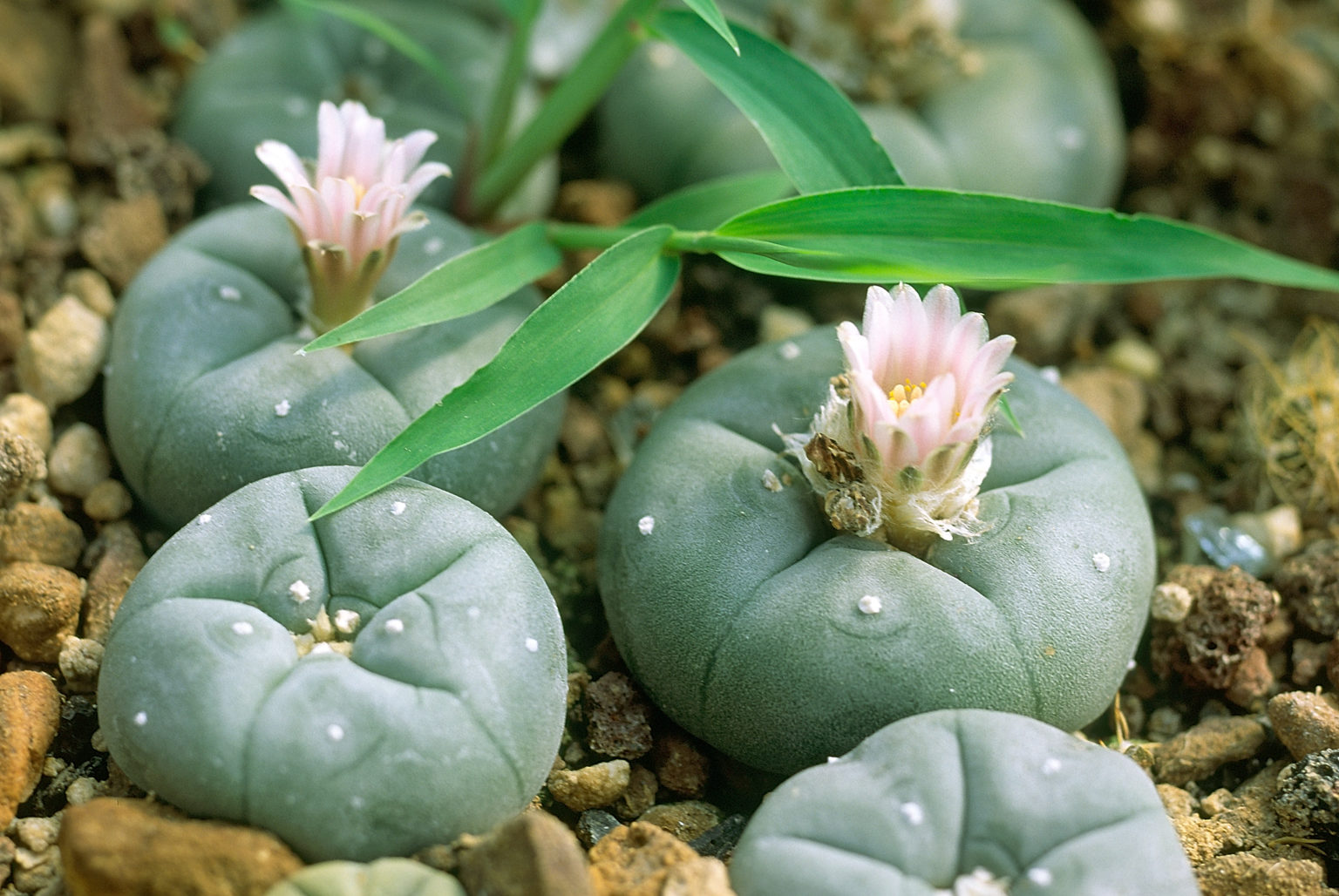
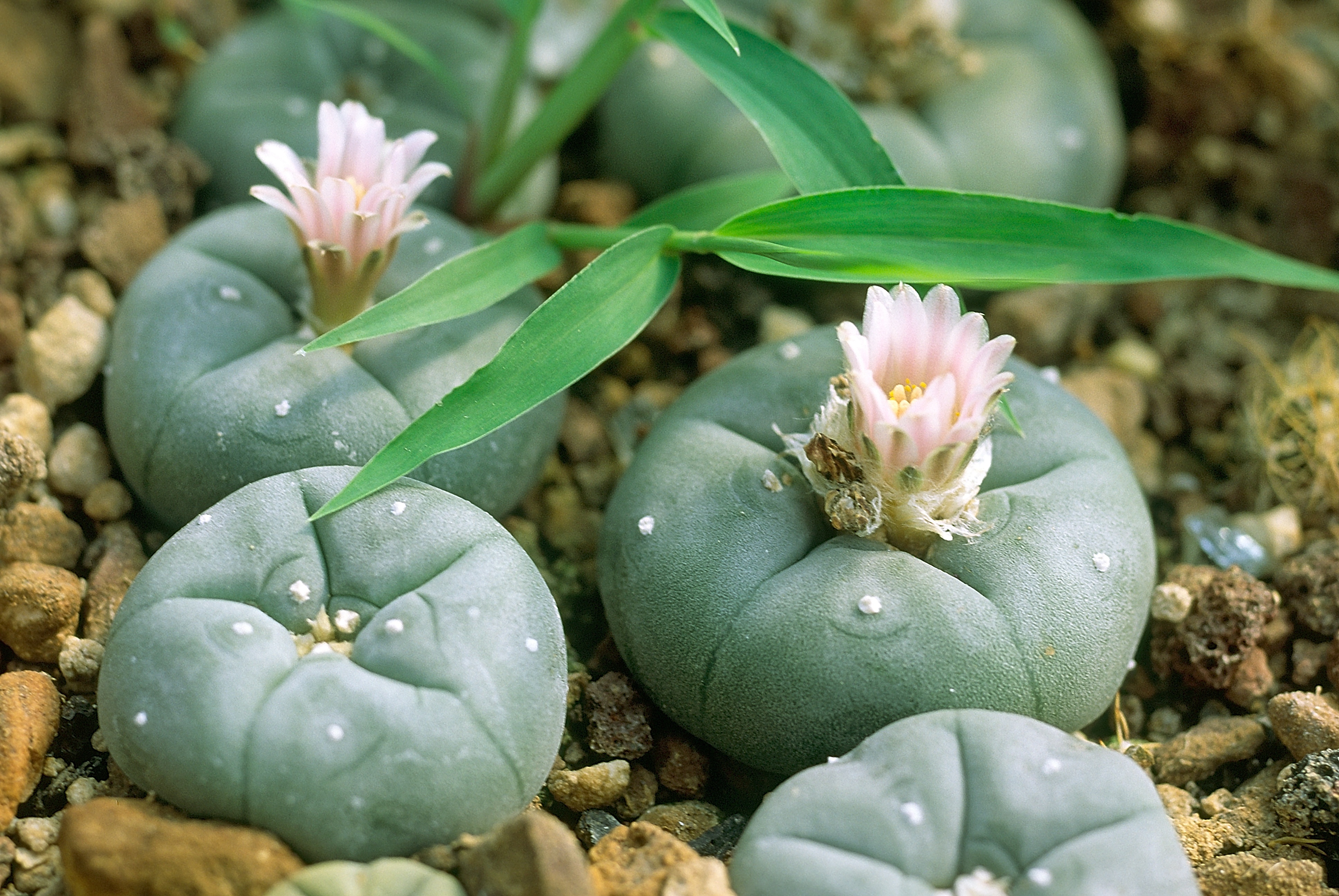
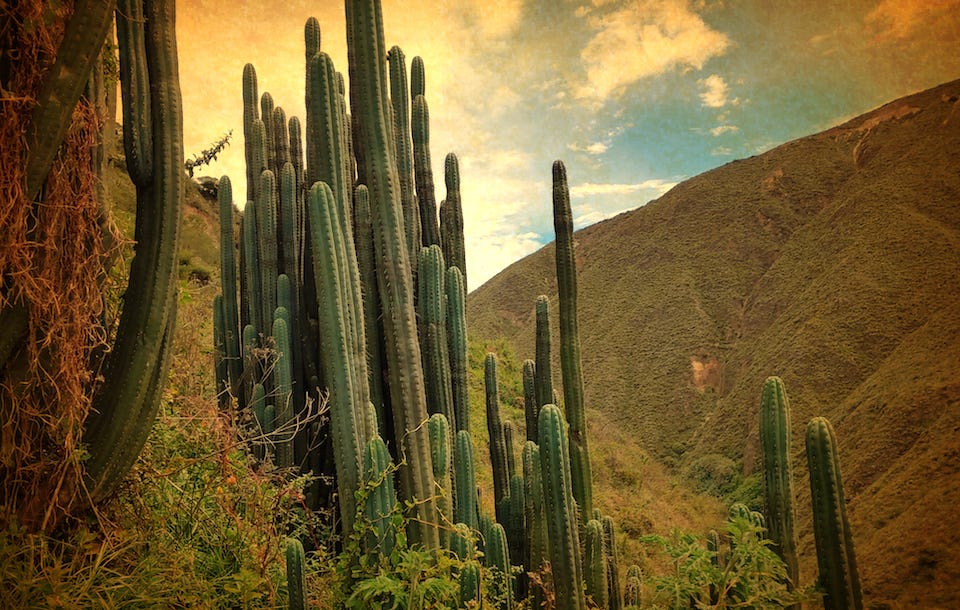
But mescaline, derived from either the San Pedro cactus (native to the Andean slopes of Ecuador and Peru), or the peyote cactus (found in the limestone soils of the Chihuahuan desert of southern Texas and northern Mexico) stands out as a different kind of psychedelic off the radar of the psychedelics industry—so far.
Though some research has examined the effects of mescaline in humans—for instance, Alexander Shulgin’s work in the later part of last century—clinical research investigating mescaline as a potential therapeutic aid has been lacking.

There are problems about working with mescaline. For example, to get the full effect of the San Pedro mescaline, it is estimated that someone would have to eat 750 grams of slimy, bitter plant material.

As derived from either plant, mescaline is physically difficult to take. Experiences and outcomes are harder to predict, and generally take too long from start to finish. But researchers know there is something significant here to discover and bring into the psychedelics industry.
Like many other psychedelics, mescaline has a long history of use. Indigenous people in North and South America used it for religious ceremonies dating back 5,700 years. That continues today.

According to “Mescaline: A Global History of the First Psychedelic,” by Mike Jay, a scientific and medical historian, mescaline was isolated from the peyote cactus by a German chemist, Arthur Heffter in 1896, and was the first naturally occurring psychedelic alkaloid to be isolated in a lab.

People who began using it then described bouts of nausea followed by long-lasting uncontrollable hallucinations. They reported experiencing racing heart and difficulties breathing. Depression. Insomnia. Delusions that turned into paranoia.

Mescaline, it seems, developed a bad rap.

Mescaline was eventually synthesized in 1919 by a chemist at the University of Vienna, Ernst Spath, and researchers thought it could help them understand schizophrenia. It didn’t.

Both the Nazis and Americans experimented with it during World War II as a sort of “truth serum.” That didn’t work either.

But there were people who challenged and added to the knowledge base of mescaline, famously Aldous Huxley who described his trip experiences in his 1954 book “Doors of Perception.”

Today, more than 100 years after mescaline was first synthesized, there finally appears to be movement on the question of whether it can be used as another psychedelic plant for mental health treatment.

Native Americans interviewed by Michael Pollan for his book, “This Is Your Mind on Plants,” told him that their peyote ceremonies had done more to heal the wounds of genocide, colonialism, and alcoholism than anything else they had tried.

Peyote is legal for Native Americans. Its use is constitutionally protected in the U.S. on the basis of religious freedom when used by the Native American Church. And it’s these ongoing experiences by native Americans that have become the basis for understanding the effects of mescaline, and a guide for more research.

In 1992, researchers studied the psychological, neuropsychological, and neurometabolic effects of mescaline in 12 normal men as a method of studying psychosis. They found that mescaline produced an acute psychotic state within 4 hours after drug intake.

But was that the best use of this plant medicine? Shouldn’t mescaline get a better chance of finding its place in the booming psychedelics industry as a wellness treatment? Maybe. But there are still a number of practical issues to resolve.

While peyote is considered endangered in some areas of Mexico, it can be freely grown in any greenhouse. But it is a difficult plant to cultivate, and can take a long time to grow in a greenhouse (peyote takes up to 25 years to grow in the wild).

The San Pedro cactus grows rapidly and is not an endangered plant. But not all San Pedro cacti have the same mescaline concentration, and two cacti grown from the same seed pod may have very different mescaline contents. To make estimating potency even more complicated, mescaline content can vary depending on when a plant was harvested or the conditions it was grown in.

Then there’s this: Peyote’s ongoing cultural significance to Native Americans played a role in recriminalizing it in Santa Cruz in 2021 after it was decriminalized two years earlier. Decrim advocates apologized to the Native American Church for their “lack of cultural sensitivity.”

In the meantime, there are a handful of companies taking a shot at mescaline development. Lophos Pharma, a Toronto-based bioscience company recently acquired by Greenridez 2.0 Acquisitions Corp., specializes in peyote research, cultivation, preservation, and drug development, and will be working on treatments using peyote for weight loss, drug addiction, anxiety and depression.

Other leading psychedelics development companies such as Compass Pathways, MindMed, Xphyto Therapeutics Corporation and Numinus are all exploring mescaline product development.

There have been other encouraging developments recently that mescaline may be catching on. For example, there was a slight uptick in clinical studies about mescaline in 2021.

Presumably, with new agri-technology for cultivation, and better research about how the plant grows—perhaps about how to grow peyote faster, or how to control the mescaline content of the San Pedro cacti—mescaline, the first psychedelic, may become tomorrow’s psychedelics superstar.

But for now, it’s been relegated as a sort of look-see, back-burner problematic substance that needs much more overall research. So.. stay tuned in.

The post Mescaline As Therapy Is Getting Attention, Despite Stigma appeared first on Green Market Report.

*From the article here :
 
Last edited:

Flora+Grubb+Gardens+San+Pedro+cactus+plant+for+Bay+Area+gardening.png


The Ancient Wonders of the San Pedro Cactus

by Tyson Curtis | Flora Grubb Gardens | 9 Apr 2021

The popular cactus Echinopsis pachanoi (syn. Trichocereus pachanoi) is known by many names, most commonly ‘San Pedro.’ This cactus is fairly common, and no doubt you’ve seen it around—we often have it in stock here at Flora Grubb Gardens, our San Francisco nursery!—but if you dive deeper there’s so much to learn.

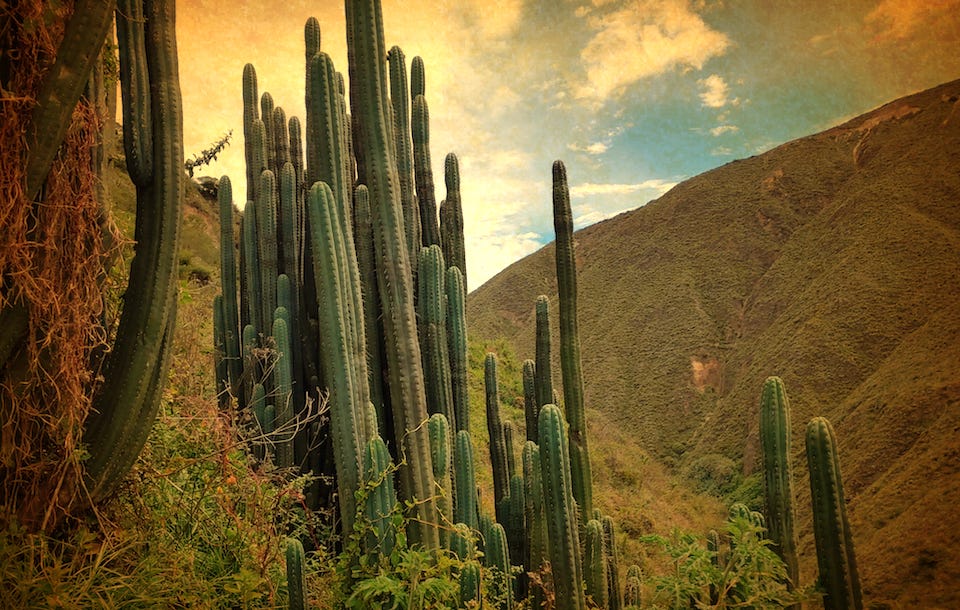
Echinopsis pachanoi grows in rocky, well-drained soil along the entire length of the Andes mountains, stretching from Argentina to Ecuador. A high altitude native (6000-9000 feet), this plant thrives in cold climates down to 15 degrees F.

Any cactus grower will tell you that a minimum temperature guideline usually means “when dry,” but not so with San Pedro! Most cactus get rainfall during their warm season, and so are likely to fail when exposed to a wet winter, even if they can tolerate much colder temps in habitat—but San Pedro, in its mountain habitat, receives ample rainfall while still enduring quite cold temperatures. This makes it one of the best candidates for a Mediterranean climate (like ours in the Bay Area). It just needs a bit of additional summer water to thrive.

Flora+Grubb+Gardens+San+Pedro+cactus+and+other+euphorbia+and+succulents+for+landscape+design+in+San+Francisco.png


The history of San Pedro is intertwined with Andean culture and traditional medicine, with archaeological evidence showing healers using the plant for religious divination as far back as 3000 years ago.

Flora+Grubb+Gardens+Ecihinopsis+pachanoi+cactus+in+the+wine+country+garden.png


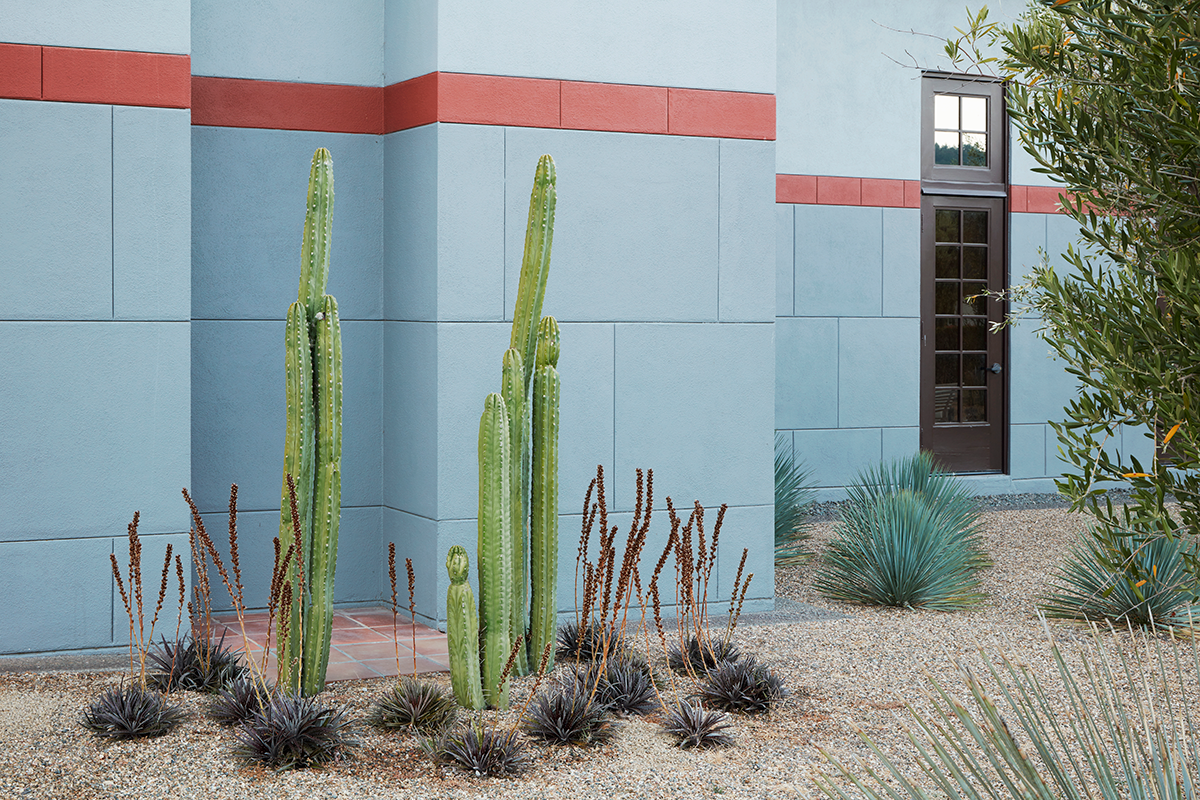
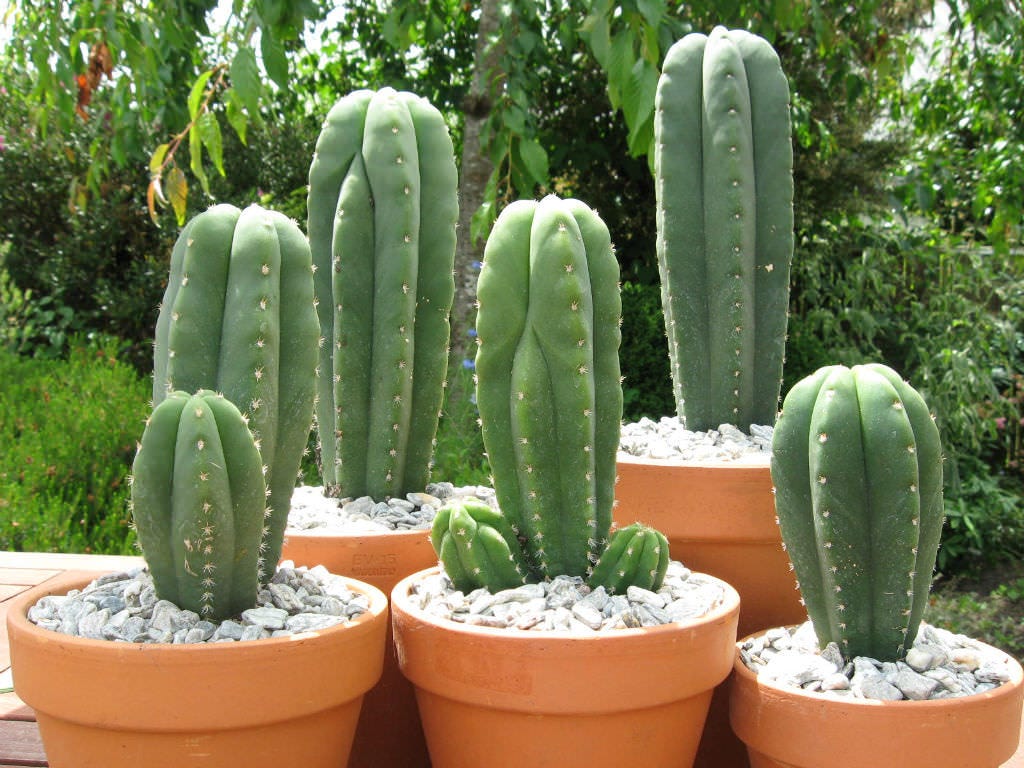
We love Echinopsis pachanoi for its ornamental uses in the garden. As a sturdy vertical design element it’s second to none, able to fit into tight spaces and growing 10-20 feet tall. A single stem will pup and branch, creating a staggered clump of fast-growing spires with a well-balanced form. Unlike other columnar cactus, San Pedro is relatively unspined, increasing its usefulness around patios and walkways, in pots and even indoors in a sunny spot.

Flora+Grubb+Gardens+San+Pedro+cactus+and+other+succulents+in+terra+cotta+pots.jpg


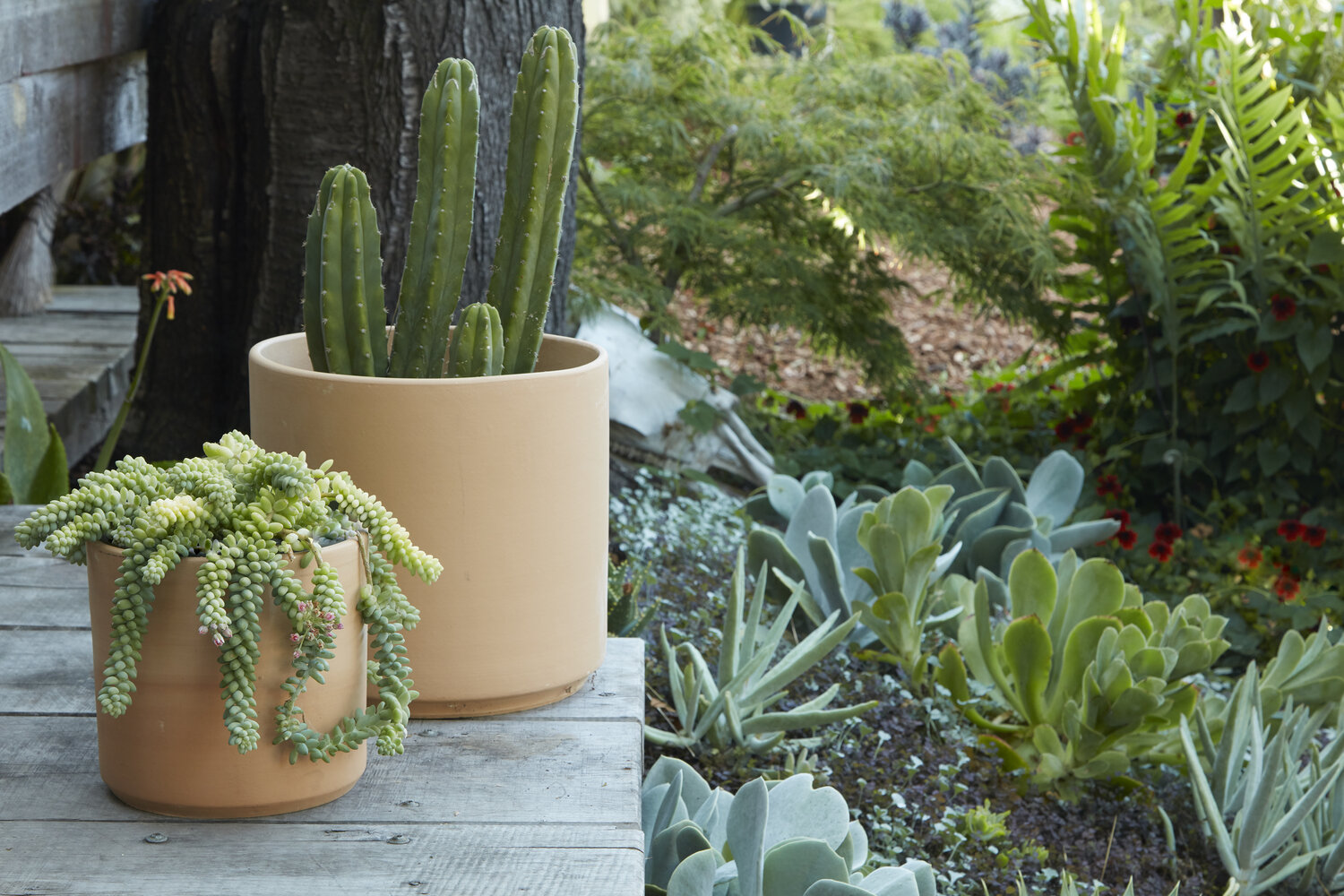
Since these plants are native to a higher rainfall area, they will tolerate overwatering, with good drainage, making them easier to intermingle with other plantings, allowing designers to set softer plants against them for contrast. In fact these cactus prefer even watering, especially during the dryer months. About the only problem we encounter is yellowing, which happens when people relinquish water entirely, plant in heavy clay, or never fertilize. San Pedro appreciates fertilizer more than other cactus and will reward you with fast growth and vibrancy.

Flora+Grubb+Gardens+San+Pedro+cactus+huge+white+flower+for+San+Francisco+landscape+design.png


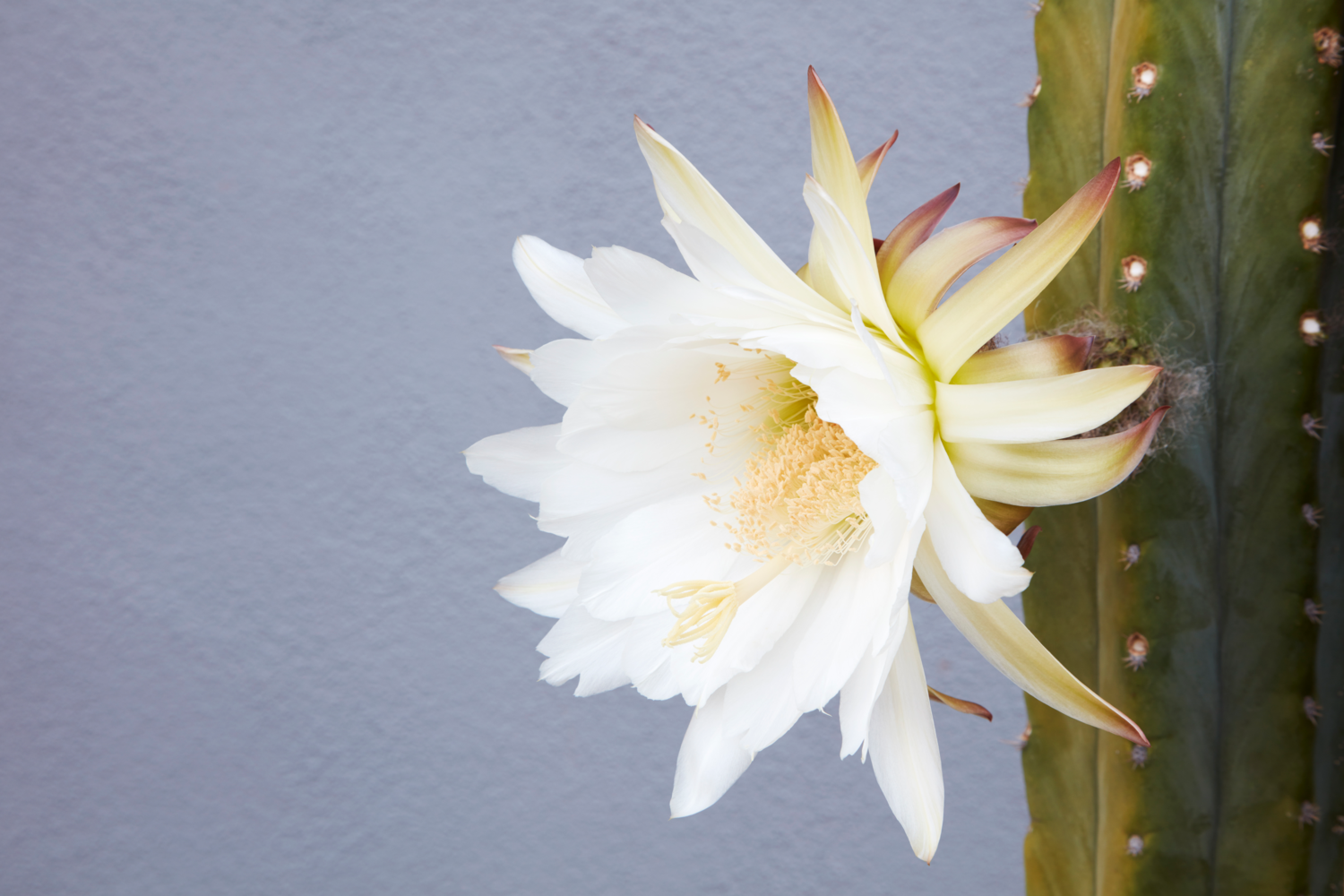
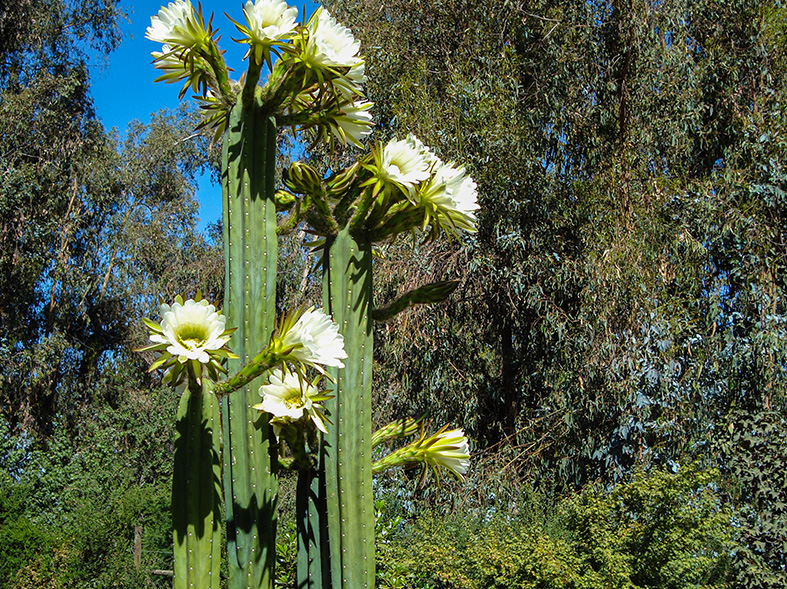
Maybe the most notable aspect of Echinopsis pachanoi are the huge white flowers, found in abundance on established specimens. These fragrant flowers are tubular and almost ten inches long and wide! The unusual size relates to the overly-large hummingbirds that pollinate them in the Andes, though they are also moth-pollinated. Since the pollinators are nocturnal, you’ll find that these huge white flowers open at night, making San Pedro an ideal candidate for a moon-viewing party in your new garden!

Flora+Grubb+Gardens+Echinopsis+pachanoi+San+Pedro+cactus+grown+in+Southern+California+for+Bay+Area+landscaping.png


We grow this plant ourselves down at Grubb & Nadler Nurseries in the gorgeous Rainbow Valley, so we often have it in stock here at FGG. Come see us soon!

Visit us at Flora Grubb Gardens in San Francisco to see our wide selection of interesting cactus plants.

For more of this kind of inspiration, delivered to your inbox, join our mailing list.

 
shutterstock_186044744-1536x1028.jpg


The Compounds in Psychedelic Cacti*

Mescaline is the best-known phenethylamine in psychedelic cacti; but what about the other “minor” compounds in those cacti?

by Barbara E. Bauer, MS | Psychedelic Science Review | 1 Nov 2021

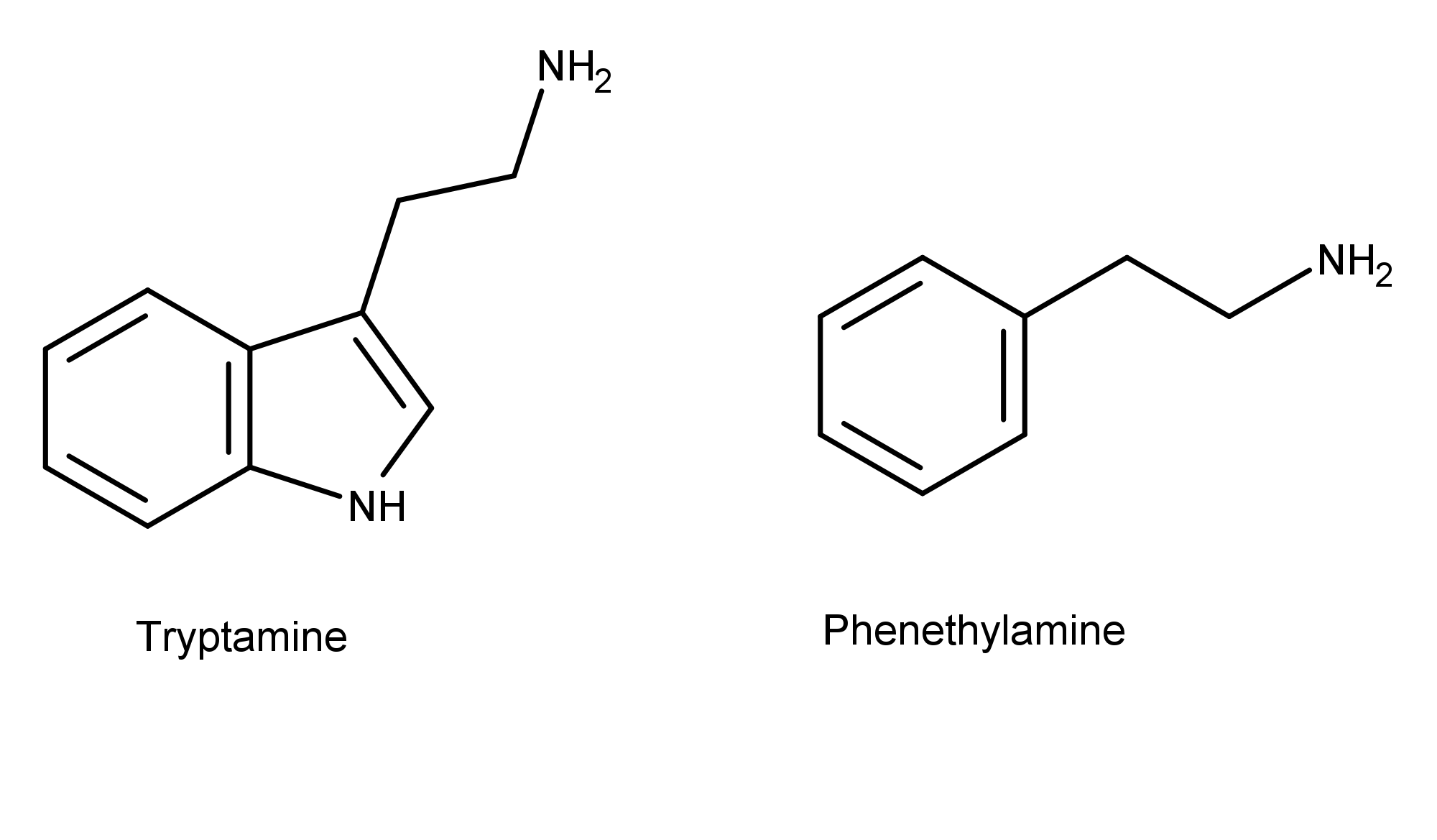
Scientists are learning that psychedelic compounds abound in nature. In addition to tryptamine compounds found in magic mushrooms and toad venom, psychedelic cacti provide a source of naturally occurring psychoactive phenethylamine compounds. The image below illustrates the difference in the chemical structures of tryptamine and phenethylamine.


Mescaline is probably the most well-known compound in psychedelic cacti. Species that contain it include the San Pedro cactus (Echinopsis pachanoi), Peyote cactus (Lophophora williamsii), and the Peruvian Torch cactus (Echinopsis peruviana). Peyote, in particular, is unique because archaeologists have found evidence of its use by Native Americans as far back as 5,700 years ago, making it the oldest known plant containing a bioactive drug compound. Mescaline was first synthesized by Ernst Späth in 1918.

In their classic book “PiHKAL: A Chemical Love Story,” Alexander and Ann Shulgin called mescaline one of the “Magical Half Dozen” compounds that they considered the most important out of all those they synthesized and studied.

Other compounds in Psychedelic Cacti

In addition to mescaline, psychedelic cacti contain other psychoactive compounds. Many of those compounds remain untested (and probably many still undiscovered) so researchers don’t have a clear picture of which ones may have psychedelic/therapeutic effects and may be involved in entourage effects and/or allosteric modulation.

In 1969, Richard Evans Schultes stated in a paper in Science that, “Peyote contains at least 15 ß-phenethylamine and isoquinoline alkaloids.” He went on to say,
The intoxications induced by mescaline and by Peyote itself are very different, but they have unfortunately been confused in the literature.

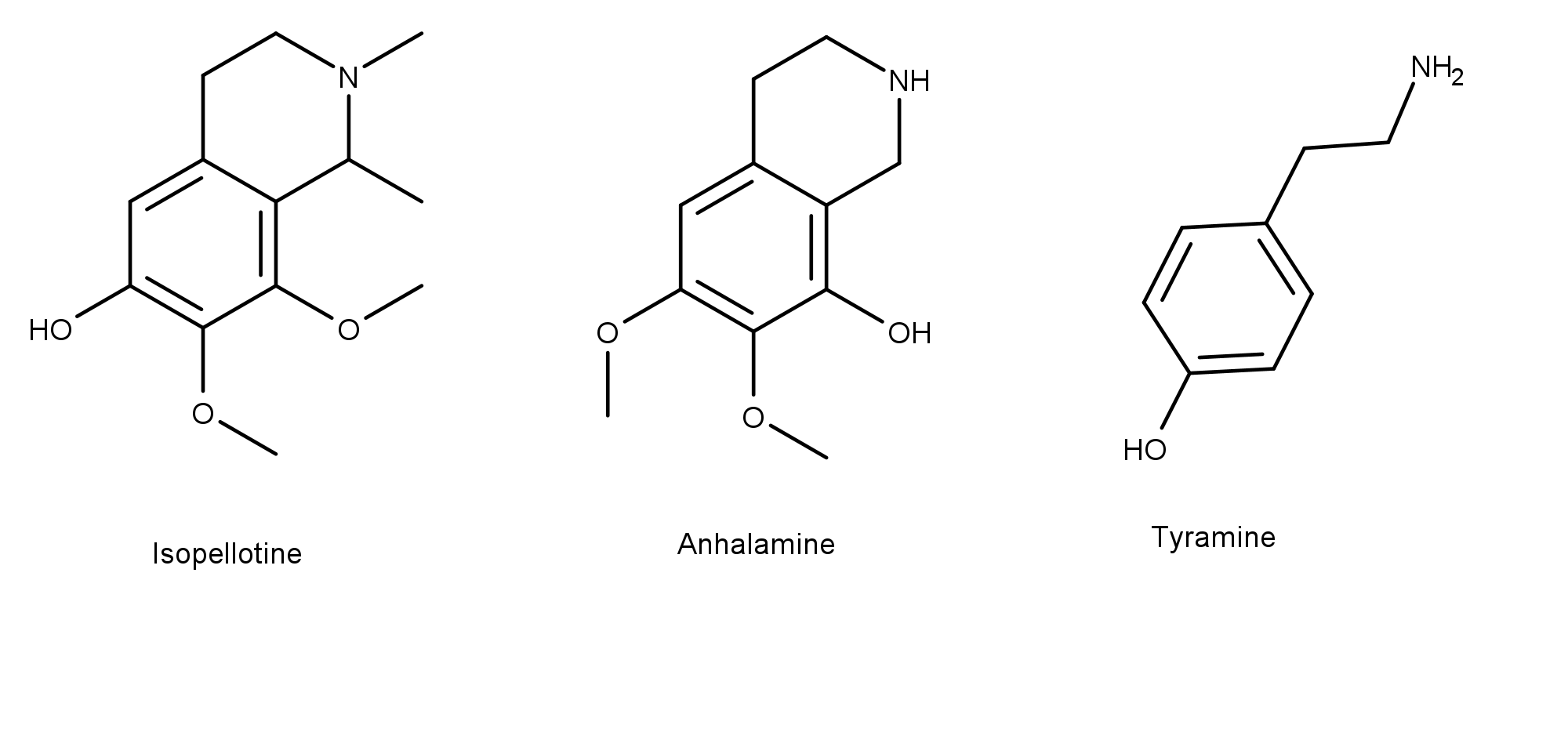
Research done in the 1970s identified compounds in the Peyote cactus including isopellotine, anhalamine, and tyramine.


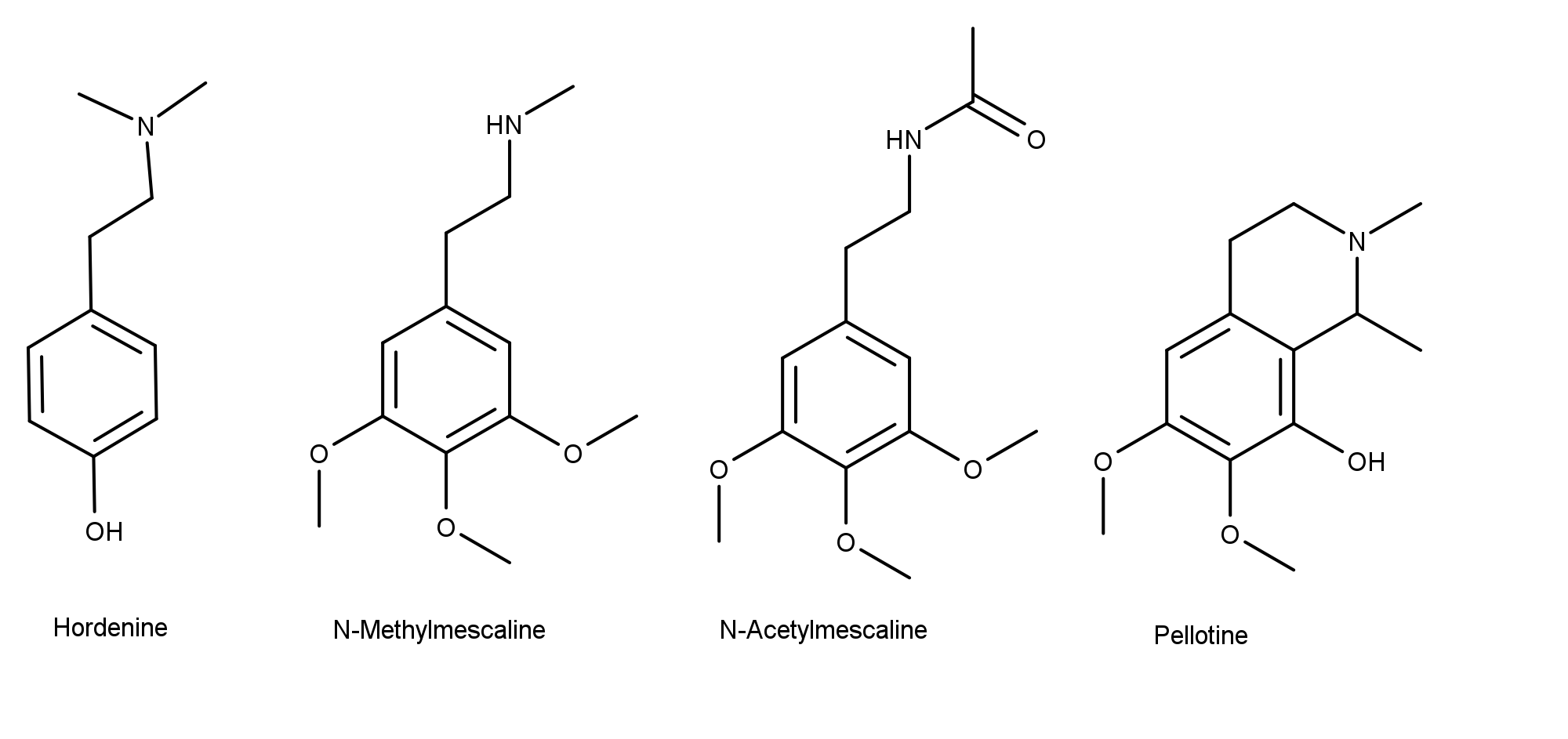
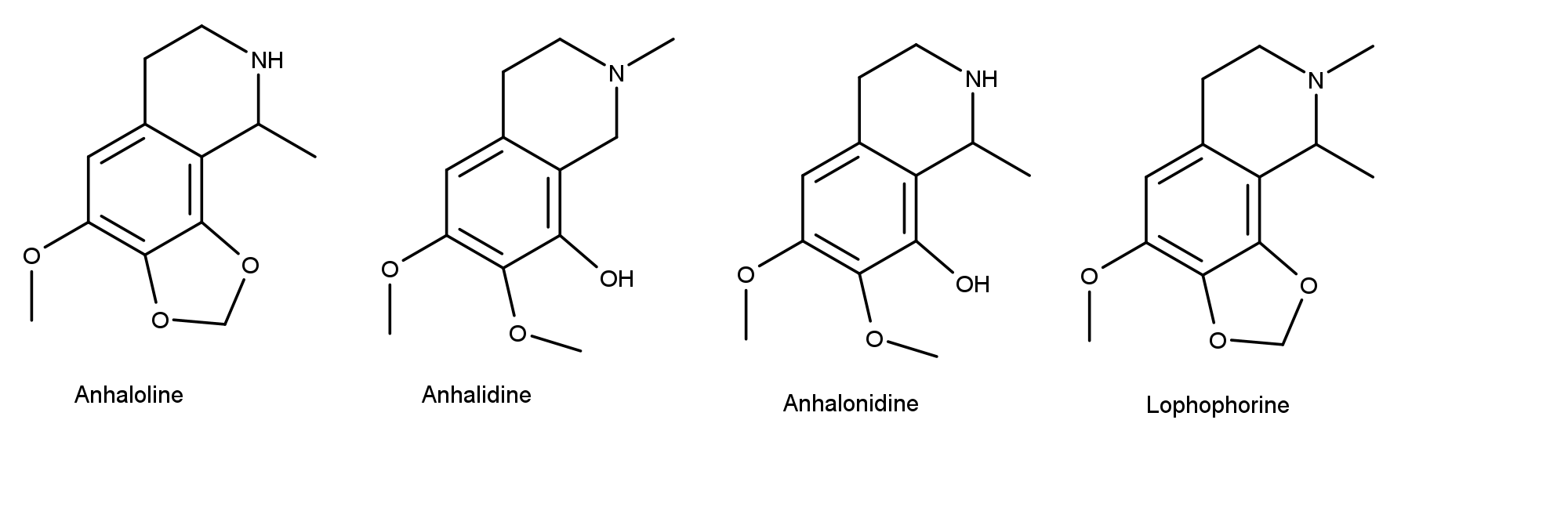
In 2015, Ibarra-Laclette et al. detected the following compounds in Peyote (and others identified previously) using GC-MS (gas chromatography-mass spectrometry):​
  • Mescaline​
  • Hordenine​
  • N-Methylmescaline​
  • N-Acetylmescaline​
  • Pellotine​
  • Anhalonine​
  • Anhalidine​
  • Anhalonidine​
  • Lophophorine​


Interestingly, the authors found that, while abundant in the “buttons,” mescaline was “barely present” in extracts obtained from Peyote roots, while hordenine (which has antibacterial properties) was found only in the roots.

Further, based on their literature review, Ibarra-Laclette et al. stated, “Not all of these substances exhibit psychopharmacological activity when administered singly, but in combination, they apparently potentiate the effects of the mescaline and definitely alter some characteristics for the experience.”

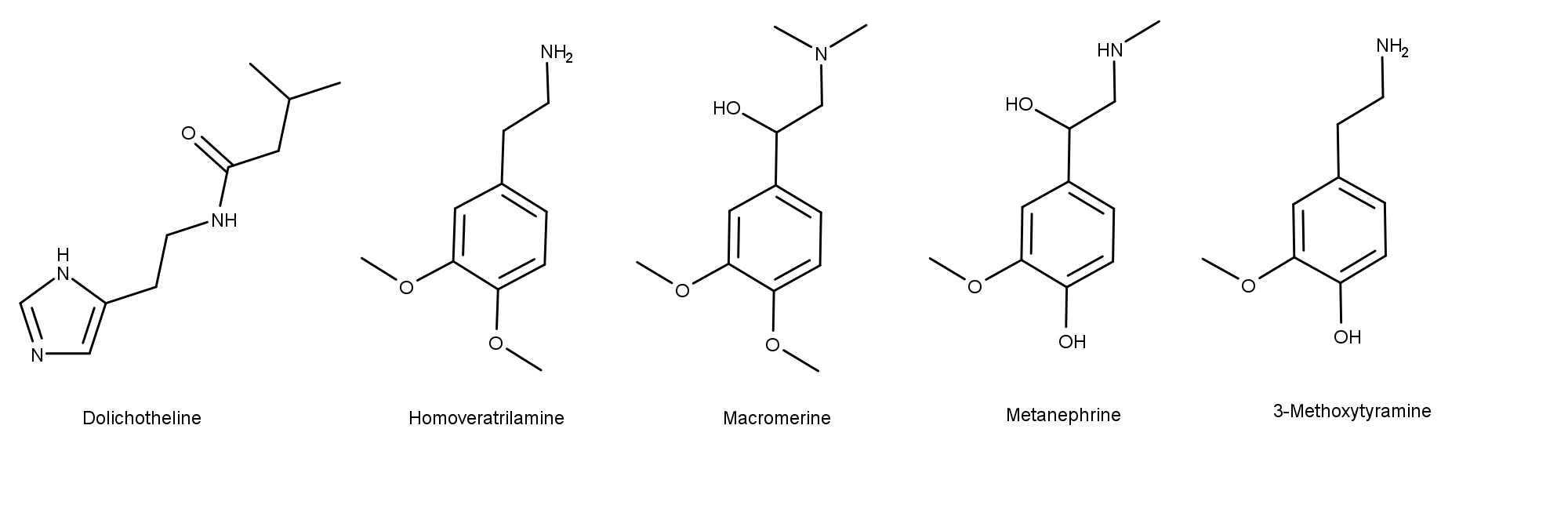
In addition to those listed so far, in the 1977 book “Peyote and Other Psychoactive Cacti,” Adam Gottlieb listed the following compounds in his ‘Dictionary of Cactus Alkaloids.’​
  • Dolichotheline​
  • Homoveratrilamine​
  • Macromerine​
  • Metanephrine​
  • 3-Methoxytyramine​
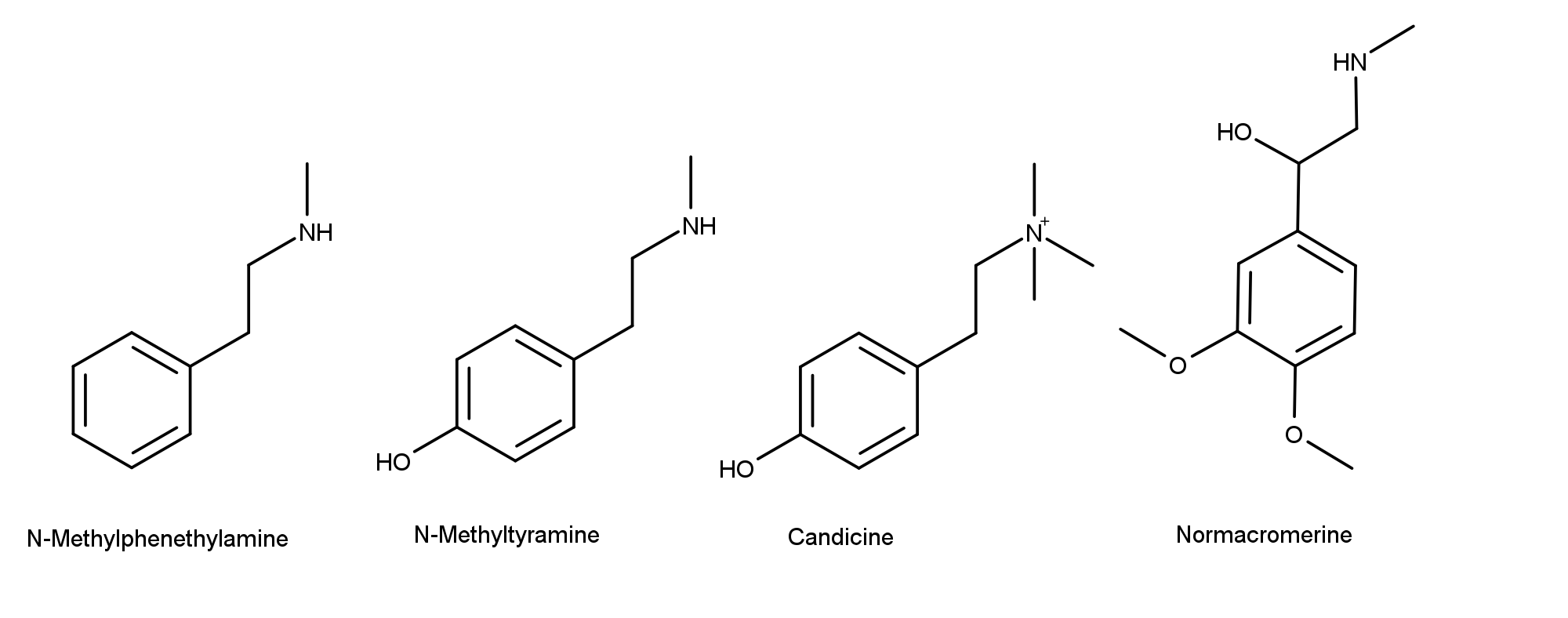
  • N-Methylphenethylamine​
  • N-Methyltyramine​
  • Candicine​
  • Normacromerine​


Here, the compound candicine is particularly interesting because it is a quaternary ammonium compound. The magic mushroom compounds aeruginascin and 4-HO-TMT also have this functional group.

Like magic mushrooms, the chemical composition of naturally occurring cacti appears to be highly variable. In 2010, Ogunbodede et al. analyzed the mescaline levels in the cortical stem from several San Pedro cactus samples. They observed that “The range of mescaline concentrations across the 14 taxa/cultivars spanned two orders of magnitude, from 0.053% to 4.7% by dry weight.” These data may bring to mind how much the levels of a single compound can vary in magic mushrooms and toad venom, and likely in other organisms.

Continuing research on Psychedelic Cacti

Clearly, there is much mystery still surrounding the chemical composition of psychoactive cacti– including the identity of all the active compounds and the concentrations of those compounds. Just like magic mushrooms and toad venom, it is feasible that these compounds have synergistic effects on the body. But it’s all speculation until scientists identify all the compounds in these cacti, elucidate their pharmacology, and understand how they work together to produce certain effects.

*From the article (including references) here :
 
1*-_4f0G1WsRvC7Sd52y-XMQ.jpeg


Macrodosing Mescaline*

by Jerry Toth

Not all San Pedro journeys are created equal. There are several key variables that influence the quality of the experience. Reaching critical mass with dosage can be the difference between disappointment and ecstatic connection with the fundamental nature of existence. Knowledge about different preparation methods and mescaline potency is useful. As always, the principle of “set and setting” applies. And there’s a few things you should definitely not do.

The suggestions contained in this article are based on seventeen years of personal experimentation in addition to conversations with hundreds of other people who have also experienced San Pedro (otherwise known as Huachuma).

I do not consider myself the foremost expert on this subject. I’m just one of many ongoing students of a sacred cactus that has the power to connect human beings with an immense source of wisdom. By the same token, I welcome feedback from anyone else who has experience with this particular plant. The goal, as I see it, is to collectively refine our understanding about something that is and always will be delightfully mysterious.

1*LwsSoEX80aogI_0dKNBgPw.jpeg

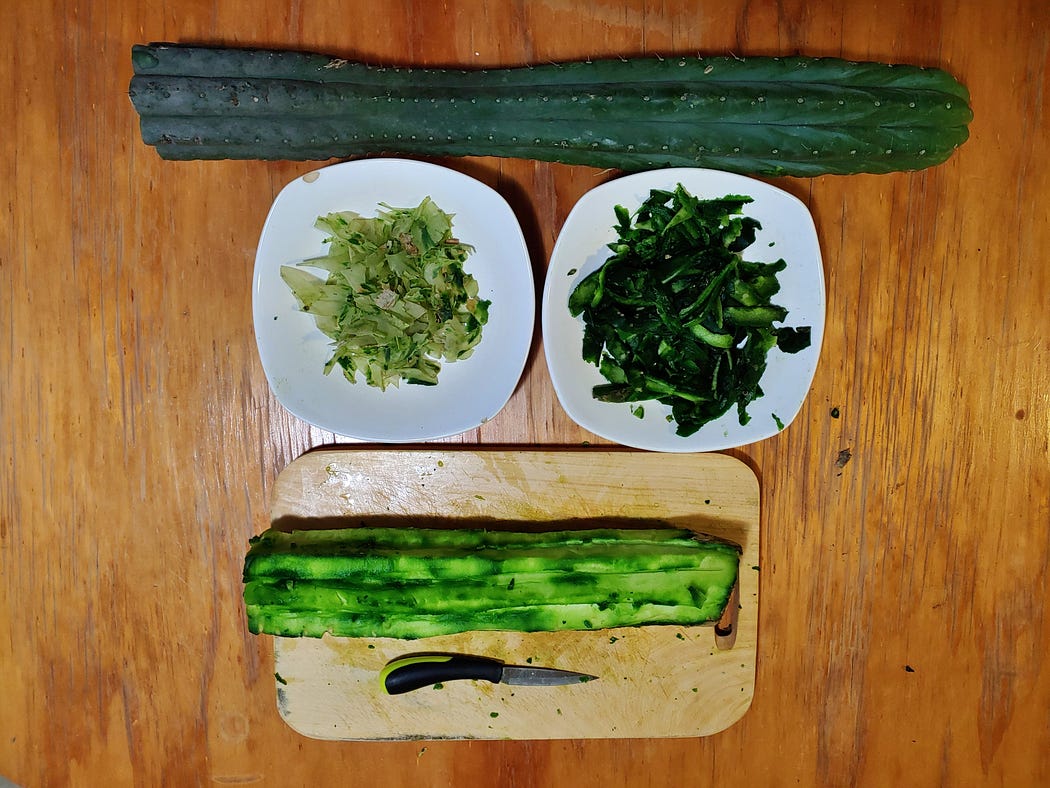
Whether you brew San Pedro tea or dehydrate/grind the flesh into powder, the first steps are always the same: remove the spines and outer skin (bowl on the left), extract the green flesh (bowl on the right), and disregard the white core (bottom). Only the green flesh is used for processing and consumption.

Not all San Pedro experiences are created equal

Extensive conversations with a broad sampling of other San Pedro explorers led me to a surprising realization. This process started in 2018 when I published an article called “DIY Mescaline: How to explore San Pedro without a guide.”

I eventually included my email address in the article and asked people to contact me if they’d like to see the final cut of a film we’re currently making about San Pedro in its native land. Many of the people who responded were kind enough to share with me their own personal San Pedro experiences, and we developed a back-and-forth dialogue.

What didn’t surprise me was that most people described their experience in glowing terms. What did surprise me is that a decent number of people described their experience as disappointing. I followed up with questions about set, setting, preparation method, and dosage. And I started to recognize an interesting pattern.

I entered into this discussion with the perspective of someone whose experiences with San Pedro were exclusively profound and transformative. One journey inspired the creation of a large-scale rainforest preserve, and I don’t even consider that journey to be my most formative. A disappointing Huachuma experience was hard for me to imagine, at first. But now it makes sense.

The most common complaint

As Timothy Leary first explained about fifty years ago, the nature of any psychedelic experience is determined by set and setting. “Set” represents all of the variables that you personally bring to the experience — your mindset as well as your accumulated life experiences, your psychology, even your neurobiology. “Setting” represents the conditions in which the psychedelic experience takes place. To these two primary factors, I would also add two more: the quality of the substance (call it medicine, if you wish) and the dosage.

Of all four of these factors, set is the hardest for me to measure in others — my access inside the hearts and minds of other people is limited. The matter of setting is a bit more straightforward. I comment on this with greater detail in “DIY Mescaline.” The quality of the medicine depends on a range of variables, which I discuss below. All of the above factors can be managed with a bit of experience.

The factor that was most frequently at the root of sub-par San Pedro experiences was dosage. Namely, the dosage was too weak. By far the most common complaint was that the medicine simply didn’t have much of an effect. People felt like they missed out on the experience. And to a certain extent, they did.

The danger of under-dosing

Sometimes a light dose of San Pedro is advisable. There are some reputable San Pedro retreats in which people are given a moderate dose and then taken on a group hike to some beautiful place. In this case, the moderate dose is intentional: people still need to be able to walk. In other cases, the moderate dose was administered in a traditional sit-down ceremony. For some people in some circumstances, this is also the right approach. It allows people to dip their feet into the experience without going too deep.

For other people, however, the experience wasn’t strong enough. I am merely reporting what numerous people have told me. They consumed just enough San Pedro to feel a bit funny in the stomach and start to perceive things somewhat differently, but the door to Huachuma World did not fully open. They remained firmly planted in the so-called default world.

This is a lost opportunity. I do not mean to discount the practice of micro-dosing San Pedro, which is also something I’ve extensively experimented with. You can read about that in my article “Micro-Dosing Mescaline: Comparing San Pedro to LSD and Psilocybin.” It can certainly be a useful practice, but it still doesn’t compare to the profound lessons that can be deeply learned on a full dose of Huachuma. It is the difference between briefly kissing someone at a doorway versus spending a very long, languid morning making love in bed with the person that you’re in love with.

1*R7-dL2SHHXXLUHLw5ecwTg.jpeg

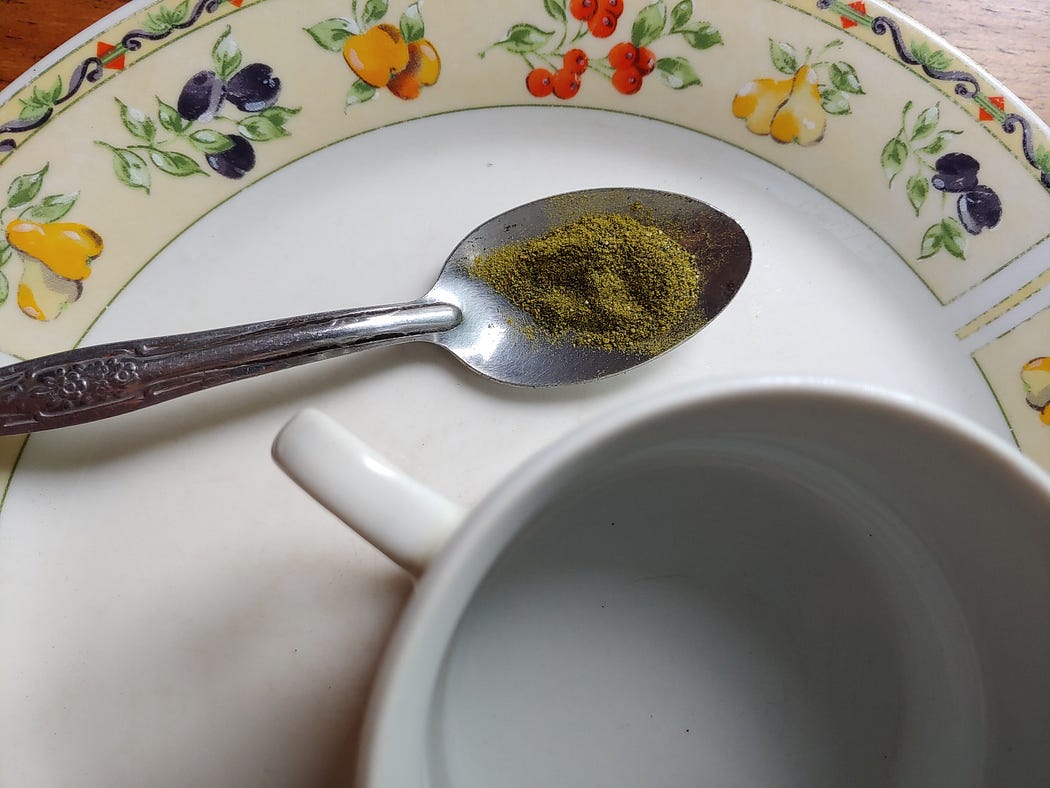
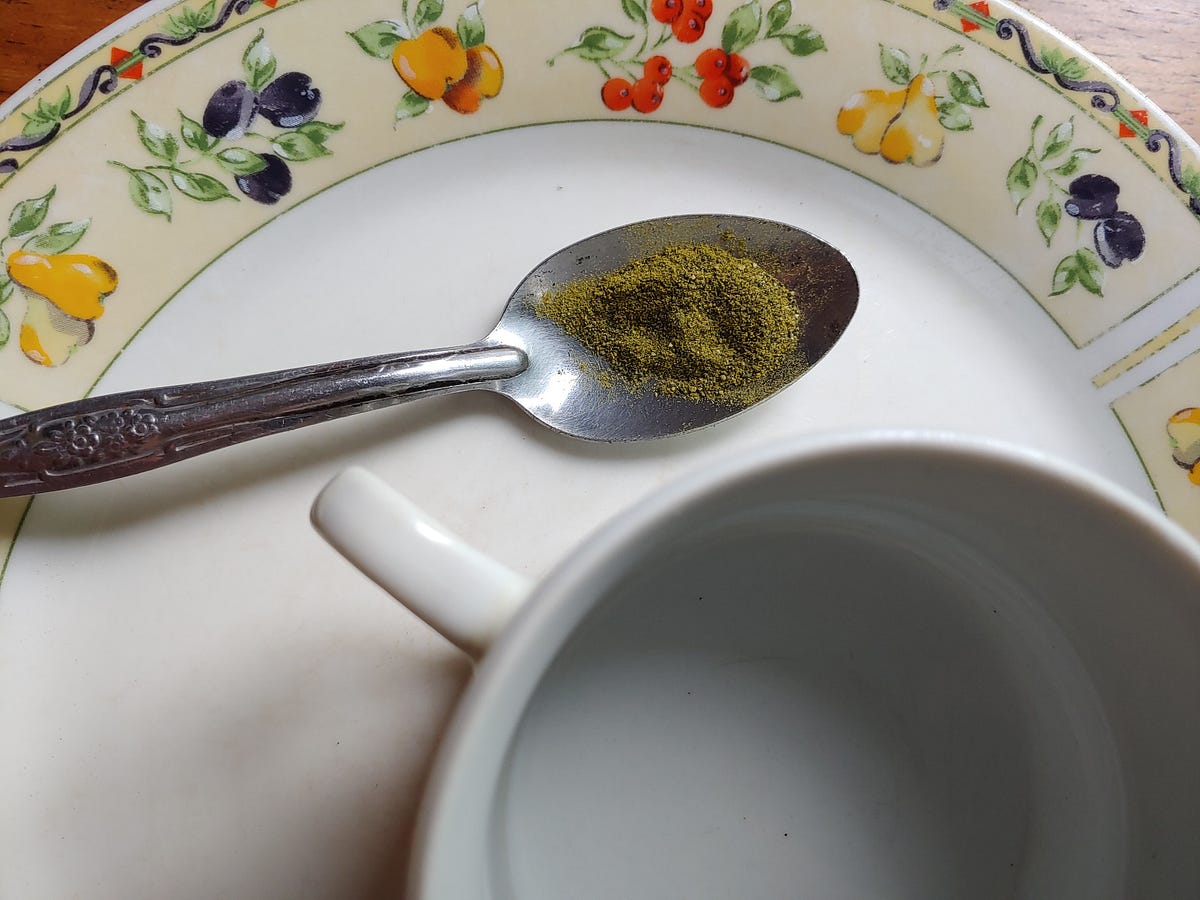
The optimal micro-dose…useful, but a far cry from a proper macro-dose.

Crossing the threshold

After hearing several accounts of weak San Pedro experiences, I did a few experiments on myself. I tried everything from 1–3 grams of dry powder and half an arm of wet cactus, all the way to what I consider much more than a full dose: two arms of a thick, wild-harvested San Pedro from a particular mountain in southern Ecuador.

From those experiences I learned many things that have nothing to do with this article. The main thing I learned, which is relevant here, is the importance of crossing the threshold. In the realm of micro-dosing, there is something called the threshold of perceptibility, but that’s not what I’m talking about. I’m talking about the threshold one must cross to reach the full Huachuma experience. A moderate dose of San Pedro only opens the door ajar, such that you barely catch a glimpse of what’s inside. To actually pass through the door, the amount of San Pedro you need to consume must reach critical mass.

Once critical mass is reached, you’ll know it. It’s like opening your eyes after years of darkness. There is a simple litmus test to help determine whether or not you’ve crossed the threshold. If you feel physically pulled to the ground, lying on your back on the naked ground and staring upwards into the sky, and you are accompanied by the sense that nothing in this universe is misplaced, that everything is exactly as it should be…you made it.

This feeling I describe is not overly intense or uncomfortable. It is deep-penetrating and comprehensive, but at the same time gentle and loving. This, in my opinion and the opinion of many others who have also reached this state, is the special nature of the Huachuma experience at full strength.

1*gPla50rARYSt6DoTWTlBrA.jpeg

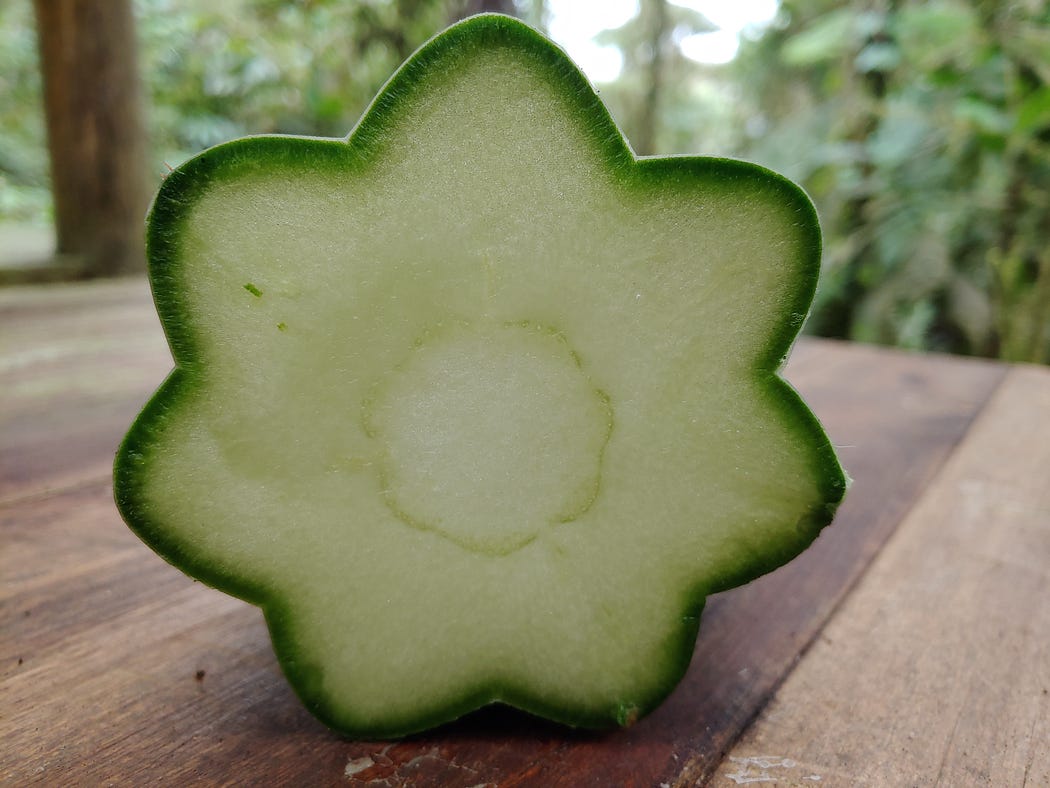
Almost all of the mescaline is concentrated in the layer of green flesh, just beneath the waxy outer skin. That’s the only component of the cactus that should be consumed.

Different Preparation Methods

Before we can talk about dosage, we first need to talk about preparation methods. There are several ways to prepare San Pedro for consumption, some of which are less than ideal. The two best methods are:

1. Brewing Tea: Slice away the green flesh and put it into a pot of water, and then boil it down into a concentrated green liquid. This is the method I’ve been using since 2002, detailed in “DIY Mescaline.”

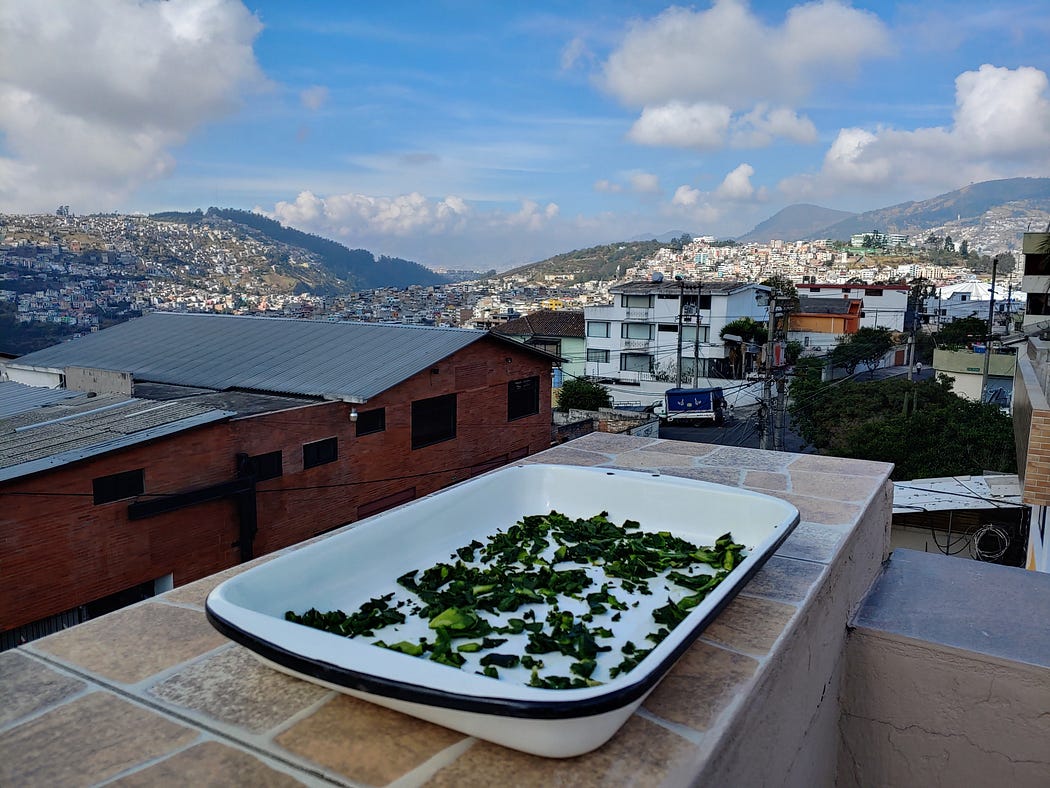
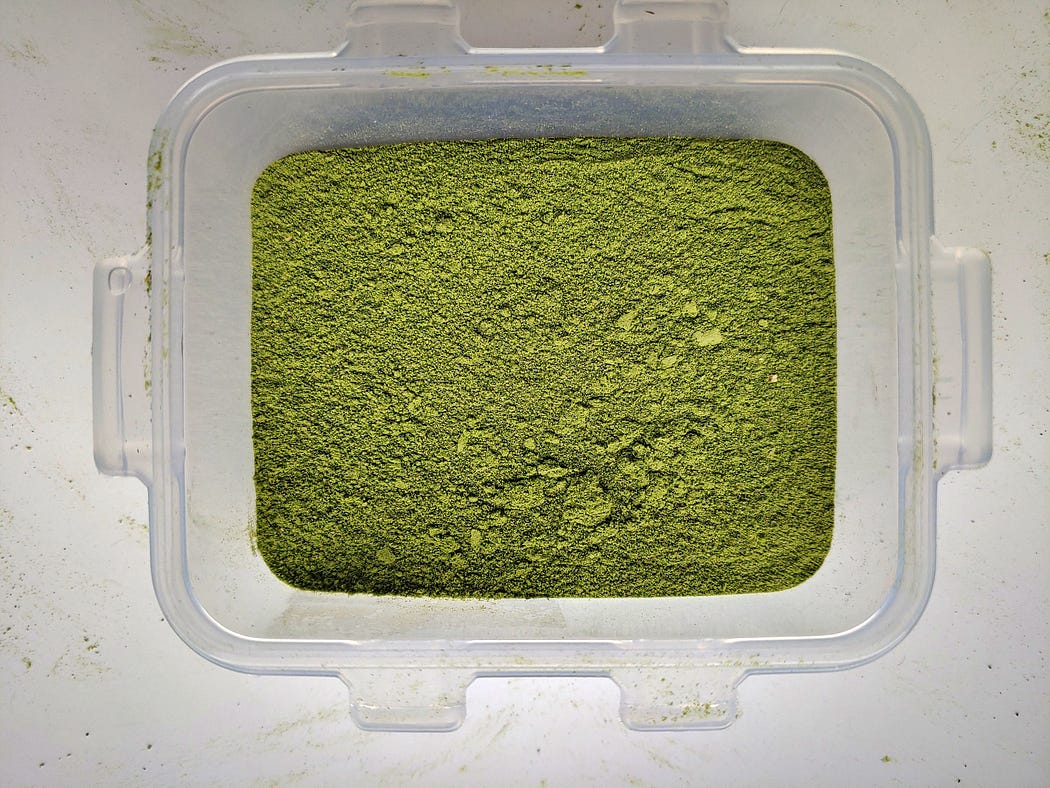
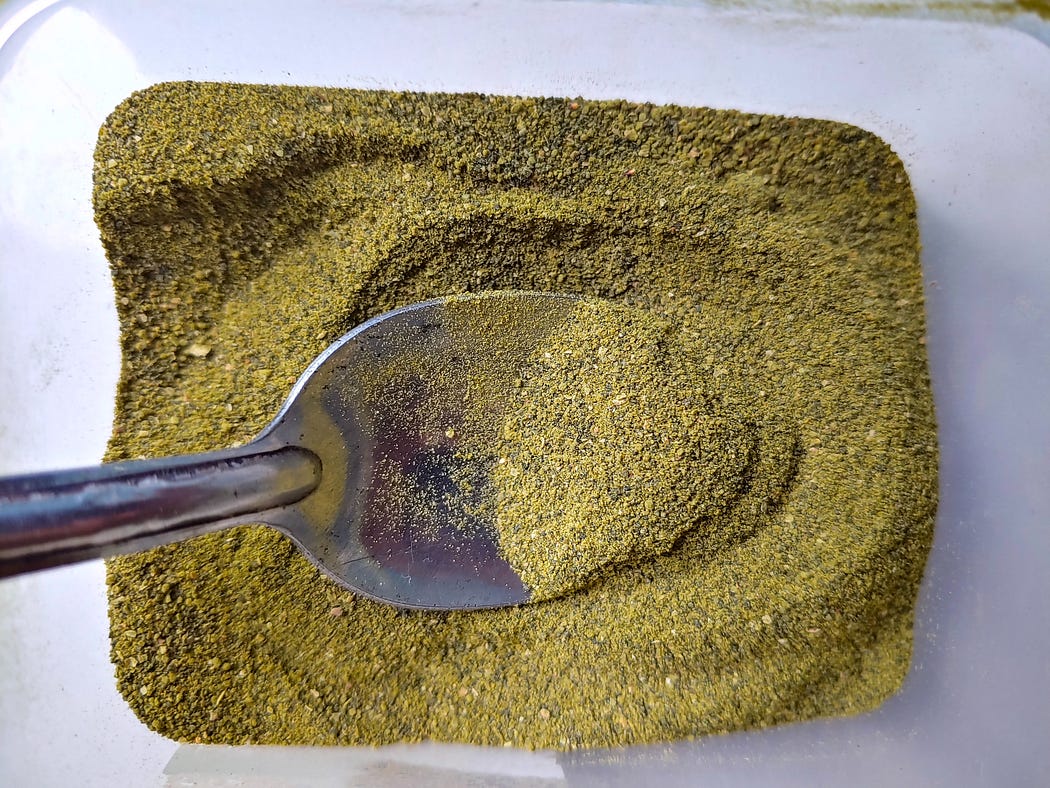
2. Drying/Grinding into Powder: Slice away the green flesh, cut it into pieces, and dry the pieces using a dehydrator, the sun, or an oven at the lowest heat setting. Once the pieces are dry, grind them into a fine green powder. This is a method I’ve recently been testing. In my experiments, a forearm’s-length of cactus (38cm long by 8cm diameter, weighing 1.38 kg when freshly harvested) yields about 20 grams of highly concentrated dried powder. See below for mescaline calculations.

In both cases, you’ll start with a fresh cutting of cactus. And in both cases you will want to remove the spines and the waxy outer skin. You should also exclude the white pulp that is underneath the green flesh. Several YouTube tutorials show people including the white pulp in their process, usually with a blender, but this is not advisable. The white pulp has a negligible amount of mescaline, and furthermore is the leading cause of nausea. Whichever method you use, the only part of the cactus that you should process is the green flesh.

1*LqNvGy4OtWHvqVQx2MCodA.jpeg

Sun-drying the flesh of an arms-length section of San Pedro on a rooftop in Quito. After fully drying and grinding the pieces, the final result was 20 grams of fine green powder.

Length of cactus per dose

The right dosage required to reach the full Huachuma experience depends on many factors. It depends on where and how the cactus was grown, which variety or cultivar it is, and your own body weight and other physiological and psychological factors.

Nevertheless, there is a general rule of thumb that I’ve always abided by and it has never failed me. Here it is: use a piece of cactus that is roughly the same length and girth as your own forearm, as measured when your hand is balled up into a fist. Personally I consider this the minimum size for a normal dose, and I usually use a piece that is slightly larger than my forearm. But for the sake of this article, I will refer to a forearm-sized piece as a “normal dose.” All things equal, this is the dosage required to cross the threshold. If the dehydration method is used, this generally equates to about 15–20 grams of dry powder, depending on the size of your forearm.

This, however, assumes that the cactus you’re using is suitably potent. Mescaline potency varies from cactus to cactus. Interesting enough, San Pedro is influenced by terroir just as much — if not more so — than wine and cacao.

1*Cm9Ng-v1xTstTw2u6mxvVg.jpeg

20 grams of fine green San Pedro powder — the yield from one 15 inch (38 cm) length of cactus, roughly 6.5 cm in diameter and originally weighting 1.38 kg when freshly harvested.

Mescaline potency

San Pedro is inherently more predictable than Ayahuasca because it only involves one plant. Ayahuasca, on the other hand, involves at least two psychoactive plants, if not three or four — all of which produce different kinds of effects. Thus, San Pedro is a lot harder to screw up and requires less experience to prepare.

Nevertheless, mescaline potency can vary. Erowid has a useful mescaline potency FAQ that illustrates the variability between species of cacti (San Pedro, Peruvian Torch, and Peyote) and between individuals within each species. The “average” potency of San Pedro is generally regarded as 1% mescaline per dry weight. However, some San Pedro cuttings have measured as little as 0.1% mescaline, and the most potent cuttings measured as much as 2.3% mescaline.

Short of testing the mescaline content in a laboratory — which is not an option for most of us — the most reliable way to test the strength of a particular cactus is to start by consuming a piece that is 1/2 or 2/3 the length of your forearm. After two and a half hours, if not sooner, you’ll have a good idea of what you’re dealing with.

Once you’re familiar with the potency of a particular cactus, it’s preferable to consume most of your entire dose at the beginning, and then top it off within the first few hours — if necessary. The whole experience can last 12–16 hours during normal circumstances, which is already quite long. So you don’t want to unduly prolong the ingestion process.

Can physical cues be used to gauge the potency of a given cactus? Different sources give different answers to this question. Some San Pedro experts suggest that potency may be enhanced when the plant is subject to environmental stress caused by adverse temperature, sun, water, soil, or pest conditions.

All of this said, a low dose of San Pedro is not the end of the world. If you don’t cross the threshold during a particular journey, it’s okay — enjoy it for what it is. But you’ll probably want to consume a larger dose the next time. Now you know.

1*qPPsvh_4noXmHv9-fUyCPQ.jpeg


On the subject of “set”

It’s natural to feel some fear or trepidation before a psychedelic experience, but if your fear is intense, it’s probably a signal that you’re not ready for this journey. And that’s okay. Timing is important.

In any event, a plant like San Pedro should never be used as a tool of escape. Rather, it is best consumed in the spirit of discovery. That said, San Pedro can be tremendously useful when working through post-traumatic stress disorder. I’m speaking from first-hand experience. It can also be extremely useful for those who are working through depression, addiction, and fear of death.

If you suffer from psychosis, however, you should probably not ingest San Pedro or any other psychedelic substance. There are plenty of other methods that can be used to learn more about self and the universe.

On the subject of “setting”

My personal preference is to consume San Pedro alone or with one or two other people. I have spoken with several people who feel similarly. There are also plenty of people who prefer to consume San Pedro in a group setting, often guided by a shaman or guide. Both of the above formats can work wonderfully; it’s a question of personal preference and temperament.

If you do wish to work with a guide, do your research and choose wisely. I would suggest meeting the guide before you commit to anything, so that you can consult your intuition. Different guides have different energies, and what may resonate with some people may not resonate with you. Be especially weary of charlatans and sexual predators. Here’s a good article about that.

The same principle applies to the actual setting. You do not want to go on a San Pedro journey in a place that doesn’t feel good. And for the love of all things holy, please do not consume San Pedro in a city. San Pedro and cities do not mix well. It is absolutely imperative that you are surrounded by the natural world.

 
Last edited:

1*R7-dL2SHHXXLUHLw5ecwTg.jpeg


Microdosing Mescaline*

by Jerry Toth

Whereas a high dose can fundamentally reframe your relationship with Life, a microdose of San Pedro is like Adderall infused with a subtle sense of gratitude for being alive.

I’ve written numerous other articles about the life-altering power of consuming full doses of San Pedro. This article, however, is about consuming small amounts of San Pedro during an otherwise normal day of life.

My career in harvesting, preparing, and consuming San Pedro goes back by almost two decades. But it wasn’t until this past year that I started experimenting with micro-dosing San Pedro.

Previously I had experimented with micro-dosing psilocybin mushrooms and LSD. The former was aimed at treating post-traumatic stress disorder, the latter was aimed at stimulating creativity. In both cases, the results were generally positive, although mixed.

Despite my abiding faith in and respect for San Pedro, I went into this new phase of experimentation with an open mind. And the results surprised me. I’m happy to share my findings here.

First, a disclaimer. Everyone reacts to psychedelics differently — some people favorably and other people unfavorably. Even people who tend to react favorably should still exercise caution. And anyone with a personal or family history of psychosis should probably avoid all psychedelics.

San Pedro can be more tricky than something like LSD because it’s harder to dose…at first. Even within the same species of cactus, mescaline content varies depending on where the cactus was grown, its age, health, and other factors. But the good news is that once you get your own personal dosage calibrated, the effects are very consistent at small doses.

1*PsHP7qqseQ6nFHBpHsaqkQ.jpeg

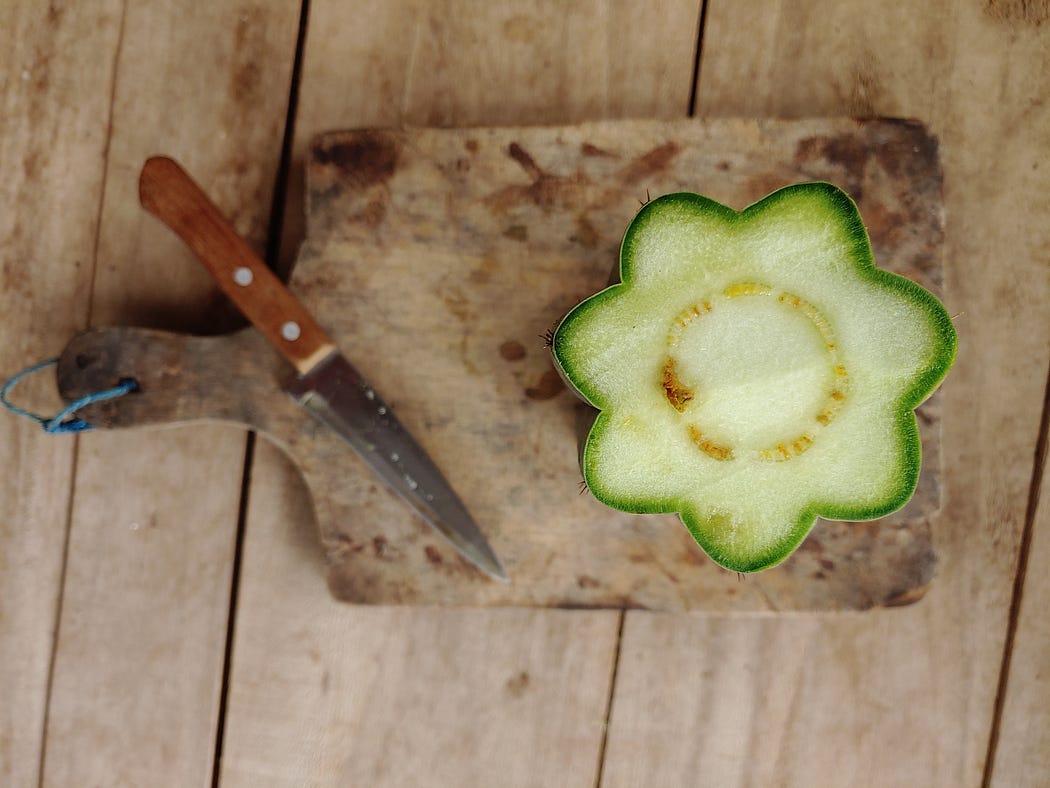
The cross-section of the piece that ultimately produced “Batch B”

DIY San Pedro

As I have expounded in other articles, I strongly advocate preparing your own San Pedro, as opposed to buying it from some dude who says he has good stuff. The benefits to the DIY approach are numerous:​
  1. You know exactly what you are consuming.​
  2. You can take measures to ensure that your batch is high-quality.​
  3. The process is fun and interesting, and fairly simple.​
  4. The more you work with this plant, the more you develop a personal relationship with it. And this generally leads to a more rewarding experience when you consume it.​
Sourcing a cutting

To prepare San Pedro, the first thing you need to do is source a cutting. The best way to do this is to grow your own plant — either indoors or outdoors, depending on where you live.

Otherwise, you can buy a cutting from a nursery. San Pedro is legally sold in plant nurseries everywhere from California and Arizona to Spain, South Africa, Israel, New Zealand, etc.

If you don’t live in one of these places, you can also buy cuttings online. If you live in the US, try AWCO.

1*YZYYFZ-oL0ERS9VqNairlQ.jpeg

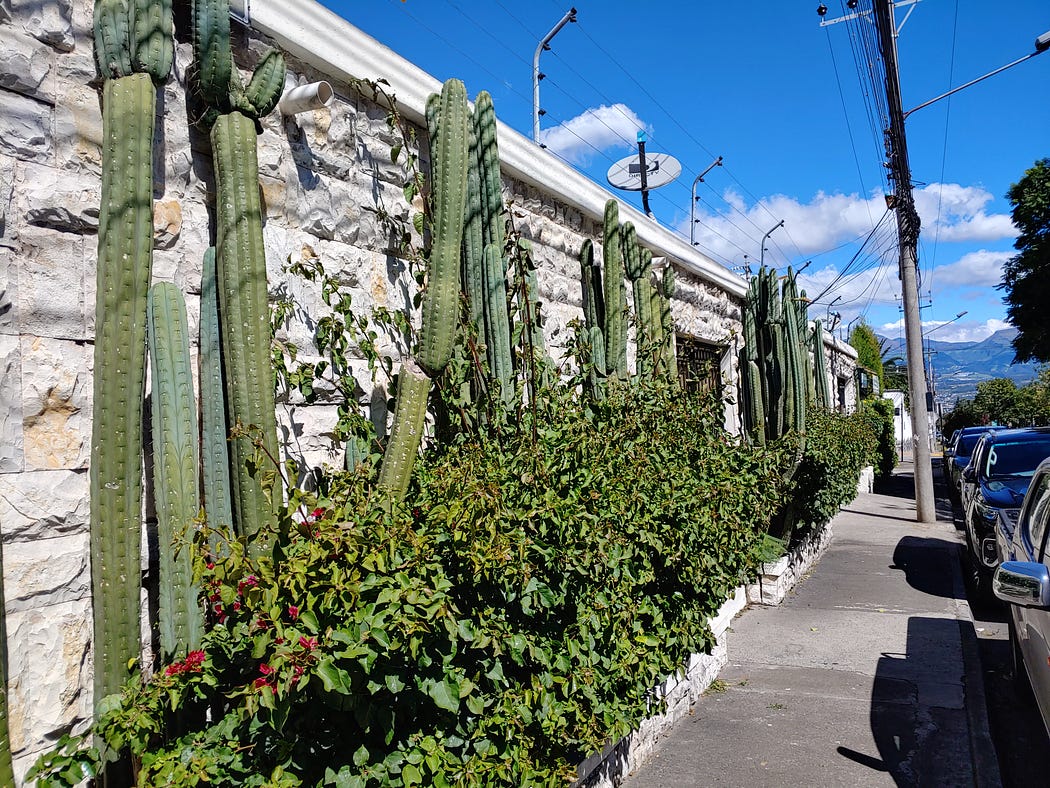
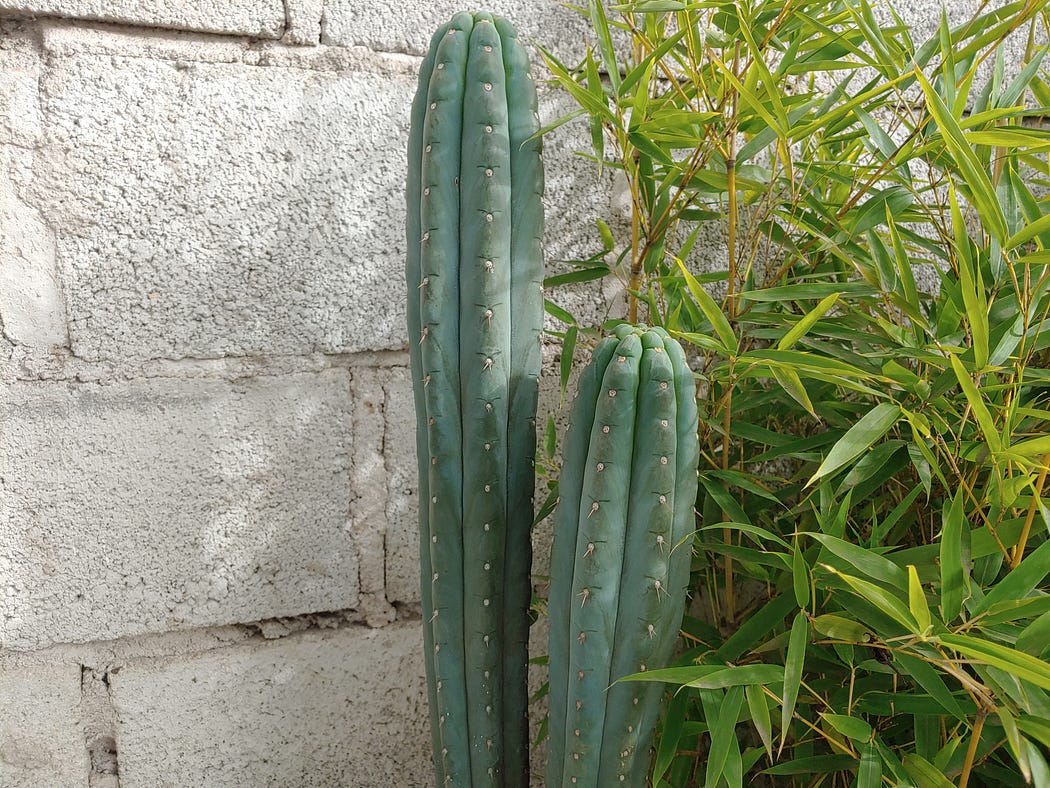
A nice wall of San Pedro outside of a storefront in Cumbayá, Ecuador.

Preparation

There are a few different preparation methods, although I only recommend two of them. The first method is to put the green flesh into the water and boil it down and then drink it. I go into detail about this method in my article DIY Mescaline: How to explore San Pedro without a guide. If you want to take a full dose, this works marvelously. But for micro-dosing, it’s less practical.

The second method is to dehydrate the green flesh and grind it into a powder. I describe this method in Macro-Dosing Mescaline: The danger of not consuming enough San Pedro. Incidentally, this is also the best preparation method for micro-dosing. The powder is easier to dose in small quantities, and you can store it at room temperature for months — if not longer — without reducing its potency.

I ‘m fortunate to live in Ecuador, where San Pedro grows abundantly in gardens, roadsides, and Andean hillsides. For my micro-dosing experiments, I made two different batches, each from the same species of cactus (Echinopsis pachanoi) but from different parts of the country. I made Batch A from a cutting sourced from a relatively young cactus growing in a garden in Cumbayá, just outside of Quito. Then a few months later I made Batch B from a huge old cactus that was growing near the city of Ibarra.

In both cases, I dehydrated only the green flesh, which is where the mescaline is most abundant. As always, I excluded the white pulp, which only has marginal amounts of mescaline and tastes even less agreeable than the green flesh. If you use only the green flesh, your medicine will be stronger per unit of weight — which means that you only need to consume a very small amount. And it will taste slightly less bad. I strongly recommend using only the green flesh.

1*aWlBQ9jb4OWbBzc72KmzRQ.jpeg

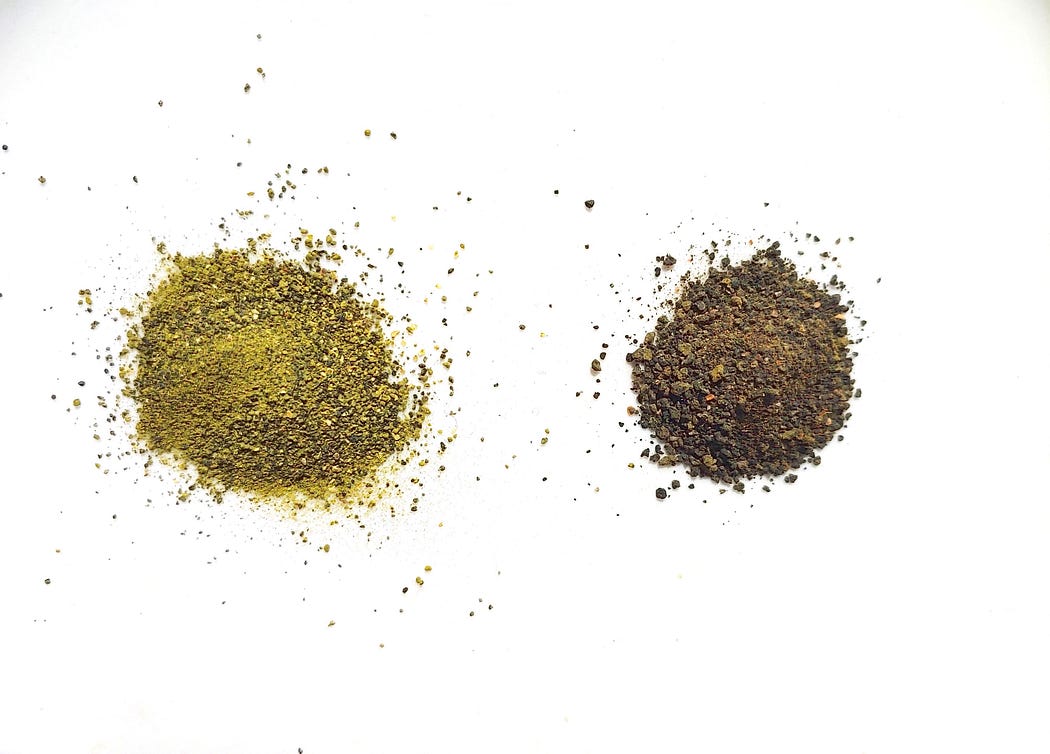
Samples from Batch A (left) and Batch B (right). Why the difference in color? Most likely due to the drying conditions. I dehydrated Batch A in a dry environment with sunny weather, and the process went quickly. I dehydrated Batch B in an extremely humid place with rainy weather, and it took a while.

Dosage experiments

When to Ingest:
In all cases, I ingested the dose shortly after waking up. Mescaline is a stimulant, and it’s long-lasting — even at small doses. So taking it at nighttime is a bad idea unless you don’t want to sleep. Morning is the perfect time to take it. I always ingested it within 10–30 minutes of eating breakfast — sometimes before, sometimes after. And I would only do it once per week.

How to Ingest: In all cases, I weighed the powder on a food/cannabis scale to ensure the precise weight, and then added the powder to a cup of water and stirred it in. A few times I added honey or sugar to the water, to try to soften the bitterness, but it doesn’t really help. Now I just drink it like a shot. It’s not that bad.

Dosage Comparison: Each batch yielded 19–20 grams of a highly-concentrated green powder, from arm-length sections of cactus that I would ordinarily use as one full dose of San Pedro. In other words, 19–20 grams roughly equates to one “macro-dose” for one person — i.e., a full journey’s worth.

1*5vw6hFRVZwtXDZYcQUZgWg.jpeg

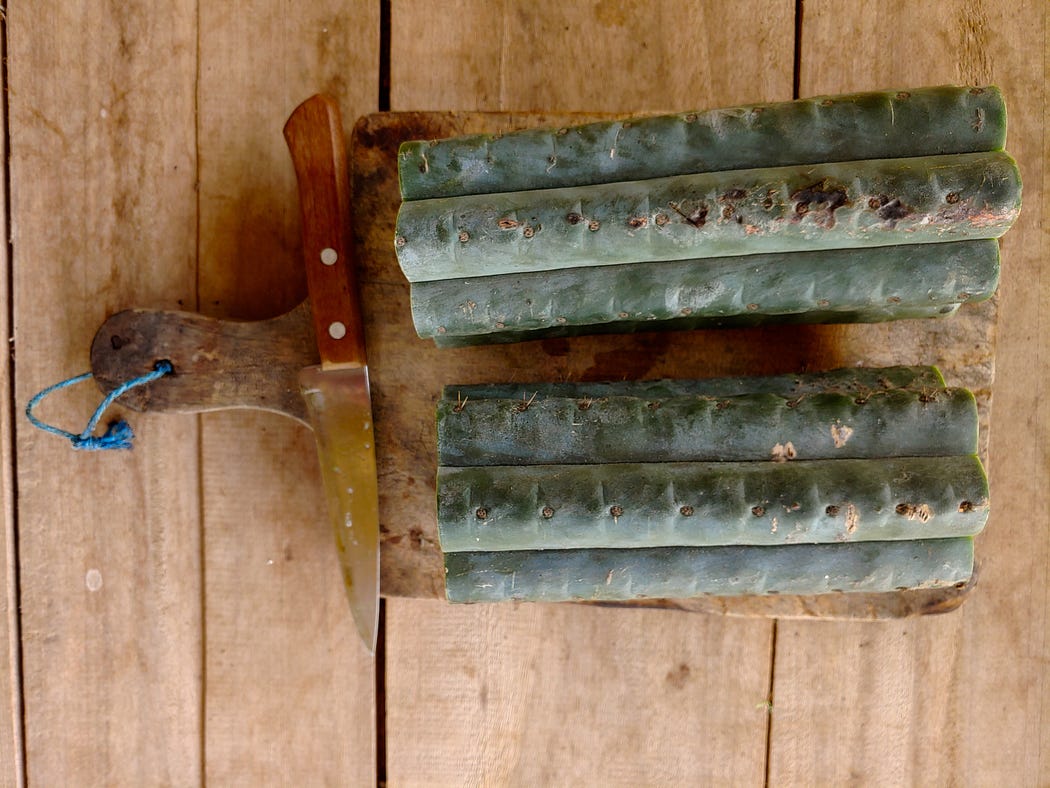
This is the entirety of Batch B before processing, which would qualify as a solid dose for one person who is looking to go deep. Its green flesh ultimately yielded 19 grams of highly-concentrated powder.

0.5 Grams (Batch A): This was the first dose I tried — roughly equivalent to 2.5% of a full dose. I did it in a beautiful place surrounded by nature, but it was a workday. As it turned out, this dosage was below the threshold of perceptibility, in the sense that I never explicitly felt any effects from the San Pedro, either physically or psychologically. But I had a really good day.

Creativity and mood were both enhanced subtly but noticeably, and my mind was sharp. I was fully capable of managing all daily tasks, social interactions, and physical activities — I could have effectively led a meeting or made a public speech, had I been called to do so. My energy level was high and sustained throughout the day. And the impetus for task-completion was unquestionably strong — shit got done.

I really liked how subtle the effects were, but it left me curious about what a stronger dose would feel like.

2.0 Grams (Batch A): For my second dose, I jumped up to 2 grams (roughly 10% of a full dose), and it did not go as well. Shortly after ingestion, I felt the physical jitters I associate with the onset of a full dose of San Pedro — similar to what I feel if I consume too much coffee. It ranged from mildly to moderately uncomfortable. Again I was in a beautiful place surrounded by nature. This time I was too jittery to sit down and write, so I got up and started doing heavy manual labor in the yard.

About two hours after ingestion, I started feeling subtle waves of psychedelic awareness. It was kind of nice, but the jitters dampened the pleasure of it, and the psychedelia wasn’t deep enough to have a lasting impact. It was exactly what I warned about in my “Macro-Dosing Mescaline” article: I was in that weird Interzone between normalcy and a proper mescaline experience, which seemed to have the downsides of both without the benefits of either.

I tried skinny-dipping in a cold river, to flush the jitters out of my system, but it didn’t work. I ended up spending a few hours just kind of sitting around, doing nothing. Fortunately I didn’t see anyone during this stretch, but if I did, it would have been hard to “play it cool.” It felt like I drank two really big cups of coffee and then chased it with a heady strain of Sativa. It was the feeling of having too much energy and no way to properly channel it.

At about six hours into the experience, the jitters gradually wore off, and so did the subtle psychedelic awareness. The rest of the day had the feeling of a coffee hangover.

1.0 Grams (Batch A): This, too, was over the threshold of perceptibility. Again I felt the jitters. It was only slightly uncomfortable, but it was distracting enough to impede a creative activity like writing. Working in the yard was okay, but less pleasant than it normally is. A few times I felt the whiff of psychedelic awareness pass through, but only a whiff. Overall, it was not something I would want to repeat.

1*u45lX1NGX2jhP3bkebznKQ.jpeg

Batch A, dehydrated in the sun and then ground in a coffee grinder.

Back to 0.5 Grams (Batch A): After my experiences with 2 grams and 1 gram, I went back to limiting the dosage to 0.5 grams, and the results were the same as they were the first time. Zero jitters, zero explicit physical and psychological effects, but noticeably positive effects on creativity, mood, and energy. And once again, work got done.

My day was also peppered with little moments of appreciation for Existence. It’s a feeling I also experience without ingesting anything, but on this day those moments came more often. It was nice.

To illustrate what I mean by sub-threshold and yet still noticeable, here’s a hypothetical scenario. If someone had somehow slipped this amount of powder into my drink in the morning (and I somehow didn’t notice the acrid taste), I would have never known I had consumed San Pedro that day. But later, if asked how my day went, I would likely describe it as a good day, and I wouldn’t necessarily know why. I would have also gotten a ton of stuff done.

I went on to repeat this dosage several times, and it was always positive. It felt like I had found my optimal dosage.

0.7 Grams (Batch A): In the interest of fine-tuning the dosage, I eventually moved up to 0.7 grams. This amount was still within the sweet spot — below the threshold of physical discomfort but accompanied by a subtle boost in creativity, mood, and energy. And, yet again, focus and task-completion were unquestionably high. I finally designated this as my optimal dose for Batch A — roughly 3.5% of a full dose. One or two days a week, this is how I would start off my day. It never failed to produce what I call “a pretty good day.”

Set and Setting

I also experimented with micro-dosing San Pedro in four different locations. Two of the locations were beaches, one was a forest, and one was a city. In all cases, micro-dosing the optimal amount yielded days that I would rate “better” than baseline days (i.e., non-micro-dosing days) in the same place. (“Better” in the sense of overall well-being and awareness, in addition to levels of creativity, mood, energy, and focus.)

One day I even micro-dosed in Quito (a city I do not particularly enjoy) on a day of heavy civil unrest (the riots of October 2019), and the results were still positive. But in general, places of natural beauty are much more conducive to a fruitful San Pedro experience, regardless of the dosage.

1*1P7R44egsP-YOFWTikFdBA.jpeg

This is not the source of Batch B. It’s just a nice little specimen I saw in Quito one day.

Batch B

After a few months of experimenting with Batch A, I made Batch B and started testing it. Although the powder from Batch B wasn’t as beguilingly green as Batch A, it was slightly more potent.

A dose of 0.7 grams yielded some jitters, but it was still generally a positive experience. If anything, the impetus for task-completion was too high — once I got started on a task, there was no stopping me until the task was complete. It actually felt a lot like Adderall.

Ultimately, I settled on 0.5 grams as the optimal dosage from Batch B (roughly 2.6% of a full dose). I found this to be a good balance between productivity and a general sense of well-being.

Comparing San Pedro to other psychedelics

How would I compare San Pedro to LSD and psilocybin mushrooms, as a tool for micro-dosing? One thing for sure is that it’s much more task-oriented. It’s like a preternaturally effective cup of coffee with no midday crash. Or, to use another analogy, it’s like Adderall but groovier, more fluid.

As I said in the disclaimer above, everyone reacts differently to different plants and chemical compounds. Hopefully the data I’ve shared here serves as a useful starting point for your own experiments.

*From the article here :
 
Last edited:
san-pedro-cactus.jpg


How to grow and care for San Pedro*

by Miruna Secuianu | Garden Beast | 5 Aug 2020

San Pedro cactus is a very easy-to-grow and popular columnar cactus. Natively found in South American countries like Peru, Chile, Bolivia, and Ecuador but grown in other parts of the world as well, this impressive cactus is quite fast-growing and it can reach up to 20 feet (3m) in height.

This ornamental cactus has been used for thousands of years in traditional medicine and shamanic rituals in South America so it comes as no surprise that it has over 25 different names such as andachuma, huachuma, achuma, aguacolla, giganton, hahuacollay, to name a few.

Cataloged by Dr. Joseph Nelson Rose, an American botanist, who named it after Eng. Abelardo Pachano Lalana, a renowned Ecuadorian botanist, San Pedroi is full of surprises. It contains mescaline, a controversial psychedelic which is illegal in the US, where the plant is sold solely for ornamental purposes.


cactus.jpg


Growing, caring for and propagating San Pedro is fun and rewarding, for beginners and experienced cacti growers alike. The San Pedro cactus thrives at high altitudes, such as the Andes Mountains, where it can be found at altitudes of 6,600–9,800 feet (2000-3000m).

When grown outdoors, the San Pedro cactus can withstand temperatures as low as 48.2°F (-9°C) and it prefers temperate climates, plenty of light, and fertile, well-draining soil.

About San Pedro
  • San Pedro cactus is native to Peru, Ecuador, Argentina, Chile, and Bolivia and it thrives at high altitudes, in the Andes Mountains.​
  • It can be grown outdoors in USDA Hardiness Zones 8b to 10b as it doesn’t mind cooler temperatures as long as they don’t drop below 15°F (-9°C).​
  • San Pedro cacti need a lot of natural light and mature plants don’t mind being in full sun. Seedlings, however, are a bit more sensitive and can suffer sunburn.​
  • When grown indoors, these cacti need well-draining soil and if they cannot get enough natural light you might have to invest in some grow lights.​
  • Like all cacti, San Pedro loves light and warmth. However, this cactus prefers soil that’s a little more nutrient-rich than regular cacti soil mix.​
  • Natively-found at high altitudes, this cactus might require more water, especially on hot summer days.​
  • It is a fast-growing cactus that’s been used in South American traditional medicine and religious rituals for centuries. Like Peyote, San Pedro contains mescaline, an illegal psychedelic similar to MDMA.​
  • While consuming San Pedro cacti is illegal in most countries, growing it is not, so it’s perfectly safe to decorate your home or garden with these amazing plants.​
  • The San Pedro is moderately poisonous, so you should keep is within a safe distance from children and pets.​

Echinopsis-Pachanoi.jpg


San Pedro: An overview
  • San Pedro cactus is a large columnar cactus that grows relatively fast. Depending on their growth environment, San Pedro cacti can grow up to 12 inches (30 cm) per year.​
  • This multi-stemmed cactus can reach up to 19 feet (5-6 meters) in height and 6 feet (2 meters) in width.​
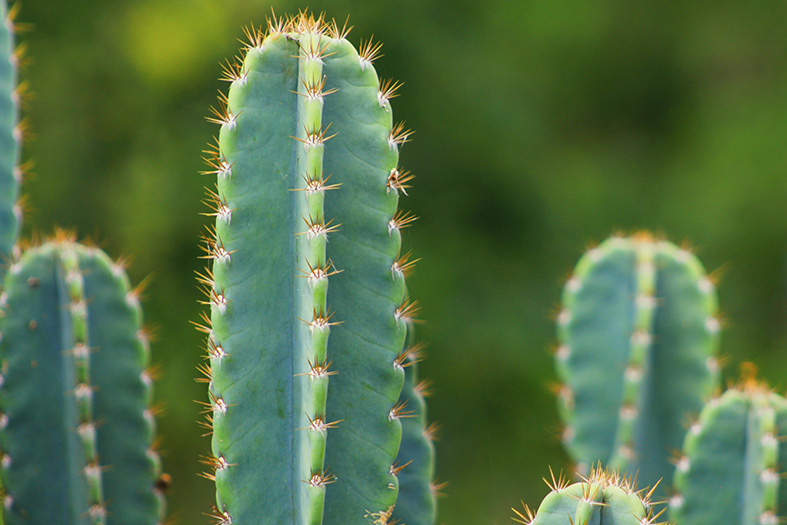
  • The thick individual stems of the San Pedroi are green or blue-green and they become darker with age. They have between 4-8 ribs each and can be 2.4-5.9 inches (6-15cm) thick.​
  • In July, the pointy buds of the San Pedro cactus produce beautiful whitish flowers which open at night, have a pleasant fragrance, and measure approximately 8.7 inches (22 cm) in diameter.​
  • The edible fruits of the San Pedro are called Pitahaya and are red-skinned, scented, sweet, and tasty.​
  • It is closely related to Trichocereus peruvianus aka the Peruvian Torch Cactus. In fact, these two cacti are so similar that their names have become interchangeable and it’s pretty much impossible to tell them apart if you’re not a specialist.​
  • San Pedro cacti pair well with Senecio mandraliscae, Aloe cameronii, Phormium tenax, and Agave truncata.​

Echinopsis-Pachanoi-1.jpg


Growing San Pedro

Growing San Pedro is easy especially since this versatile cactus is very forgiving and only needs a little water and some nutrients. The best thing about San Pedros is that they don’t mind cold weather as long as the temperatures don’t drop below 15°F (-9°C). So, if you live in a temperate region, you won’t have any issues with growing San Pedro cacti outdoors.

In its natural habitat, this cactus gets a lot of natural light and its soil is more nutrient-rich than the regular cacti soil mix. If you grow this cactus in a container, you can feed the soil a little, but not too much, because it’s still a cactus.

Cacti don’t need a lot of water to grow healthy and happy, but just like any other plant, they do need some care, love, and attention. When growing San Pedro indoors, make sure you place it on a well-lit window sill, preferably on the south-side, and water it more often on hot summer days.

51-qERqcj-L._AC_.jpg

Hoffman Organic Cactus and Succulent Soil Mix,
From Amazon

As mentioned above, these cacti grow relatively fast, especially if they are acclimatized to their growth environment, they are planted in good soil and watered more often throughout the warm summer months. Mature, established plants can grow 11-12 inches (30cm) in a year.

San Pedro cacti are quite susceptible to fungal infections such as witches broom disease and orange rot, especially when they are overwatered. If you suspect that your cactus has a fungal infection, make sure you remove all the affected parts with a clean knife. If the plant has too many lesions, it might be better to take a few healthy cuttings and start a new plant. In general, fungal outbreaks can be prevented if the cactus has well-drained soil, plenty of heat, proper ventilation, and a sterile medium.

Other common pests that can affect San Pedro include scale, spider mites, and root mealybugs all of which can be easily removed with neem oil or simply scrubbed off if the plant isn’t severely affected.

flowering.jpg


Watering San Pedro

San Pedro cacti prefer a dry environment and, like most cacti, they are very sensitive to overwatering, which is the number one cause of cacti demise. Because they naturally grow in the Andes Mountains, at high altitudes, San Pedro cacti thrive in temperate environments, so if you live in USDA Hardiness Zones 8b-10b, you can grow these beautiful ornamental plants outdoors.

When planted outdoors, San Pedro cacti will need more frequent watering in summer, and minimal watering in the cold winter months. Cold temperatures can prevent the water from evaporating, and your cacti might sit in damp soil for too long. This, in turn, can lead to root rot, which must be avoided at all costs.

A major difference between San Pedro and other cacti is the fact that it requires some nutrients from time to time. You can purchase specific cacti nutrition that has high amounts of phosphorus and potassium, and low amounts of nitrogen. The ideal NPK value for cacti fertilizer is 4-7-7 and 2-7-7.
Propagating San Pedro

You can easily propagate San Pedro cacti from offsets, which grow abundantly around the base of the mature plants. To remove the offsets safely, make a clear cut with a sharp, clean knife as close to the stem as you can. Place the fresh cutting on a piece of paper and let it dry out a little, cut it at the narrowest place possible, and let it callous for a few days. Once the cutting has calloused, you can safely place it in a container with drainage holes and well-draining soil.

If you plan on repotting your San Pedro, it’s best to do it during the warm season. Before repotting, the soil should be dry to prevent damaging the roots. Remove as much soil as possible and clean any rotten or dead roots in the process. Keep an eye out for pests and diseases and treat any cuts with a fungicide. Put the plant in its new container and spread the roots as much as possible while adding fresh cacti soil mix. Let the plant rest in dry soil for a week and then start watering it lightly until the plant adjusts to its new environment.

San Pedro have stiff spines, so you might want to wear gloves while handling these plants.

In conclusion

Growing San Pedro is fun and rewarding because these friendly giants grow faster than other cacti and they produce beautiful flowers and edible fruit. To grow healthy and happy, they need well-draining soil, plenty of natural light, and a little water once in a while. You can grow them outdoors if you live in a temperate region, as long as the winters are not extremely cold.

San Pedro cacti make amazing ornamental plants, but they are also rich in mescaline, a psychedelic substance, so consuming these plants is illegal in many countries. Growing them as ornamental plants, however, is perfectly safe, but you should still keep them away from children and pets.

*From the article here :
 
Last edited:
We were able to source some very pure Pedro extract and DMT Changa for dirt cheap. It's everything I've ever hoped for and more. The plant spirit has spoken to me for six months and now it's finally here!!!!!!

Mescaline is the perfect medicine on Gaia. I only wish I could microdose it every morning for the rest of my life. Lol.
 
San Pedro: Opening the pathways of the heart

Healing by the Willkamaya River - Sacred Valley of the Incas, Peru

I began 2012 with suicidal thoughts and fantasies because of yet another disappointing romantic relationship. On New Year's Eve I joined some friends for a celebration that included the ingestion of San Pedro, but I wasn't there to celebrate: I was there to grieve. That night I cancelled all my travels and retreats for the upcoming year and vowed instead to dedicate all my energies to healing my wounded heart for as long as necessary.

I went by the river near my house and drank San Pedro by myself as part of that process. As soon as I settled down in a familiar spot by the river it started to rain and so, with the effects of the medicine already beginning to rise, I made my way to a cave I had noticed but never visited before.

There the theme shifted from romantic love to Divine Love, one often being a reflection of the other. At some point I connected with my desire for God's love (that was easy) and then fortuitously flipped the coin to look at my resistance to actually receiving and experiencing that love. What I found was the belief that in order to receive that love I would have to change.

I realized I held the belief that God's love was somehow conditional and soon realized the fallacy of my belief, which allowed me to let go of it. As soon as I let go of that, I was flooded with Divine Love, which is really all there is. In that moment I sat up, opened my eyes, and said to myself "It is done: my healing journey is complete," and with that an experience of full self-realization unfolded, the realization of myself as part of and no longer apart from Divinity.

I relate this episode of my life because that moment of profound healing just a surrender to my ultimate nature. It was only the letting go of my own conflicts and resistance that allowed me to fall back and rest. I saw how most of the suffering I had created for myself was the result of my own resistance to who I really am. The only solution to that struggle was letting go of my inner conflict and surrendering once and for all.

To reach that place I exercised a lot of choice and determination to do whatever was necessary to meet and embrace all of myself. The experience was as surprising as it was monumental: I had no idea what was in store for me that day, and in its simplicity, the experience was truly amazing. It also filled me with hope because if I were able to heal such a sense of separation, I knew everybody else could, too.

When I got home, everything was exactly the same, and yet my own healing and transformation made me experience my familiar life quite differently: there was definitely a sense of elation and expansion, but also a serene simplicity I had never known before.

A week after that life-changing experience I returned to the river to try a new batch of San Pedro medicine. I didn't think I had any particular theme to explore that day, but I found myself holding on to an old judgement against someone. When I finally let go of my resentment and judgement, I could see how Divine Love is really everyone's legacy and destiny. In that moment I was able to own and to integrate all of my ideas about not deserving to receive and be that Love, thus completing the process.

Soon after this, as I was walking by the river, I realized that my own wheel of incarnation had come to a full stop. Astonished and amazed I told myself that even if it started moving again there was absolutely nothing to fear or worry about: being on the other side of karmic and illusory bonds helped me truly see the thinness of that illusion. Pain and suffering are not eternal, they are destined to pass. And when they are gone only Divine Love and Light remain.

Once I finally connected with and embraced that Love and Light, not only as an experience but also as the very essence of who I am, my seeking came to an end. The last letting go of any spiritual seeker is the letting go of identity. Once we find what we are seeking, that identity has fulfilled its purpose and asks to be let go of. Since then my attitude has shifted from one of constant searching to one of curious and playful exploration: I no longer look for answers as I no longer have any questions.

I am fascinated by the many ways different cultures and people have addressed the mysterious process of life and awakening. Deeply heartfelt gratitude colors my daily life: what was once a chore is now a blessing and privilege—the privilege of human life, with all its contradictions and beauty.

A week later, I realized to what extent all my fears had dissipated. Walking on this earth without the fears that had haunted me all my life allowed me to perceive this planet on a deeper level: for the first time I could see and experience its intrinsic love and nurturing energy. I have been embraced by that ever since, no matter where I am. Holding this awareness and the willingness and readiness to be enveloped by this Love has made it so that wherever I go, Nature is always sweet and showers me generously with her blessings and beauty.

-Javier Regueiro​
 
Last edited:
INSTA114.webp


San Pedro, an ancient medicine

by Chris Kilham and Zoe Helene | Medicine Hunter

Don Alejandro the shaman shakes a rattle stick, provoking a sensuous cascade of clicking sounds. He chants softly in the Peruvian night, invoking spirits to assist in healing and enlivening our small group. About twelve of us sit outside on the grass of my friend Sergio’s lawn. In the neighborhood roosters are crowing, and dogs bark next door for a time. Two blocks away, Pacific ocean surf is pounding the beach at Chorillos. Alejandro has a blanket spread out on the grass, festooned with crystals, holy statuary, swords, money, flowers, fruits, and an assortment of magical tools. This is his mesa, a sacred altar set up for ritual healing ceremonies.

After setting a mood for our gathering, Don Alejandro picks up several bottles of clear, greenish liquid. The liquid inside the bottles glistens in the night. He hands full bottles to several of us, and advises us to drink. The beverage is San Pedro, Saint Peter’s cactus Tricocereus pachanoi, and in shamanic tradition of the Peruvian Andes, San Pedro cactus is a key to heaven. This popular plant potion is rich in the psychoactive compound mescaline, and in about forty minutes we will be journeying into the spirit world with Don Alejandro as our guide.

Alejandro has done this many times before, trained since his early years to be a shaman in the northern Peruvian Chavin tradition, simultaneously a doctor, advisor, and spiritual guide. Most nights he spends performing healing work of all kinds on a steady stream of patients who visit until early in the morning. But this evening Alejandro is performing this ceremony for us, to show us the landscape in which shamans work, and to help us to awaken to greater spiritual awareness.

I open my bottle and drink the fluid. There is a moderate bitterness to it, but not too bad, and I finish off about twelve ounces. So do Sergio and a few others. Then we sit to let the San Pedro begin to work its magic. Known also as the “cactus of the four winds,” San Pedro is one of the most ancient and sacred of the plants in South America. The oldest known archaeological evidence of its use dates back to 1300 B.C. San Pedro is considered a potent medicine, useful in treating a very broad range of physical, emotional and mental disorders, and with applications for treating addictions.

Throughout history shamans in the Andes have undertaken “journeys” with San Pedro cactus at various sacred lagoons in the high mountains, where this type of cactus grows abundantly. I have personally seen vast quantities of San Pedro cactus growing in the Andes. There the cactus is also called Huachuma. Since archaic times, people of the region have boiled sliced sections of the long green cactus in water, and drunk the resulting liquid.

In the famous book on psychoactive plants “Plants of the Gods” the authors offer this quote about San Pedro cactus from a shaman. “the drug produces .. drowsiness or a dreamy state and a feeling of lethargy..a slight dizziness..then a great vision, a clearing of the faculties..It produces a light numbness in the body and afterward a tranquility. And then comes detachment, a type of visual force..inclusive of all the senses..including the sixth sense, the telepathic sense of transmitting oneself across time and matter…like a kind of removal of one’s thought to a distant dimension.”

As Don Alejandro shook his rattle stick, I felt myself slipping away, still perfectly aware of where I was, but also taking off to some distant place at the very same time, as thought swept away by an invisible current that pulled me steadily into a realm of vast geometries, of vaulted space filled with light and color and a pervasive sense of being completely connected to all things throughout all time, without beginning or end. I bathed in this experience even as a fine cool mist from the ocean settled in the night air, even as Don Alejandro chanted and sprinkled various floral waters, even as my companions laughed and sighed.

Hours later as the effects of the San Pedro waned, I observed that my sight was more clear, and my hearing was more acute. I felt the night air with greater intensity, and I could smell the aroma of salt from the sea. I expected these effects to wear off, but in fact my senses remained more finely tuned for several days. I had the experience of being cleansed, lighter in my body and mind, freed of subtle stress. As it turns out, these are typical and normal experiences resulting from consuming San Pedro cactus, a native Peruvian medicine that enlivens the body, mind and spirit. And while the ritual use of sacred plants such as San Pedro is still marginal in many parts of the world, in other areas these agents are employed regularly to enhance life.

http://www.medicinehunter.com/san-pedro-cactus
 
Top