• N&PD Moderators: Skorpio

🌟🌟 Social 🌟🌟 Rectify's molecular poetry thread

tapentadol
Interesting, another phenylpropylamine but with dual opioid/NRI effects. It's reminiscent of dimethylaminopivalophenone which is ½ the potency of morphine.

Do we KNOW dimethylaminopivalophenone has NRI activity in man? Because I found (both) patents and suspect one reason it was never made into a medicine was the low TI in animal models. While it DOES overlay pethidine in ChemOffice, the metabolism is somwhat different and more importantly, as soon as N-demethylation occur, it doesn't overlay the pethdine metabolite that has NRI activity.

If nothing else, it's been known about for DECADES and yet not one RC vendor has offered it (AFAIK) and given synthesis is ONE step, it would seem quite the obvious one to go for if it was any good.

Tapentadol is the dual opioid/NRI. I was pointing out it's based on phenylpropylamine like dimethylaminopivalophenone and these other aminoketones. How does Tapentadol relate to the *henidine SAR?
 
Tapentadol is the dual opioid/NRI. I was pointing out it's based on phenylpropylamine like dimethylaminopivalophenone and these other aminoketones. How does Tapentadol relate to the *henidine SAR?

Not much. Yeah, Lefetamine was a (weak) compound with both DRI and MOR activity but I then went on to demonstrate firstly how one intruduces NMDA activity and to balance that with the DRI activity. Maybe you can get all three - but if you do so, it's likely to be promiscuous and bind to places you don't want it to.

I've heard of mystery drug known only as 'crystal' which I summize to be the N,N-dimethyl homologue of pyrophenidone... but that's such a bad idea. Lefetamine became a scourge in post-war Japan and I have no reason to think 'crystal' will be just as dangerous.

Designing stuff where the user can go slightly crazy but still walk away having learnt a lesson is one thing. designing stuff you know could to kill people... nope, not going there.
 
Okay, the chem website I use appears to be working today again.

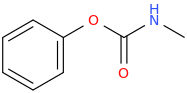
1-phenyl-1-oxa-2-oxo-2-methylaminoethane.png


TRICK
1-phenyl-1-oxa-2-oxo-2-methylaminoethane

Or

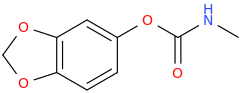
1-(3,4-methylenedioxyphenyl)-1-oxa-2-oxo-2-methylaminoethane.png


TREAT
1-(3,4-methylenedioxyphenyl)-1-oxa-2-oxo-2-methylaminoethane
 
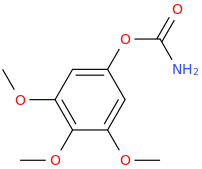
1-(3,4,5-trimethoxyphenyl)-1-oxa-2-oxo-2-aminoethane.png


INCA
1-(3,4,5-trimethoxyphenyl)-1-oxa-2-oxo-2-aminoethane

1-(indole-3-yl)-1-oxa-2-oxo-2-dimethylaminoethane.png


CASPER
1-(indole-3-yl)-1-oxa-2-oxo-2-dimethylaminoethane

1-(3,4-methylenedioxy-5-methoxyphenyl)-1-oxa-2-oxo-2-aminoethane.png


ERIN
1-(3,4-methylenedioxy-5-methoxyphenyl)-1-oxa-2-oxo-2-aminoethane

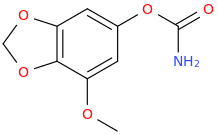
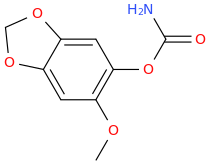
1-(4,5-methylenedioxy-2-methoxyphenyl)-1-oxa-2-oxo-2-aminoethane.png


BARRY
1-(4,5-methylenedioxy-2-methoxyphenyl)-1-oxa-2-oxo-2-aminoethane

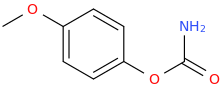
1-(4-methoxyphenyl)-1-oxa-2-oxo-2-aminoethane.png


GEORGE
1-(4-methoxyphenyl)-1-oxa-2-oxo-2-aminoethane

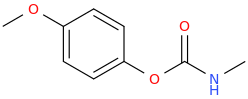
1-(4-methoxyphenyl)-1-oxa-2-oxo-2-methylaminoethane.png


GREG
1-(4-methoxyphenyl)-1-oxa-2-oxo-2-methylaminoethane

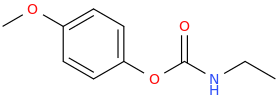
1-(4-methoxyphenyl)-1-oxa-2-oxo-2-ethylaminoethane.png


MARION
1-(4-methoxyphenyl)-1-oxa-2-oxo-2-ethylaminoethane
 
Last edited:
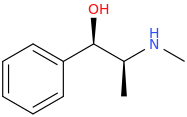
1-phenyl-1-(1R)-hydroxy-2-(2S)-methylaminopropane.png


EPHEDRA
1-phenyl-1-(1R)-hydroxy-2-(2S)-methylaminopropane

-->

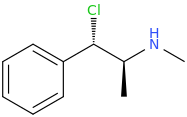
1-phenyl-1-(1S)-chloro-2-(2S)-methylaminopropane.png


1-phenyl-1-(1S)-chloro-2-(2S)-methylaminopropane

-->

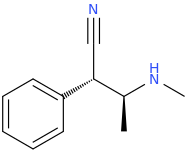
1-phenyl-1-(1S)-cyano-2-(2S)-methylaminopropane.png


1-phenyl-1-(1S)-cyano-2-(2S)-methylaminopropane

-->

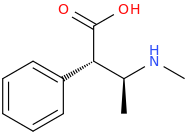
1-phenyl-1-(1S)-carboxy-2-(2S)-methylaminopropane.png


1-phenyl-1-(1S)-carboxy-2-(2S)-methylaminopropane

-->

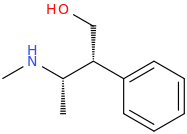
1-hydroxy-2-(R)-phenyl-3-(3S)-methylaminobutane.png


1-hydroxy-2-(R)-phenyl-3-(3S)-methylaminobutane

-->

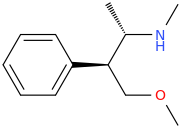
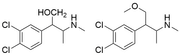
2-oxa-4-(4S)-phenyl-5-(5S)-methylaminohexane.png


SUMETHANIL
2-oxa-4-(4S)-phenyl-5-(5S)-methylaminohexane

-inspired by Sufentanil's R-CH2-O-CH3 functional group

-should last longer than Bounce if it is active
 
Last edited:
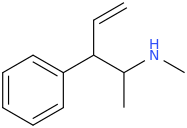
1-phenyl-1-ethenyl-2-methylaminopropane.png


ETHENEY
1-phenyl-1-ethenyl-2-methylaminopropane

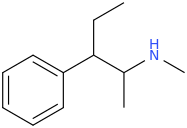
1-phenyl-1-ethyl-2-methylaminopropane.png


MEANIE
1-phenyl-1-ethyl-2-methylaminopropane

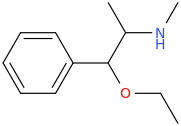
1-phenyl-1-ethoxy-2-methylaminopropane.png


MINEY
1-phenyl-1-ethoxy-2-methylaminopropane

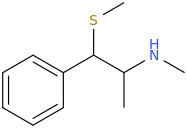
1-phenyl-1-(methylthio)-2-methylaminopropane.png


MOE
1-phenyl-1-(methylthio)-2-methylaminopropane

Catch A Tiger By His Toe.
 
Last edited:
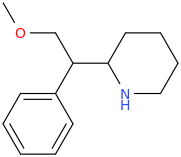
I remember dichlororitalin was reduced to the primary alcohol and alkylated to the ether by H.M. Deutsch, et al.

I thought to apply the same logic to bounce.

Misra M, Shi Q, Ye X, Gruszecka-Kowalik E, Bu W, Liu Z, Schweri MM, Deutsch HM, Venanzi CA. Quantitative structure-activity relationship studies of threo-methylphenidate analogs. Bioorg Med Chem. 2010 Oct 15;18(20):7221-38. doi: 10.1016/j.bmc.2010.08.034. Epub 2010 Aug 19. PMID: 20846865.
 
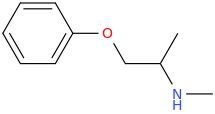
1-phenoxy-2-methylaminopropane.png


1-phenoxy-2-methylaminopropane

Anybody have any information on this one? I don't know, but it looks possibly dodgy.
 
1-phenoxy-2-methylaminopropane.png


1-phenoxy-2-methylaminopropane

Anybody have any information on this one? I don't know, but it looks possibly dodgy.
N-methyl-1-phenoxypropan-2-amine
[66022-28-4]
 
330px-Phenoxyethylamine.svg.png

Phenoxyethylamine is a parent compound of several psychedelic-related drugs including 3,4,5-trimethoxyphenoxyethylamine, CT-4719 (2,4-dichloro-5-methoxyphenoxyethylamine), CT-5126, and ORG-37684.

330px-CT-4719.svg.png

CT-4719, also known as 2,4-dichloro-5-methoxyphenoxyethylamine, is a claimed hallucinogen related to psychedelic phenethylamines like mescaline. The drug was reported to produce behavioral and electrocorticography (ECoG) effects very similar to but twice as potent as those of mescaline in cats. CT-4719 was first described in the scientific literature by 1969.

330px-ORG-37684.svg.png

ORG-37684 is a drug developed by Organon, which acts as a potent and selective agonist for the 5-HT2 receptor family, including of the serotonin 5-HT2C, 5-HT2B, and 5-HT2A receptors, in that order of potency. It has anorectic effects in animal studies and has been researched as a potential weight loss drug for use in humans. ORG-37684 produces the head-twitch response, a behavioral proxy of psychedelic effects, and hence may be hallucinogenic in humans.
 
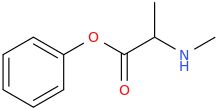
1-phenoxy-1-oxo-2-methylaminopropane.png


HIGH_SPEED
1-phenoxy-1-oxo-2-methylaminopropane

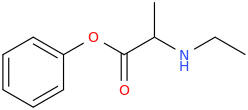
1-phenoxy-1-oxo-2-ethylaminopropane.png


CHARM
1-phenoxy-1-oxo-2-ethylaminopropane

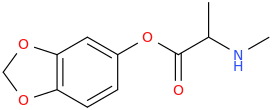
1-(3,4-methylenedioxyphenoxy)-1-oxo-2-methylaminopropane.png


CHARISMA
1-(3,4-methylenedioxyphenoxy)-1-oxo-2-methylaminopropane

Fruits Of The Spirit!
 
Last edited:
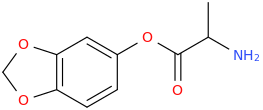
1-(3,4-methylenedioxyphenoxy)-1-oxo-2-aminopropane.png


RUB_A_DUB_DUB_THREE_MEN_IN_A_TUB
1-(3,4-methylenedioxyphenoxy)-1-oxo-2-aminopropane
 
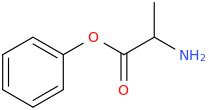
1-phenoxy-1-oxo-2-aminopropane.png


ELIZA
1-phenoxy-1-oxo-2-aminopropane

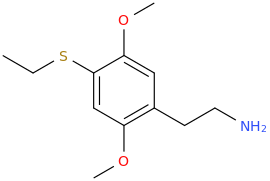
1-(4-(ethylthio)-2,5-dimethoxyphenyl)-2-aminoethane.png


BETH; 2CT2
1-(4-(ethylthio)-2,5-dimethoxyphenyl)-2-aminoethane
 
Doesn't oxygen bond at something like 109 degrees where as carbon-carbon bonds are 120 degrees?

Don't forget, MOST of the carbon atoms only serve to provide a 'scaffold' which places the key moieties in the appropriate relative spatial and rotational positions. Not forgetting that sometimes it's not the nucleus but the lone-pairs that matter.

I mean, someone made a methylphenidate homologue with no nitrogen and while less active, it WAS active in animal models at least. Which makes some sense because it's still likely that the compound would interfere with the VMAT-2 transports.

Sometimes you DO want that 109 and I have pointed to a few compounds that do just that,

You can tell that most new drugs are the result of HTS and in-silico design because they contain crazy stuff like cyclopropyl rings!

But check out sibutramine. That cyclobutyl moiety JUST FILLS SPACE. You could ring-substitute and while 5HT2a affnity is less likely, I strongly suggest that homologues would act like their simple n-propyl counterparts do. para bromo is a bad plan, but a 3,4-MD (or benzofuran for legal reasons...) yeah, I would bet £1 that as long as that chain is only 3 carbons (excepting the ring), those compounds will be nigh on identical.
 
Won't all of the phenol esters you suggested just hydrolyze relatively easily?
 
Phenoxyethylamine is a parent compound of other drugs like the α-adrenergic receptor antagonist phenoxybenzamine, the α2-adrenergic receptor modulators lofexidine, allyphenyline, and cyclomethyline, the β-adrenergic receptor agonists dextrofemine and isoxsuprine, the beta blocker carvedilol, the antihistamine phenyltoloxamine, the sodium channel blocker mexiletine, and the coronary vasodilator fenalcomine...
 
Top