• N&PD Moderators: Skorpio

quinoline replacing indole in tryptamines

stormyweathers

Bluelighter
Joined
Jan 3, 2010
Messages
200
Location
USA
Just out of curiosity, what effect do you think replacing the indole moiety of a tryptamine with quinoline would have on the activity of a substance.
I'm no chemist (yet), but I have noticed that a lot of the 5HT2 affinity that tryptamines and phenethylamines have is related to the N substituents. But I am also aware that the 4 and 5 spot substituents of tryptamines are key in subjective effects.

maybe i'm just foolish, maybe not. I would imagine these would be harder to synth anyway.

edit: maybe isoquinoline would be a better replacement.

 
pyrrolo[3,2-b]pyridine or imidazo[1,2-a]pyridine are probably better bets than quinoline I suspect

and vector is right there is another thread just like this round here somewhere
 
Quinolines (I think quipazine is one) are active at 5Ht2a, but as has been mentioned before, that's not the whole story. Also there's the danger that you find something with 5HT2b affinity, then you've got people developing elephant sized hearts and levels of blood pressure in the industrial range. Finally, I don't remember seeing that quipazine substituted for any classic psychedelic in animal models. Basically quinolines sound like their non-fused ring relatives, the phenylpiperazines (no thanks, I'll pass on that one).

Even if it did substitute in animal models, that's still no guarentee you'll get what you want. After all S-DOM substitutes for MDA in some rat studies and if you took S-DOM wanting a MDA like hit, you'd get the fright of your life, even if S-DOM is the weaker of the two chiral compounds (it can still kick your arse, only it requires 3-4 times the dose of the raceamate and anyone who's had a serious experience with DOM will tell you it is way beyond what MDMA feels like. Almost better than LSD IME
 
Last edited:
What is the reasoning for Shulgin writing a book about the class? He doesn't exactly branch out much into a diverse range of fields, there has to be some reason for the book.
 
FandB said:
Also there's the danger that you find something with 5HT2b affinity, then you've got people developing elephant sized hearts and levels of blood pressure in the industrial range.

But many of the classical psychedelics, particularly the DOxs and MDA, have significant affinity for 5ht2b. It seems that such agonism becomes a problem only with chronic use and overdose situations.

ebola
 
People get freaked out now when they hear about these recreational drugs that have 5HT2b agonism which is silly, if u r looking for a stimulant, antidepressant or diet drug which is meant to b taken on a regular basis than yeah its not good but taking it speraticly is noothing to worry about, I would be shocked if dmt,nmt,t,and 5ht neurotransmitters/5ht agonists didn't posses 5ht2b agonism as well

Also quipazine is more of a piperazine than a quinoline, look at naphthylpiperazines altho as a side note to that I wouldn't mind trying the 2-arylpiperazines, I would theorize they are closer to phenethylamines than piperazines
 
From what little I have read about quinolines, there may be some good ones here and there but for the most part you're better off with the piperazines than the quinoline derivatives and piperazines already are toxic as hell and are well-known killers. I, personally, won't touch quins until I see a lot of people do it first and don't see them end up on the news. You can't replicate tryptamines by the way. It isn't as simple as replacing tryptamine with isoquinoline derivatives (they would have to be heavily modified to even substitute as an active psychoactive chemical anyway which would defeat the purpose as isoquinoline doesn't work - someone smarter (actually less lazy) can explain it further).
 
But many of the classical psychedelics, particularly the DOxs and MDA, have significant affinity for 5ht2b. It seems that such agonism becomes a problem only with chronic use and overdose situations.

ebola

And we are talking about something that would be some sort of an EXTREME research chemical - what audience do you expect will take these? The meph generation. This board is loaded with meph generation and also the greedy Chinese just waiting for the next big thing they can cash in on. Also of note is that a lot of the DOx chemicals are quite toxic on their own and MDA can be as well as far as the temporary flux that occurs in the brain when it is abused. This is coming from someone that was part of the meph gen AND the MDA gen - I used to seek out MDA in every pill I took. And I paid for it every time.

EDIT: Wait a minute, isn't LSD based off of a quinoline base? I read something in the literature about LSD being remotely related to a quinoline. It may have been another drug. I am happy to be corrected.
 
LSD most definitely has an indole base. Is there any evidence suggesting that quinoline-replaced indoleamines have similar binding profiles to their tryptamine counterparts?
 
As what has been said already, 5-ht2b agonism isn't necessarily a bad thing. MDMA requires its 5-ht2b for its serotonin releasing action. As for DOx's and MDA's toxicity, has any of it been linked to 5-ht2b agonism? I'm not aware of any heart issues from any DOx due to 5-ht agonism. And as these would likely be psychedelics they would likely be abused less than stimulants like MDMA so I would be surprised if it caused much of an issue if any at all. I can wait for the quinazoline-2,4(1H,3H)-dione analogues from the work done on Ketanserin which led to the n-benzyl 2c's. Surely they'll make it out one day.

Doly, S., E. Valjent, et al. (2008). "Serotonin 5-HT2B receptors are required for 3,4-methylenedioxymethamphetamine-induced hyperlocomotion and 5-HT release in vivo and in vitro." J Neurosci 28(11): 2933-2940.
 
Quinine itself is a 6-methoxy-quinoline. It also has a nitrogen located where the DMT nitrogen is, with the same amount of carbons between them. But it's induitably inactive as a psychedelic. I don't think this class of drugs is the way to go. If I recall correctly from nirvus' thread abotu modelling the 5-HT2a receptor, the six-membered carbon ring in phenethylamine and tryptamine psychedelics form a Pi-stacking interaction with the six-membered ring of an amino acid residue in the binding pocket. adding another six-membered ring next to it may cause the entire molecule to shift a ring's diameter to the side when binding, behaving more of an antagonist than agonist. Disclaimer: this is all pure speculation and guesswork.

Edit: another explanation for para-aminoethylquinolines lack of activity could be that the NH in the tryptamine acts as a hydrogen bond donor, while the -N= part of the quinoline acts as a hydrogen bond acceptor due to the lone pair of the nitrogen.

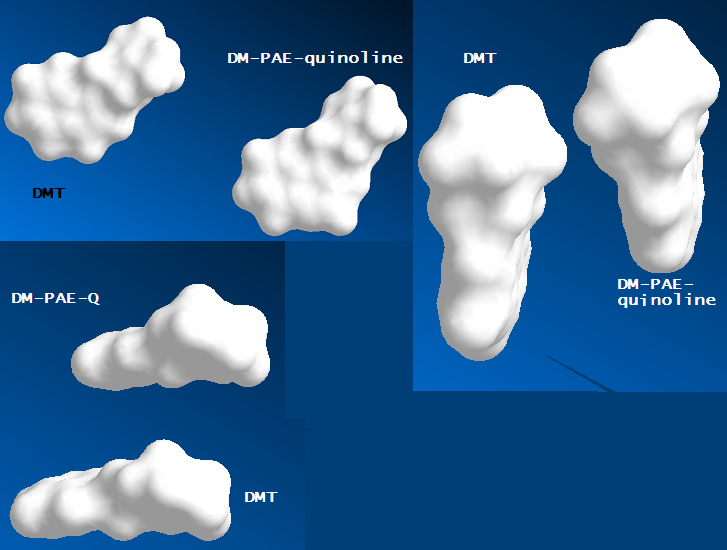
Here's a picture of N,N-dimethyltryptamine and N,N-dimethyl-4-aminoethylquinoline seen from the front, side and top. The molecules are in their energy-minimized conformations. This is also guesswork at best, but at least educated guesswork.
Sw7iT.png
 
Last edited:
Top