• N&PD Moderators: Skorpio

Psychiatric Drugs with Novel Mechanisms of Action

bupropion

Bluelighter
Joined
Feb 29, 2008
Messages
373
I know most of these drugs are not recreational, but this is definitely exciting news...................many psychiatric drugs with entirely new mechanisms of action are being developed.

Maybe someone could explains some of these......

Wikipedia said:
Saredutant, or SR 48968, is a neurokinin-2 antagonist drug being developed as an antidepressant and anxiolytic by sanofi-aventis. Its mechanism of action is different from antidepressants currently available on the market. It works by blocking the effects of Neurokinin A at the NK-2 receptor.

Phase III studies are currently being conducted. New drug application submission is expected in the second half of 2008.

I understand Neurokinin A is somewhat related to Substance P......anyone care to shed more light on the subject?


Wikipedia said:
Pexacerfont (BMS-562086) is a drug developed by Bristol-Myers Squibb which acts as a CRF-1 antagonist.

Corticotropin releasing factor (CRF), also known as Corticotropin releasing hormone, is an endogenous peptide hormone which is released in response to various triggers such as chronic stress and drug addiction. This then triggers the release of corticotropin (ACTH), another hormone which is involved in the physiological response to stress. Chronic release of CRF and ACTH is believed to be directly or indirectly involved in many of the harmful physiological effects of chronic stress, such as excessive glucocorticoid release, stomach ulcers, anxiety, depression, and development of high blood pressure and consequent cardiovascular problems.[1]

Pexacerfont is a recently developed CRF-1 antagonist which is currently in clinical trials for the treatment of anxiety disorders,[1] and has also been proposed to be useful for the treatment of depression and irritable bowel syndrome.


Lu AA21004 - bis-aryl-sulphanyl modulator - What the hell is this? - Phase III - Depression, anxiety

SSR149415 - V1B antagonist - Phase II - Depression, anxiety, hyperphagia

TIK-101 - NMDA Antagonist - Phase II - Anxiety

GSK 856553 - P38 kinase inhibitor - Phase II - Depression

ORG 34517/34850 - GR antagonist - Phase II - Depression

ORG 26576 - AMPA modulator - Phase II - Depression

ORG 24448 - AMPA modulator - Phase II - Psychosis

PRE703 - MgluR agonist - Phase I - Anxiety

AFQ056 - MGluR5 receptor antagonist - Phase I - Anxiety

AZD2327 - Enkephalinergic modulator!! - Phase I - Anxiety

URB597 - FAAH (fatty acid amide hydrolase) inhibitor - Phase I - Depression


Others:

Indiplon - approvable - insomnia
Adipiplon - alpha 3 selective - Phase II - anxiety
GSK 372475 - dopaminergic - Phase II - depression
Altropane - highly selective dopaminergic - Phase II - ADHD


http://www.neurotransmitter.net/newdrugs.html
 
Last edited:

Could this be moved to AD and the title changed to "Psychiatric Drugs with Novel Mechanisms of Action" ?
 
I don't know about THAT title, but I can shift it. When I read this half an hour ago or so I wasn't sure what to do with it. Cool thread, they might need to chop it up into several small bites; there's a lot to digest there.
 
Some are these are pretty curious, like "YKP-10A, R228060 Phenylalanine derivative with unknown mechanism (anti-depressant) ". Are they doing things like forced swim tests to determine the efficacy of these drugs (or activity in general)?

We are probably going to see more melatonin receptor agonists for sleep disorders in the future(obviously, they are not abusable) ...

In regards to "Lu AA21004 - bis-aryl-sulphanyl modulator": i think i had read it was most likely a SRI and/or 5-ht1a agonist (not 100% sure on this, i will have to find the article to confirm this), and will most likely be coming on the market in the not too distant future....

Also, doesnt alcohol act on the enkephalinergic receptor (at least, in small part)? Perhaps this parallels the proposed use of an enkephalinergic modulator as treatment for anxiety?

This one sounds strange as well: "Nemifitide
(INN 00835) Pentapeptide analog of melanocyte-inhibiting factor (MIF-1) administered intravenously (mechanism unknown) "

I was unaware of a transdermal amphetamine preparation being proposed.
 
Last edited:
nice find !

i would sample this one

AZD2327 - Enkephalinergic modulator (AstraZeneca)

cheers
 
I was unaware of a transdermal amphetamine preparation being proposed.

Not really surprising- there's a methylphenidate patch.

For depression of ADHD?
 
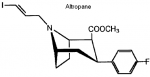
Altropane is being investigated as a DAT ligand for PET diagnosis of Parkinson's and ADHD. Doesn't look like this one is a useful drug...

http://www.freepatentsonline.com/7081238.html

A method of diagnosing attention deficit-hyperactivity disorder (ADHD) in a human patient comprising administering to a patient a labeled dopamine transporter ligand and assessing the amount of labeled dopamine transporter ligand that is bound to dopamine transporter in at least one region of said patient's central nervous system, wherein an elevated level of dopamine transporter in said patient is indicative of ADHD.


http://www.medicalnewstoday.com/articles/92185.php apparently belongs to Alseres Pharmaceutical.


Ham-milton said:
Not really surprising- there's a methylphenidate patch.

For depression of ADHD?

ADHD, of course. Marketed by Shire.
 

Attachments

  • altropane.PNG
    altropane.PNG
    8 KB · Views: 132
There is a dopaminergic for depression, GSK 372475. Any idea how strong it is?
 
We are probably going to see more melatonin receptor agonists for sleep disorders in the future(obviously, they are not abusable) ...

Well i think there is already one out : Ramelteon

http://en.wikipedia.org/wiki/Ramelteon

Its an agonist for MT1 and MT2 receptors.Used, as expected, in insomnia and given its mechanism of action one shouldnt expect an abuse potential (read : any short of "that shit is cool, gimme some more"). Psychological dependence,is another story of course, i think some people may at a time announce that they NEED ramelteon to sleep ;D

Its trade name is Rozerem and its got one of those "oh so cute" websites trying to explain to the general public what it does. Some funny ads of it by the way...

http://www.rozerem.com/consumer/home.aspx
 
Well i think there is already one out : Ramelteon

Did you really think he didn't already know all of that? Psychological dependence is rarely, if ever, seen in drugs outside of those that induce euphoria. This isn't a drug that does that.
 
bupropion said:
Lu AA21004 - bis-aryl-sulphanyl modulator - What the hell is this?

I guess they mean Modafinil [2-(Diphenyl)methanesulfinyl]acetamid... That's the only one I know. Anything else?
 
Ramelteon looks like a refined (improved) version of Agomelatine.
Agomelatine works as a melatonin agonist and 5-HT2C antagonist.
220px-Ramelteon.svg.png

I guess it shouldnt be too surprising then that Ramelteon has reported activity at the melatonin receptors.

It's hard to find much info on these codename compounds because drug companies are super secretative and would rather people remained completely ignorant of their activities. I bet half of these receptors probably dont even exist and are just a way of losing gullible people by shifting the S/N away from monoaminergic theories of mental illnesses.
 
Last edited:
I am also wary of excessive pharmacological jargon.

The biogenic amine hypothesis is quite good and elegantly simple, perhaps so much so that people come up with ways to make things sound more complicated than need be. I have noticed that a huge percentage of prescription drugs have an amine, a two (usually) carbon spacer, and then an aromatic ring of some kind in that order embedded within their chemical structures.

Thumb through the Merck Index or Physician's Desk Reference and you will be amazed at how often this fact plays out.
 
The "biogenic amine" hypothesis... is not really a particularily complete idea at all. It basically says 'there is a problem (usually lack) of _________" where _________ is a biogenic amine. That doesn't say much. It doesn't even begin to answer how it goes about producing that effect... or cover that there are many different/unique types of depression, from a pharmacological standpoint. Some people are resistant to serotonin uptake inhibition... some to NRI, and they present different symptoms (eg - serotonin and anxiety... norepinephrine and amotivation)


Even past that, saying 'it causes the syndrome because it isn't providing enough effect at ___________ receptor'... is still barely of any useful content/context such as:

-How does a lack of agonism (for example) at this receptor mediate that effect. -Why is it not getting enough agonism at that receptor?
-Maybe because another area of the brain having a reciprocal inhibitory effect, meaning it might be caused by too much agonism at another receptor.
-Or maybe because there isn't enough synthesis of the proteins/transcripts that cause production of that biogenic amine, which might itself be caused by (for example) weak action at the NK-2 receptor, which usually triggers gene expression for those amines.

There's more than one way to skin a depressed person... and "being wary of pharmacological jargon" is not one of them, nor is it going to help them at all.
 
^ I agree, and simply from experience, not that I am a scientist or anything. What worked on my depression was something that operates on receptors generally not associated with depression, but cause changes in levels of all biogenic amines (amongst other things).


An overhead pipe has a hole in it, and is dripping on our kitchen floor. We wipe the water off the floor using tissue paper. It comes back. So we decide to buy new, more expensive towels - that ougt to fix it! But the leak comes back. Hmmm, the problem must be in the floor-tiles then. We buy wax and wax them all. Next day, there is still a drip, and the water is still on the floor. Hmm... ok, we will build a small wall around the tile on which the water is dripping, so that it doesn't spread. Yay! for a few days, the leak is only a problem on a single floor tile! But wait... three days later, the walls are filled to the brim, and water starts leaking on to the rest of the tiles. The floor is now wet again. And so on. This is the problem with neuropharmacology up to just very recently.

I think the only reason people still think in terms of medicating singular transmitters (like Serotonin for depression) is still alive because it brings good cash to pharmaceutical companies.

SSRIs and the like are "bandaid" solutions that never target what is actually going on. There is a "shortage" (or whatever) of synaptic serotonin and studies show that increasing this serotonin makes people less sad. Therefore we have to work on the serotonin, ignoring the fact that the decreased serotonin is one of the many consequences of a problem higher up in the cascade.
 
^
well it does seem that anything that radically shakes up brain function in a non selective manner is effective... ketamine as chemical ECT. Or 5-ht2a agonists to shake out the cobwebs, both work.
 
^^^

Do you think these methods have the same mechanism of action they're proposing for SSRI's and exercise? To clarify: it's been hypothesized that the true uniting action of all antidepressants and exercise is the increase in neurotrophic factors and rebuilding of connections in the hippocampus, etc. Feel free to correct this, as it's kinda off the top of my head.
 
But does that really heppen?

It seems to me like (as I mentioned in my post) that SSRIs are bandaid solutions, and that any changes long-term would be simply adaptive to such a solution, not a positive effect of the drugs themselves.

Excersize is an entirely different matter as it affects everything in the body (and therefore everything in the brain).
 
Top