• N&PD Moderators: Skorpio

Poppy alkaloids; lemon juice ---> citrate alkaloids...... why?

CloudyHazeD

Bluelighter
Joined
Sep 1, 2004
Messages
1,808
First off, on a quick preliminary search, I am having a horrible time finding what the poppy's alkaloids are natively.

Are they freebase in the plant or a salt?

Anyway, I've read 'trip' reports and such of varying quality and I'm having trouble coming to a conclusion on the addition of lemon juice to purportedly aid getting the goods from poppy via tea.

So, I assume, the addition of lemon juice would lead to morphine citrate and friends, right?

Are the citrate form of poppy alkaloids any more or less soluble in water than the native form?

Is bio-availability any different citrate vs. native?

Could a tartate of poppy alkaloids be formed? If so, same questions as above.

thanks in advance for any light you guys can shed on this

 
They're a salt as I recall, but not anything common. I forget what the acid is...
 
I've been seeing reports on the internet that the use of citric acid in poppy tea preparation produces "higher level alkaloid" (their words, not mine) content, whatever that is supposed to mean. Sounds like BS to me, perhaps with a kernel of misunderstood truth behind it?
 
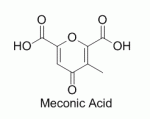
Meconic acid

The salts of opium alkaloids in poppy are mainly meconic acid salts. Meconic salts are rather unstable. Soluble in 20 parts of water, in alcohol.

Since someone asked: the tartrate triydrate: solubility 11 parts in water.
 

Attachments

  • Meconic Acid.gif
    Meconic Acid.gif
    3.3 KB · Views: 111
meconic acid.

The lemon juice is useless as the meconic acid of morphine is perfectly soluble in water.

(Unless there is freebase morphine in the pod that you are trying to convert to citrate, this I'm not sure of)
 
stupid question maybe, but if you are looking at a cytosolic alkaloid, how the hell can someone say it is one salt vs. another. Yes, it is protonated @ physiological, but do try to identify the counterion in a soup of anions seems a little bogus to me.
unless of course it is sequestered somewhere, or...?
 
that's a good question. I assume the assumption is based upon whatever acid is present.
 
Is it just me..

..or does that meconic acid look like it would hydrolyse or otherwise be transformed into some interesting/useful things?
 
around 50% of M is locked up as freebase adding acid will of course make it salt out making it water soluble
 
Will the real meconic acid please stand up?

I'm a little confused.

6-(dihydroxymethylidene)-4,5-dioxopyran-2-carboxylic acid looks like it might be a decent depressant.
 
Ham-milton said:
Will the real meconic acid please stand up?

I'm a little confused.

6-(dihydroxymethylidene)-4,5-dioxopyran-2-carboxylic acid looks like it might be a decent depressant.


Can't offer any input into your query..... but WOW! thats a great little site there:
.....pubchem...ncbi.nlm.nih....gov/
 
kidamnesiac said:
stupid question maybe, but if you are looking at a cytosolic alkaloid, how the hell can someone say it is one salt vs. another. Yes, it is protonated @ physiological, but do try to identify the counterion in a soup of anions seems a little bogus to me.
unless of course it is sequestered somewhere, or...?

wonderfully put!
 
far out , i only put lemon juice with my poppys to mask the nasty taste. i had no idea it makes it stronger. or gets the right alkaloids out or whatever. sweet, ill keep doing it. fucken that green tea tastes so bad, i mean when u grind the entire plant up, not just the seeds
 
retrogradeamnesia said:
around 50% of M is locked up as freebase adding acid will of course make it salt out making it water soluble


Where did you get those numbers?

I made PPT every day for three months, and it never made a difference between when I used lime juice and when I didn't, so it would be interesting to find out how much M really is in the free base form.

Also in my reading, I've learned that M isn't like a normal alkaloid in that if you basify it's acid salt it just drops out (like DMT), because it actually forms something with whatever you basified it with (example, Sodium Morphinate if you use Sodium Hydroxide) , so how you extract M from a solution of opium water is still foggy to me ... although the literature says to get the PH to 11.6 and the M will stay as a free "base?" and precip out. I've never had luck with it though.
 
Even if it's freebase, odds are good that any sort of filtration you're doing won't be good enough to filter out the single molecule or small clumps of morphine molecules that it'll be present as.

Plus, once you're adding water and liberating the freebase morphine, it'll convert to morphine meconate, assuming there's enough acid (I think there is) and that'll dissolve.

But even still, you may have nanoscopic sized chunks of morphine freebase floating around in there, but you're just gonna swallow it down.
 
Top