fastandbulbous
Bluelight Crew
Phenethylamines as tryptamine analogues
The fact that tryptamines constitute one distinct group of psychedelic agents, and phenethylamines another, at first seems quite strange as they are seperate chemical structures, with the only apparent common feature being that they are basically an aromatic nucleus connected to an ethylamine side chain. Examination of their structures though reveals that they are both part of a grander scheme, best exemplified by the ergoline LSD.

What appears strange at first glance is that with optically active phenethylamines (ie amphetamines) the most active is the (-) / R isomer, yet with optically active tryptamines (such as AMT and its 5-methoxy derivative) the more active isomer is the (+) / S isomer.

With both the R amphetamine and the S alphamethyltryptamine, it can be seen that the hydrogen on the alpha carbon are both above (ie if the planar molecule is in the plane of the paper) the plane of the molecule. This implies that the configuration having the hydrogen below the plane of the molecule is in some manner 'getting in the way of binding' (in other words, steric hinderance). This is effectively what abolishes the activity of alpha-ethylphenethylamines, as both isomers, due to free rotation of the ethyl group (or more precisely, the methyl group at the end of the ethyl), which causes spacial problems.
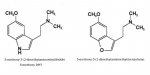
Accordingly, the dragonfly series of compounds are not dissimilar to tryptamines, in that one of the furan rings occupies the same region that the pyrrole ring of the indole. As both are dependant upon hydrogen bonding of the lone pair electrons (1 with nitrogen, 2 with oxygen) to the amino acid residue of one of the receptor subunit proteins, it is not improbable that the two are almost fully interchangable (although the oxygen cannot be further substituted, as the nitrogen can with alkyl or acyl groups). In the entry in TIKHAL for alpha-methyltryptamine, Shulgin mentions that of the other positional isomers for the 2-aminopropyl group, only the indole with the group in the 5 position is active, and then only as a long lived stimulant; from the above notes, it should be that a further substituted indole nucleus, with the 2-aminopropyl group attached at the 4 position should be active. Equally, substituting the 2-aminopropyl group into the 3 position of benzofuran derivatives should also give a series of active compounds.
Below is the metamorphosis of DOM to 5-methoxy AMT

Again, these are only speculation based on models of how phenethylamines and tryptamines bind to the 5HT2a receptor, but the given structures do fit all the criteria so far discovered.
For refs, see list given for Acid, dragonflies and the 5HT2a receptor, with additionally
NIDA Research monograph 146 – Hallucinogens, an update
Patricia A. Palumbo and J. C. Winter: Stimulus Effects of Ibogaine in Rats Trained With Yohimbine, DOM, or LSD; Pharmocologv Biochanistry and Behavior, Vol. 43, pp. 1221-1226, 1992
The fact that tryptamines constitute one distinct group of psychedelic agents, and phenethylamines another, at first seems quite strange as they are seperate chemical structures, with the only apparent common feature being that they are basically an aromatic nucleus connected to an ethylamine side chain. Examination of their structures though reveals that they are both part of a grander scheme, best exemplified by the ergoline LSD.
What appears strange at first glance is that with optically active phenethylamines (ie amphetamines) the most active is the (-) / R isomer, yet with optically active tryptamines (such as AMT and its 5-methoxy derivative) the more active isomer is the (+) / S isomer.
With both the R amphetamine and the S alphamethyltryptamine, it can be seen that the hydrogen on the alpha carbon are both above (ie if the planar molecule is in the plane of the paper) the plane of the molecule. This implies that the configuration having the hydrogen below the plane of the molecule is in some manner 'getting in the way of binding' (in other words, steric hinderance). This is effectively what abolishes the activity of alpha-ethylphenethylamines, as both isomers, due to free rotation of the ethyl group (or more precisely, the methyl group at the end of the ethyl), which causes spacial problems.
Accordingly, the dragonfly series of compounds are not dissimilar to tryptamines, in that one of the furan rings occupies the same region that the pyrrole ring of the indole. As both are dependant upon hydrogen bonding of the lone pair electrons (1 with nitrogen, 2 with oxygen) to the amino acid residue of one of the receptor subunit proteins, it is not improbable that the two are almost fully interchangable (although the oxygen cannot be further substituted, as the nitrogen can with alkyl or acyl groups). In the entry in TIKHAL for alpha-methyltryptamine, Shulgin mentions that of the other positional isomers for the 2-aminopropyl group, only the indole with the group in the 5 position is active, and then only as a long lived stimulant; from the above notes, it should be that a further substituted indole nucleus, with the 2-aminopropyl group attached at the 4 position should be active. Equally, substituting the 2-aminopropyl group into the 3 position of benzofuran derivatives should also give a series of active compounds.
Below is the metamorphosis of DOM to 5-methoxy AMT
Again, these are only speculation based on models of how phenethylamines and tryptamines bind to the 5HT2a receptor, but the given structures do fit all the criteria so far discovered.
For refs, see list given for Acid, dragonflies and the 5HT2a receptor, with additionally
NIDA Research monograph 146 – Hallucinogens, an update
Patricia A. Palumbo and J. C. Winter: Stimulus Effects of Ibogaine in Rats Trained With Yohimbine, DOM, or LSD; Pharmocologv Biochanistry and Behavior, Vol. 43, pp. 1221-1226, 1992