• N&PD Moderators: Skorpio

Phenazepam and GC/MS

cilosyb

Bluelighter
Joined
Jul 18, 2004
Messages
353
Location
Your other left
Lacking a chemistry degree or even much of a foundation in the subject, I am curious if phenazepam would show up under a GC/MS analysis which was looking for benzos. The scenario goes like this: let's say someone has taken phenazepam with such recency that it is detected on a first-pass UA under the 'benzo' category. To confirm the result the material is sent off for lab testing. Would GC/MS analysis in this scenario only be looking for specific benzos, i.e. the more popular/scheduled ones? Or does it indicate exactly which benzos are present across the whole spectrum of them, and would thus indicate phenazepam, even if they weren't specifically looking for it?

Luckily this is all hypothetical at this point. But it's rumored that someone partakes phenazepam occasionally and has an extended period of drug testing looming on the horizon, and they are curious about how sketchy it would be to continue this behavior.

 
it would definitely show up, whether they would identity it correctly is another question, phenazepam is not in everyone's spectral libraries.

we don't tend to allow drug testing questions because they veer off into discussion about beating drugs tests clearance times etc.
 
I just took a Urine test yesterday and it showed up positive for benzos even tho it has been about 2 weeks since Ive taken any Phenazepam. I was really surprised it showed up. It will be interesting to see what happens when they send it to the lab....
 
Phenazepam will show up on a GC/MS urine drug screen as a benzodiazipine. GC/MS does not test for a specific benzo but the metabolites that all benzos get broken down into during metabolism.
Hope this helps.
 
Phenazepam is close enough to drugs like clonazepam that an inexperienced person could confuse the 2 on a GC/MS trace. A 1' metabolite of clonazepam is the reduction of the nitro group to an aromatic amine (which phenaz won't do because it has a bromine there) so the metabolites should be different enough to distinguish the 2.

GCMS does test for specific benzos and specific benzo metabolites, so phenazepam should be detected as phenazepam if the lab has an internal standard - otherwise it's just an unknown benzodiazepine.

I personally would be using HPLC for benzo analysis, them's heavy aromatic drugs and I bet a GC would just shred them.
 
So just a hypothetical, I'll use camfetamine because it's not in anyones spectral libraries.
Would GC/MS spark a false/positve for fencamfamine? or better yet would Methiopropamine spark a false/positive for methamphetamine?

In other words , how would a positive test be confirmed, if the labs are not familiar(have in there database) with the substance?

I don't want to break any rules , just interested in the steps to positively identify a certain substance that a lab is not yet familiar with.

Thanks.
 
I'll use camfetamine because it's not in anyones spectral libraries.

You underestimate the spectral libraries. Good ones have hundreds of thousands of compounds. Don't forget the parent compound (fencamfamine) is in the literature, and in the case of methiopropamine, probably the drug itself.

Generally there are large MS spectral libraries and/or analysis software (and technicians) that can take a good guess at what the compounds are from their metabolism, the literature, and figuring masses out by hand.

Generally the variables relating to the compound in a GC/MS test are retention time (corresponding to boiling point/polarity) and the mass spectrum (atomic weight and structure). Both camfetamine and fencamfamine are metabolized to the same compounds so it would be likely to be misread as a positive.

Methiopropamine is different from methamphetamine on the mass spectrum but it can have a similar RT on the column so it could be misread as methamphetamine.
 
After they can be misread as "methamphetamine or fencamfamine" what step(method) is taken to actually Identify the substance in hand(methiopropamine-camfetamine) If they were not in there database?

If this makes any sense!!!!
Sorry for my LACK of knowledge!


You underestimate the spectral libraries. Good ones have hundreds of thousands of compounds. Don't forget the parent compound (fencamfamine) is in the literature, and in the case of methiopropamine, probably the drug itself.

Generally there are large MS spectral libraries and/or analysis software (and technicians) that can take a good guess at what the compounds are from their metabolism, the literature, and figuring masses out by hand.

Generally the variables relating to the compound in a GC/MS test are retention time (corresponding to boiling point/polarity) and the mass spectrum (atomic weight and structure). Both camfetamine and fencamfamine are metabolized to the same compounds so it would be likely to be misread as a positive.

Methiopropamine is different from methamphetamine on the mass spectrum but it can have a similar RT on the column so it could be misread as methamphetamine.
 
Last edited:
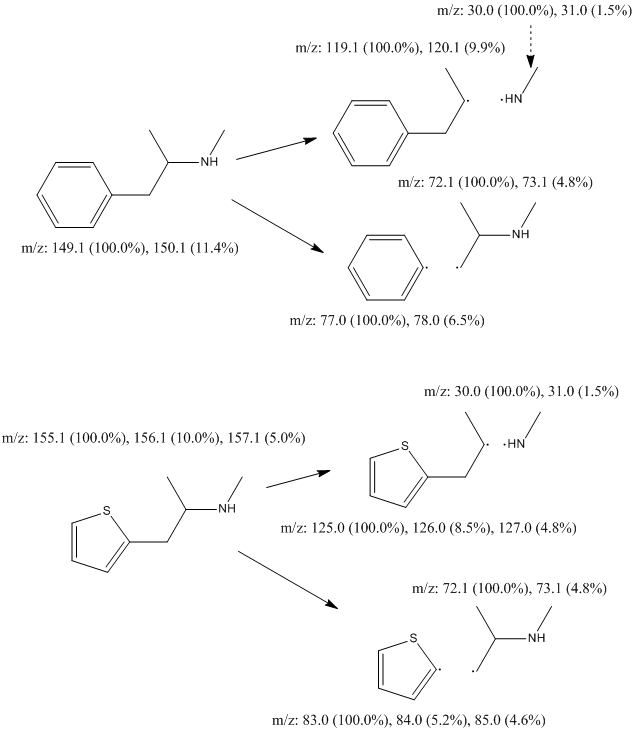
Generally in gas chromatography-mass spectrometry the second stage (the detection) is done with something called an electron ionization mass spectrometer. What it does is ionize the compound coming into the detector, breaking it into 'fragments' depending on structure. The fragments are then electrically accelerated and/or magnetically deflected and the different mass of the fragments causes them to seperate out.

znfPw.png


The end result is you get a number known as a m/z (mass over charge) describing the relation between mass and charge of the fragment, describing peaks on the spectrum. It's a matter of using chemical logic and algebra from there to figure out what it is.

One dead giveaway of methiopropamine is that sulfur has more isotopes found in nature than carbon/hydrogen, and hence has a 'messier' spectrum.
 
Phenazepam is a pro-drug for Valium. It metabolizes into diazepam and nordiazepam, so you will fail any urine screen for benzos after taking phenazepam. It's similar to how heroin, morphine, and codeine all share the same ultimate metabolite that is looked for in an UA and will cause a positive for the same substance no matter which of the 3 prodrug you originall started with.
 
Top