• N&PD Moderators: Skorpio

PEA extraction from Cocoa.

Meloxicam

Greenlighter
Joined
Nov 26, 2010
Messages
19
First i would like to say hello and sorry. I don't know if this is the appropriate subsection of the forum where to post this thread, so if any kind moderator knows where to shift the thread to, if necessary, i would greatly appreciate it.

I have noticed that when i ingest large amounts of chocolate ( around 250-500 grams a day ), then i get a very amphetamine-like rush. I suspect it is from Phenetylamine ( PEA ). I've been experimenting a little bit with Curcumin, Black pepper and chocolate, with the attempt of increasing the bioavailability of PEA through the subtle MAOI effects of Curcumin. Black pepper is necessary for allowing the Curcumin to become active. It worked... however... it wasn't as successful as i hoped for ( big surprise there ).

I am highly convinced, that the MAOI effect of Curcumin also leads to a very high activation of Theobromine ( the main active ingredient in Cocoa ) and Tyramine, which results in a complete buzzkill, if not to say a literal feeling of shit. I cannot stand caffeine at all... 1 cup is enough to make me feel like complete shit.

I took about 9 peppercorns, crushed, diluted in alcohol and heated with a small flame for about 30 seconds to make the piperine dissolve in alcohol and thus reduce the time it takes for it to become active. Ingested it, then mixed about 3/4ths of a big spoon size with curcumin with a little bit of olive oil ( curcumin is highly soluble in olive oil ) and ingested the curcumin. Then i drank a cup of green tea and ate about 100-150grams of chocolate. This was my last experiment, as it resulted in a very unpleasant caffeine overdose-like experience. Possibly the green tea added to it all as well, with it's antioxidant properties.

Long story short, does anyone here have enough knowledge in chemistry, to point me in the right direction as to how to extract either theobromine, or PEA from cocoa? It shouldn't be extremely hard from what i gather. I suspect that getting pure PEA would be the best route, because Cocoa also contains Tyramine, which may have possibly also contributed to the hypertensive crisis that i experienced. So removing theobromine might not be enough. I would like to extract PEA from Cocoa.

Any ideas? As far as i know this shouldn't also be illegal, since PEA is an uncontrolled substance.

Thanks in advance.

 
Cocoa doesn't contain enough PEA to be worth your time extracting... i'd imagine a straightforward double extraction (defat with naptha, extract the residue w/ chloroform, dichloromethane, ethyl acetate) would pull most of the xanthines though. (Look up a lab for extraction of caffeine from tea).

MAOI effect of Curcumin

I don't think it's significant at dietary intake levels. People don't get hypertension after eating curry...

I took about 9 peppercorns, crushed,

A truly homeopathic amount.

Most studies with curcumin have large amounts of it injected intraperitoneally.
 
Please run a search before posting again: for whatever reason, threads on chocolate have been pretty common.
...
sekio said:
A truly homeopathic amount.

Yup. Just dosed higher than this with breakfast. :P

ebola
 
Cocoa doesn't contain enough PEA to be worth your time extracting... i'd imagine a straightforward double extraction (defat with naptha, extract the residue w/ chloroform, dichloromethane, ethyl acetate) would pull most of the xanthines though. (Look up a lab for extraction of caffeine from tea).


I don't think it's significant at dietary intake levels. People don't get hypertension after eating curry...


A truly homeopathic amount.

Most studies with curcumin have large amounts of it injected intraperitoneally.


Thank you for the advise. Hmm... wouldn't diclhoromethane pull PEA out of Cocoa along with it?

Although i would have to disagree. 400 mg-s of pepper is enough to apparently increase the bioavailability of orally ingested curcumin by 2000% by a study. I am not sure whether 9 peppercorns adds up to 400mg, since i didn't have a scale at that time, but 2000% or 1000%, still more than 100%. Heck, i read about it from here and didn't see anyone mention it being a placebo, quite the opposite. My own experience being enough to convince me of it's effects. Of course you need a big spoonful of pure curcumin ( 2+ grams ) alongside that. I think eating the same amount of both spices in a food that is cooked and prepared, you do not get them absorbed fully enough at the same time for a noticeable effect, because your body is busy digesting and metabolizing the rest of the food as well. The effects are also only supposed to last 3 hours or so ( lasted much longer for me thouh ), requiring a frequent re-dosing, even when taken on an empty stomach. So i'd imagine with food it might be barely noticeable. That's my guess anyways.

If you don't believe me, try it the same way i did, minus the green tea and chocolate, unless you want to experience it the same way i did ;) But then again... people are different. Some are more sensitive to substances, some are less.
 
Do you live in the US? Phenylethylamine HCL is not difficult to buy in bulk online, it's used as a fitness supplement, and there are multiple manufacturers that produce it.
 
No, i don't live in the US, but i suppose i could order it here. Still more interested in the extraction however.
 
The amount of PEA in chocolate is miniscule compared to the presence of theobromine, etc. I'm not sure it would be worth your time or effort.

By far the major alkaloid in chocolate is theobromine, with caffeine and other methylxanthines, which are easily extracted with boiling water from defatted cocoa cake. (Not like Betty Crocker cake.)

This reference talks about analyzing "sweetened, unsweetened, and milk chocolate", and they find no detectable phenethylamine.

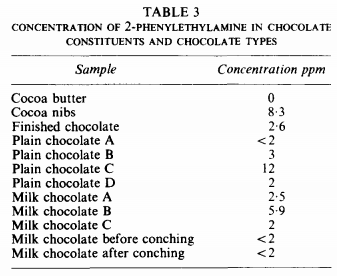
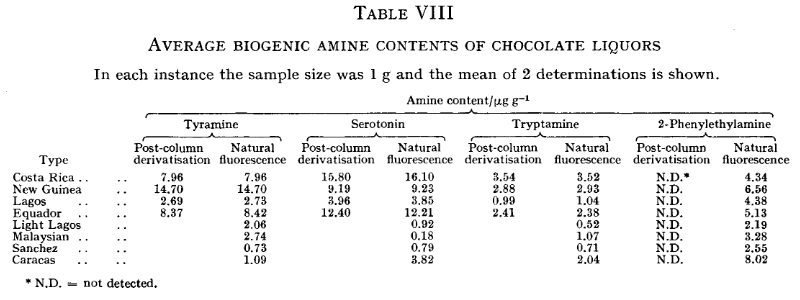
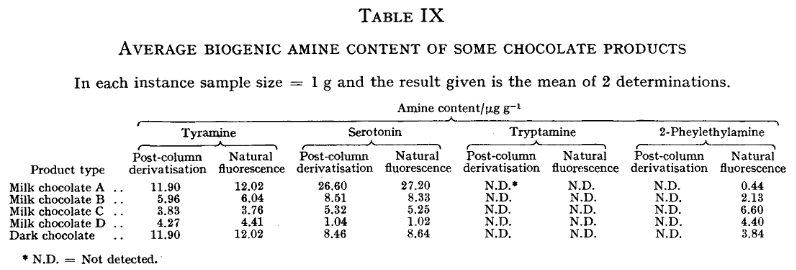
Here's another study using HPLC again. They find between 0.44 and 8 micrograms per gram - so no more than 0.8 mg per 100 grams.
NSFW:
NJ9riVO.png

fcV0ECW.png


Another study shows no more than 1.2 mg/100gm of phenethylamine in chocolate.
NSFW:
4Sc1ebW.png


Perhaps someone got confused, because there is up to ~500 mg per 100gm of phenylalanine (alpha carboxyl phenethylamine) in chocolate, but that's not the same thing.

Also curious: in a double blind test, chocolate is no more likely than carob to induce headaches.
 
The amount of PEA in chocolate is miniscule compared to the presence of theobromine, etc. I'm not sure it would be worth your time or effort.

By far the major alkaloid in chocolate is theobromine, with caffeine and other methylxanthines, which are easily extracted with boiling water from defatted cocoa cake. (Not like Betty Crocker cake.)

This reference talks about analyzing "sweetened, unsweetened, and milk chocolate", and they find no detectable phenethylamine.

Here's another study using HPLC again. They find between 0.44 and 8 micrograms per gram - so no more than 0.8 mg per 100 grams.
NSFW:
NJ9riVO.png

fcV0ECW.png


Another study shows no more than 1.2 mg/100gm of phenethylamine in chocolate.
NSFW:
4Sc1ebW.png


Perhaps someone got confused, because there is up to ~500 mg per 100gm of phenylalanine (alpha carboxyl phenethylamine) in chocolate, but that's not the same thing.

Also curious: in a double blind test, chocolate is no more likely than carob to induce headaches.

Interesting...

Where ever i have read, the studies suggest that chocolate and cocoa contain phenethylamine rather than phenylalanine. Here is an example:

http://link.springer.com/article/10.1007/s12264-013-1330-2#page-1

However... i was looking up foods high in PEA the other day and peanuts were cited as one of the top 3. So i looked up the nutrition table of peanuts, which interestingly did not have phenethylamine amongst the proteins, but it did have phenylalanine in that list. I am really confused here... if you are right about someone getting it mixed up, then apparently those who are conducting studies are speaking out of they're asses as well. Or is it so, that PEA itself does not really come from anywhere else than phenylalanine as it is metabolized from it upon ingestion, unless it is synthesized? Perhaps someone with a PHD or insight in biochemistry could answer this? 8)

Which is another thing that has me slightly confused. I found this chart the other day:

https://www.neurorelief.com/uploads/content_files/Catecholamine_pathway.pdf

It shows that the phenylalanine pathway is the one that leads to dopamine, norepinephrine, epinephrine etc... but PEA is showed as a separate entity all together, suggesting that PEA is a neurotransmitter itself. I'm really curious about this substance, because it's the root for so many psychoactive and psyhchedelic ones. Also this: abnormally low concentrations of endogenous phenethylamine are found in those suffering from attention-deficit hyperactivity disorder (ADHD), whereas abnormally high concentrations have been discovered to have a strong, positive correlation with the incidence of schizophrenia.

PEA as a neuromodulator or neurotransmitter is compelling, because it seems to derive from phenylalanine, which leads to dopamine, norepinephrine, epinephrine. And yet at the same time, it also releases norepinephrine and epinephrine, similarly to amphetamine. Kind of like a endogenous drug to say the least.

By the way, i have experimented with phenylalanine, but it did not give me the same effects that i have been after, namely the ones i've got from eating chocolate. I am not joking, when i eat 250g+ of chocolate a day, i feel the most amphetamine-like effects that i have ever felt from anything else that isn't literally a drug. I severely doubt that anything else within chocolate ( tyramine or theobromine ) is responsible for those effects that i have felt. But if chocolate contains phenylalanine instead of PEA, then my case is under question.

I should get my hands on some pure PEA and see how it effects me.
 
EDIT:

"A study by Sengupta et al. found that synthetic Beta-PEA at doses of 0.63 and 1.25 mg/day could cause Parkinson's symptoms meaning it is bypassing presystemic metabolism and trace concentrations are indeed reaching the brain. Chocolate contains averages between these levels."

"Most if not all chocolate-derived phenylethylamine is metabolised before it reaches the CNS. Some people may be sensitive to its effects in very small quantities.
Phenylethylamine is itself a naturally occurring trace amine in the brain. Phenylethylamine releases dopamine in the mesolimbic pleasure-centres; it peaks during orgasm. Taken in unnaturally high doses, phenylethylamine can produce stereotyped behaviour more prominently even than amphetamine. Phenylethylamine has distinct binding sites but no specific neurons. It helps mediate feelings of attraction, excitement, giddiness, apprehension and euphoria; but confusingly, phenylethylamine has also been described as an endogenous anxiogen. One of its metabolites is unusually high in subjects with paranoid schizophrenia. "

"Levels In Chocolate and GMO

It is again important to note that the problem associated with Beta-PEA has been related to the enrichment of chocolate and creation of concentrations that are not commonly found in nature.

The research said that a person eating 100g of chocolate per day, the standard size for most chocolate tablets, would have a Beta-PEA intake of between 0.36-0.83 mg/day depending on the type of chocolate. "

"Scientists have finalized gene sequencing of the cocoa genome which they some experts say will have enhanced concentrations of phenylethylamine they claim will "benefit" the chocolate industry and cocoa growers in West Africa where 70 percent of the world's cocoa is produced. "

https://www.worldhealth.net/forum/thread/99096/bad-news-for-chocolate-lovers-compound-i/?page=1

Yikes... makes ya wonder of how much GMO are we already eating... and how much unnatural transhumanism we are already encountering in our daily lives and our diets...
 
Last edited:
Where ever i have read, the studies suggest that chocolate and cocoa contain phenethylamine rather than phenylalanine. Here is an example:

All that says is that beta-PEA is a "constituent of chocolate", not that it is present in large quantities.

"A study by Sengupta et al. found that synthetic Beta-PEA at doses of 0.63 and 1.25 mg/day could cause Parkinson's symptoms meaning it is bypassing presystemic metabolism and trace concentrations are indeed reaching the brain. Chocolate contains averages between these levels."

Well, no. That's just wrong - Sengupta's study found that orally administered phenethylamine had no effect..... "However, per-oral administration of higher doses of PEA (75-125 mg/kg; 7 days) failed to cause such overt neurochemical effects in rats, which suggested safe consumption of food items rich in this trace amine by normal population". Phenethylamine seems to cause Parkinsons when injected, not eaten.
http://www.ncbi.nlm.nih.gov/pubmed/20691235

Both phenethylamine and phenylalanine are present in chocolate. Phenylalanine is an amino acid that is required for life, and is produced naturally in the body through breakdown of dietary protiens.

Yikes... makes ya wonder of how much GMO are we already eating...

Essentially all food is "genetically modified" through selective breeding. The article you linked was just silly fearmongering.
 
All that says is that beta-PEA is a "constituent of chocolate", not that it is present in large quantities.


Well, no. That's just wrong - Sengupta's study found that orally administered phenethylamine had no effect..... "However, per-oral administration of higher doses of PEA (75-125 mg/kg; 7 days) failed to cause such overt neurochemical effects in rats, which suggested safe consumption of food items rich in this trace amine by normal population". Phenethylamine seems to cause Parkinsons when injected, not eaten.
http://www.ncbi.nlm.nih.gov/pubmed/20691235

Both phenethylamine and phenylalanine are present in chocolate. Phenylalanine is an amino acid that is required for life, and is produced naturally in the body through breakdown of dietary protiens.


Essentially all food is "genetically modified" through selective breeding. The article you linked was just silly fearmongering.

The apparent claims of PEA not being orally active is biased. As there is evidence that in high concentrations it IS orally active, not to mention it can also be made orally active through the use of various MAOI-s. Also my own experiments with chocolate are far beyond placebo in this matter.

Selective breeding is one thing, direct genetic manipulation is another story.

By the way... fear mongering goes hand in hand with truth. Sorry for the OT.

http://rt.com/news/eu-approve-gm-crop-608/

Anyways, my whole point of the PEA thing is this:

PEA is derived from phenylalanine and N-Methylphenethylamine derives from PEA. Apparently the train seems to end there... We have Phenylalanine - > PEA -> NMPEA

Now... why am i so fascinated with amphetamine?

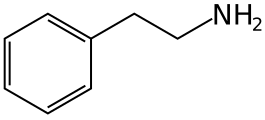
This is the PEA molecule


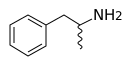
This is the amphetamine molecule


N-Methylphenethylamine molecule


Methamphetamine molecule


The reason why i called PEA the endogenous amphetamine is exactly this.
 
Last edited by a moderator:
The apparent claims of PEA not being orally active is biased.

How so?

Also my own experiments with chocolate are far beyond placebo in this matter.

Maybe you missed the discussion: chocolate contains no significant levels of PEA. And subjective effects don't determine the low-level efficacy of compounds.

(Also, oh no, genetically modified disease and pest resistant corn, better stick with "all natural" "organic" herbicides!)
 
Last edited:
How so?


Maybe you missed the discussion: chocolate contains no significant levels of PEA. And subjective effects don't determine the low-level efficacy of compounds.

(Also, oh no, genetically modified disease and pest resistant corn, better stick with "all natural" "organic" herbicides!)

How so?

http://taimapedia.org/index.php?title=Phenethylamine

http://www.drugs-forum.com/forum/showthread.php?t=60910

People wouldn't be writing these things if it didn't work.

Likewise, the possibility of GMO cocoa already being out there could mean that the chocolate i ate is enriched with PEA, which would explain a few things.

Btw... the "ADD rules" in your signature is inactive. Must be an old section.

Anyways, each to they're own. I take it you are not aware of the full implications of the transhumanist agenda. But some processes are very elaborately conceivable at 33 degrees. That is when the head becomes the tail ;)
 
I would be more apt to believe Shulgin and other peer-reviewed researchers before I took anecdotes off Taimapedia (420chan's wiki) or D-F (which is pretty much Bizzarro Bluelight, where just making up shit wholesale is common.).
 
A truly homeopathic amount.

Most studies with curcumin have large amounts of it injected intraperitoneally.

You game, Meloxicam? ;)


Claiming "What I felt was not placebo" is generally an absurd statement.

The one source I could find said "A 50-g bar of chocolate, at the most, contains about one third of 1 mg of phenylethylamine.
Phenylethylamine occurs naturally in low concentrations in the brain, where it has distinct binding
sites, although it acts as a neuromodulator rather than as a neurotransmitter. It is present in low
concentrations (< 10 ng/g) and has a rapid turnover (half-life of 5 to 10 min). It is similar to
amphetamine in that when injected into the brain of animals it causes stereotyped behavior. Although
phenylethylamine does not bind directly to dopamine sites, its effects can be blocked by dopamine
antagonists. Phenylethylamine is therefore assumed to release dopamine (Webster and Jordan,
1989). Monoamine oxidase B preferentially oxidizes phenylethylamine, although this enzyme also
oxidizes dopamine"

(full PDF of "Coffee, Tea, Chocolate, and the Brian" http://media1.tea.717.cz/files/media1:4b7b05a597b5a.pdf.upl/TF1650_10.pdf )
 
Okay...caffeine, theobromine, and rapid intake of fat and sugar in a tasty vehicle are highly psychoactive, and the placebo effect accompanies every incident of known ingestion of a suspected psychoactive drug. Levels of phenethylamine below 10 mg truly couldn't be active, even taken intravenously in combination with inhibition of MAO. I have no idea why this issue is controversial. 8(

ebola
 
Sorry if this is a bit for a village idiot question. PEA extraction from Cocoa?

When we say "Cocoa" are we talking the post cocoa butter extraction waste product (cocoa powder) or the seed of Theobroma cacao (cocoa bean)?

If we're talking about cocoa bean I got to go against the tide of opinion and say and extraction is possible with the probability of acceptable yields.

Protein hydrolysis in fermentation, so peptide bonds are broken resulting in a smaller amino acid chain and a free amino acid. The ongoing accumulation of free amino acids will be under degradation to aldehyde and amine making the point at which the reaction is interrupted the determining factor. (Strecker) If you follow what I mean. Even different temperatures used for interruption (roasting) and humidities could significantly modify the profile of amine outcomes with the possibility of a multitude of biogenic amines. There are a lot of phenolic elements from what I've read even the shells look good for tryptamine.


If we're talking about cocoa powder well that doesn't work there's an alkylation somewhere in process after the beans are roasted.
 
This study suggests that your best bet for phenethylamine in food is aged (or rotten) cheese (Halásza et al. 1994). They found rotten Gouda to contain 72-92 mg/kg of phenethylamine, a variety of french cheeses to contain 75-81, and an a variety of Swiss cheese to contain 81. So if one were to take an MAOB-selective inhibitor (you don't want tyramine poisoning) and ate a quarter to a half of kilo of cheese, it's possible that there would be psychoactivity from phenethylamine.

ebola
 
Top