

-
Select Your Topic Then Scroll Down
Alcohol Bupe Benzos Cocaine Heroin Opioids RCs Stimulants Misc Harm Reduction All Topics Gabapentinoids Tired of your habit? Struggling to cope?
Want to regain control or get sober?
Visit our Recovery Support Forums -
You are using an out of date browser. It may not display this or other websites correctly.
You should upgrade or use an alternative browser.
You should upgrade or use an alternative browser.
PD's Big & Dandy 5-IAI Thread
- Thread starter nuke
- Start date
- Status
- Not open for further replies.



Going by the few reports we have so far, i think this chemical is going to be a bit of a let down. It seems to have been completely overhyped unfortunatley, but only time will tell if the reports are legitimate (Although i can't see vendors rating their products anything less than mind blowing).

Well, we dont even know if the current batch being solled any good as it come out much faster before all the other vendors. I personally still think it can be wonderfull chemical looking at its releasing properties.
Also the example that MDAI was disappointing doesnt mean much, its just a serotonin releaser, if you find it disappointing you were just expecting too much from simple serotonin release, this has nothing to do with looking good on paper and then being disappointing in real life.
Also the example that MDAI was disappointing doesnt mean much, its just a serotonin releaser, if you find it disappointing you were just expecting too much from simple serotonin release, this has nothing to do with looking good on paper and then being disappointing in real life.
avcpl
Bluelighter
Going by the few reports we have so far, i think this chemical is going to be a bit of a let down. It seems to have been completely overhyped unfortunatley, but only time will tell if the reports are legitimate (Although i can't see vendors rating their products anything less than mind blowing).
well, I think we also have to wait until someone confirms that what they are taking is actually 5-iai too...
Well, we dont even know if the current batch being solled any good as it come out much faster before all the other vendors. I personally still think it can be wonderfull chemical looking at its releasing properties.
Also the example that MDAI was disappointing doesnt mean much, its just a serotonin releaser, if you find it disappointing you were just expecting too much from simple serotonin release, this has nothing to do with looking good on paper and then being disappointing in real life.
True, and as pointed out above, there's no way to prove what has been sampled so far is even 5-IAI.
Not sure if the MDAI thing was directed at me but i've yet to sample it myself, and even though alot of people are dissapointed with it's effects i think i sounds like something i could personaly enjoy.
True, and as pointed out above, there's no way to prove what has been sampled so far is even 5-IAI.
Not sure if the MDAI thing was directed at me but i've yet to sample it myself, and even though alot of people are dissapointed with it's effects i think i sounds like something i could personaly enjoy.
No it wasnt directed at you, but ive seen that argument showing up a few times when discussing 5-IAI, just mentioned it in general.
infinity2k7
Bluelighter
- Joined
- Aug 1, 2007
- Messages
- 572
One of the reports saying it was disappointing was someone redosing as if it was Mephedrone so its no wonder it didn't work. Its going to have to be treated more like MDMA i should think.
AussieSWIMer
Bluelighter
- Joined
- May 3, 2010
- Messages
- 78
Cant wait to hear the results. Just hope it makes its way to aus.
avcpl
Bluelighter
One of the reports saying it was disappointing was someone redosing as if it was Mephedrone so its no wonder it didn't work. Its going to have to be treated more like MDMA i should think.
That's what I was thinking too. And if someone is trying incremental dosages with a proper wait time for serotonin replenishment and receptor up-regulation, it might take a year to find out the optimal dose!
Hi. I have a small amount of what I believe to be the substance (it was sold as 5-IAI), and I'm prepared to try it and post a report. First I want to check if what I've got sounds safe (relatively).
It is an off-white powder, slightly yellow hue, which I think could be a sign of impurities not being properly removed during manufacture?
It smells a little fishy, which I think might be down to the amine group or similar impurities.
Putting a very small amount on the end of my tongue gave a sharp sensation similar to a burn, which faded to a tingle after about 5 seconds, which then lasts several minutes. The taste is sharp, chemical, bitter, and definitely different to mephedrone yet along the same lines.
Can anyone say how this compares to their own? And any comments on the safety of the substance based on my description would be appreciated, especially regarding impurities.
It is an off-white powder, slightly yellow hue, which I think could be a sign of impurities not being properly removed during manufacture?
It smells a little fishy, which I think might be down to the amine group or similar impurities.
Putting a very small amount on the end of my tongue gave a sharp sensation similar to a burn, which faded to a tingle after about 5 seconds, which then lasts several minutes. The taste is sharp, chemical, bitter, and definitely different to mephedrone yet along the same lines.
Can anyone say how this compares to their own? And any comments on the safety of the substance based on my description would be appreciated, especially regarding impurities.

Morninggloryseed
Bluelight Crew
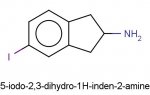
Hi. I have a small amount of what I believe to be the substance (it was sold as 5-IAI), and I'm prepared to try it and post a report. First I want to check if what I've got sounds safe (relatively).
It is an off-white powder, slightly yellow hue, which I think could be a sign of impurities not being properly removed during manufacture?
It smells a little fishy, which I think might be down to the amine group or similar impurities.
Putting a very small amount on the end of my tongue gave a sharp sensation similar to a burn, which faded to a tingle after about 5 seconds, which then lasts several minutes. The taste is sharp, chemical, bitter, and definitely different to mephedrone yet along the same lines.
Can anyone say how this compares to their own? And any comments on the safety of the substance based on my description would be appreciated, especially regarding impurities.
Most people have not been able to get any yet, so you're probably pretty much on your own. We have single digit numbers of TR's right now. We're about 2 weeks away from 5-IAI being widely available.
Fishy smell is common in RC's, particularly ones that companies havn't gotten their process up to par (from leftover amines), as is the yellow tint. If it's only a little yellow, you're doing pretty good for a new RC (i've seen pictures of stuff that was tan to light brown for this and 6-APDB).
Start small and work up the dose, and be on watch for symptoms of toxicity, and of course, report back to us


Leftley
Bluelighter
I should be trying this out relatively soon.. i'll report back.

redrangercraig
Bluelighter
I'm also waiting on a sample to arrive, probably by tomorrow. When it does I'll update on my experience but will be starting small (1mg) and slowly moving up over days or weeks! By the time I reach a decent dose I'm sure there will be a lot more reports...

sourcec
Greenlighter
- Joined
- May 12, 2010
- Messages
- 29
Well, we dont even know if the current batch being solled any good as it come out much faster before all the other vendors. I personally still think it can be wonderfull chemical looking at its releasing properties.
Also the example that MDAI was disappointing doesnt mean much, its just a serotonin releaser, if you find it disappointing you were just expecting too much from simple serotonin release, this has nothing to do with looking good on paper and then being disappointing in real life.
Exactly. Many people expected a 4-MMC euphoric hit from MDAI and thats why they didn't rate it highly. They read the Sun newspaper saw that MDAI was one of many RCs set to replace 4-MMC on the scene.
It's a very nice calm RC in its own right. I guess many might think the same about 5-IAI aswell just because they have heard it's a research chemical.
5-IAI, if what they are saying is true and it "fully substitutes for MDMA in rodents and is a putative entactogen in humans" could make this new RC very interesting indeed, especially with the low toxicity.
Then you have the issue of potency. Some RCs have the strength in 0.01g that others have in 0.05g for example.
It's a tad worrying as we have vast amounts of people eyeballing lines and not using scales for any RC not just high potency RCs. I myself was guilty of that to begin with, but what I was experimenting with was widely researched with loads of TRs to compare.
When you are dealing with an RC that has little research you are starting blind, and I can foresee people eyeballing same size lines they normally do with deadly results.
Apologises if this post doesn't make sense to you, it makes perfect sense to me but I know that it probably isnt. You know how it is.

if what they are saying is true and it "fully substitutes for MDMA in rodents and is a putative entactogen in humans" could make this new RC very interesting indeed, especially with the low toxicity.
mdai also did fully substitute for mdma in rodents.
and toxicity-wise 5-iai is compared to 4-iodo-amphetamine, which is being used in the lab to selectively kill serotonogenic neurons. i'd be careful around this one and wait until more reports (and research) are available.

moniorojo
Bluelighter
- Joined
- Jun 13, 2009
- Messages
- 224
mdai also did fully substitute for mdma in rodents.
and toxicity-wise 5-iai is compared to 4-iodo-amphetamine, which is being used in the lab to selectively kill serotonogenic neurons. i'd be careful around this one and wait until more reports (and research) are available.
I'm not sure but I think MDAI substitited for MBDB not MDMA.

rickolasnice
Bluelighter
- Joined
- Apr 19, 2007
- Messages
- 6,807
mdai also did fully substitute for mdma in rodents.
and toxicity-wise 5-iai is compared to 4-iodo-amphetamine, which is being used in the lab to selectively kill serotonogenic neurons. i'd be careful around this one and wait until more reports (and research) are available.
Yeah, but test have shown minimal toxicity in rats at very high doses..
http://www.biomedsearch.com/nih/5-Iodo-2-aminoindan-nonneurotoxic/1826785.html
mdai also did fully substitute for mdma in rodents.
and toxicity-wise 5-iai is compared to 4-iodo-amphetamine, which is being used in the lab to selectively kill serotonogenic neurons. i'd be careful around this one and wait until more reports (and research) are available.
But rats are *chilled creatures* that like to relax on MDAI as much as to rave on MDMA!
4-iodoamphetamine is as neurotoxic as MDMA and 5IAI has been screened for toxiticy and found to be a very small allmost non significant neurotoxin.
A rigid analogue, 5-iodo-2-aminoindan (5-IAI), of the serotonin neurotoxic halogenated amphetamine p-iodoamphetamine (PIA) was pharmacologically evaluated for production of serotonin neurotoxicity. A comparison was also made between 5-IAI and PIA in the two-lever drug discrimination paradigm in rats trained to discriminate saline from 3,4-methylenedioxymethamphetamine (MDMA) or saline from the alpha-ethyl homologue of MDMA, MBDB. PIA and 5-IAI were both behaviorally active, and fully substituted in both groups of animals, but were considerably less potent than p-chloroamphetamine (PCA). PIA had about twice the potency of PCA as an inhibitor of [3H]-5-HT uptake in rat brain cortical synaptosomes, while 5-IAI was only about 75% as potent as PCA in this assay. A single 40 mg/kg dose of PIA resulted in a 40% reduction of 5-HT and 5-HIAA levels and in the number of 5-HT uptake sites in rat cortex at one week sacrifice. The same dose of 5-IAI with one week sacrifice led to about a 15% decrease in 5-HIAA levels and number of 5-HT uptake sites, but only the latter was statistically significant. In rat hippocampus, PIA gave significant decreases in all serotonin markers examined, while 5-IAI slightly but significantly decreased only 5-HT levels. Neither compound produced any change in catecholamine or catecholamine metabolite levels. The results confirm earlier reports of the selective serotonin neurotoxicity of PIA, which is less severe than that of PCA, and also demonstrate that its rigid analogue 5-IAI does not appear to cause significant serotonin deficits in the rat.
Last edited by a moderator:
- Status
- Not open for further replies.