• N&PD Moderators: Skorpio

Other aromatic analogues of PHE and T ?

Vanadium

Bluelighter
Joined
Jun 3, 2006
Messages
105
hey,

Here are some other aromatics compound wich can have probably psychedelic activity.


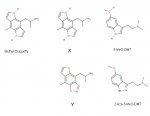
1) The molecule X is a cross between 5-MeO-DMT and the Dragonfly structure of DOM. It have 2 atom with a lone pair of electron (good h-bond donnor) in the 2,5-pattern.

2) I wonder if putting a second h-bond donnor (the nitrogen-atom of the molecule Y beside the existing oxygen atom of the fly-structure can raise the potency. The benzimidazole analogue of DMT is 5 times more potent than regular DMT.

3) I see that agomelatin is a good Melatonin agonist, therefore its 5-MeO-DMT analogue is probably a good psychedelic, no ?
 

Attachments

  • other-aromatics-PHE.jpg
    other-aromatics-PHE.jpg
    27.2 KB · Views: 173
  • agomelatin-analogues.jpg
    agomelatin-analogues.jpg
    10.8 KB · Views: 126
most of it, I'm not sure.

3. Probably not something that extends, but I've not seen a SAR or know if they're remotely transferable.

You're switching between two different types of receptors, they're likely to involve completely different SARs.
 
I think X has been made and had some receptor affinity testing...or at least the analogue without the furan ring (MeO instead) has been looked at. It was certainly spoken of here, in the acid/dragonfly thread.
 
I seem to recall reading a citation somewhere, some time ago, stating that some brief tasting has been done with the benzothiophene analogue of N,N-DMT, showing around half as much potency as DMT.

I mean, the series, using benzothiophene instead of indole, , such as via the glyoxalyl halide route.
 
morninggloryseed said:

Oh sorry I would tell about the Indazole (not benzimidazole) analogue of tryptamines. The indazole is an indole ring aromatic with a nitrogen atom in the indeole at position 2, behind the present nitrogen.

I don't remember the source of DMT-analogue but I found that :

http://cat.inist.fr/?aModele=afficheN&cpsidt=17391781

longimanus from sciencemadness.org claims that The indazole analogue of 5-MeO-AMT is 6x more potent than the indole one :

My comments:

So, the indazole analogue of 5-MeO-AMT (alpha,O-DMS in TiHKAL) is about 6x more potent than the indole and equipotent to R-DOI. The synthesis procedures suggested in the article are not the type of OTC-kitchen chemistry but still possible. 6-Methoxy-1H-indazole is commercially available and that could make things a little easier (probably the authors started with 6-HO just because they wanted to end with a periferaly acting compounds). For those interested in biochemistry it appears that "the tryptophan synthase alpha 2 beta 2 complex from Escherichia coli has been found to catalyze the beta-replacement reaction of L-serine with indazole" to the indazole analogue of tryptophan (BIZA).

Abstract :

Head-twitch induction in rodents, a stereotypical behavior induced by stimulation of central 5-HT2A receptors, has been used to assess the potential side effects of serotonergic compounds. A good correlation has been observed between the rodent head-twitch response for a compound and its ability to invoke a hallucinogenic response in man. However, this response has been shown to be modulated by agonist activity at other receptors, such as 5-HT1A and 5-HT2C, so the results of this assay must be viewed with some caution if other functional data are not available. Selected compounds from the present study along with the well-known centrally active standards 1(R-DOI) and 5-methoxy-R-methyltryptamine (19) were evaluated for their ability to induce a head-twitch response in mice following subcutaneous administration (Table 6). The effective dose required to produce a mean of five head twitches (ED5) during the 10-min scoring period was determined by interpolation of the results from bracketing doses (see Supporting Information); this value was used to provide a relative ranking of tested compounds. The responses observed for 1 and 19 in this assay, ED5 ) 0.13 and 1.0 mg/kg, respectively, were consistent with the reported human hallucinogenic dose for these two compounds, 2.3 and 2-4 mg, respectively. No perceivable response was noted in this assay for 2 (5-hydroxy-R-alpha-methyltryptamine) at doses ranging from 3 to 30 mg/kg, which is consistent with the lack of hallucinogenic activity noted for this compound. As anticipated from the permeability data, 12 ((S)-2-(6-Methoxyindazol-1-yl)-1-methylethylamine fumarate) showed a high level of headtwitch response, comparable to that of 1, with an ED5 of 0.16 mg/kg.

Limpet_Chicken, I think the benzothiophene analogues tryptamine are less potent because the sulfur is a worse H-bond donnor than nitrogen but perhaps the coumarone (benzofuran) analogue of DMT can be an interesting tryptamine-derivative...
 
Top