• BASIC DRUG
    DISCUSSION
    Welcome to Bluelight!
    Posting Rules Bluelight Rules
    Benzo Chart Opioids Chart
    Drug Terms Need Help??
    Drugs 101 Brain & Addiction
    Tired of your habit? Struggling to cope?
    Want to regain control or get sober?
    Visit our Recovery Support Forums
  • BDD Moderators: Keif’ Richards

Opioide / Opiate

Opiates are derived directly from the poppy, eg. Morphine, Codeine, Thebaine

Opioids are derived or synthesized from Opiates eg. Oxycodone (made from Thebaine) Heroin (Made from Morphine) etc

Fully synthetic drugs like Fentanyl also fall under the opioid category

EDIT: Opiods can also be classified as any substance that binds to or affects opioid receptors in the brain eg. Kratom

Generally speaking, from what I've seen here most people just use the term "opiate" even if they're technically referring to an opioid.
 
Last edited:
Technically speaking only morphine and codeine are opiates (well okay noscapine papaverine thebaine oripavine etc too to a lesser extent but they're not that fun). A lot of people group semi-synthetics like oxycodone/oxymorphone/hydrocodone/heroin etc in with the opiates because they are similar in terms of overall structure (and are dreived from morphine).

Opioids are the whole class of drugs that effect any of the opiate receptors. Pethidine, tilidine, tramadol, fentanyl, kratom, salvia (kappa opioid) etc.
 
opiates: morphine/heroin (heroin is in fact not a drug on its own, due to the fact that it is a morphine prodrug and thus natural), codeine, thebaine

opioids: semi-synthetic and synthetic opioids like hydromorphone, oxycodone, fentanyl, methadone, pethidine, etorphine.


Sometimes the semi-synthetics (hydrocodone, oxycodone, hydromorphone, pentamorphone, oxymorphone, etorphine, heterocodeine, desomorphine, and many others) are considered "opiates" aswell, because they are derived from natural supplies.
 
Last edited:
Oxycodone would be described as an Opioid rather than Opiate, as it's a Semi-Synthetic derived from Codeine (the chemical structures are rather similar) but synthesised from Thebaine (as very similar structure-wise)...
Oxycodone:
NSFW:
structure
Codeine:
NSFW:
structure
Thebaine:
NSFW:
imagefly.cgi
 
Opiates are alkoids that can be extracted from the opium poppy (papaver somniferum), like morphine, codeine etc...

Opioids are compounds that bind to the opioid receptors, all of them. (heroin, methadone, oxycodone, fentanyl, tramadol etc...)

All opiates are also opioids.
 
Opiates are alkoids that can be extracted from the opium poppy (papaver somniferum), like morphine, codeine etc...

Opioids are compounds that bind to the opioid receptors, all of them. (heroin, methadone, oxycodone, fentanyl, tramadol etc...)

All opiates are also opioids.


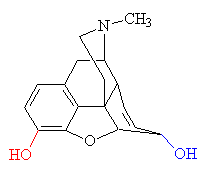
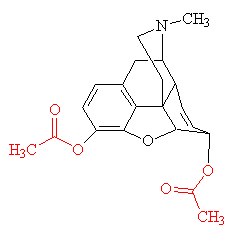
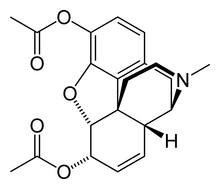
Heroin is a morphine prodrug, thus making "heroin" an opiate. Heroin is morphine with two acetyl groups added - the acetyl groups make the morphine compound more lipid soluble, delivering morphine to the brain quicker than morphine would on its own. So the two acetyl groups act sort of like propellers that propel morphine to the brain faster than morphine would on its own. Heroin is a fast acting form of morphine, it is not a true drug of its own. It's a prodrug.

Heroin molecule
OP3.GIF


Morphine molecule
OP1.GIF


Another example:

Morphine
morphine.gif


Heroin
heroin.gif


They are EXACTLY the same, besides the two acetyl groups on heroin. In the second set of pics the red parts attached to the heroin molecule is the acetyl groups, but everything else is the same.
 
Last edited:
No it's not.

Opiates are definition of natural occurring alkaloids in the opium poppy strictly.

Heroin is synthed from morphine and doesn't occur in nature. Therefore it's not an opiate although being a morphine prodrug.

And WTF do you mean by saying they're exactly the same? They have different pharmacokinetics. The two acetyl groups in the heroin molecule will cleave after the molecule has crossed the BBB and thus being more potent than morphine.

Heroin is also a prodrug for 6-monoacetyl morphine which is a potent mu-agonist, different to morphine (and more potent).

What would be the point of heroin manufacture (from morphine) if they were the same?
 
Last edited:
Heroin IS morphine! Heroin itself is a very weak mu-opiate receptor agonist! It is a quicker acting form of morphine. Morphine is an opiate, making heroin an opiate.

Look at the chemical structures. The two acetyl groups you see there to the left of the heroin molecule detach and morphine crosses the BBB quicker because of those acetyl groups.

Morphine:
200px-Morphine-2D-skeletal.png


Heroin:
220px-Heroin-2D-skeletal.png
 
The only difference is heroin is quicker acting, as a result of the two acetyl groups. The two acetyl groups added to the morphine molecule makes morphine more lipid soluble (quicker acting) and that is why heroin (which is an ester of morphine) is 1.5-2x more potent. Morphine binds to the opiate receptors in the brain and gets you high, not "heroin".

I guess you are right in that it is semi-synthetic since it has been chemically altered in someway.

But I am still right about heroin essentially being the same drug as morphine in vivo
 
The only difference is heroin is quicker acting, as a result of the two acetyl groups. The two acetyl groups added to the morphine molecule makes morphine more lipid soluble (quicker acting) and that is why heroin (which is an ester of morphine) is 1.5-2x more potent. Morphine binds to the opiate receptors in the brain and gets you high, not "heroin".


Heroin has weaker affinity to opioid receptors than morphine but it still is an agonist on it's own. It's not just prodrug.

As I already have stated it's also a prodrug to 6-monoacetylmorphine(also an opioid, not an opiate). 6-mam has a lot higher affinity towards opioid receptors than morphine.
 
Heroin has weaker affinity to opioid receptors than morphine but it still is an agonist on it's own. It's not just prodrug.

As I already have stated it's also a prodrug to 6-monoacetylmorphine(also an opioid, not an opiate). 6-mam has a lot higher affinity towards opioid receptors than morphine.

All medical literature claim that is a prodrug for the systemic delivery of morphine.


6-MAM is a very minor metabolite that is present for no longer than 20 minutes. BTW, did you know that 6-MAM itself is later converted to morphine also?

In anycase, morphine and heroin are near identical, except for the two acetyl groups which give the morphine molecule more lipid solubility thus making it more potent.
 
All medical literature claim that is a prodrug for the systemic delivery of morphine.

In anycase, morphine and heroin are near identical, except for the two acetyl groups which give the morphine molecule more lipid solubility thus making it more potent.

I'm not trying to argue with you on this one. I agree with everything you say here.

kokaino said:
6-MAM is a very minor metabolite that is present for no longer than 20 minutes. BTW, did you know that 6-MAM itself is later converted to morphine also?

Actually 6-mam can be detected up to 24h after single use from blood. That's how it can be verified if one has used heroin, not (just) morphine, which is also a metabolite of 6-mam.

My point is that the fact that something will metabolize into morphine isn't sufficient reason to classify it as an opiate.
 
No all I was saying is that morphine and heroin are near identical, they have a much different relationship than say morphine and hydromorphone or heroin and oxycodone.

Those drugs, although still very similar to morphine and heroin, they are no where near as close to either as heroin and morphine are to each other. Heroin and morphine are essentially the same drug in vivo. When taken orally, morphine and heroin are NO DIFFERENT. It's only when IV'd that 6-MAM comes into play.
 
Top