• N&PD Moderators: Skorpio

Number of molecular conformations possible in drug-like chemicals?

Nagelfar

Bluelight Crew
Joined
Nov 23, 2007
Messages
2,527
Location
Vancouver, Washington USA
I know it must be a number to the power of something (and maybe to the power again); if it is possible to calculate the amount of matter in the known observable or predicted size of the whole universe, this must be possible too if somewhat more daunting.

Has a number ever been ventured? I mean only molecular arrangements in drug/chemical size, not anything larger which would be a protein or such anyway correct? So putting such limits, has anyone a sourced number?

 
No one knows what works and what kills.. it's impossible to make a number up. The possibilities are literally endless
 
When I was at uni they said the number of possible drug-like molecules with MW below 500 and using only common atoms (i.e. C, H, O, N, S, halogens) was about 10^40...but as Swerlz says, it is pretty much impossible to calculate how many of those would be "active" as such.
 
Then circa 100,000,000,000,000,000,000,000,000,000,000,000,000,000 or a hundred duodecillion. Thanks. It's a good statistic to throw out there to counter when someone says a certain chemical probably doesn't exist. ;-P
 
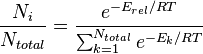
I think you mean to say "configurations" not conformations. Otherwise, this is the formula

f72784c28c69439eae4aef88d61b9045.png


"The left hand side is the equilibrium ratio of conformer i to the total. Erel is the relative energy of the i-th conformer from the minimum energy conformer. R is the molar ideal gas constant equal to 8.31 J/(mol·K) and T is the temperature in kelvins (K). The denominator of the right side is the partition function."
 
^ Yes, thats the Boltzmann distribution (statistical weight of a conformation divided by partition function), but instead of the molar gas constant R you should use the Boltzmann constant kB (gas constant per molecule).

EDIT: or are the relative energies in units J/mol ?
 
I'm not quite sure I understand the question... are you asking how many drug-like compounds could theoretically be produced given an infinite amount of time and resources?

You could probably build a computer program that, with enough available computing power, could generate all possible structures that adhere to certain lipinski-type parameters (ie, molar mass, molar refractivity, # of hydrogen bond donors and acceptors, logP, total polar surface area, etc. all falling within a certain range). This might be able to roughly estimate the total number of possible druglike compounds that could theoretically be made.

Keep in mind that our current understanding of druglikeness and what that entails in terms of the relationship between structure and activity is too limited to be absolutely predictive. It might be possible to make a good guess via computation, though.
 
Top