• N&PD Moderators: Skorpio

Pharmacology Non tryptamine, phenethylamine or lysergamide psychedelics?

This thread contains discussion about a Pharmacology-related topic

TheLightBringer

Bluelighter
Joined
May 25, 2022
Messages
675
Any worthwhile non tryp, phen, lyserg based structure 5HT2A agonist families out there that could yield worthwhile analogs/derivatives?

I know of drugs like efivarenz indirectly cause psychedelic effects due to 5ht2a agonism
However not something with a legit potential to work as a potent hallucinogen

Benzazepine structure

Pyridopyrroloquinoxaline structure

Ibogalogs (seem the most promising as far as hallucinogens)


Not mentioning partial lysegamides, conformally constrained phenethylamines or phenylpiperazines but they are active as well

The Ibogalogs seem the most interesting ranging in between hallucinogens, antidepressants and analgesic/anti-neuropathic properties

 
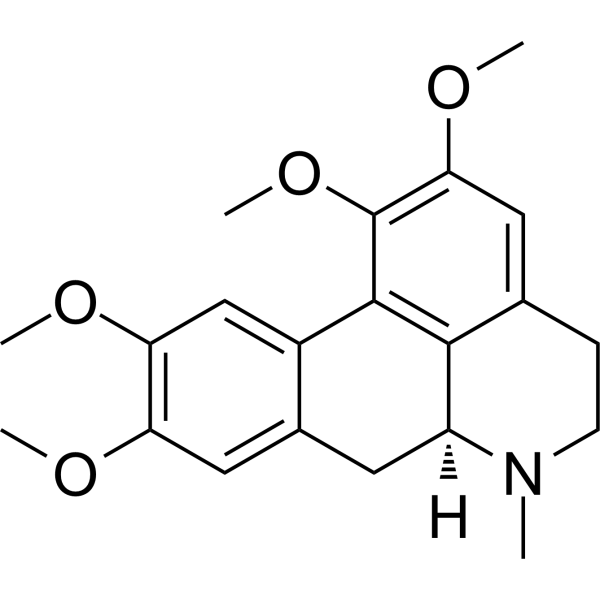
hy-n3945.gif

(S)-glaucine is partial 5-HT2A agonist whereas (R)-glaucine is a 5-HT2A positive allosteric modulator.
 
hy-n3945.gif

(S)-glaucine is partial 5-HT2A agonist whereas (R)-glaucine is a 5-HT2A positive allosteric modulator.
Yes I thought about glaucine as well but it seems to be a very ”dirty” drug from a pharmacological standpoint acting as a PDE4 inhibitor, Calcium channel blocker, dopamine receptor antagonist and 5HT2A agonist/allosteric modulator

I wonder if the molecule could be played around with to provide a more 5HT2A selective one though
 
Yes I thought about glaucine as well but it seems to be a very ”dirty” drug from a pharmacological standpoint acting as a PDE4 inhibitor, Calcium channel blocker, dopamine receptor antagonist and 5HT2A agonist/allosteric modulator
I wonder if the molecule could be played around with to provide a more 5HT2A selective one though
Probably!

Using radioligand displacement techniques ([3H]SCH23390 for D1-like and [3H]raclopride for D2-like receptors), the IC50 values of boldine for both major DA receptor types were determined in rat striatal homogenates and proved to be 0.4 lM for D1-like and 0.5 lM for D2-like receptors, respectively. In similar experiments, glaucine showed 10-fold lower affinities for both major receptor types. In vivo, both alkaloids elicited biochemical and behavioural effects suggestive of DA receptor antagonism.
- https://doi.org/10.1016/j.bmc.2005.03.022
Both (R)- and (S)-glaucine also antagonized α1 receptors, but they behaved very differently to the other compounds at 5-HT2 receptors: (S)-glaucine acted as a partial agonist at all three 5-HT2 receptor subtypes, whereas (R)-glaucine appeared to act as a positive allosteric modulator at the 5-HT2A receptor.
- https://doi.org/10.1111/cbdd.13390
Looks like glaucine is a D1/D2 antagonist and both (R)-glaucine & (S)-glaucine are alpha-1 adrenergic antagonists.

To balance these effects, glaucine could be combined with dopamine D1 + D2 agonists and an alpha-1 adrenergic agonist. A DRI and NRI should work also. Glaucine's PDE4i and CCB effects should be synergistic with 5-HT2A or at least, beneficial for overall psychoactive effects.

Hordenine is an good option since it's a D2 agonist, NRI and reversible MAO-B inhibitor. Scopoletin has activity at 5-HT2A, α1/α2-adrenergic and D2, it's found in botanicals commonly used to potentiate visuals from peyote and ayahuasca.

Looking at glaucine, there are several other botanical isoquinolines with interesting structures, eg:
- higenamine (adrenergic) - based on dopamine
- cinnamolaurine (stimulant/MDA-like) - based on MDPEA
- glaucine (5-HT2A) - based on DMPEA
- tetrahydropalmatine (various) - based on DMPEA

Cacti contain several (anhalamine, anhalidine, pellotine, anhalonidine, gigantine) all based on either 2,3,4- or 3,4,5- PEA. Some of these are known to be active, others haven't been tested.
The book "The Simple Plant Isoquinolines" covers these in more detail.
 
Last edited:
Probably!


Looks like glaucine is a D1/D2 antagonist and both (R)-glaucine & (S)-glaucine are alpha-1 adrenergic antagonists.

To balance these effects, glaucine could be combined with dopamine D1 + D2 agonists and an alpha-1 adrenergic agonist. A DRI and NRI should work also. Glaucine's PDE4i and CCB effects should be synergistic with 5-HT2A or at least, beneficial for overall psychoactive effects.

Hordenine is an ideal option since it's both a D2 agonist, NRI and reversible MAO-B inhibitor. Scopoletin has activity at 5-HT2A, α1/α2-adrenergic and D2, it's found in botanicals commonly used to potentiate visuals from peyote and ayahuasca.

Looking at glaucine, there are several other botanical isoquinolines with interesting structures, eg:
- higenamine (adrenergic) - based on dopamine
- cinnamolaurine (stimulant/MDA-like) - based on MDPEA
- glaucine (5-HT2A) - based on lophophine (2C-MMDA)
- tetrahydropalmatine (various) - based on DMPEA

Cacti contain several (anhalamine, anhalidine, pellotine, anhalonidine, gigantine) all based on either 2,3,4- or 3,4,5- PEA. Some of these are known to be active, others haven't been tested.
The book "The Simple Plant Isoquinolines" covers these in more detail.
Im amazed, how do you find all the more obscure pharmacology information like the pharmacology of cinnamolaurine or Scopoletin. Just a basic google search doesnt reveal it right away and I have to dig for studies. But thats me searching with intention.

How do you stumble upon these molecules in the first place? I gotta upgrade my method of researching 😅
 
How do you stumble upon these molecules in the first place? I gotta upgrade my method of researching
Many interesting things were found on this forum a while back. I used to participate.

Yes I thought about glaucine as well but it seems to be a very ”dirty” drug from a pharmacological standpoint acting as a PDE4 inhibitor, Calcium Channel Blocker, dopamine receptor antagonist and 5HT2A agonist/allosteric modulator
I wrote earlier that the PDE4i and CCB properties were beneficial for psychoactive purposes. To clarify, PDE4 inhibitors are useful for temporarily removing symptoms of sleep deprivation and Calcium Channel Blockers essentially act like NMDA antagonism.

Other PDE4 inhibitors:
  • Caffeine (nonselective inhibitor of PDE1, PDE4, PDE5)
  • Mesembrine/Mesembrenone from kanna
Sleep deprivation impairs cAMP signalling in the hippocampus

Treatment of mice with phosphodiesterase inhibitors rescued the sleep-deprivation-induced deficits in cAMP signalling, synaptic plasticity and hippocampus-dependent memory. These findings demonstrate that brief sleep deprivation disrupts hippocampal function by interfering with cAMP signalling through increased PDE4 activity. Thus, drugs that enhance cAMP signalling may provide a new therapeutic approach to counteract the cognitive effects of sleep deprivation.
- https://doi.org/10.1038/nature08488
Selective phosphodiesterase 4 (PDE4) inhibitors are of potential interest in the treatment of asthma. We examined the effects of the alkaloid S-(+)-glaucine, a PDE4 inhibitor, on human isolated bronchus and granulocyte function.
- https://doi.org/10.1038/sj.bjp.0702702
 
Last edited:
Many interesting things were found on this forum a while back. I used to participate.
Saw some interesting things on that forum but it seems to be inactive now, it was also a bit of a mess to navigate 😅

I wrote earlier that the PDE4i and CCB properties were beneficial for psychoactive purposes. To clarify, PDE4 inhibitors are useful for temporarily removing symptoms of sleep deprivation and Calcium Channel Blockers essentially act like NMDA antagonism which is the main property of disassociative drugs (eg ketamine, DXM, agmatine).
Yes the specific type of Calcium Channel that glaucine blocks (L-type channel) makes it useful as a cough supressant however makes me a bit cautious as to its potential to cause hypotension
 
Yes the specific type of Calcium Channel that glaucine blocks (L-type channel) makes it useful as a cough supressant however makes me a bit cautious as to its potential to cause hypotension
Fair point, this might partly be why it's paired with a stimulant/adrenergic like in recreational products from the legal high era, or this commercial product:
Each 5 ml of Broncholytin Syrup contains:
- Glaucine hydrobromide: 5.75 mg
- Ephedrine hydrochloride: 4.6 mg
- 10 ml, 3-4 times a day

Glaucine
Drug form and composition
Coated tablets. One tablet (for children) contains 10 mg Glaucine hydrobromide. One tablet (for adults) contains 40 mg Glaucine hydrobromide.

Dosage and administration
In adults, the recommended dose is 40 mg (1 coated tablet), 3 times daily. Maximal daily dose is 200 mg, and the single dose may be as high as 80 mg. In children, older than 4 years the dose is 10 mg (1 tablet), 2-3 times daily.

Pharmacological mechanisms
Glauvent is a non-narcotic antitussive preparation with central action. The active component of the medicine is the alkaloid from the plant Glaucinum flavum. Glauvent depresses the cough center, causing no effect on the respiratory center. It does not cause drug-dependence. Although the preparation exerts a weak spasmolytic effect, it does not influence intestinal motor function and does not cause constipation. Glauvent possesses some analgesic and anti-inflammatory actions.
 
Any worthwhile non tryp, phen, lyserg based structure 5HT2A agonist families out there that could yield worthwhile analogs/derivatives?

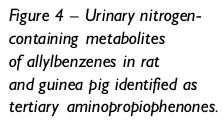
The β-aminoketone metabolites detected after administering pure allylbenzenes, eg studies for elemicin, safrole, myrstricin. They look like this for safrole:

allylsaf.png
allylconv-text.png
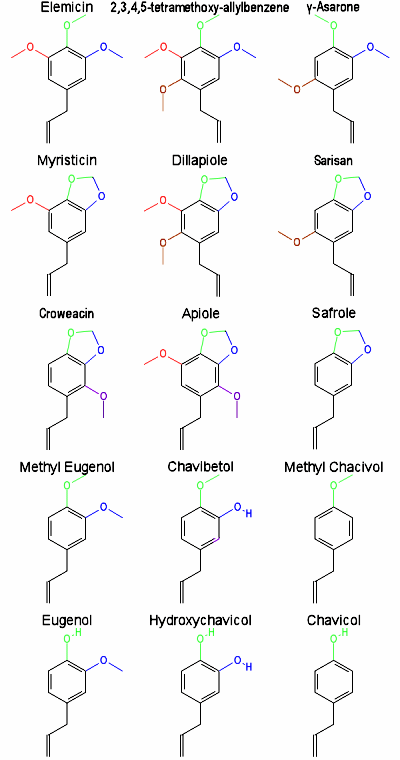
These β-aminoketone metabolites are the best explanation for the psychoactive effects associated with allylbenzenes. The synthesis requires dimethylamine, piperidine and pyrrolidine. Alternatively choline, lysine and arginine can be used for the in-vivo route.

Considering that there are over a dozen OTC allylbenzenes, this gives a pretty large selection.

image.png

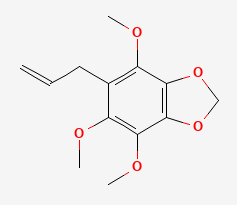
Nothoapiole (2,3,6-trimethoxy-4,5-methylenedioxyallylbenzene):
image.png
 
Last edited:
Very interesting, are there any papers on their synthesis or their effects in vivo?
The authors of the papers I linked on elemicin, safrole and myrstricin synthesised them. There are no papers on in-vivo effects afaik. You would have to explore the numerous reports from people who have tried it themselves.

As for regular tryptamine & phenethylamine which most people consider inactivate, there is a novel way to make them active without relying on MAOIs or SSAOIs.
 
Last edited:
Nothoapiole (2,3,6-trimethoxy-4,5-methylenedioxyallylbenzene):​
image.png
Very interesting, this just sent me down a rabbithole of the compounds in the perilla/shiso family of plants. And ended up in the wikipedia section about benzazepines and benzoxepines, some of which seemed somewhat active as psychedelics and other kinds acting as serotonin releasers or stimulants among other things…
 
Any worthwhile non tryp, phen, lyserg based structure 5HT2A agonist families out there ... drugs like efivarenz indirectly cause psychedelic effects due to 5ht2a agonism...
It's likely that the best psychedelic experiences involve other 5-HT receptors than just 5-HT2A. I made a thread about this here. Adding some 5-HT1A, D2, alpha-2 adrenergic and sigma 1 agonism would make things a lot richer.
 
Top