• 🇳🇿 🇲🇲 🇯🇵 🇨🇳 🇦🇺 🇦🇶 🇮🇳
    Australian & Asian
    Drug Discussion


    Welcome Guest!
    Posting Rules Bluelight Rules
  • AADD Moderators: Tronica

NEWS: Courier Mail - 23/07/07 'Drug addicts may lose kids'

lil angel15

Bluelight Crew
Joined
Jul 16, 2005
Messages
7,827
Location
Australia
Drug addicts may lose kids
Adam Gartrell and Martin Philip
July 23, 2007 12:00am

CHILDREN of drug addicts would be removed from their parents and adopted out under a dramatic plan being promoted by a high-profile Howard Government MP.

Bronwyn Bishop argues the current system is skewed towards the interests of drug-using parents rather than the best interests of their children.

"We hear the mantra everything is done in the interest of the child, but evidence I've taken in, not only the inquiry I'm doing but other inquiries, show that lip service is paid to that but it's not in the interest of the child," Ms Bishop said.

Ms Bishop, who is chairing a parliamentary inquiry into the impact of illicit drug use and families, has told the ABC she wants to see better opportunities for the children of drug addicts to be adopted.

"There are hundreds and hundreds of parents who are desperate to adopt children and give love and give good homes, but there is this biology-first principle," she said.

But Brisbane Youth Service spokeswoman Amanda Davies rejected Ms Bishop's comments, saying individual cases should be decided on their merits.

"What evidence is there to suggest that all people that use drugs are unable to parent their children?" Ms Davies said.

"It's a universal generalisation based on moral grounds, not actually based on evidence." "I disagree that you can make legalisation based on moral grounds.

"There is no evidence to support the suggestion that people who are drug addicted cannot parent their children.

"It's a moral assumption rather than an evidence-based one and I would suggest that each case needs to be assessed on its own merits, rather than making general rules based on assumptions about drug-dependence."

Queensland Council of Social Service president Karyn Walsh said children of drug-addicted parents should only be adopted out as a last resort.

"You can't just go removing children simply because their parents have a drug addiction," she said. "Children need to know their parents, and not all parents who have a drug addiction are bad parents, or incapable of parenting."

Ms Walsh said there was strong evidence forced removals caused children long-term harm. Greater investment in family support programs was needed to enable authorities to monitor the children of alcoholics.

Victorian Child Safety Commissioner Bernie Geary urged caution, saying a parent's drug use need not lead to a permanent family break-up.

"There is nothing in my experience worse than a child who's sentenced to be without their parents for the rest of their lives," said Mr Geary.

"Children are better off with families in the long run."

Courier Mail

 
"You can't just go removing children simply because their parents have a drug addiction," she said. "Children need to know their parents, and not all parents who have a drug addiction are bad parents, or incapable of parenting."
Still, I don't think children should have to be brought up in that environment. I'm not saying take them away entirely but full custody is ridiculous, this is only speaking from the examples I've seen with my own eyes. All the kids I know who have parents who use drugs or are former addicts, have used drugs.
 
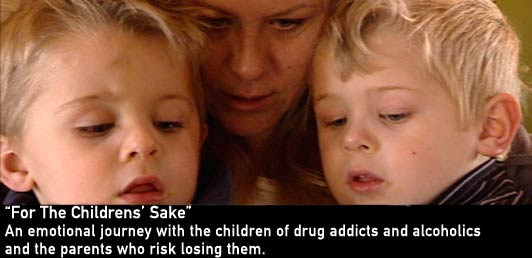
TV: ABC - 23/07/07 830pm 'For The Children's Sake'

For The Children's Sake
Reporter: Janine Cohen

r161478_596280.jpg


"My baby was the last thing that I thought about until I pulled that needle out of my arm." Sharon, drug user.

"You hear people say 'oh you know what about your kids, you should stop for your kids, but if you could you would." Jodie, alcoholic.

How do we deal with parents who are drug addicts or alcoholics? Do we just accept the dangers they pose? Is it enough to rely on rehabilitation services and monitoring? Or as a last resort should the authorities step in? How many chances should they get before they forfeit their rights to be parents? There are no easy answers. Four Corners meets drug users and alcoholics who explain their struggle to get clean and prove themselves fit to be parents.

Sharon nearly lost her baby. She went into labour seven weeks early after rupturing her placenta as a result of injecting drugs. She’s now in a residential rehabilitation program to try and kick her habit.

Fiona, another drug user, stopped breast-feeding after only three weeks so she could start using speed. She’s also in a rehabilitation program.

Debbie was five months pregnant when she went on a drinking binge, got behind the wheel and crashed her car. She’s just left a residential care program.

All these women are desperate to prove their worth as parents despite their reckless past behaviour.

Then there are the survivors, the children who have seen too much and grown up too quickly. Four Corners talks to James and Natalie. Both have appalling tales of childhood neglect and violence but disagree about whether children should be separated from their parents.

With a recent study estimating almost one in eight Australian children are regularly being exposed to drug or alcohol abuse in the home, politicians and doctors disagree about what to do.

Federal Liberal MP Bronwyn Bishop is calling for a change in the law to allow for the removal of more children of addicts in order to offer them up for adoption. "There are hundreds and hundreds of parents who are desperate to adopt children out and give love and give good homes but there is this biology first principle."

But Victorian Child Safety Commissioner Bernie Geary disagrees. "I’ve seen people … in some cases whilst using, being very adequate parents. In fact, I think some users that I’ve seen are certainly better parents than non-users."

There’s no doubt that sometimes children need to be removed. The dilemma is when to intervene. Remove the children too late and the damage is already done. Remove them too early and they could lose the chance to know their parents.

Who decides what is best, "For The Children’s Sake"? On Four Corners, 8.30 pm Monday 23 July, ABC TV.

This program will also be repeated on ABC2 at 9.30 pm Wednesday and 8 am Thursday.

ABC
 
Sweet, pump out a kid, get the baby bonus, spend it on drugs, palm the kids off to the government =D
 
Well I can tell you growing up with drugs around you doesn't help much. I've seen my parents (Mainly Dad) Use weed, lots of stimulants (Never actually saw it but I know, staying up for 2+ Days isnt normal...And of course they have told me) And even walking into a room full of people with needles 8)

THey are both clean now but I tell ya I have some bad memories. Definitely not a good enviroment to be growing up in.
 
"There are hundreds and hundreds of parents who are desperate to adopt children and give love and give good homes, but there is this biology-first principle," she said.

Unfortunately sometimes this results in the kids getting a little too much "love" if you know what I mean.... This is not the answer. A parent should only have their kids taken away when it is deemed they cannot raise them and they are suffering badly due to finance, schooling and violence or sexual abuse at home. I hate people who do drugs in front of their kids, I know this disgusting Aboriginal family who blow bong and cigarette smoke in their one year old kids face around the dining room table and stuff. And just drink constantly and swear around them and forget to feed them or put them to sleep cos they pass out, those are the people who should be targetted. Not just a parent that was dobbed in by a nosey neighbour to crime stoppers for smelling some pot smoke out of their bedroom window at 11pm to get a good nights rest before work.
 
red647 said:
Well I can tell you growing up with drugs around you doesn't help much. I've seen my parents (Mainly Dad) Use weed, lots of stimulants (Never actually saw it but I know, staying up for 2+ Days isnt normal...And of course they have told me) And even walking into a room full of people with needles 8)

THey are both clean now but I tell ya I have some bad memories. Definitely not a good enviroment to be growing up in.


That is fucked and I don't like that shit at all. You don't shoot up or have needles lying around children. You shouldn't be doing hard drugs raising children, you should be grown out of it by then, or not have a baby or use protection.
 
tribesman said:
The sad thing is a small number of people were actually having kids for the baby bonus :\

Ah yes, the common garden variety bogan. Mainly found in housing commissions with an IQ the size of their bare wallets. 8)
 
"There is no evidence to support the suggestion that people who are drug addicted cannot parent their children.

"It's a moral assumption rather than an evidence-based one and I would suggest that each case needs to be assessed on its own merits, rather than making general rules based on assumptions about drug-dependence."

I agree with this because;

Exhibit A is an ex-friend named B. B is 27, she already has 3 children under 10yrs and she recently became pregnant with #4. The father of this baby is about 20, looks like a bogan and moved into her house after they'd been together for 4 days. She owes all her friends money and she's a meth addict. She smokes meth in front of her children, she used her daughters medicine syringe to dose some GHB and she locks her kids inside the house while she has friends over so she can get fucked up without them interrupting.

She is the reason that I agree with taking kids away from drug addict parents. She should not have sole custody. I feel sorry for those kids. Many people have talked about anonymously calling children's welfare to get them out of that situation.

Exhibit B; my ex's parents were heroin users and dealers until he was about 5. My ex says his parents were really good to him. Him and his sisters were given everything they wanted and they were loved and treated right. Unfortunately his dad died of AIDS and his mum's a little loopy now but he's a good guy. He has used drugs in the past, very heavily but when he hit 18 he stopped completely and now is very anti-drugs.
 
Caution urged in drug addicts adoption scheme

The Family Council of Queensland says children should only be removed from drug-addicted parents if their health and welfare is at risk.

Liberal MP Bronwyn Bishop has called for more children of drug addicts to be permanently removed from their parents and offered up for adoption.

Ms Bishop says the current system is skewed towards the interests of drug-using parents and not their children.

Council president Alan Baker says the current system needs changing, but each case is different.

"It's not so much the rights of the parent, rather the welfare of the child," he said.

"If the child is at risk then yes, the child should be removed from his or her natural parents and protected.

"Every case needs to be assessed on its merits, but the principle is, the welfare of the child is paramount.

"There would be instances in which children should be removed from their natural parents if parents are drug-addicted and are neglecting the care of their children and those children are at risk of abuse through neglect or through violence or sexual abuse."

ABC Online
 
Delay for kids at risk
PHILIPPA DUNCAN
July 24, 2007 12:00am

TASMANIA'S child protection system waits too long to remove young children from bad parents, says the state's Children's Commissioner.

Paul Mason said Tasmania should look to Queensland, where parents get one chance to mend their ways before a child is permanently removed.

But he rejected Liberal MP Bronwyn Bishop's call for children of drug addicts to be offered for adoption.

Ms Bishop wants adoption, rather than fostering, used to separate children from parents addicted to drugs.

Mr Mason said this would create another "stolen generation" and foster care was a better option because children were not cut off from parents.

"But I do agree with Bronwyn Bishop that child protection may take too long to explore the permanent placement option," he said.

"The Tasmanian system repeatedly puts children back in homes that are never going to work, because the Government believes the best place for a child is with its parents. This is true to a point, when it is safe."

He said drug, gambling and alcohol addictions were common in the child protection system and could contribute to bad parenting.

"They all involve a parent putting their needs before a child's," Mr Mason said.

He said children aged under 3 who could not live safely at home should be placed in permanent foster care.

"Tasmania should give the child's need for stability and safety higher priority than the needs of incompetent parents," he said. "They take a child out and put them back and take them out too often. If a parent can't take steps with their bad parenting after one or two goes, the department should look at permanent options for young children.

Ms Bishop told ABC's Four Corners last night evidence showed children living with drug-addicted parents risked death, abuse and neglect.

"There are hundreds and hundreds of parents who are desperate to adopt children and give love and give good homes but there is this 'biology first' principle," she said.

Tasmania's acting Human Services Minister Steve Kons said the law stressed that families had the primary responsibility for the care and protection of their children.

He said the law also recognised the importance of maintaining a child's link with its family and community.

"Tasmania's focus is on improving our child protection system, to strengthen early intervention and family support services and prevent child abuse," Mr Kons said.

TasCOSS and the Alcohol, Tobacco and Other Drugs Council criticised Ms Bishop's proposal as dangerous, saying parents need support to kick addictions and keep children.

The Mercury
 
New programs to tackle amphetamine abuse

The WA Premier Alan Carpenter has announced more money for drug rehabilitation. (ABC)
The Premier Alan Carpenter says mothers addicted to amphetamines will be targeted as part of a range of initiatives to tackle the growing problem.

WA has the highest rate of amphetamine use in the country and a top-level summit was held last month to address the problem.

Mr Carpenter says the Government will spend more than $800,000 to help drug addicted mothers gain access to rehabilitation at a facility in Perth's northern suburbs.

He says the money will be used to provide more counselling and welfare workers.

"To help them with their children in an environment and a setting which allows them to be treated and assisted properly and appropriately," he said.

ABC Online
 
Saving the kids from parents
Jen Vuk
September 24, 2007 12:00am

I DON'T generally see eye to eye with Bronwyn Bishop, but I do see merit in her proposal to take children aged under five away from drug-addicted parents and put them up for adoption.

The suggestion, which focuses on parents whose drug use is the subject of a child protection notification, was one of several announced in a parliamentary report released by Ms Bishop (pictured below).

Extreme? Sure. Interventionist? Without a doubt. Worth considering? Absolutely.

For far too long our focus on the drug user has been to the detriment of the children.

This is wrong in so many ways. Addiction, no matter its nature or the fierceness of its grip, is, at its core, a choice.

Choice is a luxury unknown to a child of a drug-addicted mother. Moments after taking its first breath, the child enters the hell of withdrawal.

Just because you can have children doesn't mean you should. Especially if you're hopelessly addicted to illegal drugs.

Working for the Salvos taught me this, so don't tell me substance abuse is not behind the increasing number of children entering the child protection system in Australia.

Many of them come through the Salvos' revolving door. Again and again and again.

In Victoria, according to children's charity Barnardos Australia, some two-thirds of parents in cases of abuse and neglect had substance abuse problems.

No one is arguing that addiction is not an illness and that those under its influence should not be treated with respect and care.

But it does beg the question that when an addict's own needs are all-consuming, how on earth can they meet the needs of their children?

The answer is closer to home than you think. Take a stroll down Smith St or Victoria St in Melbourne. It gets to you when you see a child under five playing with cigarette butts on the pavement while her parents are busy scoring.

To those parents who have managed to kick the habit, good on them. It is no easy road to recovery and help must be on hand if the parent relapses.

But how many relapses before a mother or father is no longer a proper parent? And how long can a child wait?

The sad irony is that as the number of children needing care continues to rise, more and more foster carers are abandoning the system.

A 2003 review by the Victorian Department of Human Services found that almost 900 foster carers left the system in 2001-02 and there are too few recruits to replace them.

Many of those remaining are long-time carers looking after an average of 39 children each.

At the time of the report there were just over 3000 foster parents in Victoria.

One of the main reasons for the exodus was the growing number of "increasingly difficult children" because of their parents' substance abuse.

And yet there's a group of Australians who, given half a chance, would welcome these kids into their lives in a heart beat.

These are couples who are often casualties themselves. Casualties of the fertility lottery.

The reality is that loving couples are missing out on being parents and children are missing out on a childhood.

The suggestions of the inquiry headed by Bronwyn Bishop are shocking, but no more shocking than the death of nine children last year.

The children were left in parental care despite a sibling being placed under state protection.

Shocked? We should be appalled.

This isn't about breaking up families. It is about saving children's lives.

As German theologian Dietrich Bonhoeffer said, the test of the morality of a society is what it does for its children.

The inquiry may well be the drug debate's toughest test.

But the point isn't so much whether we pass the test, it is whether we accept that we are failing the children.

Herald Sun
 
I know of one personm who this should apply to. In the past he has often bought his child to drug meetings/deals and the drugs usually were Ice. He is a daily user, injects roughly half a gram a day, upto a gram. With base, a single hit would be one gram normally if he wants a rush.

There hasn't been one time where a drug deal was just a drug deal, he is always asking if I wanted to buy jewellery (he often even had a big box of some womans gold collection on him), power tools, mobile phones (some were even locked to 3 without him knowing), and other stuff he's stolen. He is not fit to raise a child and this child will grow to be fucked up. I think parents should get first hand care if problems are like this. Not a child molestering foster house.
 
Bishop's report recommends that adoption be the DEFAULT option for kids of drug-using parents. That is the problem - on a case by case basis there are certainly times when it might be the best option - but making it the default option is wrong.

Just remember more government money gets spent on those dumb ad campaigns & booklets than gets spent on treatment programs - now that is a problem too....
 
There is no doubt that many children should be removed from their parents and put in the care of family, foster care or some other alternative form of accommodation until an adequate level of recovery has taken place. In my opinion, the state should not have the power to permanently remove a child from a family, like what is being suggested, unless the parent foregoes their parental responsibility. Obviously children have rights, but it would appear the government is admitting defeat, or simply unwilling to address addiction recovery issues, before even attempting them.


I had to laugh at the author of this piece when reading two of their conflicting views on addiction.

Jen Vuk said:
This is wrong in so many ways. Addiction, no matter its nature or the fierceness of its grip, is, at its core, a choice.

Jen Vuk said:
No one is arguing that addiction is not an illness and that those under its influence should not be treated with respect and care.

Just like all those people out there who have cancer, AIDS or any other illness chose to have them.
 
I've just received a hardcopy of the report. Just when I'll get a chance to read it I'm not sure, but in the meanwhile I'll pass it on to others for their opinions.
 
Experts reject addicts' kids adoption debate
PM - Monday, 29 October , 2007 18:26:00
Reporter: Emma Alberici


EMMA ALBERICI: A Federal Parliamentary Committee last month recommended that children of drug addicts be adopted out. One Liberal member said children were routinely returned to homes where they were at risk because state governments were against adoption.

Another Labor MP who also sat on the committee, said the death of two-year-old Dean Shillingsworth, whose body was found stuffed in a suitcase floating in a western Sydney lake, was quote "just another example of a child dying because the state government Department of Community Services is totally unable to see that quite a few of these children need to be adopted out."

But speakers at a conference today rejected that philosophy.

The 2007 Network of Alcohol and Other Drug Agencies Conference was told that the goal of any intervention should be about helping parents better manage their children's behaviour and helping them connect with extended family members.

Professor Sharon Dawe is the Director of the Griffith Psychological Health Research Centre at Griffith University. She presented at the conference and I spoke to her a short time ago.

I began by putting the parliamentary committee's proposal to her that for drug addicted parents with children under five years of age the default action should be to adopt those children out:

SHARON DAWE: It seems to be both practically an untenable suggestion and in terms of everything that we know about child development and parenting, a less than useful proposition.

I would not support it.

EMMA ALBERICI: But repeated studies have shown, have they not, that these children are at risk of serious abuse and neglect and even death?

SHARON DAWE: Many studies have highlighted that children raised in multi-problem families whether that be with, due to mental illness, domestic violence, substance abuse or all of the above, have very poor outcomes. That is absolutely true. We also have, however, growing evidence that providing intensive family based interventions for multi-problem families is associated with a substantial reduction in child abuse potential.

EMMA ALBERICI: But that's not happening in any Australian state at the moment?

SHARON DAWE: We have some extremely good work happening across the sector in Australia but you know it is being done in a patchy kind of manner and it's being done on a shoestring budget.

EMMA ALBERICI: So there is a fundamental problem at the state level, the state government level?

SHARON DAWE: I think there is a fundamental problem at state and national government level. The first problem is that there has not been sufficient recognition of the importance of working with families and children where there is substance misuse problems. I think there is also problems that substance misuse has been kind of targetted as the defining characteristic of multi-problem families and in fact it is very often isn't.

When you've got a family with parental substance misuse, there is often domestic violence, there is often social disadvantage, there is often mental health problems. There is often literacy and numeracy problems in the children so it is not really just about 'oh, let's identify family, mum's got a drug problem, we'll take the children away'. It's actually stepping back and saying, 'this is a family with lots of complex needs'.

EMMA ALBERICI: Do you advocate that at some point, children should be taken away?

SHARON DAWE: Yes, I think there is always going to be a situation when your family focused intensive intervention has failed to improve family functioning sufficiently that children should be considered to be better placed elsewhere. That is certainly true, but that shouldn't certainly not be the first line of attack.

EMMA ALBERICI: So how many chances should they have before they forfeit the right to be parents?

SHARON DAWE: I don't know that anybody is going to be able to come up with a figure on that. Like you get three hits and you're out. I think what you need to do is to look very carefully at the family circumstances and make very clear objectives for the family.

Often families in my experience, anywhere that I've worked with, have been identified as having significant concerns by child protection services and they're told to go and improve their parenting.

Now, that can mean many things to many people. What I would propose is that what we need to do is work with families more intensively and say what we want you to do this week is get your seven-year-old to school each day with breakfast and then want to do next week is etc etc.

So you provide families with structured goals that you want them to achieve and that you work to support them in achieving those goals.

EMMA ALBERICI: Federal Liberal MP Bronwyn Bishop says the whole system currently is skewed to the interests of drug-addicted parents and not to their children where it should be.

SHARON DAWE: I think what we have at the moment in Australia is a growing recognition of the importance of treating the family, not just an individual with a substance misuse problem. I think this is something that has occurred in the context of a growing realisation that we're not going to find a cure for substance abuse and that in fact, it's a problem that is grounded in a lot of social issues.

What we need is increasing government funding for the development of effective family based intervention.

EMMA ALBERICI: Professor Dawe, thank you very much.

SHARON DAWE: You're welcome.

ABC PM
 
Top