• N&PD Moderators: Skorpio

New lysergamide related drugs predicted by ligand based virtual screening

jingle_jangle

Greenlighter
Joined
Apr 30, 2018
Messages
4
CljoCi.png


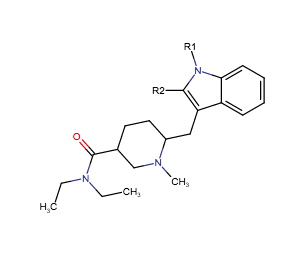
Through my admittedly amateur research I have found a new class of lysergamide related compounds using a ligand based virtual screening software. They are predicted to have binding affinities at a wide variety of receptors depending on the different substituents, including 5ht-2A/B/C receptors, Mu, Delta and in some cases Kappa opioid receptors as well as dopamine, and rarely melatonin receptors. Some compounds were predicted to affect monoamine transporters as well. After extensive experimentation I have found that a large moiety such as a phenyl or cyclohexyl group is required at R1 or R2 for any predicted efficacy, I have also experimented with a dimethyl moiety on the piperidine ring at the meta position (compared to the nitrogen) and shifting the diethylamide group to the para position. I am unsure as to what conclusions can be drawn from a virtual screening study, but I believe it would be interesting to see these compounds tested. I am interested to see as to what you guys and girls think about these compounds. Any input would be greatly appreciated.

Research by pseudonym TDA

The software used was the Swiss Institute of Bioinformatics' target prediction website.

EDIT: binding also predicted at cannabinoid and sigma receptors

EDIT: Also, apparently the piperidine ring isn't strictly necessary, and if the piperidine ring is removed (not the whole ring just the two carbons) and R1 and R2 are left blank we get a wide variety of 5HT and adrenergic receptor binding, and if subsequently the chain between the amide and the amine is shortened we get 5HT and opioid activity
 
Last edited:

In-Silico models are famously inaccurate. Agonist or antagonist and what's the Ki? I can certainly see it will overlay LSD but only the =O is important. The alkylated nitrogen is just space-filling (the NBOMe s prove this). 2 chiral cehtres and conformational isomerism pose twin problems. If you want the simplest solution, it's right here.

https://imgur.com/a/nITMYzF

Trade Name is 'Empathy'. The 7-Me makes the (R) isomer an SDRI while the (S) isomer is a 5HT2a agonist. That means the (R) is identical to MDMA, the (S) is like AMT (but shorter acting) and the racemate is unsurprisingly like candyflipping. I tried out many different ratios and a 2:1 mix of (R:S) is like super-MDA. Since the PDA I cannot be involved with making such stuff but I'm sure both users and chemists will see the utility of the agent. The downside? The precursor is kind of pricey. Still, 80mg of the 2:1 is like 140mg of MDA. Anyone who came across the Seagull logo tablets will know the effects. It isn't an MAOI but the alpha ethyl IS so don't go there. It isn't hard to racemate the product so getting the 2:1 is just a solvent-management issue and not complex.
 
About 2 years ago, people tried to make a less rigid analogue of LSD called NDTDI:
N%2CN-diethyl-3-(methyl(1%2C3%2C4%2C5-tetrahydrobenzo%5Bcd%5Dindol-4-yl)amino)propanamide.png


However, it was pretty much a dud, as it was apparently active in the ~10 mg range, which isn't much more powerful than a common 4-substitued tryptamine, i.e. not worth the complex synth.

The thing about LSD is that according to the latest research, the diethylamide moiety neatly fits into a pocket in the 5HT2A receptor, which apparently causes the receptor to change its shape, and the LSD to become trapped; only a narrow range of substitutions at the amide achieve a potency similar to LSD (2-butylamide; 3-pentylamide; N-methyl,N-Isopropyl-amide, and 2S,4S-Dimethylazetitide); opening up LSD's nice planar polycyclic structure even more seems like it would have a fairly low chance of resulting in an potent psychedelic; and if you need >10 mg for an active dose, you might as well do a 4-HO- or 5-MeO-substituted tryptamine.
 
About 2 years ago, people tried to make a less rigid analogue of LSD called NDTDI:
N%2CN-diethyl-3-(methyl(1%2C3%2C4%2C5-tetrahydrobenzo%5Bcd%5Dindol-4-yl)amino)propanamide.png


However, it was pretty much a dud, as it was apparently active in the ~10 mg range, which isn't much more powerful than a common 4-substitued tryptamine, i.e. not worth the complex synth.

The thing about LSD is that according to the latest research, the diethylamide moiety neatly fits into a pocket in the 5HT2A receptor, which apparently causes the receptor to change its shape, and the LSD to become trapped; only a narrow range of substitutions at the amide achieve a potency similar to LSD (2-butylamide; 3-pentylamide; N-methyl,N-Isopropyl-amide, and 2S,4S-Dimethylazetitide); opening up LSD's nice planar polycyclic structure even more seems like it would have a fairly low chance of resulting in an potent psychedelic; and if you need >10 mg for an active dose, you might as well do a 4-HO- or 5-MeO-substituted tryptamine.

Dr. Dave (Nichols) did that one. The NBOMe s provide more data on the pocket i.e. it needs to be planer but only the O is needed as a H-bond acceptor. The O is most likely to result in the receptor moving into a less energetic state. The affinity must be damned high because that and other classes aren't rigid. You can ramp up the potency of the lysergamides quite a lot. The azetidine was legal until the PSA but the problem was acquiring the chiral material. Oh, and for those of you in countries where LSD analogues are legal, bromocryptine is the easiest source. The 2-Br is removed from the final amide using NaBH4. A Japanese team used it to label using NaBD4 but the 78% yield is good enough considering you can get the immediate precursor legally in China. NaBH4 in a bucket and mix DCM into methanol and back-extract with benzene... simples....
 
Top