



-
HEALTH & RECOVERYWelcome Guest
Posting Rules Bluelight Rules Thread Directory 1 Thread Directory 2
Mindfulness Links Addiction & Mind
Sober Living Partner Program (SLiPP) -
H&R Moderators: streaM Freak
You are using an out of date browser. It may not display this or other websites correctly.
You should upgrade or use an alternative browser.
You should upgrade or use an alternative browser.
Need suggestion on ginseng
- Thread starter kiwi1234
- Start date



Maya
Bluelight Crew
- Joined
- Feb 17, 2013
- Messages
- 7,310
I am guessing you are taking ginseng tea right? I have tried Oolong Ginseng tea before and I mixed it with sugar and it gave me a lasting effect for concentration and energy throughout the day. I can suggest Oolong Ginseng tea if you haven't tried this before. I consumed about three cups before.

I am guessing you are taking ginseng tea right? I have tried Oolong Ginseng tea before and I mixed it with sugar and it gave me a lasting effect for concentration and energy throughout the day. I can suggest Oolong Ginseng tea if you haven't tried this before. I consumed about three cups before.
Thanks.
I have taken and would prefer it in capsule form but if tea is better then i'll give it a try.
By 3 cups, do u mean 3 cups in a day?
You could give American ginseng (Panax quinquefolius) a shot, I don't know much about Panax [Korean] ginseng but American ginseng gives me noticeably more physical energy than just drinking coffee
I have learned from info available on internet that korean ginseng gives most noticeable energy. Can u share the brand of american ginseng that u tried?
Thanks.
Maya
Bluelight Crew
- Joined
- Feb 17, 2013
- Messages
- 7,310
Yes 3 cups a day.Thanks.
I have taken and would prefer it in capsule form but if tea is better then i'll give it a try.
By 3 cups, do u mean 3 cups in a day?
I wanted coffee before but coffee for some reason gives me headaches so I went with oolong tea instead


red22
Bluelighter
- Joined
- Nov 23, 2009
- Messages
- 2,179
Source: Healing Thresholds: A Modern Journey into Taoist Health Philosophy. Rehmannia Dean Thomas (2010), pages 161–167
Ginseng (see below for various varieties) is a premier Chi herb. Good ginseng is considered an "adaptogen." It can strengthen our basic capacity to adjust, both mentally and physically, to changes in circumstance or environment. Complex polysaccharides called ginsenosides are highly empowering, immune modulating antioxidants. Ginseng that is at least seven years old contains multidimensional nutrients that increase our physical and emotional endurance and adaptability. Adaptability is the true measure of our lives, which is what makes Ginseng so precious.
The historical documentation of Ginseng in Asia is immense and illustrious. Ginseng has always been held in the highest esteem by the Chinese for its power-enhancing qualities. In America, this precious herb is not fully understood, even though it was consumed by the first Americans and European newcomers since colonial days. Ginseng must be allowed to mature before it is harvested or its phytochemistry will not be balanced. Prematurely harvested Ginseng that is phytochemically immature will produce a "uni-directional" stimulating effect similar to the alkaloids in roasted coffee. It appears far too many western herbal products may contain these immature Ginsengs, as evidenced by a widespread incidence of the reported side effect of feeling jittery by western Ginseng consumers, and the subsequent misunderstanding of Ginseng's true therapeutic potential. Making products with immature Ginseng is a good example of western industry's impatience with allowing plants to properly mature before harvesting.
There are many varieties of Ginseng, and its effects on metabolism range from Korean Ginseng (Korean: I long Sam), which is very stimulating and warming, or Yang, to American Ginseng (P. Quinquefolius) which is more depth re-charging, or Yin. Chinese Ginseng (Panax Ginseng) is generally processed to be slightly warming. This is evident if the ginseng root is a darker red color. The unprocessed Chinese Ginsengs will be a pale brown color. Still for simplicity's sake, Ginseng in general is classified as supporting Chi.
Depending on the Ginseng plant's origin and on how the roots are processed, this herb's potential therapeutic properties can cover an expansive range, from calming and restoring to highly invigorating. For instance, traditional practices for processing Ginseng in Korea involve steaming the herb with very Yang herbs such as Aconite in order to help the Ginseng produce a warming affect on the consumer. This process has been practiced there for thousands of years in order to help people adapt to the harshly cold winters in this northern longitude (Korea is near Siberia). This is where a misunderstanding can occur; a western layperson may take Ginseng, not knowing it is Korean Ginseng, and get over-stimulated from the Yang properties in this variety of the herb. This person may then form an ill-conceived opinion about the overall effects of taking Ginseng. Such energy and Yang-enhancing processes were never applied to American Ginseng, and by the time Colonial settlers recognized its value, the Chinese were the first large scale customers for our domestic Ginseng. They appreciate it particularly for its calming Yin properties.
Native American peoples were well aware of Ginseng's health-enhancing properties, and it plays a role in early American history. The Boston Tea Party, which helped shape our country's independence, occurred when a British ship docked in Boston carrying a load of black tea from China, which was intended to be traded for Ginseng. If the raid by American Colonialists, who infamously dumped the tea into the Boston Harbor in protest of the taxes levied by the British, had taken place a few hours later, the "Boston Ginseng Party" would have been recorded in our history books. Daniel Boone, of early pioneering fame, was actually a Ginseng poacher. He made his living by searching for the plants in Kentucky, filling barges and shipping them to the north for export to China. He was known in those days as a failed businessman, as he reportedly consistently overfilled his barges with Ginseng, causing them to sink on route to the northern ports.
Here's what one Colonel Byrd had to say about it some time in the late 1800s:
"Though practice will soon make a man of tolerable Vigour an able footman, yet, as a help to bear fatigue I us'd to chew the root of Ginseng as I walk't along. This Kept up my spirits and made me trip away as nimbly in my half jack-boots as younger men cou'd in their shoes. This plant is in high esteem in China, where it sells for its weight in silver... Its virtues are, that it gives an uncommon warmth and vigour to the blood, and frisks the spirits, beyond any other cordial. It cheers the heart, even of a man that has a bad wife, and makes him look down with great composure on the crosses of the world. It promotes insensible perspiration, dissolves all phlegmatick and viscous humours that are apt to obstruct the narrow channels of the nerves. It helps the memory and would quicken even Helvetian dullness. ‘Tis friendly to the lungs, much more than scolding itself. It comforts the stomach, and strengthens the bowels, preventing all colicks and fluxes. In one word, it will make a man live a great while, and very well while he does live. And what is more, it will even make old age amiable, by rendering it lively, cheerful, and good humour'd.[64]
Wild Ginsengs are considered far superior in quality to cultivated or semi-cultivated plants. The cultivated Ginsengs are usually farm grown and often harvested at an early stage. Semicultivated Ginsengs are basically plants that were discovered in the wild but were deemed too young for harvesting," whereby the discoverer provided irrigation, soil fortification and protection from predator animals who might consume it, until it was ready for harvest. Semi-wild, semi-cultivated Ginsengs are easy to spot at an herb bazaar. The top half will generally have a rougher topography, with deep dark lines, or striations; this will be the part of the herb that developed in the wild. The bottom area will be lighter and generally clear of striations. This section represents the growth of the ginseng root after someone made its life easier with water and TLC. The cultivated part will be found to contain lesser therapeutic value than the deeply striated "wild" part due to less compaction of inherent nutrients in the marrow and less need to develop defenses against the ravages of nature. A Ginseng root must be around eight years old before it begins to develop the adaptogenic properties that make it valuable for our consumption. Before this time, the plant is dominated by Yang growth hormones. Ginseng consumed during this stage in its growth will merely produce an effect similar to that of coffee. The young roots' unbalanced Yang nature produces the jittery, caffeine-like effect.
Americans, not realizing the importance of the plant's age, will purchase immature ginseng products. Many buyers on the herb market will pay low prices for these herbs, promoting a policy where growers find it profitable to harvest Ginseng before it matures.
Nature's wisdom keeps the Ginseng from developing its therapeutic potential during these first eight years in order to allow a process of natural selection to take place, for in its early stages, Ginseng is just a plant like any other. Foraging animals, crowding, and bad weather conditions can weed out all but the strongest plants. If Ginseng had its powerful properties from the beginning, it would have crowded out most other plant forms by now.
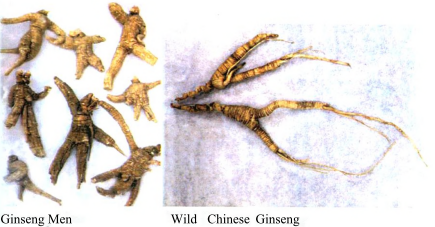
Once the Ginseng plants that survive this initial vulnerable period reach their eighth year, they seem to undergo a genealogic upgrading, developing the capacity to withstand severe drought or wet conditions, extremes of cold and hot, and other natural challenges. They begin to produce natural antibiotic properties that help to fend off viral damage of infections inflicted by foraging critters. The plant is now mature enough that the osmosis of sun on its leaves can send power back down into the marrow of the root, helping it to develop Yin properties deep in the root core. Over time, the root will develop its adaptogenic or "dual directional" properties. As the root further ages, it accumulates additional Yin properties in the marrow and Yang energy at the surface and thus fosters balance and adaptability. As a Ginseng root ages beyond 10 or 15 years, it can seem to take on the appearance of an aged and wizened human; this is why the Chinese call Ginseng, "Man Root." Legend has it that mature Ginseng actually starts to develop the capacity to invoke wisdom in the consumer. This can explain why old wild Ginseng roots can fetch such high prices at markets in China, as the cultivation of wisdom is highly revered there. A fifty-year-old wild Ginseng root can sell for $20,000.
Wild Ginseng roots are almost impossible to find in China nowadays; because they are so prized, fewer of these old roots are found on the planet each year, which is why they command such a lofty price. Many Ginseng hunters lose their lives every year trying to scale high cliff's while searching for Ginseng in the crags. This kind of wild Ginseng is especially sought after, as the plants found growing in the most inhospitable regions are thought to contain the highest concentrations of power by enduring such difficult living conditions.
Ginseng plants are thought to contain a subtle, barely detectable luminescence, which some hunters cultivate the ability to see on dark moonless nights. Because Ginseng plants are said to "hide" in inaccessible places, they may not be noticeable during the daytime. Ginseng hunters will go out on dark nights with bow and arrow. They will see the luminescence of a Ginseng plant that is hiding in an inaccessible area, and shoot a flagged arrow in the direction of the Ginseng, then return to the vicinity in the morning, find the arrow and discover the Ginseng nearby.
When purchasing Ginseng, one should make the effort to learn the origins of a Ginseng species and its general "atmospheric energy" (Yin/Yang and heating/cooling properties) before consuming. Good resource books about Ginseng include Ron Teeguarden's The Ancient Wisdom of the Chinese Tonic Herbs and Michael Tierra's The Way of Chinese Herbs Going to Chinese herb shops and looking at Ginseng can prove insightful. But beware, some high priced, purportedly old and aged Ginsengs may be fake. They are called “art Ginseng,” and may be merely young immature roots that have had striations cut into them with sharp blades and dirt rubbed into the recesses, and extra roots craftily glued onto their sides, and extra nodes attached to the stems, giving them the appearance of older ginseng roots. A trained eye can, with a good magnifying glass, detect these fake Ginsengs.
64. Horace Kephart and Ralph Roberts, Our Southern Highlanders (New York; Outing Publishing 1913), 39.
Ginseng (see below for various varieties) is a premier Chi herb. Good ginseng is considered an "adaptogen." It can strengthen our basic capacity to adjust, both mentally and physically, to changes in circumstance or environment. Complex polysaccharides called ginsenosides are highly empowering, immune modulating antioxidants. Ginseng that is at least seven years old contains multidimensional nutrients that increase our physical and emotional endurance and adaptability. Adaptability is the true measure of our lives, which is what makes Ginseng so precious.
The historical documentation of Ginseng in Asia is immense and illustrious. Ginseng has always been held in the highest esteem by the Chinese for its power-enhancing qualities. In America, this precious herb is not fully understood, even though it was consumed by the first Americans and European newcomers since colonial days. Ginseng must be allowed to mature before it is harvested or its phytochemistry will not be balanced. Prematurely harvested Ginseng that is phytochemically immature will produce a "uni-directional" stimulating effect similar to the alkaloids in roasted coffee. It appears far too many western herbal products may contain these immature Ginsengs, as evidenced by a widespread incidence of the reported side effect of feeling jittery by western Ginseng consumers, and the subsequent misunderstanding of Ginseng's true therapeutic potential. Making products with immature Ginseng is a good example of western industry's impatience with allowing plants to properly mature before harvesting.
There are many varieties of Ginseng, and its effects on metabolism range from Korean Ginseng (Korean: I long Sam), which is very stimulating and warming, or Yang, to American Ginseng (P. Quinquefolius) which is more depth re-charging, or Yin. Chinese Ginseng (Panax Ginseng) is generally processed to be slightly warming. This is evident if the ginseng root is a darker red color. The unprocessed Chinese Ginsengs will be a pale brown color. Still for simplicity's sake, Ginseng in general is classified as supporting Chi.
Depending on the Ginseng plant's origin and on how the roots are processed, this herb's potential therapeutic properties can cover an expansive range, from calming and restoring to highly invigorating. For instance, traditional practices for processing Ginseng in Korea involve steaming the herb with very Yang herbs such as Aconite in order to help the Ginseng produce a warming affect on the consumer. This process has been practiced there for thousands of years in order to help people adapt to the harshly cold winters in this northern longitude (Korea is near Siberia). This is where a misunderstanding can occur; a western layperson may take Ginseng, not knowing it is Korean Ginseng, and get over-stimulated from the Yang properties in this variety of the herb. This person may then form an ill-conceived opinion about the overall effects of taking Ginseng. Such energy and Yang-enhancing processes were never applied to American Ginseng, and by the time Colonial settlers recognized its value, the Chinese were the first large scale customers for our domestic Ginseng. They appreciate it particularly for its calming Yin properties.
Native American peoples were well aware of Ginseng's health-enhancing properties, and it plays a role in early American history. The Boston Tea Party, which helped shape our country's independence, occurred when a British ship docked in Boston carrying a load of black tea from China, which was intended to be traded for Ginseng. If the raid by American Colonialists, who infamously dumped the tea into the Boston Harbor in protest of the taxes levied by the British, had taken place a few hours later, the "Boston Ginseng Party" would have been recorded in our history books. Daniel Boone, of early pioneering fame, was actually a Ginseng poacher. He made his living by searching for the plants in Kentucky, filling barges and shipping them to the north for export to China. He was known in those days as a failed businessman, as he reportedly consistently overfilled his barges with Ginseng, causing them to sink on route to the northern ports.
Here's what one Colonel Byrd had to say about it some time in the late 1800s:
"Though practice will soon make a man of tolerable Vigour an able footman, yet, as a help to bear fatigue I us'd to chew the root of Ginseng as I walk't along. This Kept up my spirits and made me trip away as nimbly in my half jack-boots as younger men cou'd in their shoes. This plant is in high esteem in China, where it sells for its weight in silver... Its virtues are, that it gives an uncommon warmth and vigour to the blood, and frisks the spirits, beyond any other cordial. It cheers the heart, even of a man that has a bad wife, and makes him look down with great composure on the crosses of the world. It promotes insensible perspiration, dissolves all phlegmatick and viscous humours that are apt to obstruct the narrow channels of the nerves. It helps the memory and would quicken even Helvetian dullness. ‘Tis friendly to the lungs, much more than scolding itself. It comforts the stomach, and strengthens the bowels, preventing all colicks and fluxes. In one word, it will make a man live a great while, and very well while he does live. And what is more, it will even make old age amiable, by rendering it lively, cheerful, and good humour'd.[64]
Wild Ginsengs are considered far superior in quality to cultivated or semi-cultivated plants. The cultivated Ginsengs are usually farm grown and often harvested at an early stage. Semicultivated Ginsengs are basically plants that were discovered in the wild but were deemed too young for harvesting," whereby the discoverer provided irrigation, soil fortification and protection from predator animals who might consume it, until it was ready for harvest. Semi-wild, semi-cultivated Ginsengs are easy to spot at an herb bazaar. The top half will generally have a rougher topography, with deep dark lines, or striations; this will be the part of the herb that developed in the wild. The bottom area will be lighter and generally clear of striations. This section represents the growth of the ginseng root after someone made its life easier with water and TLC. The cultivated part will be found to contain lesser therapeutic value than the deeply striated "wild" part due to less compaction of inherent nutrients in the marrow and less need to develop defenses against the ravages of nature. A Ginseng root must be around eight years old before it begins to develop the adaptogenic properties that make it valuable for our consumption. Before this time, the plant is dominated by Yang growth hormones. Ginseng consumed during this stage in its growth will merely produce an effect similar to that of coffee. The young roots' unbalanced Yang nature produces the jittery, caffeine-like effect.
Americans, not realizing the importance of the plant's age, will purchase immature ginseng products. Many buyers on the herb market will pay low prices for these herbs, promoting a policy where growers find it profitable to harvest Ginseng before it matures.
Nature's wisdom keeps the Ginseng from developing its therapeutic potential during these first eight years in order to allow a process of natural selection to take place, for in its early stages, Ginseng is just a plant like any other. Foraging animals, crowding, and bad weather conditions can weed out all but the strongest plants. If Ginseng had its powerful properties from the beginning, it would have crowded out most other plant forms by now.
Once the Ginseng plants that survive this initial vulnerable period reach their eighth year, they seem to undergo a genealogic upgrading, developing the capacity to withstand severe drought or wet conditions, extremes of cold and hot, and other natural challenges. They begin to produce natural antibiotic properties that help to fend off viral damage of infections inflicted by foraging critters. The plant is now mature enough that the osmosis of sun on its leaves can send power back down into the marrow of the root, helping it to develop Yin properties deep in the root core. Over time, the root will develop its adaptogenic or "dual directional" properties. As the root further ages, it accumulates additional Yin properties in the marrow and Yang energy at the surface and thus fosters balance and adaptability. As a Ginseng root ages beyond 10 or 15 years, it can seem to take on the appearance of an aged and wizened human; this is why the Chinese call Ginseng, "Man Root." Legend has it that mature Ginseng actually starts to develop the capacity to invoke wisdom in the consumer. This can explain why old wild Ginseng roots can fetch such high prices at markets in China, as the cultivation of wisdom is highly revered there. A fifty-year-old wild Ginseng root can sell for $20,000.
Wild Ginseng roots are almost impossible to find in China nowadays; because they are so prized, fewer of these old roots are found on the planet each year, which is why they command such a lofty price. Many Ginseng hunters lose their lives every year trying to scale high cliff's while searching for Ginseng in the crags. This kind of wild Ginseng is especially sought after, as the plants found growing in the most inhospitable regions are thought to contain the highest concentrations of power by enduring such difficult living conditions.
Ginseng plants are thought to contain a subtle, barely detectable luminescence, which some hunters cultivate the ability to see on dark moonless nights. Because Ginseng plants are said to "hide" in inaccessible places, they may not be noticeable during the daytime. Ginseng hunters will go out on dark nights with bow and arrow. They will see the luminescence of a Ginseng plant that is hiding in an inaccessible area, and shoot a flagged arrow in the direction of the Ginseng, then return to the vicinity in the morning, find the arrow and discover the Ginseng nearby.
When purchasing Ginseng, one should make the effort to learn the origins of a Ginseng species and its general "atmospheric energy" (Yin/Yang and heating/cooling properties) before consuming. Good resource books about Ginseng include Ron Teeguarden's The Ancient Wisdom of the Chinese Tonic Herbs and Michael Tierra's The Way of Chinese Herbs Going to Chinese herb shops and looking at Ginseng can prove insightful. But beware, some high priced, purportedly old and aged Ginsengs may be fake. They are called “art Ginseng,” and may be merely young immature roots that have had striations cut into them with sharp blades and dirt rubbed into the recesses, and extra roots craftily glued onto their sides, and extra nodes attached to the stems, giving them the appearance of older ginseng roots. A trained eye can, with a good magnifying glass, detect these fake Ginsengs.
64. Horace Kephart and Ralph Roberts, Our Southern Highlanders (New York; Outing Publishing 1913), 39.
Last edited:

Foreigner
Bluelight Crew
Chinese ginseng (panax ginseng) is the strongest, and is warming in nature. It's also the most expensive variety. It has the greatest metabolic impact of all the ginsengs. Most people who take it for too long end up feeling bitchy. It has a cumulative effect on the liver which backs up the body and causes feelings of frustration, even anger. You shoudn't take it more than 2 weeks at a time, if we're talking true ginseng and not some watered down extract. You can give this variety to people who have been weakened by long-term illness or whose vitality is totally collapsing, and it can revive them.
American ginseng (panax quinquefolius) is more cooling and moistening in nature. It's good for people who have low energy but also tend to be on the dryer side, people whom, when they get exhausted, get tired, hot, and sweaty. These people tend to paradoxically get hyperactive when they are faced with burnout. If you tend to have fluid retention I'd avoid it. But if it's a match for you, it's somewhat safer to use long term (>1 month) than the Chinese variety.
Korean ginseng is somewhat in between, but IMO is the weakest variety. I've experimented with it in various forms and it just doesn't have the same impact as the others.
Anything else called ginseng is not true ginseng (i.e. Siberian, or notoginseng).
American ginseng (panax quinquefolius) is more cooling and moistening in nature. It's good for people who have low energy but also tend to be on the dryer side, people whom, when they get exhausted, get tired, hot, and sweaty. These people tend to paradoxically get hyperactive when they are faced with burnout. If you tend to have fluid retention I'd avoid it. But if it's a match for you, it's somewhat safer to use long term (>1 month) than the Chinese variety.
Korean ginseng is somewhat in between, but IMO is the weakest variety. I've experimented with it in various forms and it just doesn't have the same impact as the others.
Anything else called ginseng is not true ginseng (i.e. Siberian, or notoginseng).

PriestTheyCalledHim
Bluelighter
- Joined
- Oct 7, 2005
- Messages
- 14,682
I've taken various types of Ginseng and it does not have a "warming" effect on my body, or stimulate me like coffee does.
Ginseng also does not help me with concentration, work efficiency, or athletic endurance.
However I do understand that drugs and herbal supplements do not effect me or my body the way they do to most people.
I've had authentic Chinese ginseng as a friend of mine in college was from Hong Kong and his parents gave my parents a gift of oolong tea with Ginseng since we had my friend or their son stay with us during holiday breaks from the university. It added a unique flavor to the wuyi or oolong tea but that was it.
Stash tea also used to make a honeybush and ginseng tea and again it just was more of an added flavor, and I did not get any sort of stimulant effect from it. I have had ginseng in tea and as supplements but again none of them had no real effect on me.
Ginseng also does not help me with concentration, work efficiency, or athletic endurance.
However I do understand that drugs and herbal supplements do not effect me or my body the way they do to most people.
I've had authentic Chinese ginseng as a friend of mine in college was from Hong Kong and his parents gave my parents a gift of oolong tea with Ginseng since we had my friend or their son stay with us during holiday breaks from the university. It added a unique flavor to the wuyi or oolong tea but that was it.
Stash tea also used to make a honeybush and ginseng tea and again it just was more of an added flavor, and I did not get any sort of stimulant effect from it. I have had ginseng in tea and as supplements but again none of them had no real effect on me.