



• Find All Reports by Search Term
    Find Reports
    Find Tagged Reports by Substance
    Substance Category
    Specific Substance
    Find Reports
  • Trip Reports Moderator: Cheshire_Kat | M!$ter-ED

(Myristica fragrans/3 mL essential oil) - Fifth Time - The Most Underappreciated Psychedelic

However, sassafras root bark is something I can attest to. A couple of hundred grams made into a strong infusion most certainly has an effect. At the time I had no knowledge or experience of the empathogenic effects of MDA/MDMA and yet that's exactly what I felt - very much so - along with, admittedly mild, psychedelic activity. In my experience, it definitely mimics the behaviour of the aminated forms of safrole, which I now in my later years have greater familiarity with. What the mechanism is, whether enzymatic amination, receptor promiscuity, or... [make up your own hypothesis section], is open to debate, but in my personal experience it does work.

I posted this in another thread but its relevant here. It's a study looking at the alkaloids in sassafras root bark. iirc someone was doing A/B extractions on sassafrass/cinnamon bark over on dmt-nexus looking for cinnamolaurine.

Identification of Sassafras albidum alkaloids by HPTLC/DESI-MS and mapping by DESI-MSI

Sassafras albidum is an important tree species that occurs across North America. The presence of benzylisoquinoline and aporphine alkaloids has been previously described
...
A total of 12 alkaloids were indentified in the roots and twigs, and six of them were detected for the first time...five aporphines and seven benzylisoquinolines.
...
All alkaloids seem to accumulate more in the outer layers of Sassafrass albidum roots.
...
Coclaurine, N-methyl coclaurine, and armepavine...are described here for the first time in the genus sassafras.
...found in the roots: norcinnamolaurine, cinnamolaurine, boldine, reticuline.
...
The two alkaloids with a methylenedioxy group identified in this work: norcinnamolaurine and cinnamolaurine
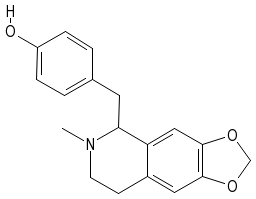
Cinnamolaurine
Cinnamolaurine.gif
 
I took 20 drops of nutmeg essential oil and only felt a slight stimulation. Meanwhile 5g nutmeg powder feels really potent for me. Like a more trippy version of cannabis with occasional short term memory loss. Also strong anticholinergic (?) effects without hallucinations. I completely lose ability to sweat on even as low as 5g of nutmeg powder.

Is it because of Licarin A which is a FAAH inhibitor but not present in steam distilled essential oil?

Source: https://pubmed.ncbi.nlm.nih.gov/31595522/

Full text:
 
Last edited:
A study on the psychoactive effects of myristicin:
The pharmacologic and toxic effects of myristicin have been examined in laboratory animals in order to estimate its safety in man. Myristicin is assumed to be the principal active ingredient of nutmeg powder. In 400mg doses, myristicin produced mild cerebral stimulation in human subjects. This effect is much less than that produced by 15g of nutmeg powder, which was taken by one of the authors in order to describe its psychopharmacologic action. Removal of the volatile components of nutmeg eliminates the psychic action but not all of the side effects. It appears that myristicin does not reproduce the entire activities of whole nutmeg.
https://www.erowid.org/references/texts/show/7158docid6486
After some animal testing, 10 human subjects were given either 400mg of myristicin or a placebo. The administration was orally in capsules. Out of 10 subjects, 4 had confirmed effects from this does. 2 had doubtful but possible effects from myristicin orally. The other 4 either had placebo or no reaction. To see how this differed from actual nutmeg, one of the authors took 15g of nutmeg himself, and reports on the experience. 3 authors then take 10g of nutmeg with the volatile oils removed - they did not get hallucinogenic effects but some did get either sedation or stimulation (suggesting that the fixed oils - i.e. trimyristin - may have some effects which differ in different subjects).
This is the first study on nutmeg that I can find in the literature.
It's not a new phenomenon. According to the study, published in 1961, myristicin - and possibly all allylbenzenes - are active in only about 40% of the population if administered orally as the sole ingredient in a capsule. No wonder so many people think this is BS. Most people don't get effects orally from straight allylbenzenes. But in nutmeg, which contains about 20% trimyristin by weight as well as a lot of other compounds, it is active in almost everyone.
 
Top
