• N&PD Moderators: Skorpio

Multiple substitutions on the flourinated amphetamines

Liquid Sunshine

Bluelighter
Joined
Jan 9, 2010
Messages
476
Location
Oregon Coast <3
I was thinking about 3-Fa and it's cousins, as well as the n-methylated friends, and I was curious if it were possible to have a flouride at both the 4 and 2 position simultaneously, or 3 and 2 or anything along those lines?

Forgive my relative ignorance
 
I think something like a methoxy might work better. It would probably end up being MDMA like or even psychedelic.

Example: 4-FA with a methoxy at the 2 and 5 position would probably be a strong psychedelic

4-FA with a methoxy at the 3 and 5 position would be a potential psychedelic/empathogen

2-FA with a methylenedioxy on 3 and 4 may be an active stimulant and even potential empathogen

There is also the prospect of using a fluoromethyl group instead of a fluoro group, or a fluoromethylthio

I could literally think of probably 10 or 20 compounds based on variations of this (without using anything crazy like the fluoromethylthio group) and maybe even more. Some of them probably simple to synthesize.

3-methoxy 4-fluoro amphetamine, probably MDMA-like.

there is also difluoromethyl and trifluoromethyl groups as well. 4-trifluoromethyl 2, 5 (or 3, 5) dimethoxy amphetamine would surely be a powerful psychedelic.

There's a lot of room for potential here if someone would take up the task. I think there's still a lot to learn from the phenethylamine backbone.


and in response to your question I don't think having a fluoro group at multiple positions on the ring would be preferable. But it would still yield some active compounds, I can think of antidepressants (ssris and stimulant based ones) with a similar structure.
 
I'm very interested in this from the pure stimulant point of view also. I wonder what 2-trifluoromethylmethamphetamine is like in comparison to 2-fluoromethamphetamine. I'd also be very curious about fluoinating the alpha methyl and n-methyl groups in methamphetamine, and dimethylamphetamine.

And a bit off topic, but anyone think fluorinated phenmetrazine derivatives might interesting?

Aren't fluorinated amphetamines much more variable in activity than the other halogens though?
Varible? How so exactly? They are usually less potent by weight than the other haloamphetamines
 
I wonder what 2-trifluoromethylmethamphetamine is like in comparison to 2-fluoromethamphetamine.

Trifluoromethyl (and trifluoromethoxy) are much more 'halogen like' than a single fluorine. For instance, 2C-TFM is active like 2C-I, 2C-F is not.

I'd also be very curious about fluoinating the alpha methyl and n-methyl groups in methamphetamine,

I recall asking about alpha-fluorinated amphetamines (both alpha-fluoromethyl-phenethylamine and alpha-methyl-alpha-fluoro-PEA) a while back. I don't think they are known as drugs.
 
Why is the bromine atom at the place that I know as the 6 position? That is not where the fluorine is at in 2-FA. I must be missing something.

and sekio, is it possible to have a fluorine at the alpha position or attached to the nitrogen without a methyl?

Are you sure? Accounting for free rotation of the phenyl ring?
 
alpha-trifluoromethylphenethylamine is known. I will quote from a review:

When compared to amphetamine (1),
2-amino-3-phenyl-1,1,1-trifluoropropane (11) was found to be
inactive when testing anorectic, antiemetic, central nervous system,
monoamine oxidase inhibitory and pressor activities. Later, this was
explained by electronic effects[38]; the trifluoromethyl group
dramatically lowers the basicity of the amine (amphetamine
pKa = 9.93, 11 pKa = 4.97). As a consequence, under physiological
conditions 11 cannot be protonated anymore and its body distri-
bution may be significantly altered.

The variants with fluorine at the carbon next to the phenyl ring seems more promising. N-trifluoroethylamphetamine is apparently inactive.

Read more in the nice review "Fluorine in psychedelic phenethylamines", Drug Test Anal. 2012 Jul-Aug;4(7-8):577-90
 
Last edited:
Ahh, I may be losing you here. I think I just don't know how it works :p

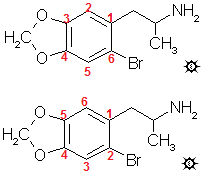
Actually you were right to question that structure. What I posted was 2-Br, 4,5 Methylenedioxy (AKA 3,4 Methylenedioxy, 6-Br), whereas your first post said 2-F, 3,4 Methylenedioxy. My mistake.
 
What I posted was 2-Br, 4,5 Methylenedioxy (AKA 3,4 Methylenedioxy, 6-Br)

Okay, thanks for the clarification! What I'm wondering about now is how the 2-br, 4,5 methylenedioxy translates to being 3,4,MD 6-Br
I've seen other instances of some confusion with the phenyl ring, like certain pics depicting 2Cs or 2C-Ts as having the methoxys at (what I assume is) the 3 and 6 positions instead of the 2 and 5, however they are used interchangeably. Apparently there is just something about the phenethylamine numbering system that I do not know.

@RALF2: Thank you!! Very informative and thanks for the study you mentioned, I will read it later. "Fluorine in psychedelic phenethylamines" ahh.... sounds amazing.
 
Okay, thanks for the clarification! What I'm wondering about now is how the 2-br, 4,5 methylenedioxy translates to being 3,4,MD 6-Br
I've seen other instances of some confusion with the phenyl ring, like certain pics depicting 2Cs or 2C-Ts as having the methoxys at (what I assume is) the 3 and 6 positions instead of the 2 and 5, however they are used interchangeably. Apparently there is just something about the phenethylamine numbering system that I do not know.

It depends how you do the numbering:

iALKsLW.png


The bottom numbering is technically more correct, because it gives a lower total # when you add up all the substituents' numbers.
 
Top