Morninggloryseed
Bluelight Crew
hugo24 said:Hmm,entactogens are usually active at 100mg +/-,it appears an unbreakable pattern so far,but you'd be welcome %) ....
Not when it comes MMDA-2.




N&PD Moderators: Skorpio
You are using an out of date browser. It may not display this or other websites correctly.
You should upgrade or use an alternative browser.
more MDMA substitutes
Morninggloryseed
Bluelight Crew
hugo24 said:
Hmm,entactogens are usually active at 100mg +/-,it appears an unbreakable pattern so far,but you'd be welcome %) ....
Not when it comes MMDA-2.


MattPsy
Bluelighter
I'm really starting to think that the search for single-molecule entactogens is a waste of time, and really what we should be doing is making very selective molecules for each of the tasks required for empathogenic activity, and co-administering them. That way we can fine-tune them, too.
Thoughts, anyone?

hugo24
Bluelighter
MGS-ah you picked the one...unfortunately (yes,it always intrigued me) I have no experience with MMDA-2,though PIHKAL sounds a bit like its a somewhat entactogenic experience.We're lacking more voices on this compound!Has the N-Methyl-MMDA-2 tasted in the mean time btw?Would give us really some clues.
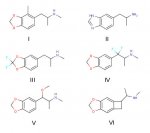
2-methyl-MDA analogues are more potent and better than 5 or 6 methyl-analogues.
I is called MADAM-2 and is the best methylated-MDMA compound
II : Indole and benzimidazole MDA-analogues are known to be more powerful than regular MDA but I heard they are more sedating than stimulating...
III & IV are two fluorinated unkown MDMA analogues.
V is the b-methoxy version of MDMA. Shlgin made some b-MeO PHE, some are very interesting such as BOD the b-MeO version of well-known 2C-D.
VI is the cyclobutyl analogues of MDMA. These structures aren't the same plane of regular-PHE and the cylcobutyl-analogues of 2C-series are tested more active than regular-phenethylamines .
Attachments

haribo1
Ex-Bluelighter
Has anyone tasted the furan analogs? I sort of thought it was the oxygen at the 3 position that was the most important thing... I seem to remember a discussion in which someone suggested 3 methoxy methamphetamine as a substitute. Of course, I would never post sources, but the substituted ketone is available from some places in Kg quantities. Tie in the Dutch 'cold method' i.e. Dissolve ketone in methanol, bubble through methyl amine & reduce using NaBH4. Low yield, but you can do it in any old container...
While I'm yapping, anyone know if there has been a proper series of tests using the alpha keto analogs of the PEA series? I mean, can you make bkDOM or such?
Last edited:

Riemann Zeta
Bluelighter
I think the nitroso analogue (which is probably better written as the zwitterionic species) looks like a very unhappy, angry molecule--even it turned out to be stable, I sure as fuck wouldn't want to be the first person to try it out. My bet (just intuitively), is that number 3 would not be stable enough to really be worth it--it would dimerize or undergo addition--and number 2 would be very weakly active, like any 2,3,4,5-substituted amphetamine (tetramethoxyamphetamine).
Vadadium: I have also always been curious about the imidazol-analogue (essentially replacing the oxygens of the methylenedioxy- moiety with nitrogens) of MDMA. I have had this one in my notes for years, but have never seen any research on it (even though I apparently gave it a bitchin' nickname at the time):
Last edited:

rolls
Ex-Bluelighter
MattPsy said:
I'm really starting to think that the search for single-molecule entactogens is a waste of time, and really what we should be doing is making very selective molecules for each of the tasks required for empathogenic activity, and co-administering them. That way we can fine-tune them, too.
Thoughts, anyone?
I think this is the way also. I only have first year uni knowledge of chemistry though so I don't know how possible/difficult this would be.

Ham-milton
Bluelighter
How long before a prodrug before it gets scheduled? Odds are any pro-drug is gonna be considered an analogue, as well.
Oh, the not getting caught eating it? Yeah, too bad.

Acyl
Bluelighter
MattPsy said:
No, they'll cyclize up.
They need to be secondary amines to avoid this, which of course ruins the activity as we know.
What about N-acetyls? If they survive the stomach with the acetyl group still intact they could pass through the intestines without this sort of problem. Id imagine they would be de-acetylated in the liver and then spread out accordingly.
Am I looking at it the wrong way?
Acyl
Bluelighter
I'm really starting to think that the search for single-molecule entactogens is a waste of time, and really what we should be doing is making very selective molecules for each of the tasks required for empathogenic activity, and co-administering them. That way we can fine-tune them, too.
Thoughts, anyone?
Good idea, but think about how hard it would be to get any sort of results from that. You'd be taking several different drugs that react quite similarly with very few receptors, there would be much competition. If chemical A and B contain the important structural characteristics of a typical hallucinogen and together produce an effect that in no way resembles one, what could you do? There are too many variables as is when you're taking one drug.. taking multiple ones at the same time just introduces a few more.
I think picking a target receptor and making slight modifications to its endogeneous transmitter and/or other drugs with affinities is the best way to go about finding how to predict the pharmacodynamics of future compounds.
MattPsy
Bluelighter
No, what I mean is like, say a MDA-MDMA hybrid mimic:
+ A VMAT2 agonist.
+ A 5-HT2A partial agonist, maybe a small amount of pFPP because it can generate some of the sort of bodyload we want through 5-HT1 agonism, and it has a bit of SERT inhibitor activity as well...
+ A combination DA+NE reuptake inhibitor (NDRI), or a DARI and a NERI in specific proportions.
+ A selective 5-HT releaser like MDAI.
All in the right proportions. You could simply change the proportions for increased trippiness, speediness, etc.
As for the N-acetyls - sure, if such structures exist. I haven't learnt enough chemistry to know whether you can form those structures. I'd be looking toward a hydroxylamine acetyl ester, if you could form it.
Ham-milton
Bluelighter
That's true. It's hard enough trying to figure out what causes what from a single drug. Doubling it'll be even worse.
Acyl
Bluelighter
it just seems like you'd be limited to meth/amphetamines and the usual psychedelics like LSD/mushrooms to get any sort of decent mix. The amphetamine intake would regulate speediness and LSD psychedelia, I dont really see how you could take a (half decent) dopamine/norepinepherine reuptake inhibitor that wont interfere with the VMAT2 agonist you may have taken also. The amp would just act as one anyway..
I mean you could go for pFPP and the MDAI, and take a few more drugs that effectively satisfy the specific criteria youve outlined. I just think youd have to deal with the whole whack load of drugs you took by an incredibly pissed off peripheral nervous system. Also theres no doubt that some would overlap in their affinities..
Also, the N-acetyl can be easily formed.. and im not quite sure what you mean by "hydroxylamine acetyl ester" as the molecule I picture in my head would be a secondary amine that wouldnt be very susceptible to primary amine conversion at any point before it enters general circulation.
synchrojet
Bluelighter
What is a specific MDMA prodrug? I was unaware that any applicable examples exist. Not surprising, given my overall ignorance in this area, but if someone would please indulge my curiostiy, I would be much obliged. You can PM me with it if that's the thing.
MattPsy
Bluelighter
Acyl: Well no what I was envisaging wouldn't really be satisfied by many existing compounds. More advanced materials are required.
And: So you're actually thinking of a amide =/ ? This structure: -NH-C(=O)-CH3 ?
I was thinking of -NH-O-C(=O)-CH3 . Again, not sure if this can even exist.
Also, does anyone know what happens in terms of metabolism to oximes? Perhaps a MDA ketoxime might be a MDA prodrug?