• N&PD Moderators: Skorpio

Monosodium Glutamate

Status
Not open for further replies.

Ham-milton

Bluelighter
Joined
Jul 20, 2007
Messages
5,738
I was reading that MSG is metabolized into GHB in vitro, but I can't figure out how that happens (what liver enzyme, something else?). Does anyone here know more about this subject?

Also, and realize this isn't a synthesis question (nor something I could perform if I wanted to), is this something that could be done in a lab? I assume it'd be either difficult or really low yield since no one's doing it, just wondering.

 
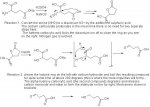
Looking at the structure, you could decarboxylate it and react with nitrous acid to convert the nh2 to oh, which would cyclise to gbl. Not sure how you'd decarboxylate it or weather you could do the amino acid acid selectively.

Apparently theres an enzyme that decarboxylates it to GABA:
http://en.wikipedia.org/wiki/Glutamate_decarboxylase

But if that enzyme is anywhere other that the brain its not gonna get u high, besides it doesnt really sound like something i want to be eating a lot of.
 
My cell bio teacher says its pleasurable but she didn't mention it being metabolized into GHB. She said it was pleasurable due to glutamate's activity in the brain.

Glutamate is a NT in our brains(and an essential amino acid), as you know, I wouldn't expect it to be metabolized to GHB..

Please cite where you heard that MSG is metabolized into GHB, im interested in the source
 
I think the shroomery has a synthesis outlined somewhere in the chem & pharmacology forum.

Its probably reliable as all the procedures have been pulled from the literature and only been modified slightly ;)
 
OH I just realized you said IN VITRO, i thought you were talking about in vivo

you're aware that "IN VITRO" means in a test tube right (AS IN NOT IN THE BODY)?
 
Yeah, I know, typo (drinking for the first time in 2 years or more!) and when I try to edit it doesn't save..

I took Wikipedia at it's word on the subject (here) which is definitely not infallible. It's in the section that talks about the 2 previous cases that tested the act (one found it unconstitutionally vague, the AET case), the latter one discussing 1,4 butanediol being an analogue of GHB, is where you want to read it.
 
Im going to bet that its alcohol dehydrogenase and then aldehyde dehydrogenase

I dont really know much about biochemistry though, Im sure someone else has something to say about this.
 
A easy way of decarboxylating it is the TCCA (trichloroisocyanuric acid ie. very common pool chlorinator!) oxidative carboxylation to the nitrile, which you'd then hydrogenate to the amine (GABA).
Then you're stuck with the problem of converting that to a hydroxyl, which yeah you can do with HNO2 but apparently it sucks and is hard to separate. At least there wouldn't be anything very toxic in the reaction mixture (providing you purified at each step).
 
Other than for the Tiffeneau-Demjanov reaction or conversion of anilines to phenols, reaction of R-NH2 with HNO2 to try to obtain R-OH gives mostly a big mess.
 
retired_chemist said:
Other than for the Tiffeneau-Demjanov reaction or conversion of anilines to phenols, reaction of R-NH2 with HNO2 to try to obtain R-OH gives mostly a big mess.

Wrong.

Glutamic acid and sodium nitrite cyclizes to a butyrlactone very smoothly, yields are 60%+.
 
From there the hydroxyl is a simple lactone hydrolysis away.
 
Oh? Do you have references for that? All those that i've talked to who tried it said it sucked and they couldn't recover any decent amount of product. They could have, however, just been useless bastards :p .

Oh and is there any easy way to extract the produced GBL? Does GBL have more affinity for dissolving in non-polar solvents, perhaps? (So, add methybenzene, separate, prepare NaOH solution, add GBL-containing methylbenzene solution to it slowly while measuring the pH of the NaOH solution - as GBL is converted to GHB and enters the aqueous phase and thus lowers the pH down toward neutral, stop when neutral?)
 
Last edited:
From GABA I can see it, although I would be pretty skeptical of that kind of yield. From glutamic acid, I would be interested to see a decarboxylation mechanism.
 
Like I said, someone on the shroomery posted a synthesis in the Chem & pharmacology forum.

The decarboxylation is actually a decarbonylation, the procedure was taken from a 'decarbonylation' of citric acid. It uses fuming sulphuric acid, this is very feasible because it is also an alpha-hydroxy acid. Im sure there are other ways to do this...

Id tell you the procedure but im afraid thats not allowd here.. so go to the shroomery and do a quick search.


Yes I have a reference,

Organic Syntheses, Coll. Vol. 7, p.99 (1990); Vol. 63, p.121 (1985).


Its the exact same procedure BTW.
 
Last edited:
The cyclization doesnt produce GBL it produces a gama-butyrlactone-gama-carboxylic acid

This is then hydrolyzed, decarboxylated (decarbonylated, with the procedure ive seen), reduced to an alcohol and extracted.


The final reaction would probably depend on how you carried out the synthesis. In the above, GBL isnt even produced, it goes from the open chain alpha-hydroxy acid to GHB in two steps.
 
Interesting. So... glutamic acid gets deaminated, cyclizes to 1,4-butlactone-4-carboxylic acid, that is decarboxylated and ... how does that produce GHB? If the decarboxylation is effected with conc. H2SO4, where does the stabilising Na ion come from?
Or have you simply neglected to mention basifying it with NaOH at the end? because from what I can see - this DOES produce GBL... decarboxylating that r-4-carboxylic acid should yield GBL.

Ok. The carboxylic acid part checks out. I'm not so sure about that decarboxylation though, and you haven't provided a reference for that part.
 
Last edited:
Alright whatever.... I don't see how any of this is in vivo at all?

Are we talking transfected cells here or what kind of cells are we talking?
 
This is in response to his "can it be done in the lab" question.
 
Status
Not open for further replies.
Top