• N&PD Moderators: Skorpio

Molecules Under a Microscope

SNR

Bluelighter
Joined
Apr 20, 2011
Messages
140
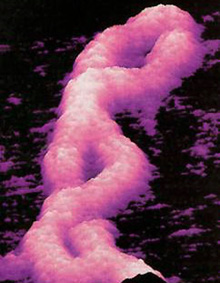
What exactly would molecules look like, hypothetically, if we had a microscope that could zoom to any magnification needed? Would they look like what we usually see with crystal structure models, or what? I found this picture of a DNA molecule online, and thought it would go well with my question.

dna_molecule.jpg
 
The question is fundementally flawed; it depends what you mean by "microscope" and what medium you're using to do the sensing. Light microscopes just don't work beyond a certain size because a light wave is from 400 to 700 nanometres 'wide' - it starts to diffract and do crazy things when you shine it onto, or past, really really small things.

Atomic Force Microscopy and related techniques use a cantilever probe with a very tiny tip (nanometres) that is "dragged" or "tapped" across the sample. Scanning tunneling microscopes use quantum tunneling to induce currents in the tip and have imaged things like the atoms in a carbon nanotube or atoms of gold in a sheet.

Back in 2009, pentacene was directly imaged with a modified atomic force microscope; it "looks" the same way you'd expect it to. I don't think the process was easy or cheap, though, and you can't really call it a microscopic image because it's actually a map of molecular forces and not a map of light interactions like we expect a photograph to be. Regardless, I think that the VSEPR model and things like that are pretty good predictors of how molecules 'look' in the real world.
 
I doubt they would look that much different from X-ray crystallography solved electron density maps.
 
Indeed they dont look much different^^

STM images confirm X-ray crystallographic experiments and structures predicted by VSPER theory to a great extent. Personally I was hooked from the first time I saw an STM image of an assembly of organic molecules on a surface. I find it extremely intriguing to do an experiment which is so close to taking an actual image of single molecules/atoms :)
 
I can confirm with first hand experience that Pentacene molecules do, in fact, "look" just as we draw them. But again the definition of look is a bit loose. By using a Scanning and Tunneling Microscope what we can "see" is essentially a mapping of the local density of states, or in more layman's terms we see the electron structure of the molecule which more ore less agrees with how we draw them normally.

The picture, pun intended, gets a bit more blurred when you were dealing with more complicated molecules or systems of molecules (crystal structure). For instance, when imaging graphene (single layer of carbon atoms) atop a ruthenium lattice the STM produces pictures of the Moiré pattern that occurs when two lattices of slightly differnet sizes are overlaid. (Both graphene and ruthenium form 2-d hexagonal lattices)

If care is taken, and the conditions are right, and you are really good at fiddling with the STM, and you have a lot of patience, you can get atomically resolved images out of those moiré patterns. This provides a more definite idea of the physical structure of what you are looking at.

 
I dont think youd be able to see much. Pentacene is, for this purpose, only a 2 dimensional molecule. Molecules like morphine or cocaine are much more 3 dimensional in their structure so to speak. The closest thing you get to a picture of cocaine or morphine is X-ray crystallography. APM techniques are to a large extent limited to macromolecules or rigid, aromatic molecules. At least when it comes to carbon based molecules.
 
2D in profile

Oh I am aware, but I could always get a front & profile shot eh? :P

Well, after some heavy digging, I found a image of the profile for this 2-D molecule:


=> _________________________________


^ Hope that helps! :)


Ok, but seriously, I do remember the C&E News bit that came out a decade ago that purported to directly observe atomic orbitals, an even greater feat than that for molecules. Unfortunately, when I went to find a link to the images, my research exposed that the story is likely not so simple.

A nice read on directly imaging atomic orbitals:

http://anonym.to/?http://philsci-archive.pitt.edu/228/1/Orbital_Observed.pdf

Also, to the OP- your best bet would probably be electron density maps, which can provide quite resolved "images" of single molecules (or the atomic force microscopy, xray crystallography that were mentioned above).
 
Top