• N&PD Moderators: Skorpio

MMDA and 'brain movies'

blueberries

Bluelighter
Joined
Jan 13, 2011
Messages
334
Location
Shangri-La
I was investigating MMDA and could not find much information on the pharmacological profile of MMDA other than it being a serotonin releaser and a 5-HT2a agonist. If these were the sole processes then such unique effects as 'brain movies' would not be produced, only MDA type effects.

So my question is; what mechanisms produce these effects?

I was thinking along the lines of anticholinergic effects as with myristicin (a close analogue of MMDA, sans the amine) and possibly some mild MAO inhibition, like nutmeg, which would potentiate the serotonin release and thus enhance 5-HT2a agonism in a similar way to Ibogaine (which can produce 'brain movies') and Ayahuasca (Pharmahuasca (using Moclobemide as an MAOI) produced mild 'brain movie' type effects for me, personally, but seemingly not as profound as those described in MMDA (which I have not tried, hence I have not been able to extrapolate differences in effects)).

Also the methoxy seems to be integral in this process as 5-Methyl-MDA does not produce such effects, but more along the lines of MDA itself. At different positions too, as with MMDA-2 and MMDA-3a; they also do not produce such effects, so the 5 position is also needed. Then again a slight alteration to the methylenedioxy group at 3 and 4 (breaking the ring) changes it into Mescaline that does not produce such unique effects.

It seems there is nothing else like it (apart from Ibogaine and maybe Ayahuasca) in the whole spectrum of psychedelics so it must be to do with MAOI and anticholinergic effects like Myristicin, right? Therefore a combination of a psychedelic and a deleriant may produce similar effects (something which could be tested fairly easily but I'm really not a fan of deleriants).

However looking at some experience reports on Erowid with combined LSD and Datura it seems the brain movies are not produced. This could be due to the overwhelming nature of Datura itself though. Also reports of psychedelics, other than DMT, and MAOI's also do not produce such effects, like with the 2C-T-x's and when MAOI's are combined with Mescaline or mushrooms.

Are MMDA's effects really that pronounced in comparison to other psychedelics and is it just 5-HT2a agonism mixed with some MAOI and anticholinergic properties alongside the serotonin release, enhancing the effects further? Also could it have some mild NMDA antagonising effects too (or some heavy sigma agonism which can inhibit NMDA function along with neuroprotection, another facet of MMDA as it's serotonin release is non-neurotoxic), which could compound the 5-HT2a agonism into a drastically different psychedelic? The only other ones I can think of are Ibogaine and PCP analogues but the NMDA antagonism there is far higher than would be needed and as such these unique effects are not present (one could say ketamine or MXE have the ability to do this but seemingly not in the same way that MMDA does). Perhaps k opioid agonism is present too, though I can't be sure.
 
Last edited:

I think that there is still a lot that we don't know about drugs producing altered states of mind. For me there's clearly some common aspect shared by psychedelics and dissociatives, depending on the compound used the pattern may be more or less noticed. MMDA has oxygens in the same positions as mescaline, a related compound to MMDA is DMMDA, it has an additional 6-methoxy, I've wanted to try it for quite some time, I've got a feeling it may be a great psychedelic too. I've often seen mescaline reported to be a great psychedelic by a lot of people on the Internet. I think there may be something unique in compounds having 3 oxygens at 3,4,5 positions, they may not be the most potent, but just happen to have a perfect pharmacological balance or target some site whose importance is a mystery to us.

What I mean is exactly what you proposed in your last paragraph. I think that 5-HT2A agonists, NMDA antagonists, and kappa agonists have something in common. I think it's something indirect, something that is caused by all of these three actions independently (imagine a chain and a common link for all of them). Sadly, there's presently no research that would allow us to even draw a theory making sense on paper and could be tried in reality. But I've seen that there are quite a lot of people that suspect the very same thing happening.
 
Sorry for the double post, but I wanted to bump the thread. I think it's very interesting, but perhaps nobody has seen the potential yet.

I've been wondering about this 3,4,5-pattern. It seems that it produces a lot of interesting compounds like allylescaline and TM (similar in dosing to 2C-T). It's a bit hard to draw a clear comparison between 2,4,5-pattern and 3,4,5-pattern. There's 4-Br-3,5-DMA, which seems much less interesting than DOB. Your mileage may vary, but I think qualitatively psychedelic phenethylamines are generally better than amphetamines, perhaps in the 3,4,5-pattern group it's more pronounced.

I think that 3,4,5-substituted phenethylamines may aim for some target that 2,4,5-substituted phenethylamines don't, it could be something minor or it could be just a better affinities balance. For 2,5-dimethoxyphenethylamines, oxygen at 4. position isn't really desired as 2C-O, a 2,4,5-positional isomer of mescaline, is inactive, and mescaline itself is reported to be a great psychedelic. Both MMDA and DMMDA have interesting descriptions in PIHKAL with some comparisons to LSD, I think their phenethylamine analogues could be great psychedelics too. 4-bromo-3,5-dimethoxyphenethylamine could be more interesting than 4-Br-3,5-DMA as well, but there's also a chance that electronegative groups aren't that well tolerated at 4. position (qualitatively). However, hydrophobic groups may be well tolerated, e.g. TM and TE (4-methylthio- and 4-ethylthio-3,5-dimethoxy-PEAs) are very potent compared to mescaline, thus I think that 4-methyl- and 4-ethyl-3,5-dimethoxyphenethylamines could be good psychedelics. That's not like 10 possible ways to check, so one could easily find out. If simple alkyl groups worked fine, then I wouldn't want to miss discovering a lot of potentially great 4-substituted-3,5-DMPEAs. 4-vinyl- or 4-prop-1-enyl and 4-ethynyl or 4-prop-1-ynyl could be better substitutes for 4-methylthio in TM, sulfur differs a bit in electronegativity from carbon.

Any idea for a naming pattern? 4-X-3,5-DMPEA is bit too long, perhaps just 4-X-DMPEA?. There was a thread about 4-chloro-3,5-dimethoxyphenethylamine here.
 
Last edited:
Not a problem. The thread you linked was very interesting. I've always thought of expanding DESOXY into compounds with a simple alkyl group instead of an oxygenated alkyl group. For instance 3,5 dimethoxy 4-ethylphenethylamine I would expect to make a great compound at perhaps the 20-40mg level. Also as with what we've seen in Allylescaline and Methallylescaline, potency can be enhanced a lot more if you'd just remove that oxygen. There's a whole undiscovered world of mescaline analogues and so far only DESOXY has been explored.

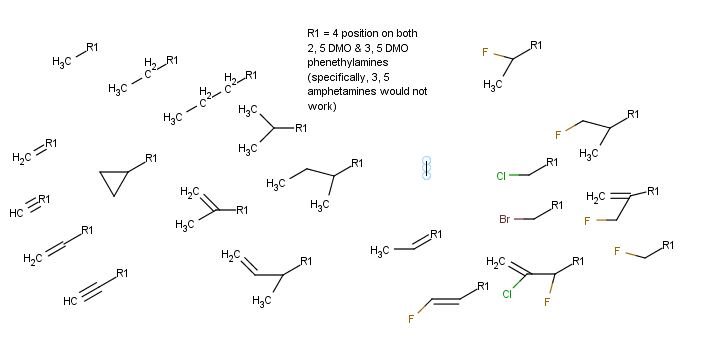
I would go about calling the aforementioned compound '4-Ethyl-Mescaline' or 4-EM and so on. I'm not sure about the halogens but from what Shulgin described there could very well be a lot of activity here, however my passion would lie in the alkyl groups. There are so many options available here:
OPoVL4r.jpg
. And these are just the basics, the number of different alkyl groups that could be produced are endless.

I'm also very much interested in the -thio mescaline compounds but still the problem arises of MAO inhibition which could be more pronounced in the mescaline analogues. We still have yet to side widespread production of the other T-x's which I am incredibly interested in as all the alkyl groups associated with them could in turn be added to the 2C or mescaline backbone. There are literally hundreds of probably active compounds waiting just out of reach due to non exploration, yet people are beset on 2C-B or 2C-E which in my mind, while being very interesting compounds are lacking the imagination of what could be done.

This is getting fairly OT though. However if one were to add these alkyl groups to the 5-position of MMDA after the oxygen, could more 'brain movie'-esque compounds be produced? Such as 5-EtO-MDA or 5-iPO-MDA (something that sounds very exciting indeed!). The problem still exists of potency (and production costs) however and I think if one were to add another methoxy group to a different position in addition to the 5 group it would extend duration as well as potency (like with the 2C-G's) making it a lot less attractive.

I would also be fairly hesitant to add an NBOMe group to these to increase potency as the flaws in these compounds are numerous and fairly annoying (i.e seizures and extended tolerance, also a lack of 'true' psychedelia as I would put it).

The extension of DESOXY however IMO is the next step in RC's but without reports people are unwilling to test them. I would though.

EDIT: I mentioned a complete list of extensions in this post in the 'random compounds' thread:
Ok, I'm not going to draw out each one but you can see where I'm coming from, hopefully!

These are my notes on Tryptamines & Phenethylamines:

TRYPTAMINES


N, N, xx-Trypamines :

DMT
MET
MiPT
MPT
MBT
MALT
DET
EiPT
EPT
EBT
EALT
DiPT
iPALT
DPT
PET
PiPT
PBT
PALT
DBT
MBT
EBT
iPBT
PBT

More xxT's include:

Ethenyl (V)
Ethynyl (Y)
2-Methyl-Ethenyl (MV)
2-Fluoro-Ethenyl (FV)
2-Chloro-Ethenyl (CV)
Ethyl-Dimethy (IB)

Therefore:

MVT
EVT
iPVT
PVT
BVT
ALVT
MYT
EYT
iPYT
PYT
BYT
ALYT
MMVT
EMVT
iPMVT
PMVT
ALMVT
MFVT
EFVT
iPFVT
PFVT
BFVT
ALFVT
MCVT
ECVT
iPCVT
PCVT
ALCVT
DiBT
MiBT
EiBT
iPiBT
PiBT
ALiBT


Halogens:

DFT
MFT
EFT
iPFT
PFT
BFT
ALFT

Then all substitutions inbetween using V, Y, MV, FV, CV, iB:

VYT
VMVT
VFVT
VCVT
ViBT
YMVT
YFVT
YCVT
YiBT
MVFVT
MVCVT
MViBT
FVCVT
FViBT
CViBT

Substituted Tryptamines (using same N, N substitutaions as previous):

4-HO-xxT

4-AcO-xxT

4-Propioniyl-xxT

5-MeO-xxT

4-HO-MPMI - alpha-pyrrole n, methylT,

4-HO-xPMI with N-Substituted attachments.

4-Fluoro-xxt??

4-HO,5-MeO-DMT-5-HemiFLY: furan ring from 5-Meo to 6 position

4/5 benzofuran-xxT - like 4,5 MDO but ABPish. 4=potent, 5=psychedelic

6-HO-xxT - Metabolised from 4-HO-xxT

4, 7 DiMeO 5-Fl/Cl/Pr/etc xxT **

4,5,6 - Halogen - xxT - Halogenated T

5-Ethoxy-xxT

5-Ethyl-xxT

4-HO-xEFT N - 2, fluroethyl-

4-HO-DTFMT - ditrifluoromethyltryptamine

DTFMT - Ditrifluoromethyltryptamine

7-TMT - 7 position could be 'magical' position along with 5

4, 5 MDO-xxT - MDMA Tryptamine

5, 6 MDO-xxT - MDMA Tryptamine

7-MeO/HO/Fl/Cl/Br/I/MeS-xxT - 4 position in phens

2-Me-xxT - weak tryptamines

Mexamine - Endogenous dream compound - 5-Me-T

5-CT - Nonselective, high affinity full agonist at HT1A, B, D, 5A and 7 receptors, as well as at HT2, 3 and 6 with lower affinity. Negligible affinity for HT1E & 1F. It binds strongest to HT1A however.

PHENETHYLAMINES

4-SUBSTITUTIONS:

Methyl
Ethyl
Propyl
isoPropyl
Butyl
Methenyl
Ethynyl (YN)
Propynyl (PYN)
Ethenyl (IV)
Propenyl (PIV)
isoButyl
Carboxy (COOH)
Cyanide
Amine
Ethylamine
Propylamine
Cyclopropylmethyl
Pyrrole
Phosphorous
Benzyl
Napthyl
Morpholine
Allyl
Methallyl
Ethallyl
Propallyl
Thio-Alkyl
Di-Alkyl
Thiodialkyl
Oxo-isopropyl

Fluorine
Chlorine
Bromine
Iodine
Selenium
Tellerium
Fluoromethyl
Fluoroethyl
Fluoropropyl
Chloromethyl
Chloroethyl
Chloropropyl
Bromomethyl
Bromoethyl
Bromopropyl
Iodomethyl
Iodoethyl
Iodopropyl
Difluoromethyl
Difluoroethyl
Difluoropropyl
Dichloromethyl
Dichloroethyl
Dichloropropyl
Dibromomethyl
Dibromoethyl
Dibromopropyl
Diiodomethyl
Diiodoethyl
Trifluoromethyl
Trifluoroethyl

3,4/4,5 DiAlkyl
3,4/4,5-Bnb,
3,4/4,5-Methylenedioxy
4/5/6-Benzofuran


I hope everyone can make sense of this and apply it to various Tryptamines and PEA's

This is the big list and can be tinkered with in anyway possible.

This is but the beginning, we can use these alkyls and halogens to produce multitudes of compounds.

The structure soon turns into art and the greatest compounds can be made from all of these suffixes.

Have Fun!


Oh! And by the way the total number of psychedelic compounds utilising such substitutions are over 50,000. The key is to find that one chem that could be a game changer!
 
Last edited:
wow, I never would have thought that 2c-selenium was a possibility.

I think brain movies are possible on many drugs, but I assume MMDA has a very manageable and immersive style with them. I've had what I thought were brain movies on DOC, but they're usually conjured up by music. Also, a few people have told me that snorting 2c-e can produce brain movies for them.
 
2,5-dimethoxy-4-ethylphenethylamine isn't really 4-ethylmescaline. Mescaline is 3,4,5-trimethoxyphenethylamine, so you can't add anything at the 4. position and 4-alkyl-mescalines are impossible. I completely forgot DESOXY, which happens to be 3,5-dimethoxy-4-methylphenethylamine and it doesn't seem interesting at all. It could be active in higher doses though, just as mescaline is. It's quite understandable, methyl doesn't offer any strong interaction in that case, it's not polar and it's too small to reach far. Methylthio is definitely much bigger than methyl and it seems just perfect in TM. TE is already weaker, so the pattern is completely different than for 2C-T's. It could be that an ether at C4 in the aromatic ring is just necessary and thioethers substitute, but the results are non-linear, so perhaps 4-ethyl-3,5-DMPEA would be actually close TM in potency, who knows. Allylescaline's potency suggests that there is some weak electronic interaction between the double bond in 4-allyloxy and 5-HT2A receptors, so I suppose going for 4-allylthio-3,5-dimethoxyphenethylamine wouldn't be a mistake, a sulphur atom is bigger than an oxygen atom though, but some adjustment of the chain length is possible (allyl to cyclopropyl? or allyl to vinyl?). Too much speculations I guess, unless you can confirm them.:|

If you substitute 5-methoxy in MMDA with 5-ethoxy, you're going to have a compound much much less potent. 5-methoxy in MMDA seems to correspond to 5-methoxy in 2C-X's. 5-ethoxy analogues of 2C-X's are tweetios and they have several times reduced potency in comparison to parent compounds. 5-methoxy in phenethylamines mimics the pyrrole ring in tryptamine's indole, when you make the chain longer to ethyl, then it sticks out too much, I guess, and hence the drastically decreased potency.

----EDIT----

I'm going to delve deeper into it stubbornly. I now think for all psychedelics affinities at other 5-HT receptor subtypes are determining as for the character of experience. Various 5-HT receptors have neuromodulatory roles, increasing/decreasing levels of various neurotransmitters like dopamine, noradrenaline, glutamate, and GABA.

When you compare diphenidine/dizocilpine structure with some 5-HT2C ligands and some SSRIs, you can notice that the alpha-phenyl in diphenidine may be in the right place to confer some additional serotonergic activity. There are 5-HT2C antagonists that have some bulk similarly placed, diphenidine isn't ring-constrained, so its aminoalkyl chain may bend to fit at various sites. There is no proof that diphenidine is directly dopaminergic, it might be indirectly though. I think pentedrone-like compounds may also make use of that to boost their dopaminergic activity; beta-ketone +beta-phenyl ensure some affinity at DAT, alpha-propyl perhaps isn't too bulky to kill all of its releasing ability, but long enough to reach out for some points of interaction of 5-HT2C receptors. In this theory, alpha-phenyl phenethylamines (or specifically their cathinone analogues) effects could be even more 5-HT2C receptors mediated and less by direct DAT inhibition/DA release. Also, two aromatic rings ensure affinity towards NMDA channel. If one replaced the piperidine in diphenidine with secondary propyl amine, one could get a novel antidepressant with both NMDA antagonist, 5-HT2C antagonist, and perhaps 5-HT1A agonist properties. A secondary propyl amine could be even substituted with an ethyl/isopropyl amine to provide a better pharmacological balance between NMDA-mediated and 5-HT receptors mediated effects.

How does it relate to MMDA? 3,4,5-trisubstituted phenethylamines may have better balance of affinities at 1A, 1B, 2A, 2B, and 2C subtypes, they all have regulatory functions. It may be that some tryptamines are lively and some are sedative, because of differences in affinities at 5-HT receptor subtypes that modulate glutamate and GABA levels. The uniqueness of some psychedelics thus in my opinion lies in their activity at different 5-HT receptors. I'm not an expert and I don't have affinities of many psychedelics at hand right now to try drawing correlations. There are a lot of psychedelics that haven't been tested for their affinities, so there is some lab work done needed as well.
 
Last edited:
I wasn't implying that it were a straight 'Ethyl-Mescaline' as obviously this would be impossible but rather suggesting a quick and handy name for such compounds. I guess one could go to 4-EDMP (4-ethyl-dimethoxyphenethylamine) or 4-EDM (4-Ethyl-4-Desoxy-Mescaline) but it puts it in line with that dance sub-genre EDM which I really wouldn't want to associate with this compound, however further alkyl modification would rid this effect (such as 4-PDM). Then again you could go to 4-DODMOPEA (4-desoxy, 4-ethyl, 3,4 Dimethoxyphenethylamine) but it's a bit of a mouthful.

Having said all this, Shulgin's namings weren't exactly on point as with DOM (DesOxy-Methyl) which is fairly vague in the relative terms of it all. So one could really get pretty vague in the naming of them, as described in my 4-EM naming.

Anyway this is all semantics. What I did notice is the comparison between 2C-D and DESOXY, the relative potency being about 2x less potent with the mescaline analogue so if this were to go forward with an Ethyl chain at the 4 position, the potency would be between 20 and 40mg. An adequate level for such a compound. I'm still skeptical about the thio analogues however. In my opinion these are just an evolution of simple alkyl chains and should not be purported to be the backbone of such compounds, perhaps only a side note as with the 2C-T's.

Also with regard to the extensions on the 5-position on MMDA, if potency is not a factor then the affect of such compounds would be very interesting indeed. Growing that ring would undoubtable bring the potency down but as to actual affect the results could be surprising and with a little tweaking, one could produce a more potent compound incorporating the Ethoxy or Isopropoxy group at 5. Although I'm not sure where such tweaking would occur, unless an extra methoxy group was added to the upper side of the molecules but that would also increase duration, which isn't really a desired factor.

However a thought I had regarding Etonitazine would be to add an Ethylbenzene-para-methyl group at 2. This in Etonitazine enhances it's potency by a fairly heavy amount, but would it work with straight tryptamines, or even phenethylamines? I'm crossing NBOMe's off the list as this would detract from true psychedelic properties, IMO.

In your edit you referenced alpha groups as being intermediates to higher potency levels but with regard to that, Shulgin explains (somewhere) that increasing chain length at the alpha point only lead to enhanced SRI properties, so I think this would be a bane to psychedelic action. In fact I think most alpha chain increments are patented and some are utilised as SSRI's in research. I'll have to find that bit in PIHKAL though.

I wholeheartedly agree though that without proper research on these chemicals we may never find the answer to such unique properties. Should we see the drug war end then maybe we'll get some answers but before then it can be only guesswork and clandestine testing. Or if MAPS ever gets off their asses and starts researching unique psychedelics instead of MDMA and LSD.

EDIT: this was only a quick post as I'm going out soon but I'll get back to it deeper at a latter point. Surprisingly 'quick-post' means several paragraphs but I've gotten fairly quick at typing lately but less-so on researching!
 
Last edited:
I think we've already discovered most of the really good drugs. Just my 2 cents.
 
Yeah..Nah. We haven't even scratched the surface. Shulgin gave us guidelines and the most basic of compounds, so that future chemists have the patterns to create even better ones and DESOXY is a prime example of that. Just relate it to 2C-D and then to Mescaline and TMPEA respectively.

There could be hundreds that could act completely differently or bind to each receptor in such a way to create much more effective psychedelics. For instance a mescaline type compound with no nausea, more euphoria, more intricate visual effects, less muscle tension and a higher ability to cause revelationary ideas. There are loads of tweaks that could be made to produce much more effective psychedelics (for each specific purpose; recreationally, psycho-therapeutically, spiritually, for cognitive enhancement and even more purposes and properties that haven't even been seen in psychedelics yet) than we have at the moment.
 
Last edited:
Top