




SeenSoFar
Bluelighter
- Joined
- Jun 21, 2013
- Messages
- 242
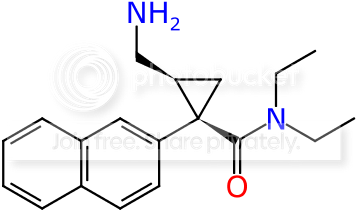
OK, so I cannot confirm the NMDA antagonist part of the story because I don't have full access to the paper, I only have our unreliable friend Wikipedia to go on. If someone could provide me with the full paper it would be greatly appreciated. I can confirm however that this is in fact a triple reuptake inhibitor.
So, here's the real question. Does anyone have any doubt that a triple reuptake inhibitor and NMDA antagonist all rolled into one would be anything less than incredibly abusable? What are people's thoughts on this?
A series of Milnacipran analogs with variation in the aromatic moiety were prepared in high enantiomeric excess. Structure–activity relationships for two parallel enantiomeric series are described. The (−)-(1R,2S)-naphthyl analog (8h) showed the highest potency in the two series and is a triple reuptake inhibitor of the SERT, NET, and DAT.
EDIT: Funnily enough, this compound also fits the morphine rule, and it's 3D structure is also a perfect fit for an opioid. Wouldn't that be just about the most recreational compound on the planet, a triple reuptake inhibitor, NMDA antagonist, and opioid? A speedball in a single compound, with some dissociative thrown in for good measure... I think I need to change my pants...
EDIT 2: I made an error drawing this molecule since I drew it before getting to view the full paper. I have replaced the skeletal formula at the top of the page with the correct one.
Last edited:




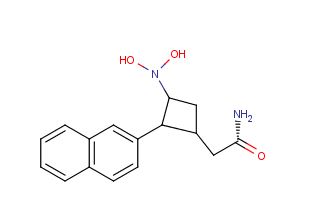
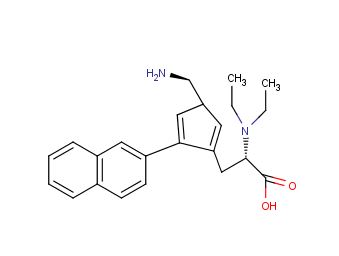

 If it was so simple, then designing drugs for some targets wouldn't take years, I literally mean years. OK, the hardest part of that is recognising the nature of the site you want a compound to bind to, but still the "tuning" bit may take a very long time too. There's a multitude of ways in which a single molecule can potentially interact with a receptor, bonds have various lengths and depending on the type they're more or less flexible. There are quite a few methods of drug design, two major groups of methods are ligand-based drug design and structure-based drug design. The former relies on the structure of existing ligands, e.g. MXE can be seen as a result of the analysis of the structure-activity relationship among PCP analogues (3-MeO-PCP, PCE, and ketamine all taken into consideration). Alternatively a base structure is derived called a pharmacophore, which is then modified. One can then check how a molecule binds to a receptor and derive compounds that have higher affinity and/or selectivity or are agonists or antagonists, and so on. In the long run this is a trial-and-error method at some point, well they all are actually. Anyway, this is what people are attempting in the "Random Molecules" thread, they look at existing compounds and try creating new ones, however often not taking into consideration that different substituents have different sets of properties and that different bonds are different in nature, bond lengths and angles are also very important for predicting 3D structures (with that being said, I wouldn't change more than one variable at the same time). The structure-based drug design relies on 3D images of target receptors, one gets an image of the receptor they want a compound to bind to and then they design a ligand. The advantage here is that you get to know what residues (aminoacids) a binding site is made of and then you can modify your ligand according to that knowledge. In practice you're going to need a lab at some point anyway, but great ideas may indeed be born on paper.:D