I've tasted pure 3,4,5-TMPEA and found that it was nothing compared to the buttons. Does anybody know the complete %'s of the various isoquinolines and related alkaloids in buttons, and whether or not the button experience is based on the presence of these alkaloids? Has anyone tried the pure alkaloids themselves to determine unique psychedelic activity?




-
Neuroscience & Pharmacology Discussion Welcome Guest
Posting Rules Bluelight Rules Recent Journal Articles Chemistry Mega-Thread FREE Chemistry Databases! Self-Education Guide -
N&PD Moderators: Skorpio
You are using an out of date browser. It may not display this or other websites correctly.
You should upgrade or use an alternative browser.Mescaline alkaloids
- Thread starter Bondmaker
- Start date


dorothyperkins
Bluelighter
- Joined
- Oct 18, 2007
- Messages
- 426
I don't know, i looked earlier wondering how easy it would be to crystallise pure mescaline from cactus alkaloid extract. All i could find was some extraction tek that said mescaline should be at least 50 % of the alkaloids.
How can you compare pure mescaline to buttons without knowing how much is in the buttons? Extract the alkaloids and then you can compare, though really you need to know the percentage of mescaline the alkaloid extract contains. If you know its 50% mescaline, for example, you can compare 250mg pure mescaline with 500mg mixed alkaloids. I think in the amounts present in a dose of mescaline the other alkaloids would be inactive by themselves, but will potentiate the mescaline to some degree.
There are a few examples in pihkal of inactive compounds potentiating other psychedelics.That's what I was thinking. In a chemical sense, plants might contain components that do nothing when ingested in isolation. However, shamistically speaking, these could augment/potentiate/synergize with the active ingredients.
I've not yet seen any research papers on mescaline containing plants, but I do have a number of articles discussing some various other psychoactive containing plants.
I'm much more into my chemistry given that this is the subject that I studied for years at university. There's still a demand for analytical chemists to analyze the composition of plants though. That way, when vendors sell their products it will be possible for customers to see in more depth what exactly it is that they are buying.
dorothyperkins
Bluelighter
- Joined
- Oct 18, 2007
- Messages
- 426
Crazy, i still cant find anything, you'd think someone would have worked out how much of the various alkaloids are in peyote or something!
Not related but i did find this:
Mescaline-like activity of 2-amino-7-hydroxytetralin
Life Sciences, Volume 12, Issue 10, Part 1, 15 May 1973, Pages 475-479
2-Amino-7-hydroxytetralin has sleep effects in rats like mescaline and D-LSD, and it showed cross-tolerance with mescaline, as did D-LSD. These properties had been predicted by total valence electron calculations.
Can anyone get this? I dont have access. I'm curious because Nichols made this dimethoxyaminotetralin as a hybrid between LSD and DOM, but it was inactive.
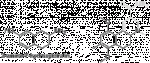
Maybe this type of molecule does work but needs a different substitution pattern on the ring, the phenol in this molecule is in the position corresponding to the phenol of 5HT.
Ham-milton
Bluelighter
- Joined
- Jul 20, 2007
- Messages
- 5,738
^ His non-neurotoxic MDMA analogue paper showed that the tetralin analogue was active (but not as)
dorothyperkins
Bluelighter
- Joined
- Oct 18, 2007
- Messages
- 426
Ah thanks, i hadn't seen that. The indan analog seems almost as active as MDMA. And the DOM indan analog seems fairly active. It does all seem to lead to the cyclobutene's as the ideal side chain conformation.
Imagine that, a non-neurotoxic MDMA analog, active at maybe 1mg!
fastandbulbous
Bluelight Crew
I've not yet seen any research papers on mescaline containing plants, but I do have a number of articles discussing some various other psychoactive containing plants.
It does exist as I remember reading several papers on the alkaloidal constituents of several mescaline containing species. From what I remember, Trichocereus species mostly contain other phenethylamines which are part of mescaline biosynthesis pathway and a couple of offshoots like 4-hydroxy-N,N-dimethylphenethylamine (next main alkaloid after mescaline in T pachanoi). In comparison, peyote contaied quite a few substituted isoquinoline alkaloids that are offshoots of mescaline biosynthesis in L. williamsii & also introduces another ring component into alkaloids, the methylenedioxy group. Some of the isoquinolines are responsible for the flushing & increased feelings of nausea seen with peyote. There's even the possibility of applying the methylenedioxy biochemistry to the phenethylamine biosynthesis (isoquinoline is just a phenethylamine that has had the ethylamine tail condensed into an isoquinoline) to give 3-methoxy-4,5-methylenedioxyphenethylamine, which is active at lower than mescaline doses and pretty unique if substance (it's the 2 carbon derivative of MMDA) - however unlikely that might be
mad_scientist
Bluelighter
- Joined
- Apr 20, 2006
- Messages
- 619
There are a bunch of other compounds similar to mescaline in the cactus too like 3,4-dimethoxyphenethylamine, N-acetyl mescaline, N,N-dimethylmescaline etc.
I've always figured that even though these compounds are not active in themselves, they are similar enough to mescaline that they will compete for the enzymes that metabolise the mescaline, hence make mescaline work better and last longer by increasing its half-life in the body.
Also at least one of the isoquinoline compounds has been reported to be active in its own right, so there may well be several other compounds in the mix that further explain the difference in effects between cactus alkaloid extract and purified mescaline.There are some classics...
Which I'm SURE, all you peeps have read such as...
http://books.google.com/books?id=Ec...j&sig=H8bIxFArKjsyzGV3YlwKl3LJgNw#PRA1-PA6,M1,.
And most "on topic" from the grand Master Himself
http://leda.lycaeum.org/?ID=16291
BUT- not much greater review since 1972- I've seen some chromatographic work on the phenethylamine components, but little in depth studies on the pharmacologocal activities of some of the trace compounds found.
The Erowidzrds vault with a complete list of components of the cactus;
http://www.erowid.org/plants/cacti/cacti_guide/cacti_guide_lophopho.shtml
links- http://mescaline.com/exp/index.htm
A nice pic of the little deeviles
http://mescaline.com/exp/index.htm
Interesting, but not just lophophora williamsii;
http://entheogen.netfirms.com/articles/articles/Narcotic_Cacti.html
However; I'm looking for that needle in the mescalito haystack that i suspect is there. Also, though it could just be some kind of a mescaline prodrug, since mesc is the only active phenethylamine and only 2% of it gets past the BBB. I wonder if there is any 3,4,5- trimethoxyphenylalanine in the buttons? I've never heard of it though.
As you can see, the components are known quite well, but only in structure, not neccessarily activity. It would be very interesting if something cropped up in the future that had nanomolar psychedlic activity. I swear, the two experiences are not by any means equivalent; by a long shotLast edited:
kidamnesiac
Bluelighter
- Joined
- Oct 19, 2006
- Messages
- 533
the dea squished shulgins plants before he could look

Biphasic
Bluelighter
- Joined
- Feb 9, 2008
- Messages
- 29
I wonder if there is any 3,4,5- trimethoxyphenylalanine in the buttons? I've never heard of it though.
http://www.springerlink.com/content/u544qm3854080m06/Seventeen male hooded rats were trained on a CAR schedule in a shuttle box, using sound as the CS and shock as the US. After training, nine animals were injected intraperitoneally with 25 mg/kg mescaline hydrochloride, and eight animals with 25 mg/kg followed by 12.5 mg/kg. The results were recorded in terms of the number of shocks received, the number of crossings made and the reaction time from the onset of the CS. The results showed that mescaline exerted a biphasic effect, initially depressing the CAR, and then giving rise to a prolonged excitatory phase. When the experimental series was repeated two weeks later, it seemed that, although the behavioural pattern was basically the same some. tolerance of the drug had persisted. Further tests showed that this tolerance has disappeared eight weeks after the last injection. The smaller dose depressed the CAR less, and in fact the CAR was not depressed in less sensitive (Class II) animals, whereas the excitatory phase was increased and significantly so in Class II animals.
Tests with trimethoxyphenylalanine indicated that this compound did not appear to affect CAR behaviour, even in doses of 100 mg/kg.
fastandbulbous
Bluelight Crew
^ The carboxylic acis group (-COOH) is much bigger than the alpha-methyl group od TMA-1 (the amphetamine analogue of mescaline), as well as being much more polar, and as seen with the alpha-ethylPEAs, or more to the point their lack of psychedelic activity, such molecules will only fit the 5HT2a receptor if there is a small (H or CH3) group on the alpha-position
kidamnesiac
Bluelighter
- Joined
- Oct 19, 2006
- Messages
- 533
question for you guys who have worked with rats:
how the hell do you get a rat to eat 100mg/kg of a really shitty tasting chemical? starve em for a while then slip it in their tacos? or just hold their mouths open and dump it in there? do they puke when you give em 200mg of mescaline sulfate?
or is it all injection? do they puke this way too?good question..
Rats can't vomit. They might want to (who knows?) but they can't. And yes, a "bolus" of compound is made up with rat chow or whatever and just shoved down their throats. And anotyher thing, when a rat is tripping, they exhibit a behavior called "Straub tail" which is when they twist their tails unnatuarally, it's quite noticable.
kidamnesiac
Bluelighter
- Joined
- Oct 19, 2006
- Messages
- 533
hmm, they also do this if their dna methylation pathways are messed up, and it can be restored by feeding them sam-e or adenosyl-methionine, which is the methyl donator for dna methyltransferases. coincidence?
yea probably
fastandbulbous
Bluelight Crew
You can also put it in their water supply, rats will dribk just about any foul tasting soln when they get thirsty enough. Mostly though it's injection via IP route

