
DirtyMexican
Bluelighter
Guys sorry for the stupid question but wtf is this?
http://postimage.org/image/ezrhkmz51/
 [/url][/IMG]
http://postimage.org/image/ezrhkmz51/




N&PD Moderators: Skorpio
You are using an out of date browser. It may not display this or other websites correctly.
You should upgrade or use an alternative browser.
MDMA related chemical?
DirtyMexican
Bluelighter
Guys sorry for the stupid question but wtf is this?
http://postimage.org/image/ezrhkmz51/
[/url][/IMG]


King Kong
Bluelighter
methylenedioxyephedrine
or 1-(benzo[d][1,3]dioxol-5-yl)-2-(methylamino)propan-1-ol
Probably a poorly active compound with a lot of peripheral side effects: http://www.bluelight.ru/vb/threads/270751-3-4-methylenedioxyephedrine
DirtyMexican
Bluelighter
King Kong,
Dioxol has a Oxygen group attached similar to bk-mdma right? But not this I believe.
The difference between methylone and the image you posted is that the oxygen on methylone is double bonded and the chemical in the first post has a single bond. Oxygen can have two bonds so when in the single bond posted it is also bonded to 1 hydrogen. I have no idea how that changes effects, but I suspect it would, possibly to a large extent.
DirtyMexican
Bluelighter
wait is that FLEA, mdhma, holly... etc...
http://en.wikipedia.org/wiki/Methylone

The image you posted is just the double bond on the oxygen changed to a single bond.
Flea is

DirtyMexican
Bluelighter
The image you posted is just the double bond on the oxygen changed to a single bond.
More or less. Replacement of the double Oxygen bond with a a single hydroxyl (−OH) bond.
My chemistry is not as good as many here. I believe there is a reduction reaction that produces this... not sure.
Good catch and correction on mdhma.
King Kong
Bluelighter
Dioxol represents this kind of structure: http://en.wikipedia.org/wiki/Dioxolane
Dioxol has a Oxygen group attached similar to bk-mdma right? But not this I believe.
Also, I had use chemdraw to convert your structure to this name. So, I think it’s correct.
Your structure has a hydroxyl function (-OH), compared to methylone or MDMA, it will cross the blood brain barrier less efficiently (due to the ability of hydroxyl function to make hydrogen bond with water). It means that this substance should have more peripheral side effects than MDMA or methylone. A bite like the comparison of ephedrine with methcathinone or methamphetamine (they had also a different pharmacodynamic, but it’s another subject).
Hydroxyl functions are also more prone to conjugation to glucuronide (or other molecules) and to excretion by your body…
The FLEA (or MDHMA) case is different. FLEA is certainly a prodrug of MDMA: http://www.ncbi.nlm.nih.gov/pubmed/20299167
For the methylenedioxyephedrine pharmacodynamics: I have no clue.
I hope I didn’t say stupid things.
Sorry for my poor English.

Roger&Me
Bluelight Crew
the compound the OP posted is most likely being offered as a precursor, as a simple oxidation of that hydroxyl functionality with something like jones' reagent would yield bk-MDMA.
Ingesting the beta-hydroxy compound would likely be a shit experience, just IMHO.

sekio
Bluelight Crew
this is methylenedioxyephedrine, a primary metabolite of methylone suspected of causing bad side effects like cardiac stress and vasoconstriction
reduction of the ketone to an alcohol reduces affinity at DAT and also makes the compound harder to cross the blood brain barrier.
iupac name 1-(benzo[d][1,3]dioxol-5-yl)-2-(methylamino)propan-1-ol

pharmakos
Bluelighter
just fyi, in court this stuff would for all intents and purposes be just as illegal as methylone
DirtyMexican
Bluelighter
this is methylenedioxyephedrine, a primary metabolite of methylone suspected of causing bad side effects like cardiac stress and vasoconstriction
reduction of the ketone to an alcohol reduces affinity at DAT and also makes the compound harder to cross the blood brain barrier.
iupac name 1-(benzo[d][1,3]dioxol-5-yl)-2-(methylamino)propan-1-ol
But again looking at chemical structure the reduction and all else. that just does not fit the structure does it. Am I
missing something?
http://www.molbase.com/bitmaps/9/0063/00638506.png
Do you keep the double oxy bond for methylenedioxyephedrine
or not or _____?
sekio
Bluelight Crew
The name fits perfectly, you don't know what you're talking about.
What you're showing is methylenedioxymethcathinone aka methylone, the ketone/carbonyl version of methylenedioxyephedrine.
A "double bonded" oxygen attached to a carbon is called a carbonyl. A "single bonded" oxygen attached to a carbon & a hydrogen is called a hydroxy group or alcohol. The two are totally different. Methylenedioxyephedrine and methylenedioxymethcathinone are not the same thing. A simple example is isopropanol vs. acetone. They are not the same thening and behave totally differently, even though they both have the same structure (ignoring hydrogens). The fact is you can't ignore extra hydrogens on a molecule...
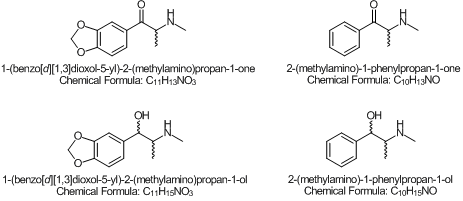
Top: methylenedioxymethcathinone (left), methcathinone (right)
Bttom: methylenedioxyephedrine (left), ephedrine (right)
DirtyMexican
Bluelighter
The two are totally different. Methylenedioxyephedrine and methylenedioxymethcathinone are not the same thing. A simple example is isopropanol vs. acetone. They are not the same thening and behave totally differently, even though they both have the same structure (ignoring hydrogens). The fact is you can't ignore extra hydrogens on a molecule...
Top: methylenedioxymethcathinone (left), methcathinone (right)
Bttom: methylenedioxyephedrine (left), ephedrine (right)
Response is perfect. Yeap you are right. That was where the confusion came in.
What would one do with it... it being 50 grams of it, which by any measure "just ignore it" would be a scientific sin.
seams to be i guess equal to a diet drug class of stimulant.
Any easy chemical reactions for more fun... ahhh under the sun... There is a thread here about this chemical re-deriving mdma, seams that thread gives up.
cannibalsnail
Bluelighter
Wouldn't a reaction with LiAlH4 (Lithium Aluminium Hydride) produce MDMA?
Or rosenmund reduction.
King Kong
Bluelighter
I don't think so. Reduction of hydroxyl functions aren't easy.
But we can't speak about synthesis here.
sekio
Bluelight Crew
One could in theory oxidise md-ephedrine to md-methcathinone but you'd need to know what you were doing. No synthesis discussion though. LiAlH4 won't do the reduction.
Unfortunately for you if you have 50 gr of this stuff you've wasted a lot of your money!