• N&PD Moderators: Skorpio

MDMA enantiomers

hinjeet

Greenlighter
Joined
Jun 29, 2009
Messages
26
Location
nyc
I'm trying to make sense of the various visual representations of MDMA, and figure out why some are different. Please provide relevant explanations to my questions.
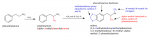
220px-NDMA-Formel.png

This one, found on wikipedia, seems different from the others because NH is attached to the second carbon counting from the ring. By the way, how does one count carbons? For instance, below the picture refers to alpha-carbon, counting from the leaving group. but what's the leaving group here? Can you clarify the leaving group concept to me? If 2-phenethylamine is the reference structure, why does it go last?
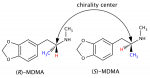
MDMA chirality.png
mdma formula.png
These two are the same and correct I think.
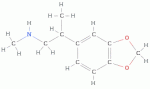
mdma expanded.gif
This one, generated by wolphramalpha for query mdma, is also different because the methyl is attached to the first carbon outside the ring, and not the second, why?. It cites this name for it: 2-benzo[1,3]dioxol-5-yl-N-methyl-propan-1-amine. It's slightly different from that found on wikipedia: (RS)-1-(benzo[d][1,3]dioxol-5-yl)-N-methylpropan-2-amine; though I would expect them to be equivalent. Could someone explain why they are named differently and why this isn't one of the synonyms listed on wikipedia?
 
Last edited:

Sorry about the minor thread jack...

But what could make clean MDMA trippy, and more stimulating, than other clean MDMA?
pills tested as clean with that really expensive machine, but they're trippy and more of an upper than all other clean mdma pills I've had. Maby something like an RC that the machine didn't pick up or something? Tested by ecstasydata
 
sir thizzalot, set and setting. also, did you test the exact pill or was it the same 'brand/stamp' that may have been counterfeit?

hinjeet, that last structure (from wolfram alpha) is simply wrong. the methyl group is attached to the beta carbon for some reason.

i don't know where you got 'leaving group' from, as that term is only applicable if you are performing an actual chemical reaction (in which one group leaves and another group attaches to a particular carbon).

when naming compounds, the reference structure always goes last. for example,

amphetamine is alpha-methyl phenethylamine.

methamphetamine is N-methyl, alpha-methyl phenethylamine.

MDMA is 3,4 methylenedioxy, n-methyl, alpha-methyl phenethylamine.

when counting carbons, for phenethylamine the alpha carbon starts right next to the nitrogen, followed by the beta carbon, followed by the phenyl ring. the carbons on the phenyl ring start with #1 (where the ethylamine group is attached), and go around the ring in succession. hence 3,4-methylenedioxy has one unfunctionalized carbon separating the MD ring from the ethylamine group.


look closer at the first few pictures you posted, they are the exact same because the carbon-carbon bonds can rotate around.
 
Think of your left and right hand. They have the same digits, in the same order, yet they are different from one another. If you tried to place your right hand on your left, they wouldn't match. Enantiomers are just mirror images of each other. Just like if you were to put your right hand in front of a mirror. The mirror image will be exactly like your left hand. This is your s and r, or levo and dextro. A compound may have multiple different stereo isomers depending on the number of chiral centers. Though the presence of chiral centers doesn't always make a compound chiral, see meso compounds. What qualifies a carbon (or other atom) as a chiral center is the presences of 4 unique branches R', R'', R''', and R'''', so obviously, the atom needs to be quaternary.

Enantiomers make a big difference in how they interact with receptors. For example, substance that deal with serotonin receptors interact with a g protein-coupled receptor which has specific binding sites. When an enantiomer interacts with the g protein-coupled receptor the locations, or the stereochemistry of individual moieties or atoms makes a difference in the effects on the given receptor or system. I'm not honestly sure on the specifics when dealing with MDMA. My knowledge in neuroscience or pharmacology is pretty thin.
 
Last edited:
The enantiomers matter with MDMA.
R-isomer of MDMA is almost inactive. S-isomer is much more active.

This isn't surprising; the S-isomers of amphetamines are far more active monoamine releasers, while the R-isomers are more active as psychedelics - but as we all know, you lose the psychedelic effects when you have an extra substituent on the alpha carbon and on the amine...
 
Start counting from the carbon next to the amine group(alpha carbon), then re-read everything and look again and it should make sense.
 
you lose the psychedelic effects when you have an extra substituent on the alpha carbon and on the amine...

Wut? You can have a methyl on the alpha carbon, but not on the amine.
 
Wut? You can have a methyl on the alpha carbon, but not on the amine.

_AND_

You don't necessarily kill the potency by putting something on the amine (ex the super-potent NBOMe's), or by putting a methyl on the alpha carbon, but when you do both, you lose the psychedelic effects - the amphetamine NBOMe's aren't active (or not very).
 
Top