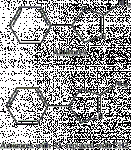
Abbott have already been here
for what it is worth Abbott synthesised these phenylpyrrolidine's and published it in 1995,
Bioorganic & Medicinal Chemistry Letters
Volume 5, Issue 9, 4 May 1995, Pages 991-996
doi:10.1016/0960-894X(95)00154-L
to briefly summarize the 1-methyl 2 phenyl pyrrolidines do bind to the nicotinic sites acetylcholine sites NAChR,
the following Ki s were observed using displacement of radiolabel cytisine,
Phenyl 450 nM
4-Bromophenyl 75 nM
3,4-Dichloro 68 nM
3,4-Methylenedioxy 46 nM
and those are the most potent. removing the N methyl reduces affinity significantly.
to put it in perspective nicotine itself has a ki somewhere in the region of 1 nM in the same assay. so unless these compounds have amazzing pharmokinetics and bioavailability they are going to be much less potent than nicotine.
Abbott no doubt have discovered a lot of interesting nicotinic agents, as they have spent a huge amount of money and time looking at the area as potential therapies for PD and alzheimers etc. some of these may have abuse potential perhaps greater than nicotine, but you can be sure these are the ones that are not researched further by abbott.
for what it is worth Abbott synthesised these phenylpyrrolidine's and published it in 1995,
Bioorganic & Medicinal Chemistry Letters
Volume 5, Issue 9, 4 May 1995, Pages 991-996
doi:10.1016/0960-894X(95)00154-L
to briefly summarize the 1-methyl 2 phenyl pyrrolidines do bind to the nicotinic sites acetylcholine sites NAChR,
the following Ki s were observed using displacement of radiolabel cytisine,
Phenyl 450 nM
4-Bromophenyl 75 nM
3,4-Dichloro 68 nM
3,4-Methylenedioxy 46 nM
and those are the most potent. removing the N methyl reduces affinity significantly.
to put it in perspective nicotine itself has a ki somewhere in the region of 1 nM in the same assay. so unless these compounds have amazzing pharmokinetics and bioavailability they are going to be much less potent than nicotine.
Abbott no doubt have discovered a lot of interesting nicotinic agents, as they have spent a huge amount of money and time looking at the area as potential therapies for PD and alzheimers etc. some of these may have abuse potential perhaps greater than nicotine, but you can be sure these are the ones that are not researched further by abbott.